TL;DR
- AI call routing removes annoying phone trees by using machine learning and natural language processing to route calls based on purpose rather than merely button pushes.
- Unlike traditional systems, intelligent call routing pairs callers with the most suitable operators using skill-based logic, predictive analytics, and real-time adaptability.
- Switching to AI-powered call routing software helps businesses reduce missed calls, improve agent utilization, and increase customer happiness.
- Real-world applications include auto service departments, contact centers that combine incoming and outbound advertising, healthcare, and e-commerce, which overcome obstacles such as long wait times and inefficient people.
- For companies prepared to call more intelligently and cease losing money to subpar phone systems, Dialora provides an AI voice agent platform with rapid intent recognition, CRM integration, and scalable routing.
Are your clients departing before they get the opportunity to talk with your staff?
Revenue is reduced with every missed call, lengthy wait, and transfer to the incorrect department. Conventional call routing systems either randomly distribute calls or route callers through annoying phone trees in the hopes that the appropriate agent will be available. Meanwhile, customers hang up and call your competitor.
Here's the thing: AI call routing changes that entirely. It uses artificial intelligence to recognize caller intent, instantly connect clients to the relevant person or resource, and eliminate the guesswork that makes traditional phone systems feel like a maze. Instead of instructing callers to "press 1 for sales, press 2 for support," AI systems understand what they require and route calls accordingly, frequently in seconds.
This tutorial describes automated call routing, how AI-powered systems differ from outdated methods, and the reasons why businesses, from auto repair departments to enterprise contact centers, are making the switch.
What is Automated Call Routing?
A phone system feature called automated call routing routes incoming calls to the appropriate person, department, or resource without requiring human assistance. The system makes routing decisions instantly using pre-established algorithms or criteria rather than relying on a receptionist to transfer each call manually.
Traditional automatic routing employs basic reasoning. Depending on the time of day, callers may hear "Press 1 for billing" or be diverted. Strict if-then guidelines are followed by the system; if a caller reaches 2, the call is forwarded to support. Send it to voicemail if it's after five o'clock.
That is OK for simple scenarios, but it quickly falls apart. What if the caller doesn't know which department they require? What happens if the optimal agent is not in the queue selected by the system? What would happen if wait times and call volume increased dramatically?
That's where AI call routing steps in.
How AI Call Routing Works
AI-powered call routing utilizes machine learning, natural language processing, and predictive analytics to make informed decisions in real-time. The system listens to callers, determines their intent, and routes them based on context rather than relying on button pushes or strict menu options.
Here's what happens behind the scenes:
- Intent recognition: The system gathers caller speech or IVR replies and uses natural language processing to determine the customer's needs. The response to "I need to schedule an oil change" differs from that of "My check engine light is on."
- Skill-based matching: AI assesses agents based on their availability, experience, and most current performance indicators. If the call is technical, it is directed to someone with expertise in resolving complex problems efficiently.
- Predictive prioritization: The technology may assess caller value using CRM data. While a first-time caller is routed to the best agent available for their query, a high-lifetime-value customer may be able to avoid the wait completely.
- Adaptive learning: Over time, the AI refines its routing decisions by analyzing outcomes. The algorithm learns to direct comparable calls to specific agents if they close more deals or fix problems more quickly.
What is the outcome? Customers receive faster service, employees answer calls they're trained to handle, and your contact center runs like a well-oiled machine rather than a guessing game.
Key Differences Between Traditional and AI Call Routing
Let's break down how intelligent call routing compares to older systems:
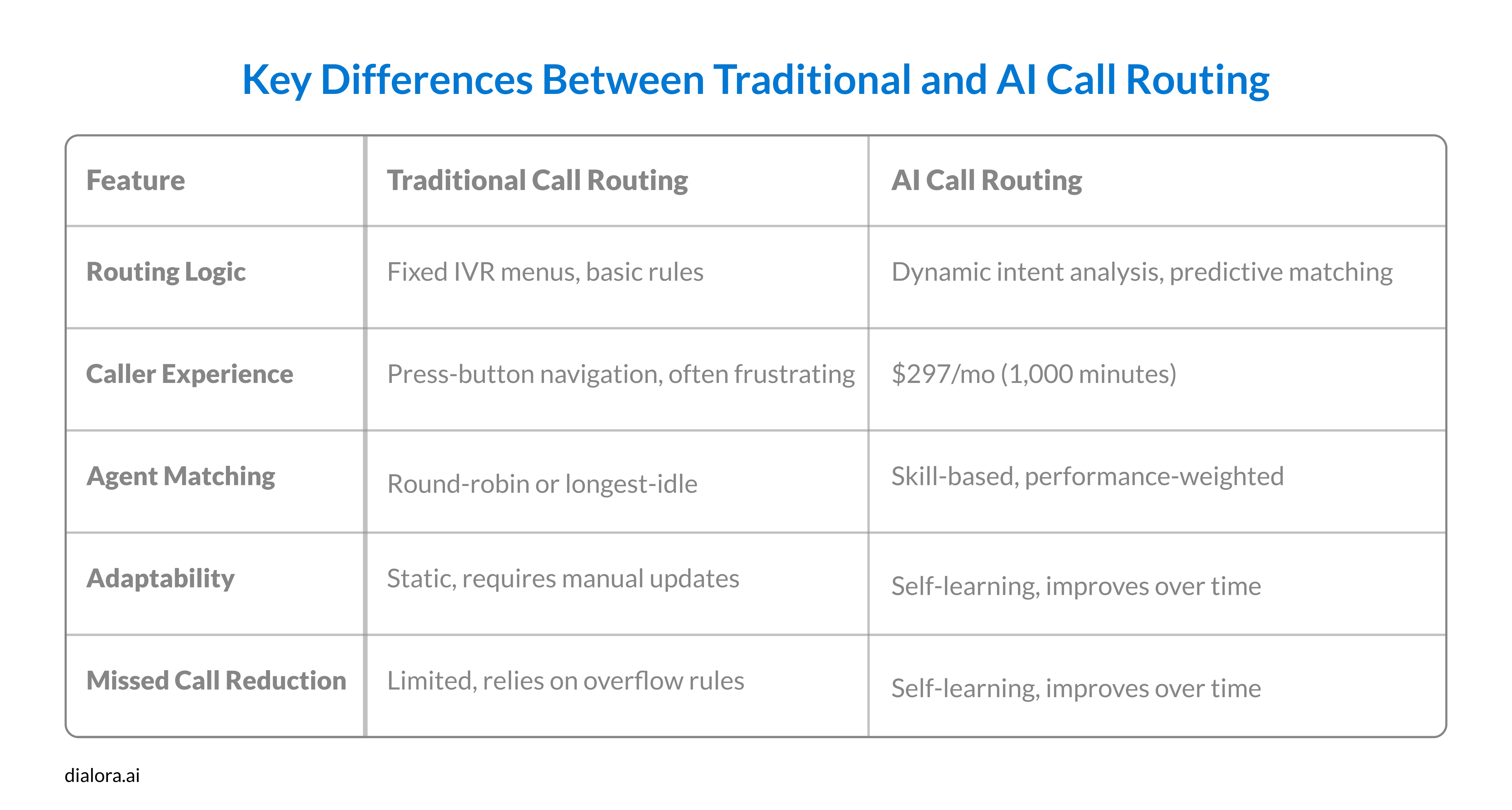
Every call is handled uniformly by traditional systems. Every call is dealt with as if it were important by AI systems because it is.
Why Businesses Are Switching to Smart Call Routing
The transition to AI-based routing is more than simply keeping up with technology improvements. It addresses real challenges with actual difficulties that cost firms money and clients.
- Reduced wait times: AI routes calls more efficiently by eliminating unnecessary menu navigation. Callers can get in touch with the right person in one step rather than having to wade through three layers of options. This is especially crucial in high-volume environments such as auto repair businesses, where customers require timely information regarding appointments or service status.
- Better agent utilization: Conventional systems assign calls to whoever is available, so your best agents spend time answering basic inquiries while mismanaging important problems incorrectly. Intelligent call routing systems match expertise to need, so every agent works in their area of expertise.
- Fewer missed calls: AI systems for reducing missed calls in auto service departments and contact centers use fallback logic. If all agents are busy, the system can provide callbacks, route calls to voicemail with transcription, and even perform outbound follow-ups. Nothing falls between the cracks.
- Higher customer satisfaction: Consumers are more satisfied when they can get in touch with the right person right away. They are faithful when they are not transferred three times or placed in the hold purgatory. AI routing directly improves Net Promoter Scores and retention rates.
- Scalability without chaos: As call volume grows, traditional systems buckle. AI scales seamlessly, absorbing spikes by dynamically modifying routing logic and prioritizing high-value interactions.
Real-World Applications of AI Call Routing
AI call routing isn't theoretical. It's solving problems across various industries right now.
- Automotive service departments: Dealerships and repair firms lose revenue when appointments or service updates go unanswered. When a caller says, "I need an oil change for a 2018 Honda," AI systems translate their intent and direct them to scheduling professionals, or they can make appointments using speech AI. The system priortizes prompting human action for critical problems, such as "My car won't start."
- Contact centers blending inbound and outbound: The best call routing software for combining inbound/outbound campaigns allows agents to manage incoming support calls while making outbound sales calls within the same shift. By assigning incoming calls to agents in between outgoing activities, AI balances the burden and increases efficiency while reducing burnout.
- Healthcare scheduling: Medical offices utilize intelligent call routing to distinguish between appointment requests, medication refills, and billing inquiries. Staff members spend less time transferring calls, everyone is less agitated, and patients get answers more quickly.
- E-commerce support: Online retailers redirect callers based on order history; for instance, one team handles refunds, while another handles product inquiries. Even when someone calls to report a misplaced package before a birthday, AI recognizes the urgency and sets priorities accordingly.
Choosing the Right Call Routing Software
Not all call center routing software is created equal. Here's what to look at while analyzing possibilities:
- Intent detection accuracy: Does the technology only recognize terms, or can it truly comprehend what callers want? Test it using actual business call scenarios.
- CRM integration: The greatest systems retrieve client data in real time. If your CRM identifies the caller as a VIP or has an open support request, your routing should reflect this.
- Customizable routing rules: You must be adaptable. Certain calls should be routed to teams, certain agents, or voicemail. Make sure the program allows you to establish rules without the need for a developer.
- Analytics and reporting: You are operating in the dark if you are unable to monitor routing performance data like average handle time, first-call resolution, or call abandonment rate. Look for dashboards that show the locations of bottlenecks.
- Ease of setup: Some phone call routing software takes weeks to configure. Some operate unconventionally. Before you commit, take your team's technical capabilities into account.
- Voice AI integration: AI speech agents are integrated with routing algorithms in sophisticated systems like click-to-call and phone routing. Before speaking with a human, callers can get answers from an AI assistant, freeing up agents to handle more difficult jobs.
How an AI Call Center Determines Caller Intent
Understanding how AI contact centers determine caller intent is key to appreciating what makes these systems effective.
When a call is received, the AI processes speech in real-time using natural language understanding (NLU). It does not only listens for keywords. It examines the sentence structure, tone, and context. A caller expressing "I need help with my account" may be referring to billing, login troubles, or account closure. The AI determines it by cross-referencing CRM data or posing clarifying queries.
Some systems use contact center routing algorithms that combine intent with other signals:
- Historical data: If the caller called help twice this month concerning billing, route to billing.
- Sentiment analysis: Frustration detection results in priority routing or escalation to senior agents.
- Time sensitivity: Urgent queries, such as "I am locked out of my account," are priortized above typical queues.
This multi-layered approach is what makes AI-powered call routing feel less artificial and more helpful than hitting 1 for English.
Read more:
- AI in Call Centers
- AI Cold Calling
- Automation Software Tools
- automated answering service
- Call Centre Automation Work
- Outbound Calls vs Traditional Calls
Common Challenges and How AI Solves Them
Even the best call center routing systems face obstacles. Here's how AI addresses the big ones:
- Call volume spikes: Black Friday, product debuts, and service failures all result in unforeseen spikes. AI modifies routing logic in real time, bringing in backup agents or providing self-service options to avoid gridlock.
- Agent turnover: When experienced agents leave, routing quality falls if systems rely on manual changes. As new agents join the team, AI retrains itself, adjusting routing based on their abilities.
- Complex customer journeys: A caller may ask a sales question first, then follow up with a bill inquiry before requesting technical assistance. AI monitors the context of the conversation and, if necessary, reroutes in the middle of a call to prevent customers from repeating themselves.
- Language barriers: Multilingual intelligent call routing recognizes language preferences and routes calls to agents that speak that language, eliminating awkward transfers and miscommunication.
What This Really Means for Your Business
Switching to automated call routing with AI isn't just upgrading your phone system. It's rethinking how customers interact with your business.
Every call that is promptly resolved is a sale that you were able to close. Every caller who gets through to the correct agent on their first attempt is a client who doesn't write a one-star review. Every agent who solves problems they are skilled at throughout the day avoids burnout and resignation.
Conventional routing handles calls like assembly line widgets. AI routing views these as chances to provide value. Your sales, client retention, and team morale all reflect this difference.
Take Action with Dialora
It's time to make intelligent calls with Dialora if you're tired of losing calls, annoying clients, and wasting team time with antiquated routing systems.
Dialora is an AI-powered voice agent platform designed specifically for businesses that want to eliminate missed calls and instantly route every customer to the right solution. Dialora manages everything without the hassles of human labor, whether you run a contact center that combines incoming and outbound campaigns or an auto service department that is overburdened with appointment requests.
Here's what makes Dialora different:
- Instant intent recognition: Consumers describe their needs in simple terms, and Dialora routes them flawlessly without the need to push any buttons.
- Seamless CRM integration: Incorporate customer history, open tickets, priority levels, and connect with a CRM with text messaging into each routing choice.
- Click-to-call and advanced routing: Combining speech AI with human agents yields the best of both worlds.
- Built to scale: Manage 10,000 calls or 10 calls without exerting any effort.
Stop guessing which calls matter most. Let Dialora's intelligent call routing system do the work while you focus on closing deals and keeping customers happy.
Book a demo today and see how AI call routing transforms your phone system from a bottleneck into a revenue driver.