TL;DR: Key Takeaways
- Definition: AI customer service telecom is the use of automation to handle high-volume inquiries like billing, technical support, and plan upgrades.
- Benefits: Drastic reduction in wait times, 24/7 availability, and lower OPEX.
- Proactive Shift: AI is moving from reactive troubleshooting to proactive "Self-Healing" networks that alert users before they experience a problem.
- Human-Centric: AI handles the routine, allowing human agents to focus on complex, high-emotion retention tasks.
Customer experience is the only thing that really sets Telecom Solutions Mobile Services apart in a very competitive market. AI customer service telecom refers to the strategic integration of artificial intelligence, including Generative AI, machine learning, and NLP, to manage, streamline, and scale support operations.
Gone are the days when customer support meant waiting on hold for forty minutes to activate a SIM card. Today, AI-powered customer support is a multi-layered ecosystem that doesn't just react to problems, it predicts them. From AI virtual agents for customer support that resolve billing disputes in seconds to predictive algorithms that detect network outages before a single user reports them, automation is the new standard for modern connectivity providers.
1. How AI is Changing Customer Service in Telecom
The shift from "Legacy Support" to "AI-Native Support" involves three primary technological pillars. Understanding these is essential for any mobile operator looking at the Best AI tools for telecom industry customer service.
- Conversational AI and Virtual Agents
Modern conversational AI in telecom uses advanced Natural Language Processing (NLP) to understand intent, sentiment, and context. Unlike the rigid IVR (Interactive Voice Response) systems of the past, an AI virtual assistant customer service tool can handle complex, multi-turn conversations. This lets people change their data plans, fix problems with their home Wi-Fi, or set up roaming all through a natural chat or voice interface.
- Predictive Maintenance and Proactive Support
One of the most exciting telecom customer service AI news trends is the move toward "Zero-Touch" resolution. By analyzing network telemetry data, AI can identify a failing cell tower and proactively text affected users: "We've noticed a signal dip in your area. Our engineers are on it, and we've added 5GB of data to your account for the inconvenience." This flips the script from an angry customer calling the center to a delighted user feeling "seen" by their provider.
- Intelligent Routing and Agent Augmentation
AI doesn't just replace humans; it acts as a co-pilot. When an AI customer service assistant identifies a high-churn-risk customer, it doesn't just pass the call to an agent; it provides a "Context Card." This card includes the user’s last three dropped calls, their billing history, and a suggested "Save Offer" generated in real-time.
2. Solving the Telecom Churn Crisis with AI
It costs about five times as much to get a new mobile subscriber in 2026 as it does to keep one. AI in customer service for telecom is the primary weapon against churn.
Sentiment Analysis as an Early Warning System
AI-powered customer service tools now feature "Emotion Detection."The system can tell how frustrated someone is by looking at the pitch of their voice or the words they choose in a chat. If a customer is reaching a "boiling point," the AI agent for customer support can trigger an immediate "Warm Handoff" to a senior retention specialist, ensuring the relationship is saved before the customer hangs up.
Hyper-Personalization at Scale
AI in customer communications for telecommunications allows for "Segment of One" marketing. Instead of sending a generic "Upgrade to 5G" blast to everyone, the AI analyzes a user's specific behavior. If a user consistently hits their data cap on weekends while streaming sports, the AI offers a "Weekend Warrior" data bolt-on at exactly the moment they need it.
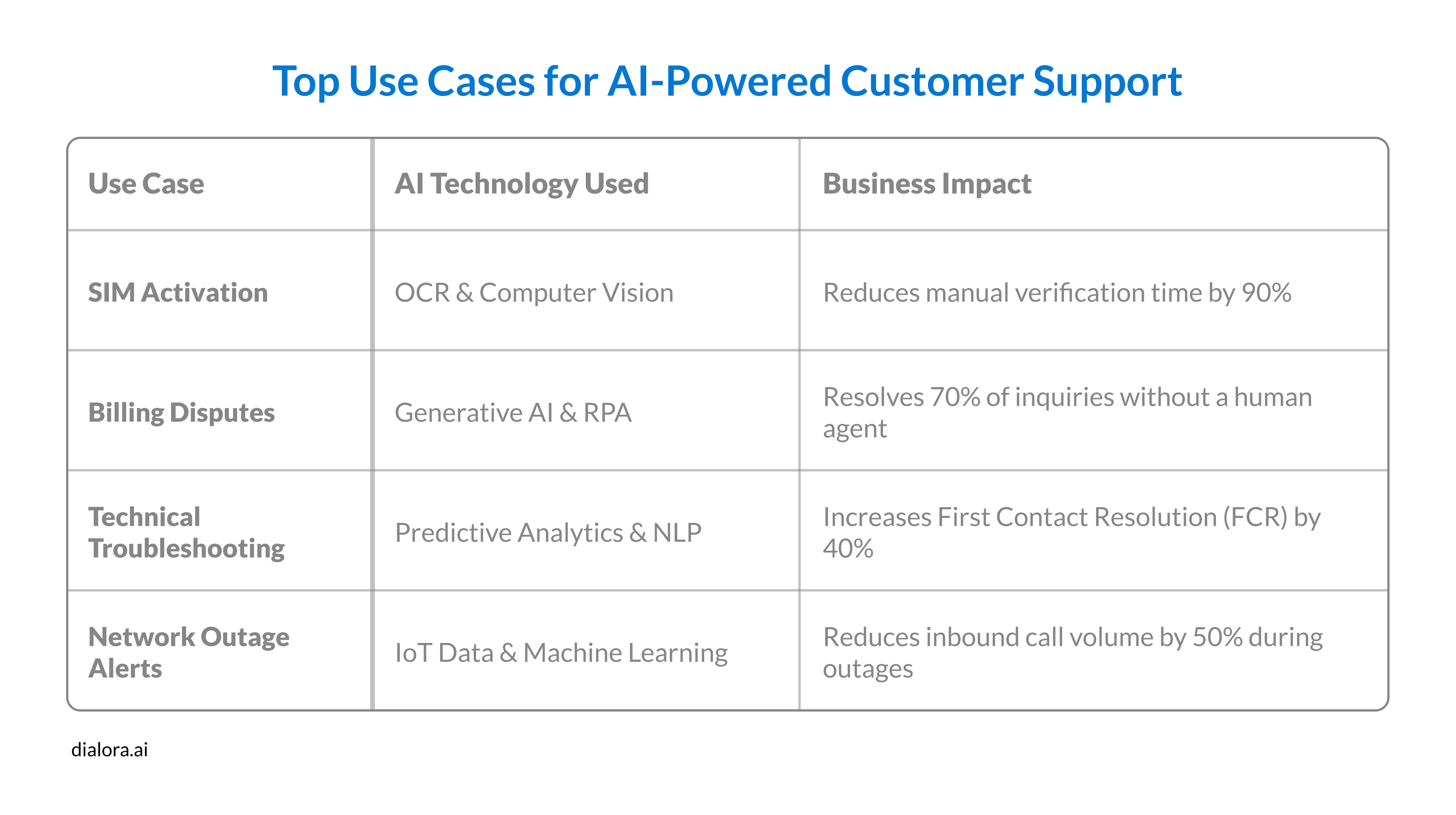
3. Top Use Cases for AI-Powered Customer Support
4. Why Mobile Operators are Moving to AI-Based Call Centers
Transitioning to an AI-based call center isn't just about cutting costs, it's about operational elasticity.
- 24/7 Availability: AI virtual agents for customer support don't take lunch breaks or sleep. For global mobile services, this means instant help across every time zone.
- Multilingual Support: With AI virtual assistant customer service, a regional telco can instantly offer support in 50+ languages, removing barriers for expat communities and travelers.
- Scalability: During a major network event or a new iPhone launch, call volumes can spike by 400%. An AI virtual assistant customer service platform scales instantly to handle thousands of concurrent queries, preventing the dreaded "busy signal."
5. Telecom AI Customer Service News: Trends for 2026
The latest Telecom AI Customer Service News points toward a future of "Agentic AI." This goes beyond simple chatbots. Agentic AI refers to systems that have "agency" the ability to use tools and make decisions.
In 2026, we are seeing the rise of AI assistants for customer service that can browse internal knowledge bases, access billing APIs, and even negotiate plan prices within set guardrails. This level of automated customer service software reduces the "Mean Time to Resolution" (MTTR) from days to minutes.
Conclusion: Embracing the AI-Driven Future of Telecom
The question is no longer if telecommunications will automate, but how fast. As we’ve seen, how AI is changing customer service in telecom is through a fundamental shift from human-first to AI-first architectures. By deploying a robust AI customer service telecom strategy, providers can finally solve the age-old "telecom paradox": delivering higher quality service while simultaneously reducing operational costs.
Whether you are looking for the Best AI tools for telecom industry customer service or trying to navigate the latest telecom customer service AI news, the goal remains the same: frictionless, invisible, and immediate support.
Transform your subscriber experience with Dialora AI.
At Dialora, we provide specialized AI-powered customer support solutions built specifically for the unique demands of the telecommunications industry. From high-accuracy voice agents to predictive churn reduction, we help you turn every interaction into a loyalty-building moment.
FAQ:
How does AI improve technical support for mobile services?
AI can run remote diagnostics on a user's device or router via the cloud. It guides the user through step-by-step visual troubleshooting, often resolving hardware issues without needing to ship a replacement or send a technician.
Is AI customer service secure for telecom data?
Yes. Modern AI customer service platforms are built with SOC 2, HIPAA, and GDPR compliance. They use data masking to ensure that virtual assistants never "see" or store full credit card numbers or sensitive PII (Personally Identifiable Information).
What are the best AI tools for telecom industry customer service?
While many general-purpose tools exist, specialized platforms like Dialora.ai are preferred for their native integration with Telecom BSS/OSS systems and their ability to handle high-latency voice environments.