TL; DR Summary
- Inbound Call centers are places where people may get help with their orders, technical issues, and customer service.
- Outbound Call Centers are proactive engines used for Telemarketing, Appointment setting, and Lead generation.
- Hybrid Call Centers combine both models to maximize efficiency, often using voice AI platforms to manage both streams.
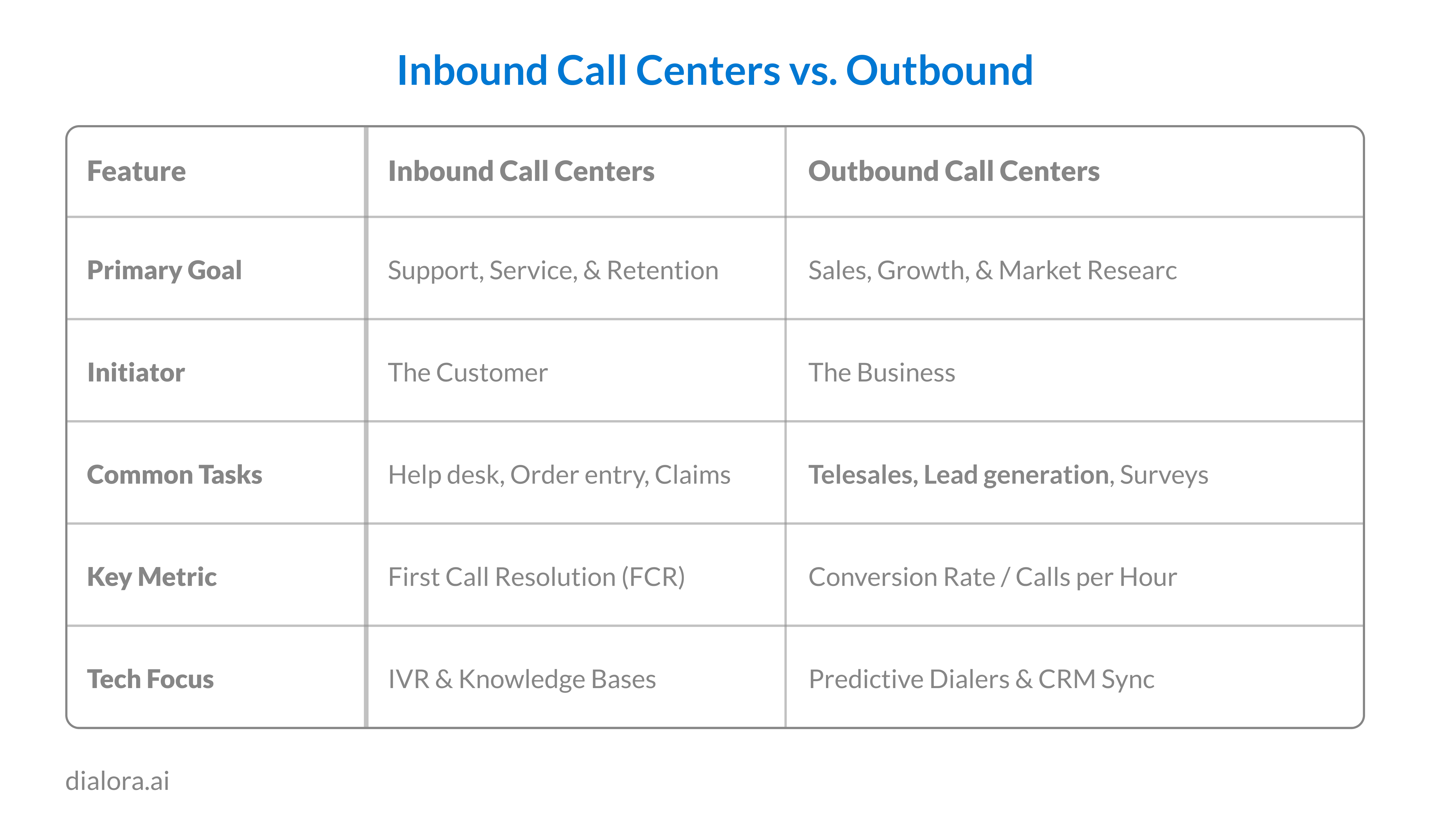
- The main difference between inbound and outbound call centers is the direction of the calls and the key performance indicators (KPIs) they use (resolution vs. conversion).
- Dialora AI provides the technology to automate both, ensuring you never miss a lead or a support request.
Introduction
In 2026, when business moves swiftly, talking to people is still the best way to attract new consumers. But when their enterprises grow, many business owners have to make a tough choice: do they need an outgoing engine to locate new leads, or an inbound crew to capture every lead? Understanding the core mechanics of Inbound and Outbound Call Centers is more than just a lesson in terminology; it is a strategic decision that dictates your overhead, your technology stack, and your ultimate ROI.
Inbound vs. Outbound is a choice you have to make based on your main goal, whether you're a law firm handling urgent requests or a SaaS company growing its lead generation.: Are you providing support, or are you driving sales?
Defining the Two Pillars of Communication
To grasp the difference between inbound and outbound call center models, we must first look at the direction of the "ping."
What is an Inbound Call Center?
An Inbound Call Center is a hub designed primarily to receive incoming calls from existing or potential customers. These are not merely "complaint departments" anymore in 2026. They are advanced resolution centers where clients can get help with technical issues, placing orders, or billing questions. These centers are reactive by nature because the client makes the first contact, but they also need to be very quick and empathetic to keep the customer satisfied.
What is an Outbound Call Center?
Conversely, Outbound Call Centers take the initiative. Agents (or voice AI platforms for inbound and outbound call centers) reach out to a list of prospects or customers. This model is proactive and typically focuses on Lead generation, Telemarketing, and Appointment setting. Success here is measured not by how fast you answer the phone, but by how many successful connections you make and how many leads you convert.
Core Comparison: Inbound vs Outbound Call Centers
How Inbound Call Centers Work
Most of the time, when a consumer calls you, they want help with an issue. In a modern Inbound call center services environment, the workflow is heavily focused on "Containment" and "Routing."
- Customer Support & Help Desk: This is the most usual usage scenario. Customers contact to ask about service interruptions or to fix a problem with a product.
- Inquiry Management: Potential leads calling to ask about pricing or features. If handled well, this inbound inquiry becomes a high-intent sales opportunity.
- Payment and Billing: Managing renewals or updating credit card information.
- Emergency Triage: For industries like legal or healthcare, inbound calls often represent urgent "fire-drills" that require immediate attention.
In 2026, the standard for Inbound and Outbound in call center operations has shifted. Static "Press 1 for Support" menus are being replaced by agentic AI that can resolve the issue entirely without human intervention, drastically reducing the outbound call center services cost by preventing unnecessary escalations.
The Mechanics of Outbound Call Centers
An Outbound Call Center Service is a proactive engine. It doesn't wait for the phone to ring; it makes the phone ring. This is where your growth happens.
- Telemarketing and Telesales: Sales presentations to businesses or directly to consumers.
- Lead Generation: Cold or warm contacting to find possible buyers for the sales team.
- Appointment Setting: This is critical for high-ticket service industries. An agent calls a prospect to book a consultation on a closer’s calendar.
- Debt Collection and Reminders: Proactive outreach to ensure payments are made or appointments are kept.
The challenge with Outbound Call Centers has always been the "rejection factor." However, with the rise of talent acquisition for inbound and outbound call centers shifting toward AI-native workers, businesses can now run 24/7 outbound campaigns that sound hyper-natural and never burn out.
The Hybrid Model: The Best of Both Worlds
Most growing enterprises eventually realize that they don’t have to choose between Inbound or Outbound Call Center Service. They move toward Hybrid Call Centers.
In a hybrid setup, the same technology stack and often the same agents handle both directions. For instance, an agent might spend the morning answering support tickets (Inbound) and the afternoon following up on abandoned carts (Outbound lead generation).
This is where Dialora and other voice AI platforms for inbound and outbound call centers come in. You don't have to hire two distinct teams; you can create one AI agent to flip between both jobs without any problems, keeping the brand voice the same in every contact.
Key Technical Differences to Consider
When evaluating Inbound and outbound call center technology, the requirements differ significantly.
1. Software Needs
Automatic Call Distributors (ACD) and Interactive Voice Response (IVR) technologies are used by inbound centers. But for outbound centers, their Predictive Diallers are everything. They automatically dial numbers and only connect an agent when a person answers the call.
2. Agent Skillsets
An Inbound and outbound call center agent requires different "muscles."
- Inbound agents need to have a high EQ, be patient, and be good at listening.
- Outbound agents need to be tough, convincing, and good at dealing with concerns.
3. Compliance and Regulations
Laws like the Telephone Consumer Protection Act (TCPA) closely control outbound calling. You need to have "Do Not Call" (DNC) list integration and dialling, depending on the agreement. Inbound calls usually have fewer regulatory problems because the client is the one calling.
Conclusion: Which One Does Your Business Need?
Deciding between Inbound and Outbound Call Centers isn't about choosing one over the other; it’s about aligning your communication strategy with your business goals. You need an inbound solution if your "missed call" log is filled with angry clients. If your sales funnel is empty, you need to do more to reach out to people.
In 2026, the top businesses will be the ones that make simple tasks automatic and hard tasks more human. By leveraging voice AI platforms for inbound and outbound call centers, you can bridge the gap between these two worlds. You no longer need a massive headcount to provide world-class Inbound call center services or aggressive Lead generation.
Whether you need a 24/7 virtual receptionist to catch every inbound lead or a proactive AI agent for Appointment setting, the future is automated, natural, and efficient.
Stop losing revenue to missed calls and manual outreach. Dialora AI helps you set up hyper-realistic AI voice assistants that can easily handle both inbound and outbound call centers.
FAQ
What is an Inbound Call Center?
It is a centralized office (or cloud-based system) used for receiving a high volume of requests by telephone from customers seeking assistance.
What is an Outbound Call Center?
It is a center where agents make calls to customers on behalf of a business for purposes such as fundraising, sales, or data collection.
What is an inbound and outbound call center?
An inbound call center answers calls from clients who need help or assistance, while an outbound call center calls potential customers or existing customers to sell them something or reach out to them.
What is the difference between inbound and outbound call centers?
The primary difference between inbound and outbound call centers is how the call goes. When you call the customer, that's being proactive. When they call you, that's being reactive.
What is a call center inbound and outbound?
This is about the two basic ways that customer service and salespeople talk to each other. Most firms today employ a mix of both to keep track of their customers from start to finish.
What is an inbound and outbound call center agent?
The primary responsibility of an inbound agent is to provide information and assist individuals with their issues. An outbound agent's main job is to meet goals, qualify leads, and make sales or set up appointments.