TL; DR Summary
- Strong NLU capabilities earn Kore AI a 9.2 G2 score, delivering accurate intent recognition and smooth conversational experiences for enterprise deployments
- Complex pricing structure uses 15-minute billing sessions that can create unpredictable costs, with entry-level plans starting at $50 monthly and enterprise requiring custom quotes
- Steep learning curve challenges teams beyond basic functionality, with limited knowledge base resources requiring heavy support reliance for advanced conversational design
- Enterprise-focused platform suits Fortune 2000 companies with dedicated IT teams, but creates barriers for SMBs needing faster deployment and transparent pricing
- Dialora offers a streamlined alternative for businesses seeking comparable AI voice capabilities with faster setup, flat-rate pricing, and no-code deployment in days rather than months
The Reality of Scaling with Kore AI
For many Fortune 2000 companies, the name Kore AI is synonymous with "Enterprise Grade." If you are an IT Director at a global bank or a CX Lead at a massive healthcare provider, you’ve likely seen their name atop the Gartner Magic Quadrant. But in 2026, the landscape of AI voice solutions has shifted. The question isn't just "Does it work?" but "How much friction does it create for my team?"
Reviewers across G2 and Capterra often describe Kore AI as the "Swiss Army Knife" of AI—it has a tool for everything, from AI voice analytics to complex AI agent builder no-code workflows. However, as any seasoned developer will tell you, a tool that does everything often requires a specialized team to keep it sharp. This Kore AI review dives into whether the platform’s power justifies its complexity, or if modern alternatives like Dialora offer a faster path to ROI.
Kore AI Review Core Strengths and Platform Capabilities
When you look at Kore AI reviews, the praise is consistent in one area: the XO Platform’s sheer breadth. Unlike lightweight chatbots, Kore is a unified ecosystem designed to handle customer service (SmartAssist), employee experience (WorkAssist), and even search (SearchAI).
Deep Integration and Enterprise Governance
One of the most cited pros in Voiceflow g2 Reviews compared to Kore AI is that Kore handles the "boring but critical" enterprise stuff better. We are talking about SOC2 compliance, HIPAA readiness, and the ability to plug into legacy mainframes that haven't been touched since 2005.
- Multilingual Support: Their ai based voice assistant capabilities cover over 100 languages with native-level NLU.
- Model Agnosticism: You aren't locked into one LLM. You can toggle between GPT-4, Claude, or Kore’s own specialized models.
- Omnichannel Reach: Build once, and deploy across WhatsApp, Web, IVR, and SMS.
The Complexity Trap and Implementation Hurdles
Despite the "no-code" marketing, many Kore AI reviews from 2025 and 2026 highlight a significant learning curve. The platform is powerful, but it is not exactly "plug-and-play."
The Developer Paradox
While there is a visual builder, setting up a truly high-performing AI calling assistant often requires understanding "Dialog Nodes" and "Entity Extraction" in a way that most marketing managers find daunting. On Voiceflow Capterra Reviews, users often praise the UI, but Kore users sometimes complain about the interface feeling "heavy" or "cluttered" when managing thousands of intents.
"Kore is like a Boeing 747. It can take you across the world, but you need a licensed pilot to fly it. If you just need to cross town, you’re better off with a car." — Summarised from G2 Enterprise Review, January 2026.
Pricing Opacity
Another common pain point is Kore AI pricing. Unlike the transparent, usage-based models seen with Dialora, Kore often operates on a sales-led, custom-quote basis for enterprise tiers. This can lead to "sticker shock" when you realize that certain advanced AI voice analytics features are locked behind premium add-ons.
Evaluating Kore AI Pricing and Value for Money
Is the investment worth it? It depends on your scale. If you are handling 50,000 calls a day, Kore’s efficiency gains are massive. If you are a mid-market company or an agency, the math starts to look different.
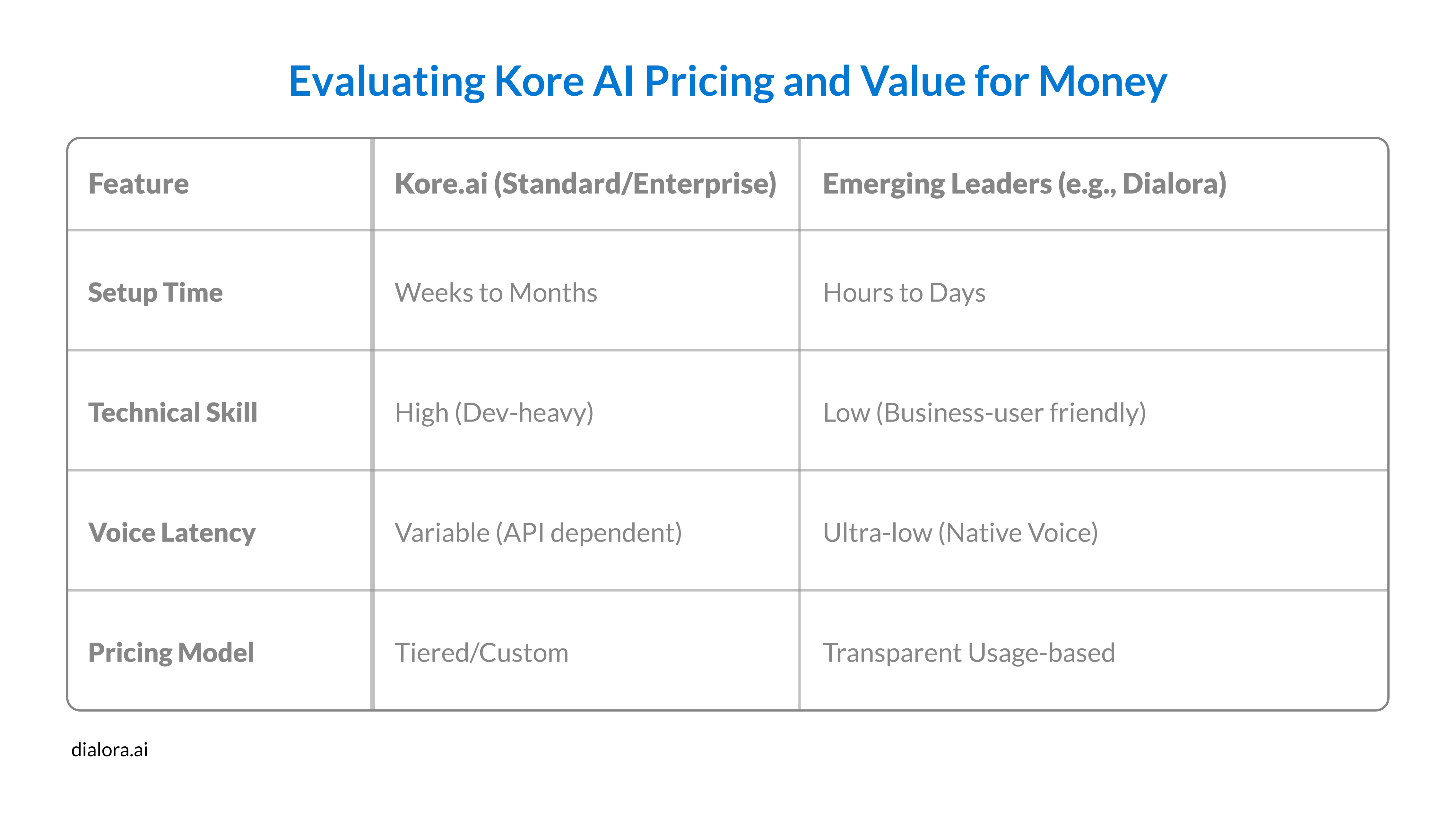
While Kore AI pricing for the "Standard" plan starts with some free credits, the transition to production often requires a heavy upfront commitment. For teams that need to iterate fast, this "heavy" architecture can become a bottleneck.
Recommended articles:
- Best AI Voice Agents
- Best AI Voice Agents for Phone Calls
- Honest Bland AI Review
- Lindy AI Review
- Goodcall Reviews
- Synthflow AI Reviews
Why Agility is Winning the AI Voice Race
In the current market, speed is a competitive advantage. This is where the Kore ai review takes a turn toward the "New School" of AI. Platforms like Dialora have identified the biggest flaw in enterprise giants: the time-to-value gap.
The Dialora Difference
While Kore focuses on being everything to everyone, Dialora focuses on being the best AI voice agent for businesses that need results yesterday.
- Zero Training Required: You don't need a 40-hour certification to launch a campaign.
- Native Telephony: Unlike Kore, which often requires external SIP trunking or complex telephony setups, Dialora handles the "phone" part of the phone call natively.
- High-Fidelity Audio: Many Korean AI voice generator tools and legacy platforms still sound "robotic." Modern AI agent assistant tools like Dialora prioritize human-like latency and tone.
Conclusion: Finding the Right Fit for Your Business
The verdict of this Kore AI review is clear: Kore AI remains a powerhouse for massive organizations with the budget and technical staff to tame its complexity. It is the right choice if you need a "single pane of glass" for every possible AI use case across a global workforce.
However, if your goal is to grow your business through high-performance AI voice solutions without the enterprise baggage, you need something leaner. If you want an AI voice agent that can book appointments, qualify leads, and answer customer queries with zero latency and human-sounding warmth, the "Standard" enterprise path might slow you down.
For businesses that value speed, transparency, and a platform that works for them (rather than the other way around), Dialora is the modern alternative. Don't let your lead response time suffer while you're still reading the Kore AI documentation.
Frequently Asked Questions about Kore AI
How does Kore AI compare to Voiceflow?
According to Voiceflow producthunt Reviews, Voiceflow is often preferred by designers for prototyping and web-based bots. However, for deep enterprise backend integration and 24/7 voice assistant solutions, Kore AI offers more robust governance and security features.
Is Kore AI actually no-code?
It is "low-code." While you can build basic flows without writing a script, a production-grade AI agent builder no-code setup on Kore usually requires a technical architect to handle API hooks and complex logic.
Does Kore AI support voice natively?
Yes, but it is often added as a layer over their chat architecture. This can sometimes lead to higher latency compared to voice-first platforms like Dialora, which are built specifically for the nuances of real-time phone conversations.
What is the average ROI for Kore AI?
Enterprises typically report a 30% reduction in support costs within the first year, but this is offset by high initial implementation fees and consultant costs.