TL; DR
- Voiceflow excels as a no-code workflow builder for designing chat and voice agent flows, especially for product teams.
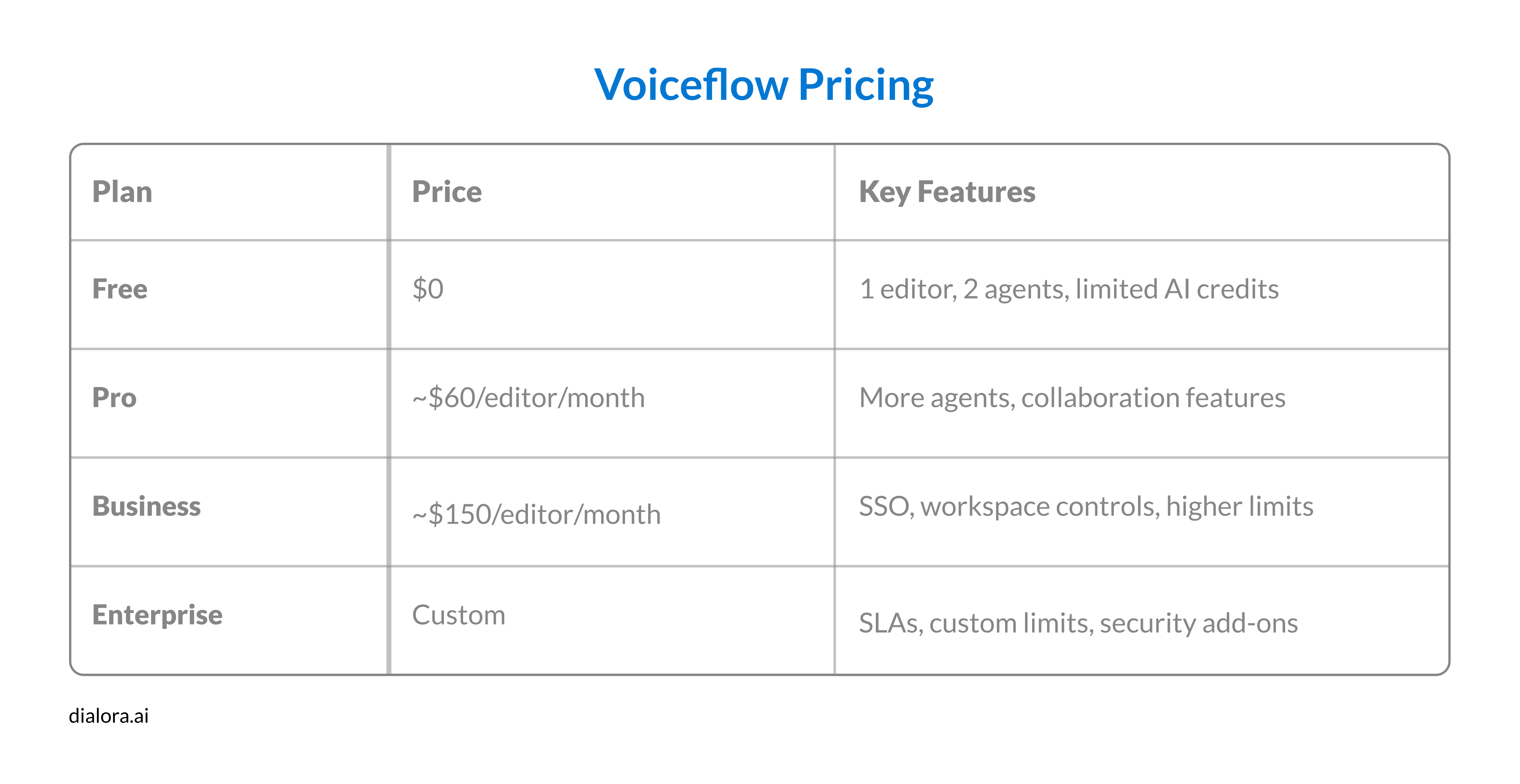
- Voiceflow pricing ranges, charges between $60 and $150 a month for editor seats plus AI usage, which soon adds up.
- Voice capabilities depend on third-party integrations, which might cause delays that make phone experiences worse.
- Best for UX teams and agencies; less ideal for non-technical service businesses.
- Dialora.ai offers ready-to-deploy AI voice agents for businesses needing phone automation without technical complexity.
Introduction
If you're running a business in 2026, you've likely heard the noise: AI is important, chatbots for customer support are becoming more popular, and if you're not automating, you're slipping behind. You suddenly start looking for tools and stumble upon Voiceflow. It looks slick. It argues that you don't need to know how to code to develop AI voice agents and chat interfaces. But here's the true question: Do you want to make a solution, or do you want one that works?
This Voiceflow review cuts through the marketing fluff. We examine Voiceflow AI's capabilities, shortcomings, and suitability as a tool for business owners who require more than simply design tools.
What is Voiceflow?
Voiceflow is a low-code platform designed for teams to design, prototype, and launch conversational AI agents. At first, it focused on making skills for Alexa and Google Assistant, but now it can be used to construct chat and speech interfaces for any purpose.
Think of Voiceflow as the "Figma of conversational AI." You are given a blank screen on which to arrange conversations by dragging and dropping blocks. The platform helps designers, developers, and product managers work collaboratively without having to worry about the code needed to connect Large Language Models like GPT-4 or Claude to a user interface.
Here's the thing: Voiceflow is a toolkit, not a turnkey solution. You are still the architect and construction team even when you receive the physical space. This is ideal for a software startup that is developing a new feature for an app. It's a big do-it-yourself effort for a plumbing company that has to take calls at two in the morning.
Voiceflow Key Features
Visual Flow Builder
The heart of Voiceflow is its drag-and-drop canvas. You use "Logic" blocks to figure out what happens next once you connect "Talk" blocks (what the bot says) to "Listen" blocks (what the user says). You can mock up conversations in minutes and save reusable components for common flows like authentication or intake forms.
AI and LLM Integration
Voiceflow AI is model-agnostic. Anthropic's Claude, OpenAI's GPT-4o, and other models can be accessed via an API. The Knowledge Base feature reduces AI hallucinations by allowing you to upload PDFs or scrape URLs to ensure your responses are based on accurate information.
Collaboration Tools
Multiple team members can work on a project simultaneously, leave comments, and review versions. It feels like working in Google Docs or Figma, which product teams appreciate.
Voice Capabilities
Voiceflow works with phone companies like Twilio so that you can use a voice agent to answer calls. The firm has made latency better, but voice is still an add-on feature instead of a built-in one.
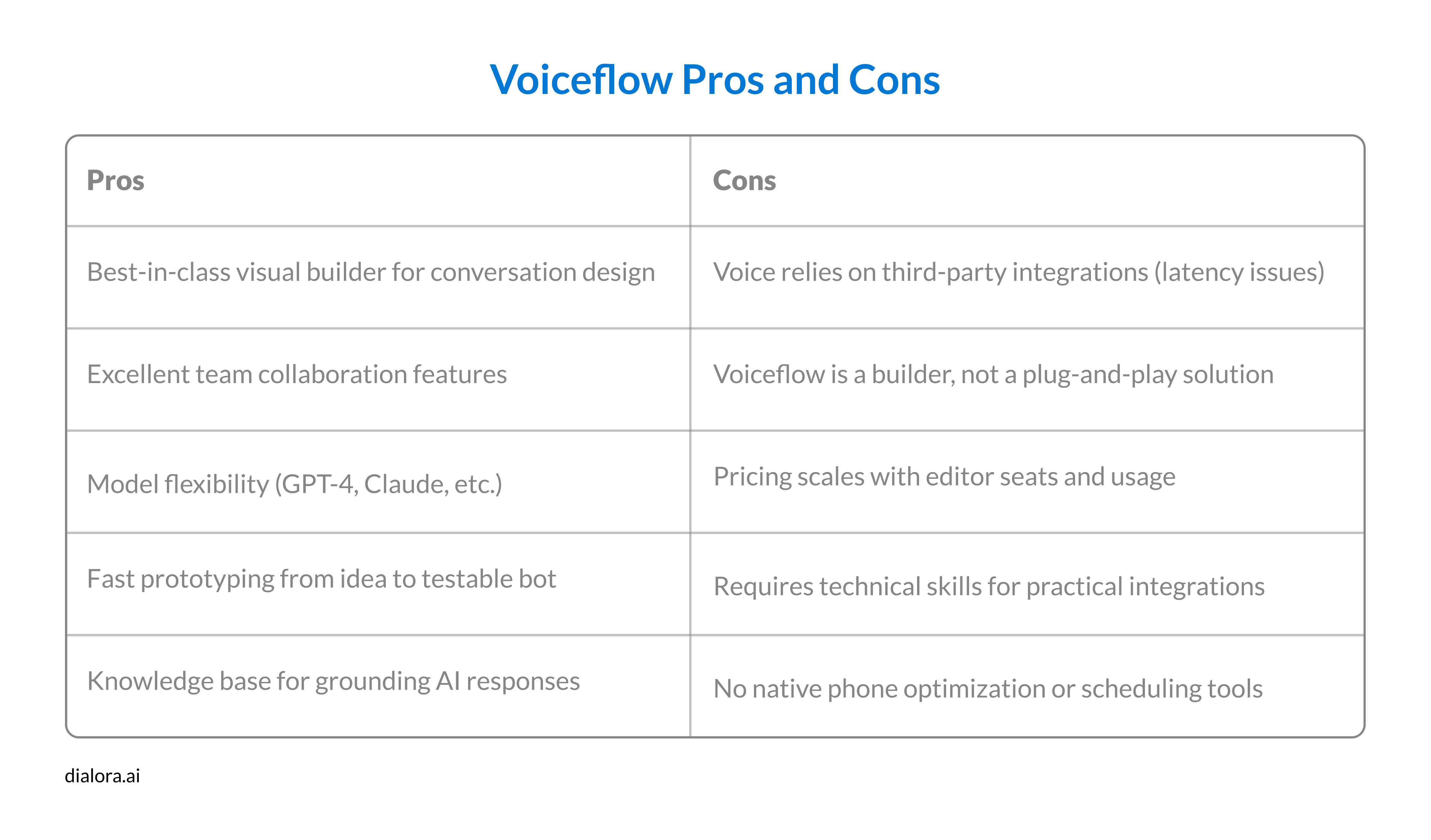
When you connect several APIs, such as speech-to-text, Voiceflow, LLM, text-to-speech, and telephony, the latency might produce awkward gaps that make customers less likely to trust you. Although Voiceflow has improved operations, the platform is not truly voice-first.
Voiceflow Pricing Review
Voiceflow pricing combines per-seat charges with usage costs:
The Hidden Costs
Beyond subscriptions, Voiceflow projects incur:
- AI usage fees (LLM tokens)
- Telephony costs (Twilio phone numbers and minutes)
- Text-to-speech provider fees (ElevenLabs, Amazon Polly)
- Developer or agency time for API integrations
For service businesses, managing multiple vendors for one phone workflow gets complex compared to all-in-one platforms.
Who Voiceflow is for (and Who It's Not)
Best For:
- UX designers and product managers visualizing conversational flows
- Developers wanting visual state machines with code control
- Agencies building custom chatbots for customer support
Not Ideal For:
- Service businesses without technical staff (plumbing, HVAC, dental)
- High-volume call centers needing minimal latency
- Teams needing immediate phone automation without DIY integration work
Best Voiceflow Alternatives for 2026
If Voiceflow feels too hands-on or not specialized enough for your business, here are alternatives that better fit service operations and phone automation.
1. Dialora.ai – Best AI Voice Agent for Small Businesses
Dialora.ai is an AI voice solutions platform built specifically for service businesses that need phone automation without building from scratch.
What it is: A vertical AI calling assistant platform for HVAC, plumbing, electrical, healthcare, and home services. Combines AI-based voice assistant technology with scheduling and customer management in one platform.
Key features:
- Pre-trained for service terminology (no prompt engineering needed)
- Native AI voice agent stack optimized for low-latency phone conversations
- Built-in scheduling, lead capture, and AI voice analytics
- Usage-based pricing (platform free, pay per call/booking)
Use cases:
- Answer every inbound call 24/7, including after-hours
- Book and confirm appointments automatically
- Capture and qualify leads without staff involvement
- Run outbound reminders with natural conversation
Dialora vs Voiceflow:
- Voiceflow gives you a canvas to design custom conversations; Dialora gives you a working AI calling assistant tuned for service industries
- Voiceflow supports voice through integrations; Dialora is built for phone performance from day one
- Voiceflow costs scale with seats, usage, telephony, and developer time; Dialora offers transparent usage-based pricing
If your priority is booking more jobs with minimal setup, Dialora delivers value faster than building with Voiceflow.
2. Dialogflow CX
Google's enterprise conversational platform with industrial-grade NLU and direct Contact Center AI integration. Best for large organizations already on Google Cloud with in-house engineering teams.
3. Botpress
Open-source platform developers appreciate extensibility. Excellent for internal tools and SaaS projects where technical teams require fine-grained control over every detail.
4. Kore.ai
A business platform for automating conversations across all channels on a large scale. Good for Fortune 500 organisations in banking, retail, and healthcare that have complicated compliance demands.
Read more:
- Top Voiceflow Alternatives in 2026
- Top Retell AI Alternatives 2026
- Top Bland AI Alternatives in 2026
- Best Goodcall Alternatives
Which AI Voice Agent is Best for Small Businesses?
When deciding which AI voice agent is best for small businesses, think about how tech-savvy you are and what your sector needs.
Dialora AI is made for service organizations like HVAC, plumbing, and healthcare. It has pre-trained workflows, native phone optimization, and built-in scheduling. You get a working AI agent assistant without building from scratch.
For product teams needing custom design with developer resources, Voiceflow offers unmatched flexibility as an AI agent builder no-code platform.
The best choice: Do you need to design a custom solution (choose Voiceflow), or do you need working phone automation today (choose Dialora)?
How Does Voiceflow Compare to Dialora AI?
Design Philosophy:
- Voiceflow: Builder platform for custom conversation design
- Dialora: Ready-to-deploy AI voice agent with pre-built service workflows
Voice Performance:
- Voiceflow: Relies on third-party telephony (can introduce latency)
- Dialora: Native voice stack optimized for phone conversations
Target User:
- Voiceflow: Product teams, agencies, and developers are comfortable with APIs
- Dialora: Non-technical service business owners needing immediate automation
Pricing:
- Voiceflow: Per-seat ($60-150/month) plus usage, telephony, and often developer costs
- Dialora: Platform-free, usage-based pricing on calls and bookings only
Time to Value:
- Voiceflow: Days to weeks to design, integrate, and test
- Dialora: Hours to get a working AI calling assistant handling real calls
Both platforms excel at what they do. Voiceflow gives unlimited design flexibility. Dialora gives you a working phone system built for service industries.
Conclusion
Voiceflow is an impressive conversation design platform in 2026. The Voiceflow no-code workflow builder democratizes creation of chat and voice agents for product teams and agencies, with powerful visual tools and flexible LLM integrations.
Voiceflow is generally a project for service business owners, not a solution. Designing flows, connecting APIs, and maintaining integrations require ongoing technical skill. The Voiceflow AI pricing model also scales quickly when factoring in seats, usage, telephony, and developer time.
Dialora.ai takes a different approach. Instead of a blank canvas, it delivers a ready-to-use AI voice agent platform that answers phones 24/7, books jobs, and captures leads. For businesses evaluating AI voice solutions and voice assistant solutions, Dialora offers faster deployment and lower technical overhead.
If you're ready to move from experimenting with flowcharts to reliably booking more jobs, sign up for Dialora.ai and start automating your front desk today.
FAQs
Does Voiceflow have a free trial?
Yes, Voiceflow has a free plan that comes with one editor, two agents, and a small number of AI credits. This is great for learning and making little prototypes. For commercial use with teams and production traffic, you'll need a paid plan starting around $60 per editor per month.
Is Voiceflow free or paid?
Voiceflow has both free and paid options. The free plan suits individual users and prototypes. Paid plans start around $60/month per editor for Pro tier and scale to $150+ for Business plans. Additional costs include AI usage, telephony, and potentially developer support.
How does Voiceflow compare to Dialora AI?
Voiceflow is a visual builder giving complete design flexibility for custom conversational flows. It's ideal for product teams with technical resources. Dialora AI is a ready-to-deploy AI voice agent built for service businesses, with pre-trained workflows and native phone optimization. Voiceflow requires you to build and maintain; Dialora provides working phone automation from day one.
Which AI voice agent is best for small businesses?
The greatest AI voice agent for small businesses depends on the type of business you run and how good you are with technology. Dialora.ai is best for service firms like HVAC, plumbing, and healthcare because it has pre-made workflows and built-in scheduling. Product companies with developer resources may prefer Voiceflow for design flexibility. Evaluate based on your need for customization versus speed to deployment.