TL; DR: Key Takeaways
- Cost Efficiency: Live receptionists cost a lot of money (more than $1,000), while automated answering services are economical and don't always have the capabilities that will help you convert more customers.
- The AI Advantage: AI virtual receptionists nowadays can talk to you 24/7, integrate with your schedule, and qualify leads for a lot less than hiring a person.
- Scalability: Automation allows you to manage unlimited simultaneous calls, whereas human services force you to pay more as you grow.
- Branding: AI makes sure that every time you talk to a receptionist, they sound professional, so you don't have to worry about a "rude" or "tired" receptionist hurting your brand.
Introduction
Every time your business phone rings and goes unanswered, a potential client is likely hanging up and calling your closest competitor. For a small enterprise or a busy medical office, missing connections isn't just a modest problem; it's a chance to make money. When you realize you can no longer handle the call volume alone, you typically find yourself at a crossroads: virtual receptionists vs. automated phone service.
Choosing the right path isn't just about price. It's about the "vibe" your brand projects and the efficiency of your daily operations. Do you require the warmth of a human voice, or do you need an automated answering service that is always on and always accurate? Modern technology has blurred these lines, introducing AI virtual receptionists that offer the best of both worlds. This article will help you break down the pricing, features, and mental effects of each option so you can stop losing leads and start growing.
Understanding the Core Differences
At their simplest level, these two services solve the same problem answering the phone but they do so through different mechanisms.
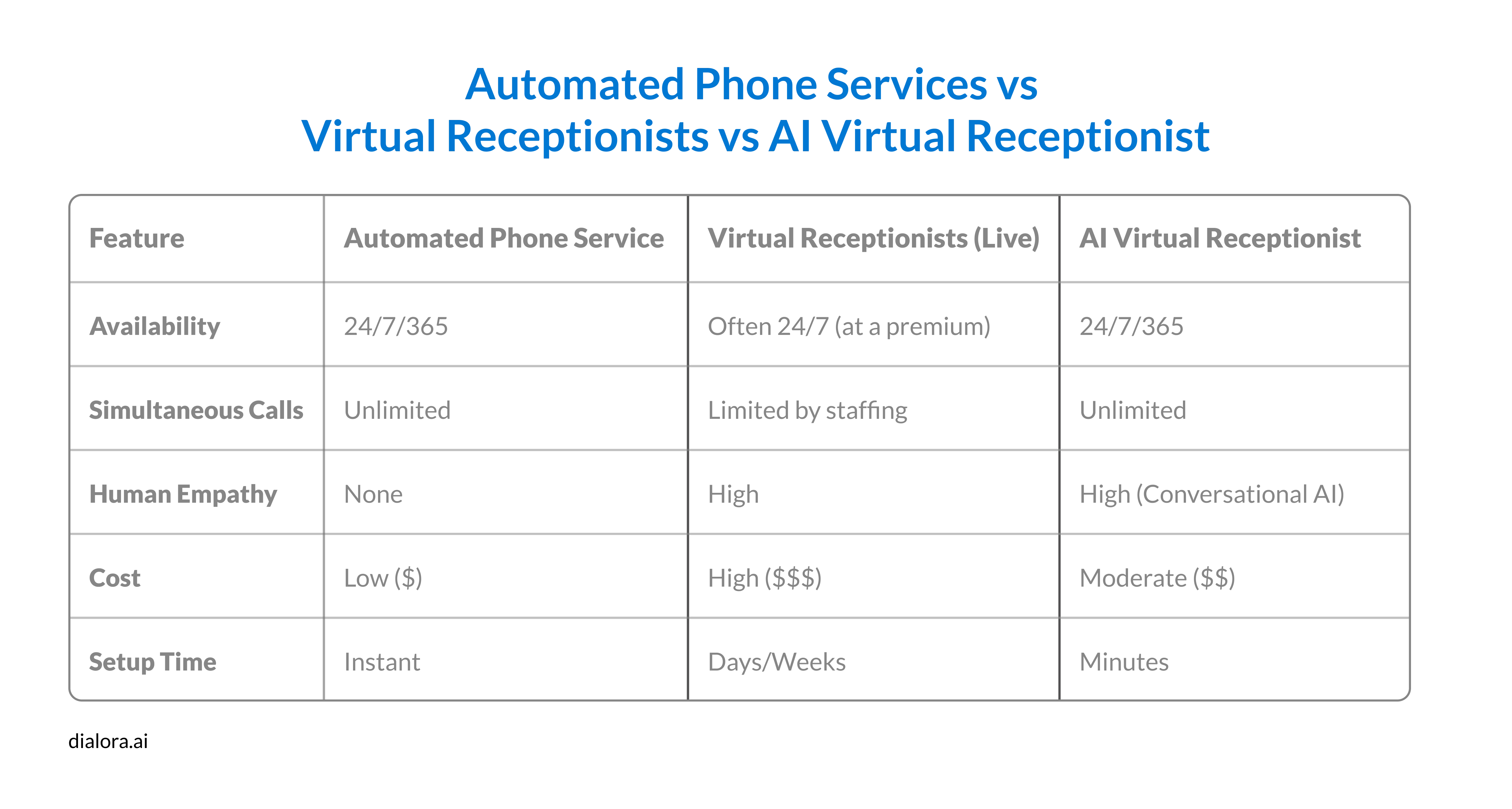
An automated phone service is a software-based system. Historically, this meant an "Auto-Attendant" or an Interactive Voice Response (IVR) system where callers hear, "Press 1 for Sales." It is efficient, never takes a sick day, and is incredibly cost-effective. But the problem has always been that it doesn't have any "soul." A strict menu can feel like a digital dead end if a caller is in trouble or has a complicated query.
On the other hand, virtual receptionists are traditionally live, remote professionals. They have a human touch, can understand how others feel, and can handle conversations that are a little more complicated. For a virtual receptionist law firm or a high-end boutique, this personal touch is often considered non-negotiable for building trust. But people have limits: they can only answer one call at a time, they need training, and their prices go up a lot with more calls.
Why Small Businesses Struggle with Traditional Automation
For many years, an automated phone service for small business was a double-edged sword. While it saved money, it often frustrated customers. We have all experienced the "loop of doom," where the automated system doesn't understand our request and keeps repeating the menu.
For a medical office virtual receptionist role, this frustration is amplified. Patients calling a doctor’s office are often stressed. They don't want to press buttons; they want to know if their prescription is ready or if they can be seen today. Traditional automated phone answering service setups often fail in these high-stakes moments. This is where the industry is shifting. The modern solution isn't just "push-button" automation anymore; it's conversational intelligence.
The Rise of the AI Virtual Receptionist
We are entering the era of the AI virtual receptionist. Not only a recording, but this virtual phone assistant employs Natural Language Processing (NLP) to understand the caller's actual words.
Imagine a virtual receptionist for small business that can:
- Answer the question, "How much do you charge for a meeting?" using your own knowledge foundation.
- Check your calendar and say, "We can meet at 2:00 PM on Tuesday."
- Send a follow-up email or SMS as soon as the call is over.
By using an AI virtual receptionist, you eliminate the "robotic" feel of an automated phone call service while avoiding the $3,000-per-month price tag of a high-end live service. It provides a consistent brand voice every single time the phone rings. Unlike human agents who might have an "off day," your AI agent is always professional, always patient, and always informed.
Evaluating the Cost: Virtual Receptionist vs. Automated Phone Service
For MOFU purchasers, the budget is frequently the most important thing. Let's take a look at the actual numbers for 2026.
Virtual Receptionist Cost
Usually, a live best virtual receptionist service costs by the minute or by the call.
- Per Minute: Rates are normally between $1.50 and $3.50 a minute. You are spending more than $10 only to answer the phone once if a typical intake call lasts 5 minutes.
- Base Fees: Most services have a monthly "seat" or "platform" fee starting at $100–$300 before a single call is even answered.
- Total: For a medium-volume office, you can easily spend $1,200–$2,500 per month.
Automated Phone Service Cost
Basic automated answering services are often included in your VoIP plan or cost a flat fee of $20–$50 per month. They are the most affordable option, but they offer the lowest conversion rate because they cannot "sell" your services or handle complex scheduling.
The AI Middle Ground
An automated phone answering service powered by AI (like Dialora) typically offers flat-rate monthly pricing. You might pay $100–$300 for a system that handles unlimited minutes. When you compare the virtual receptionist cost of $2,000 for a human vs. $200 for AI, the ROI becomes undeniable for most growing firms.
Integration: Beyond Just Answering the Phone
A major pain point for business owners is the "double work" of taking a message and then manually entering it into a CRM. When comparing virtual receptionists vs. automated phone service, you must look at virtual receptionist appointment scheduling capabilities.
Live receptionists can log into your software, but they often require extra fees for this "premium" service. An AI-driven automated answering service can integrate directly with your tech stack via API.
- Calendar Sync:It shows when you're free in Google Calendar or Outlook right now.
- CRM Integration: It adds the caller's name, phone number, and a record of the conversation to your database.
- Email Follow-ups: With a link to your digital brochure, you can send an email that says, "Thank you for calling."
Which Solution Is Right for Your Industry?
For Law Firms
In the legal world, first impressions are everything. A virtual receptionist law firm setup needs to be professional and capable of handling lead qualification. You don't want to spend time on the phone only to find out that the person has a case you can't help with. You can train AI to ask certain qualifying questions so that only the most valuable leads get to your desk.
For Medical Offices
A medical office virtual receptionist must be HIPAA-compliant and incredibly accurate. While some practitioners prefer live humans for the "care" aspect, many are moving to AI to handle the heavy lifting of rescheduling and FAQs, leaving the human staff to focus on the patients physically in the building.
For General Small Businesses
If you are a contractor, a plumber, or a solopreneur, you simply need to capture the lead. A virtual receptionist for small business that can answer the phone at 8:00 PM on a Saturday and book a quote for Monday morning is the difference between a growing business and a struggling one.
Conclusion: Making the Final Call
In the battle of virtual receptionists vs. automated phone service, there is no longer a one-size-fits-all answer. But the research reveals that firms are moving away from menus that are too stiff and annoying, as well as the high costs of having live workers available 24/7.
The sweet spot is the AI virtual receptionist. It provides the human-like interaction your customers crave with the 24/7 availability and low cost of an automated phone service. By choosing a solution that integrates with your calendar and CRM, you aren't just "answering the phone"; you are building a lead-generation machine that works while you sleep.
If you are tired of missing high-value leads or paying thousands for a service that can only handle one caller at a time, it’s time to upgrade. Book a demo with Dialora AI today to see how our virtual receptionists vs. automated phone service hybrid technology can transform your business from a missed-call liability into a conversion powerhouse.