TL; DR
- Cold transfer involves sending a call directly to another agent or department without giving them any information or a briefing.
- Also called blind transfers, they happen during high call volumes, simple routing needs, or when the first agent lacks relevant information
- The main advantage is speed, but the downside is that customers often repeat themselves and risk being routed incorrectly
- Warm transfer provides context before completing the transfer, reducing customer frustration but taking slightly more time
- The best approach uses both transfer types strategically based on call complexity, volume, and customer needs
- Always tell customers before you transfer them, make sure the route is correct, and use internal notes where you can make things better.
Introduction
A brand's reputation can be made or broken by the way a call proceeds from point A to point B in the fast-paced world of modern communication. You have probably been the victim of a badly handled Cold Transfer if you have ever been "passed around" a customer service department and asked to repeat your account number five times.
While efficiency is the goal of every AI answering service and human-led support team, there is a fine line between a quick connection and a "cold shoulder." The first step to improving your business's communication flow and making sure your customer care agents have the necessary tools for the job is to learn what a cold transfer call is.
Defining the basics of a cold transfer call
To answer the core question: what is a cold transfer? It is the process of routing an active call to another representative or department without providing any context or prior briefing. In the industry, this is often referred to as a "blind transfer."
When a Cold Transfer occurs, the original agent simply hits the transfer button and hangs up. The receiving party picks up the phone "cold"—they don't know who the caller is, what their problem is, or how long they have already been waiting. While this is a very fast type of call transfer, it often places a heavy burden on the customer to restart their story from scratch.
How does a cold transfer work in a modern call center
The mechanics of Cold Transferring a Call are straightforward but vary slightly depending on your hardware. In a typical cloud-based system, the agent selects the "Transfer" option, enters the extension or selects a department from a directory, and executes a "Blind" command.
Unlike more sophisticated methods, there is no "holding" period where the two employees speak. The caller is moved instantly. For customer service agents, this is the quickest way to clear a queue, but it frequently leads to a "ping-pong" effect where the caller is bounced between departments because the first agent didn't verify if the second person was the correct contact or even at their desk.
Comparing a cold and a warm transfer
The best way to understand the impact of your Call Handling is to look at the "temperature" of the handoff. While a cold transfer is abrupt, a Warm Transfer (or attended transfer) involves a brief conversation between the two employees before the caller is introduced.
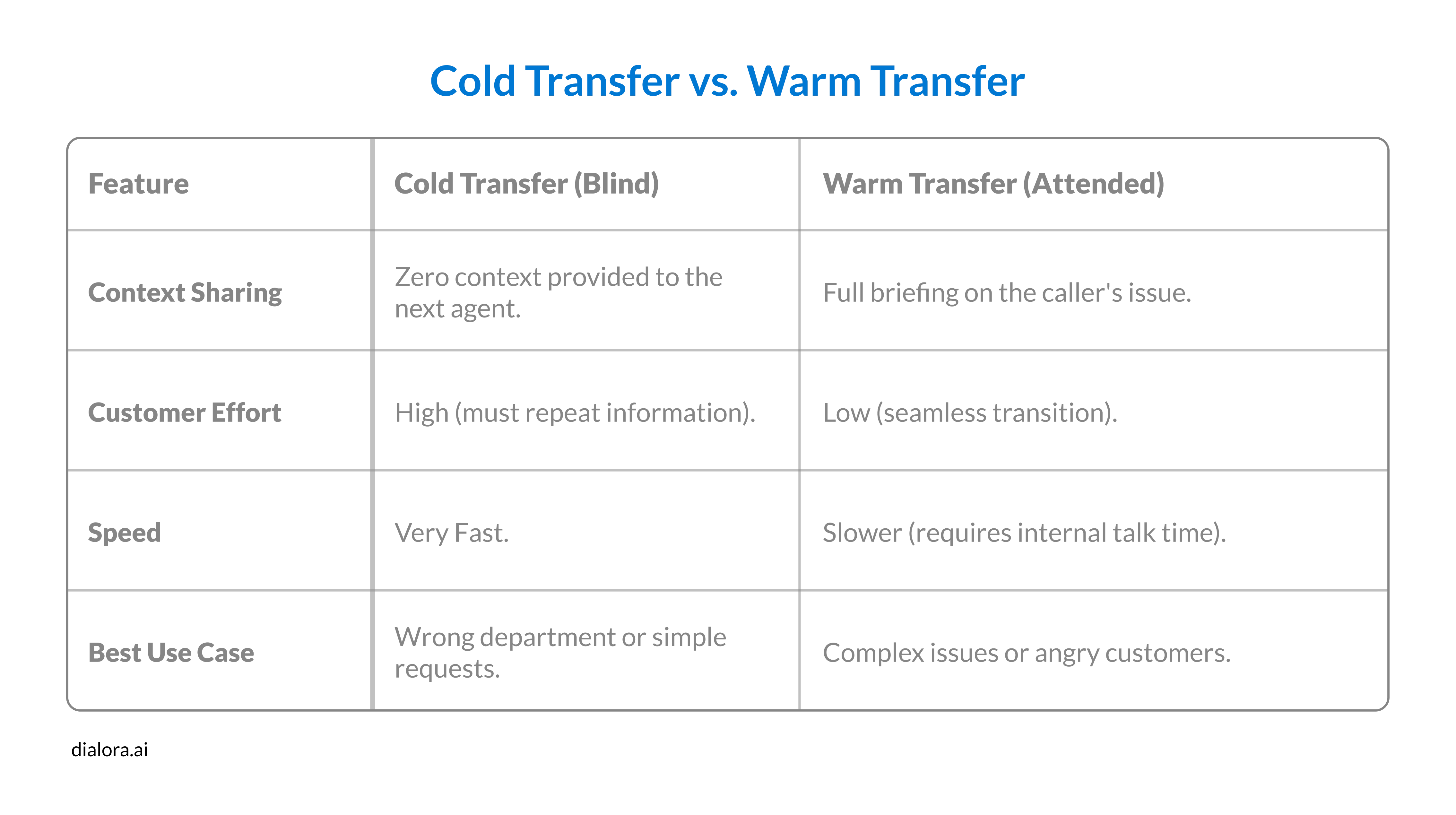
In 2026, the best AI answering service providers are moving away from the "cold" model. Instead, they use AI-Powered Interview Scheduling or routing logic to make sure that every transfer feels "warm," even if there isn't a human agent engaged.
What is an example of a cold transfer in action?
Imagine a customer calling a law firm to ask about a specific billing statement. They reach a general receptionist who realizes the call belongs to the accounting department.
In a Cold Transfer scenario, the receptionist says, "One moment while I connect you," and clicks a button. The customer hears music, then a new voice says, "Accounting, how can I help you?" The customer now has to explain their entire situation again, potentially getting frustrated that the first person didn't pass along their details.
In contrast, an AI voice agent would be able to transcribe the first half of the call and "whisper" those details to the accounting rep, effectively turning a cold process into a warm experience.
Managing call handling time without sacrificing quality
One of the main reasons managers stick with Cold Transferring a Call is to lower their Call Handling Time (CHT). Because there is no internal consultation, the total duration of the agent's involvement is minimized.
However, this is often a "false economy." While the first agent's AHT goes down, the second agent's time goes up because they have to spend the first three minutes of the call re-identifying the customer. Using an AI agent for your business allows you to maintain low handling times by automating the data collection, so the transfer even if it is "cold" is backed by a digital file that the next agent can see instantly.
Ready to turn your "cold" interactions into high-conversion conversations?
What is cold transfer in customer service best practices
If your team must use cold transfers, there are ways to do it without alienating your clients.
- Always Ask Permission: Never move a caller without saying, "May I put you through to our billing department?"
- Provide a Direct Extension: Give the caller the direct number of the person they are being moved to in case the call drops.
- Verify Availability: If your system allows it, check the "presence" status of the receiving agent to ensure they aren't on "Do Not Disturb" before you Cold Transfer a Call.
Conclusion
The debate between Cold and a Warm Transfer isn't about which one is "right," but about which one is right for your customer's current journey. While the speed of a Cold Transfer is tempting for busy teams, the long-term cost of a frustrated customer often outweighs the seconds saved.
By integrating an AI agent for your business, you can enjoy the efficiency of automated routing while providing the "warmth" of a personalized introduction. In 2026, the best AI answering service is one that eliminates the friction of the transfer, ensuring that every time you Cold Transfer a Call, your team is still set up for success.
Discover how Dialora ai can automate your call handling and provide a seamless, human-like experience for every caller, 24/7. Whether you need a sophisticated AI voice agent or a smarter way to manage your Call Flow, we help you keep your customers happy while your agents stay productive.
FAQ Section
How Does a Cold Transfer Work?
A cold transfer works by redirecting an active phone line to another extension or external number without the original sender speaking to the recipient first. The connection is instantaneous, and the original agent drops off the line as soon as the transfer is initiated.
What is cold transfer in customer service specifically?
In customer service, it is a method used to quickly move callers to different departments. It is most effective when the caller has reached the wrong person entirely or when they are asking for a specific individual by name.
What is an example of a cold transfer?
An example is a caller asking for "Technical Support" and a general operator immediately clicking a button to send them to the tech queue without introducing the caller to a technician first.