TL;DR
- Warm transfer means that the first agent connects the customer with a specialist and gives them some background information before hanging up, making the transfer smooth.
- Unlike cold transfers, customers don't repeat themselves, leading to 23–35% fewer abandoned calls and higher satisfaction
- Best for difficult problems, important accounts, or private matters where the situation has a big effect on the conversation
- While keeping a personal touch, contemporary AI virtual receptionists can automate certain steps of the process.
- Success metrics include transfer completion rate, first-call resolution improvement, and post-transfer satisfaction scores
You might have gone through it. You call a business and tell the first person who answers what's wrong. They then send you to someone else who asks you to repeat what you said. I know how you feel.
That's a cold transfer. Additionally, it's costing companies more than they realize in terms of lost revenue, lost time, and tarnished reputations. Warm transfer offers a better approach, one that respects your customer's time and increases the chances they'll actually get the help they need.
Here's the thing: call handling isn't just about routing people to the right department. It's about making things go smoothly, even when a lot of people are there. Let's talk about what warm transfer really means and why it's important for your business.
Understanding Warm Transfer in Call Centers
A warm transfer happens when the person answering your call stays on the line to introduce you to the next representative. They tell you about your problem, make sure the expert is ready to help, and only stop talking to you when they are sure you are in good hands.
Think of it like a professional handoff in a relay race. It is not as if the first runner simply drops the baton and walks away. Only when the next runner has a firm hold on it do they release it.
In practical terms, here's what happens:
- The first agent gathers your information and understands your needs
- They put you on a brief hold while contacting the appropriate specialist
- The specialist hears a quick summary of your situation before you join the call
- After introducing you and making sure everyone is prepared, the first agent ends the conversation.
Compared to a cold transfer, in which you are immediately moved to a different line without being introduced, this procedure takes a little longer. But the payoff is worth it. Your customers don't have to say the same thing over and over; the specialist is ready for the call, and you lower the chance of missed calls or angry hangups.
Warm transfer call center operations report significantly higher first-call resolution rates compared to centers that rely primarily on cold transfers. The difference comes down to information continuity and customer respect.
Warm Transfer vs Cold Transfer
The distinction matters more than you might think.
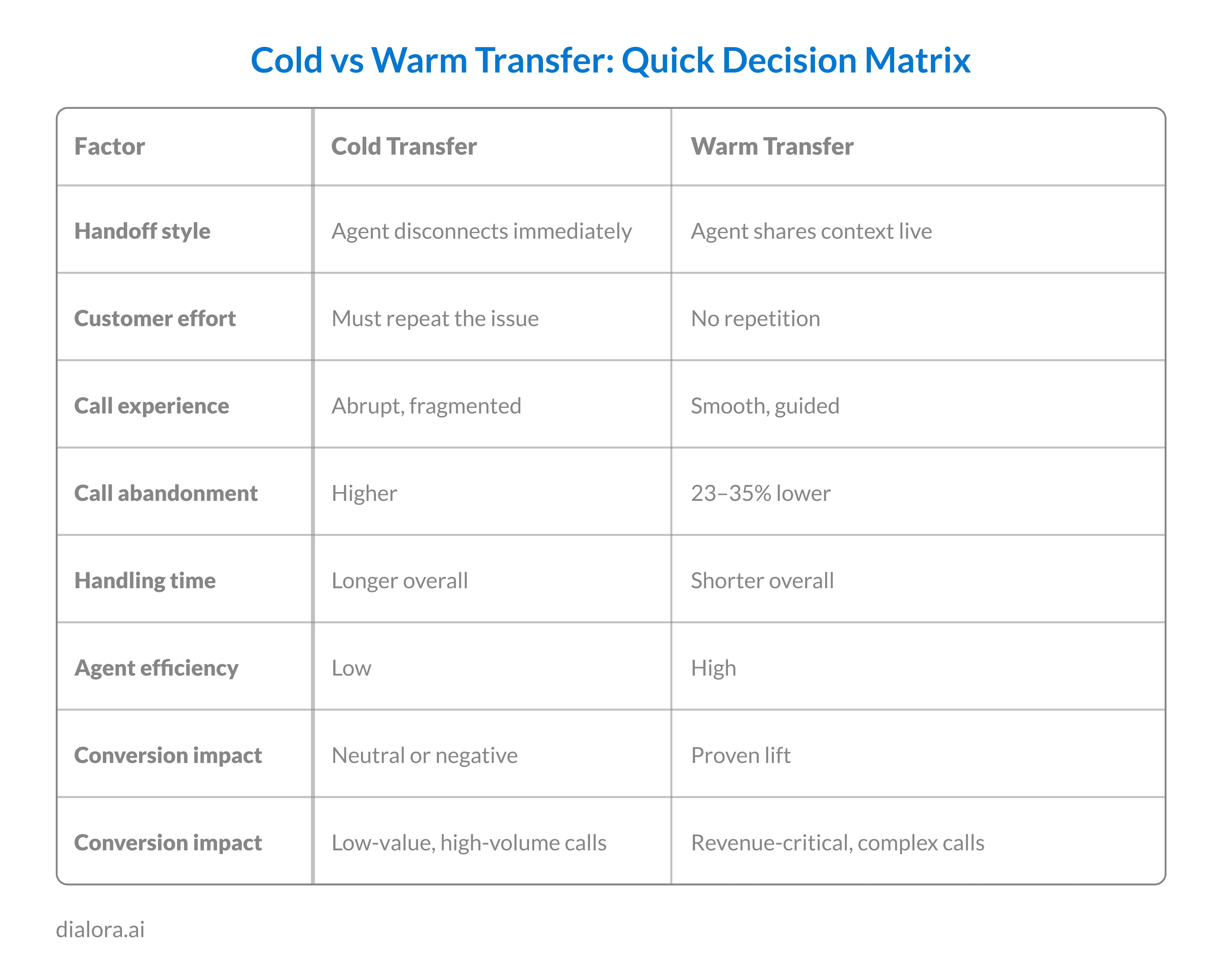
One real estate agency switched from cold to warm call transfer protocols and saw its lead conversion rate jump by 18% in two months. The difference? Warm transfer leads arrived with context, making specialists more effective and prospects more receptive.
How Warm Transfer Works in Practice
The mechanics are straightforward, but execution requires coordination and the right systems.
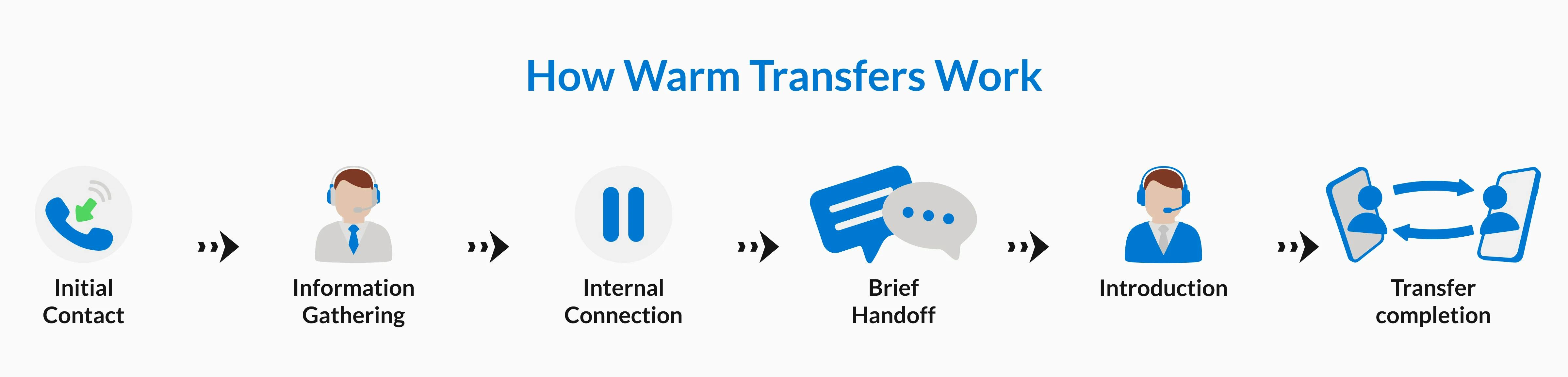
Let's walk through a typical warm transfer script scenario:
- Initial contact: Your customer reaches your answering service or front desk
- Information gathering: The first agent understands the customer's needs
- Internal connection: Agent reaches out to the appropriate specialist via internal line
- Brief handoff: Agent explains the situation to the specialist (customer on hold)
- Introduction: All three parties join the call; the agent makes introductions
- Transfer completion: Original agent confirms the specialist has everything needed and disconnects
Modern AI answering service platforms automate parts of this process. An AI virtual receptionist can get basic information, route calls intelligently, and even send specialists written summaries before the call connects.
Some businesses worry that warm transfers slow down operations. The reality is different. Yes, the transfer takes an extra 15–30 seconds. But you eliminate the 2–3 minutes customers spend re-explaining their situation. You also reduce transfers to wrong departments, which wastes far more time.
Call routing technology has evolved significantly. AI call routing systems can predict which specialist is best suited for each customer based on inquiry type, customer history, and even sentiment analysis. When combined with warm transfer protocols, you create an experience that feels personal and efficient.
Virtual receptionist services often use warm transfer as a standard practice. They know that their job is more than just answering the phone; they also have to make a good first impression on your business. That goal is hurt by a rushed, confusing transfer.
When to Use Warm Transfer
Not every call requires a warm handoff. Understanding when to use this approach helps you balance efficiency with customer experience.
Use warm transfer when:
- The customer has a complex issue requiring specialist knowledge
- You're working with valuable accounts or prospects for sales
- The inquiry involves sensitive information (medical, financial, legal)
- Several departments need to work together to find a solution
- The customer has already been transferred once before
- You're handling warm transfer leads from marketing campaigns
Consider cold transfer when:
- The customer requests a specific person by name
- The issue is straightforward, and the receiving department has all the necessary context in its system
- You have robust CRM integration that automatically displays customer history
- The transfer is to voicemail or a callback system
Many call centers adopt a hybrid approach. They use automatic call distribution service technology to route simple inquiries automatically (essentially cold transfers enhanced by smart routing), while reserving warm transfers for situations where context matters.
A straightforward rule was put in place by one medical practice: A warm transfer is given to any patient who calls regarding test results, billing issues, or appointment changes. General inquiries about hours or directions can be cold-transferred or handled by an AI voice agent. This tiered system cut down on patient complaints by 41% while keeping call handling times reasonable.
Benefits Beyond Customer Satisfaction
Although the obvious benefit is a better customer experience, warm transfer also has unexpected operational benefits.
- Improved specialist productivity: When your experts spend less time gathering background information, they solve problems faster. Because each call began with context rather than confusion, a financial services company discovered that its advisors handled 22% more calls daily after putting warm transfer protocols into place.
- Reduced training burden: When new employees know they can get help from experienced coworkers through a warm transfer, they can handle front-line calls with more confidence. In order to avoid awkward conversations, the safety net promotes better initial service rather than hurried cold transfers.
- Better data and insights: You get useful information about what your customers need and what makes them unhappy when transfers include summaries. This data helps you identify training gaps, refine warm transfer scripts, and improve overall service quality.
- Higher conversion rates: For sales teams, warm transferred leads convert at significantly higher rates than cold leads. The context given during the transfer helps salespeople tailor their approach right away, which helps them build rapport faster.
Some businesses outsource your call centers specifically to access better warm transfer capabilities. Professional services have better processes, trained staff, and technology infrastructure than small internal teams do.
Technology That Enables Better Transfers
The right tools make warm transfers practical at scale.
Traditional phone systems: Most modern business phone systems support three-way calling and internal extensions, the basic requirements for warm transfer. But manual processes create inconsistency.
Call center software: Dedicated platforms offer features like:
- Whisper coaching (agent hears information before the customer joins)
- Disposition codes to categorize transfer reasons
- Real-time specialist availability displays
- Integrated CRM data that follows the call
AI-powered solutions: This is where things get interesting. An AI virtual receptionist can do the first screening, get the necessary information, and even guess which specialist would be best based on the conversation. A human specialist is given a structured synopsis of the client's requirements when they take over.
AI call routing algorithms analyze factors like:
- Customer history and previous interactions
- Specialist expertise and current workload
- Issue complexity and urgency
- Language preferences and communication style
These systems can execute warm transfers without human intervention in the first stage. The AI agent introduces the customer to a human specialist, provides context, and smoothly exits the conversation.
Companies implementing automatic call distribution service with AI enhancement report 30–40% improvements in first-call resolution compared to basic routing systems.
Measuring Warm Transfer Success
What you measure determines what you improve.
Key metrics to track:
- Transfer completion rate: The proportion of warm transfers that maintain a connection without disconnecting
- Post-transfer satisfaction: Particular comments from customers regarding the transfer experience
- First-call resolution improvement: Look at the rates of resolution for warm and cold transfers
- Average handling time: Total time including transfer process
- Repeat transfer rate: How often customers get transferred multiple times
Most businesses say that warm transfers add 8–12% to the time it takes to handle the first call, but they cut the total resolution time by 15–20% because there are fewer escalations and callbacks.
When warm transfer becomes the norm for complicated questions, customer satisfaction scores usually go up by 15 to 25 points on a 100-point scale.
Warm transfer call center operations often use speech analytics to evaluate transfer quality. The system can flag transfers where:
- The customer repeated information unnecessarily
- The specialist seemed unprepared despite the handoff
- The transfer took longer than expected
- The customer expressed frustration during or after the transfer
You can use this information to make processes better and help individual agents find coaching opportunities.
Conclusion
The reality is simple: customers remember how you made them feel during interactions. A warm transfer shows them that you care about their time and want to help them. A cold transfer lets them know that they're just another call in line. That view has a much bigger impact on loyalty, referrals, and long-term revenue than most businesses know.
Examine hybrid strategies. Warm transfers for every call are not necessary for every business. Smart call routing that reserves warm transfers for specific situations lets you deliver premium service where it matters most while maintaining efficiency for routine inquiries.
Dialora AI offers AI-powered virtual receptionist solutions that combine warm transfer capabilities and intelligent routing, if you're prepared to make your call handling experience more seamless rather than frustrating. Our system makes sure that your customers always feel heard, valued, and quickly sent to the right person. Set up a demo to see how automating warm transfers can make your customers happier and save you money at the same time.
Frequently Asked Questions
What is a warm transfer in a call center?
In a call center, a warm transfer occurs when the first agent remains on the line to introduce the client to a specialist or another department, giving background information about the client's requirements before cutting the call. This ensures the receiving agent understands the situation without requiring the customer to repeat information. Cold transfers send customers to another person right away, but warm transfers make the handoff smooth, which makes the customer experience better and raises the rate of first-call resolution.
Can AI handle warm transfers effectively?
Yes, AI virtual receptionists can do great warm transfers by gathering customer information, routing calls intelligently, and giving human specialists detailed summaries of the calls before they start. The AI smoothly brings in a human expert after doing the initial screening and building the context, if needed. By combining human knowledge and AI efficiency, this hybrid approach frequently produces better outcomes than completely manual procedures.
Do warm transfers work for all industries?
In industries where context and continuity are crucial, such as healthcare, financial services, legal, real estate, and technical support, warm transfers are especially helpful. But warm transfer protocols are helpful for any business that deals with complicated customer questions or high-value interactions. The trick is figuring out which inquiries can be handled automatically and which ones need the human touch of a warm handoff.