TL;DR
Most contact centers hit a wall around the 200-agent mark, adding headcount stops fixing handle times and starts adding quality variance. AI call center agents handle the repeatable 60 percent of call volume, so your humans focus on the calls that actually need judgment. Operations leaders who deploy them right see AHT drop 40 percent without CSAT taking a hit.
Your floor supervisor already knows the Monday afternoon pattern. Queue times climb past four minutes, AHT drifts up, and your best agents end the shift handling the same tier-one questions they handled at 9 am. Scaling a contact center used to mean hiring more of them. That math stopped working somewhere around 2023, and the VPs who keep ignoring it are the ones explaining 18-month payback periods to their CFOs.
Stats - According to the Gartner report, Agentic AI will autonomously resolve 80% of common customer service issues without human intervention by 2029, Agentic AI will autonomously resolve 80% of common customer service issues without human intervention by 2029, driving a 30% reduction in operational costs as automation becomes the dominant strategy for all service teams.
The real cost of running a human-only contact center at enterprise scale
A 500-seat BPO floor running 24/7 burns roughly 70 per cent of its operating budget on labor. Attrition sits between 30 and 45 per cent annually across the industry. Training a new agent costs between $4,000 and $7,000 before they hit quota. Multiply that by your replacement rate, and the number stops being a line item. It becomes the single largest controllable cost on your P&L.
Then there is the quality problem. Calls routed to under-trained agents generate repeat contacts, escalations, and post-call surveys that drag CSAT down for 90 days. Every operations leader knows this cycle. Fixing it with more hiring has become the expensive answer to a question that now has a better one.
What AI call center agents actually do
AI call center agents are voice-first systems that handle full conversations end-to-end. They answer inbound calls, qualify the intent, resolve tier-one issues, route complex calls to the right human agent with full context, and log everything to the CRM automatically. Outbound, they run follow-up sequences, reminder calls, and lead qualification at volumes no human team can match.
The practical difference from a legacy IVR is simple. An IVR asks the caller to press 1 for sales. An AI voice agent asks what they need, understands the answer in natural language, and either resolves it or warm-transfers the call to the right person with a summary already attached.
For enterprise BPO and logistics operations, the deployment pattern that actually works looks like this.
Start with a narrow, high-volume intent
Pick one call type that generates 20 percent or more of your inbound volume. Order status, appointment confirmation, and password resets are the usual candidates. Deploy the AI agent against that single intent before expanding scope.
Route by confidence score, not by keyword
Legacy systems route based on whether a keyword appears. Modern AI agents route based on intent and confidence. If the system is 94 percent sure the caller wants to check an order status, it resolves. If confidence drops below threshold, it warm-transfers with context. This is the single biggest quality unlock.
Measure containment rate alongside CSAT
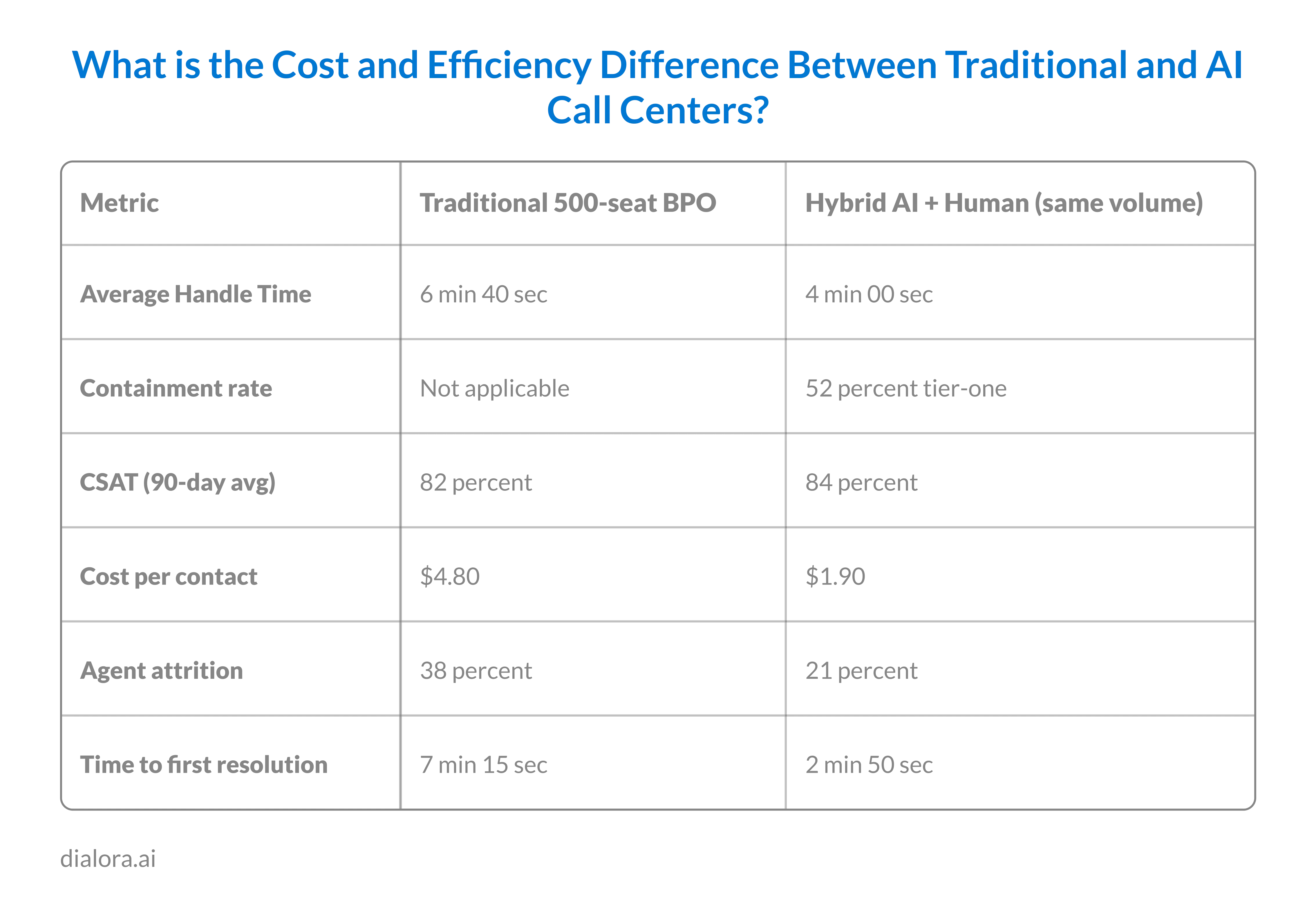
Containment is the share of calls fully resolved by AI without human transfer. A healthy enterprise deployment hits 45 to 60 percent containment on tier-one intents within 90 days. CSAT for AI-handled calls typically lands within 3 points of human-handled, and often higher for simple transactional calls.
Key Takeaway
One intent at 20% of inbound volume is worth more than five intents at 4% each. Depth beats breadth in early deployment, the model matures faster, containment data is cleaner, and the case for expansion builds itself
The proof layer for operations leaders
A hybrid model where AI agents handle the first-touch containment layer, and humans handle escalations, produces the 40 percent AHT reduction without the CSAT trade-off most directors fear. The mechanism is straightforward. Humans stop burning their first 90 seconds on authentication and intent discovery. They pick up calls that already have context attached and start solving from minute one.
Attrition improves for a second reason most RFPs miss. Agents who spend their day on escalations and edge cases report higher job satisfaction than agents running the same tier-one script 80 times per shift. The boring work leaving the queue is not a downside. It is why your best people stay.
Dialora's AI voice agents handle inbound and outbound contact center volume at the intent layer, warm-transfer complex calls to your human team with a full summary attached, and sync every call to your CRM automatically. For an enterprise CX director running a multi-region operation, that is the path from 200 agents handling everything to 120 agents handling the work that actually needs them with the same coverage and better numbers across the board.
Conclusion
Your floor is already running a containment problem. The only question is whether you fix it by hiring 40 more agents this quarter or by letting AI handle the tier-one layer.
The containment gap is the cheapest 40 per cent AHT reduction your contact center will ever find. See It Handle a Real Contact Center Call
FAQ
What are AI call center agents
AI call center agents are voice-first systems that handle complete phone conversations with callers. They answer inbound calls in natural language, resolve common requests, route escalations to human agents with full context, and log every interaction to the CRM. The best deployments work as a layer in front of your human floor, not a replacement for it.
How do AI agents work in a call center
They use speech recognition to understand what the caller needs, natural language understanding to match intent against your knowledge base, and speech synthesis to respond in a human-sounding voice. When confidence is high, they resolve the call. When confidence drops, they warm-transfer to a human agent with a written summary attached, so the human picks up mid-context instead of starting from zero.
Can AI fully replace call center agents
Not yet, and enterprises that try this tend to damage CSAT within 60 days. The working model is hybrid. AI handles the 45 to 60 percent of calls that are repeatable tier-one intents. Humans handle everything that needs judgment, empathy, or nuanced problem-solving. That split is where the 40 percent AHT reduction comes from without CSAT dropping.
What is the best AI for call centers
The right answer depends on your volume, your existing stack, and your verticals. For enterprise BPO and logistics operations, prioritise platforms that handle warm transfer with context, integrate natively with your CRM, and run multilingual if you support non-English markets. Dialora handles all three and covers 30-plus countries in multiple languages.
How do I deploy AI agents in my contact center
Start narrow. Pick one high-volume intent that accounts for 20 percent or more of inbound calls. Deploy against that single intent, measure containment and CSAT for 30 days, then expand scope. Full-floor deployments that try to automate every intent at once tend to fail on edge cases before the model matures.