TL; DR
A front desk that misses calls between 5 pm Friday and 9 am Monday is quietly costing most law and accounting firms more new clients than their marketing budget brings in. AI virtual receptionists answer every call, qualify the lead, book the intake, and log it to your system — without a human in the chair. Firms running one typically stop losing weekend leads within the first month.
Your front desk went home at 5:30. Between then and Monday morning, 11 people tried to call your office. Most of them hit voicemail. Two of them called the next firm on their Google results page. You will never know which two. This is the math every small professional services firm runs without ever putting a number to it.
Stats - Solo law firms using online schedulers and intake tools saw 53% higher revenue and 48% more client leads than those that didn't - Clio 2025 Trends
Why the calls you miss cost more than the ones you answer
The industry data is not flattering. 62 percent of callers hang up if their call is not answered within 20 seconds. For a law firm or accounting practice, that is not a customer service problem. That is a revenue problem with a direct line to your closing rate. A missed intake call for a $4,000 matter is not a missed call. It is a $4,000 hole in next month's number.
The after-hours picture is worse. Nights, weekends, and holidays account for roughly 40 percent of inbound new-client inquiries in professional services, because prospects research firms outside their own work hours. A firm that only answers calls 9 to 5 is visible for 40 hours a week and invisible for 128.
What an AI virtual receptionist actually does
An AI virtual receptionist is a voice-first system that answers your phone line, in your firm's name, in a voice indistinguishable from a trained human receptionist. The difference is that it answers at 2am, during lunch, on weekends, and during every simultaneous call that would have otherwise gone to voicemail.
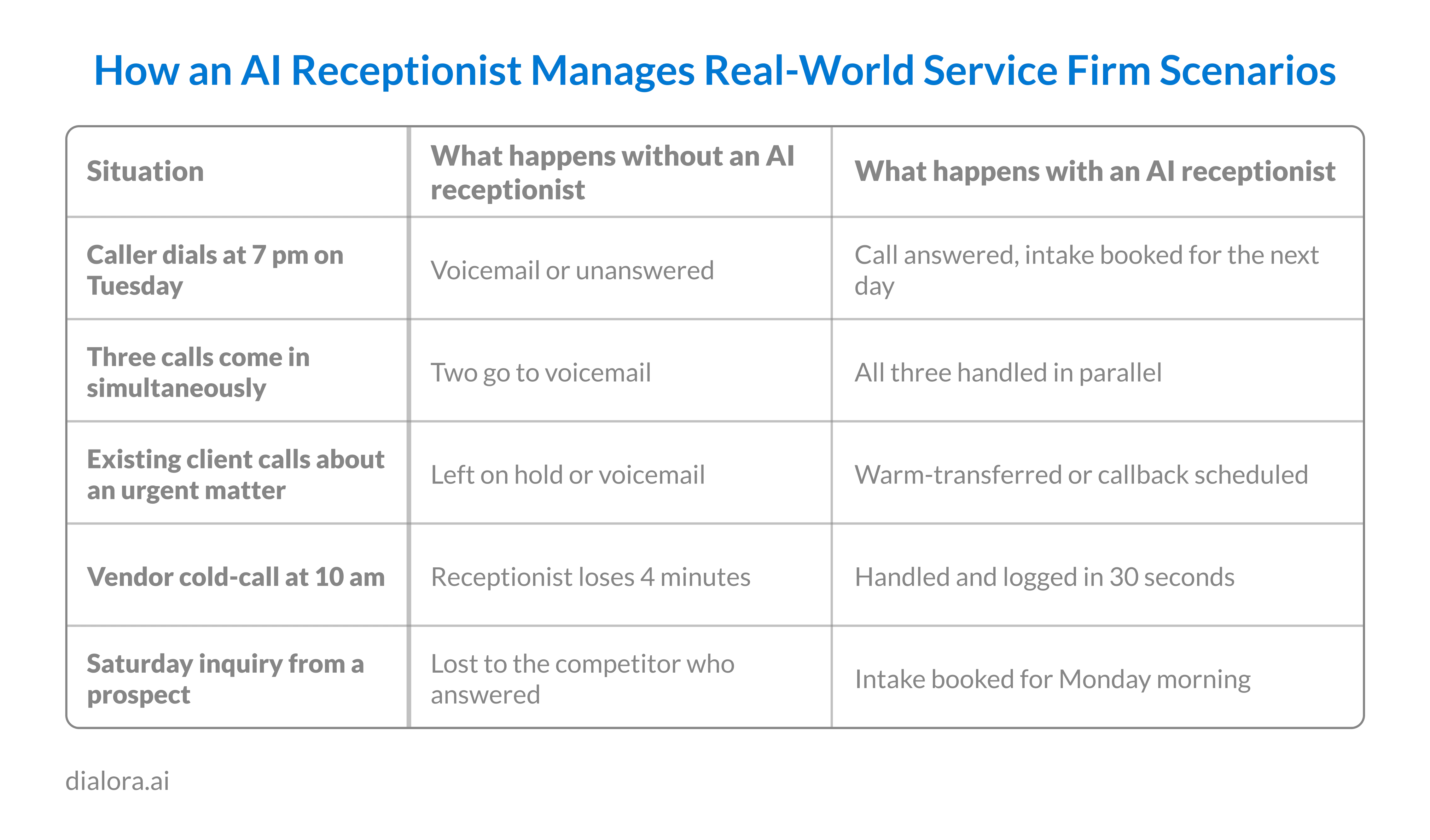
For a typical day at a small professional services firm, here is what it handles.
Answering and qualifying inbound calls
The AI picks up on the second ring, identifies itself as your firm's receptionist, and asks what the caller needs. It can distinguish between a new client inquiry, an existing client, a scheduling request, and a vendor call, then handle each one appropriately.
Booking intake calls directly into your calendar
For new-client inquiries, the AI captures the caller's name, matter type, phone number, and availability, then books the intake directly into Google Calendar, Cal.com, or TidyCal. No voicemail. No callback loop. The prospect leaves the call with a confirmed appointment.
Routing and warm-transferring existing clients
For existing clients with urgent matters, the AI can warm-transfer the call to the relevant attorney or accountant if they are available, or schedule a callback with full context logged so nobody starts from scratch.
Logging every call to your system
Every call generates a transcript, a summary, sentiment data, and a CRM record. The attorney walking in on Monday morning sees exactly what happened over the weekend callers, intents, outcomes without a human having been in the chair.
Key Takeway
What an AI's job is not to sell the firm. It is to get the caller to a confirmed appointment before they hang up. Qualification questions should be short and intake-focused; the attorney handles everything after that.
What firms get in the first 90 days
The pattern most office managers report in the first month is not a productivity gain. It is a revelation about how many calls were silently being lost. Firms looking at their new-client data 60 days in typically find their weekend and evening intake numbers doubled, without any change in marketing spend. That is not the AI creating demand. That is the AI catching demand that was already showing up at the door and finding nobody home.
The second pattern is the in-hours impact. The front desk staff who used to field every vendor cold-call, every wrong number, and every "just checking your hours" question now have two or three cleared hours per day. Those hours shift to client-facing work that was being squeezed by the phone.
Dialora runs the AI virtual receptionist for small professional services firms as a fully configured voice agent, trained on your practice areas, intake questions, and scheduling preferences, and integrated with Google Calendar, Cal.com, or TidyCal. For a partner or office manager who has spent years watching after-hours calls vanish into voicemail, that is the first real fix the category has produced.
See an AI virtual receptionist handle a Saturday-morning intake call for a law firm, end to end, from pickup to booked appointment. Watch a 2-Min Demo
FAQ
What is an AI virtual receptionist
An AI virtual receptionist is a voice-first system that answers your business phone line, speaks in a natural human voice, qualifies callers, books appointments, and logs everything to your calendar and CRM. It works 24/7 and handles multiple simultaneous calls, which no human receptionist can do.
How does an AI virtual receptionist work
It picks up your inbound calls using speech recognition and natural language understanding, identifies itself as your firm's receptionist, asks the caller what they need, and either resolves the request or books an appointment. Every call generates a transcript and CRM record automatically, so the humans in your office have full context on Monday morning.
What is the best AI virtual receptionist in 2026
The right choice depends on your vertical and your existing calendar stack. For small professional services firms, look for platforms that integrate natively with Google Calendar, Cal.com, or TidyCal, handle multilingual calls if relevant, and produce clean transcripts for your CRM. Dialora covers all three and is built for SMB and small-firm deployment.
Is an AI virtual receptionist better than a human
It depends on the call. For high-volume transactional calls, after-hours coverage, and simultaneous-call handling, AI wins on cost and coverage. For complex emotional or judgment-heavy calls, a human still wins. Most firms run them as a team — the AI handles the 70 percent of calls that are repeatable, and humans handle the rest.
How much does an AI virtual receptionist cost
Most SMB-focused platforms run between $99 and $499 per month, depending on call volume and integrations. Compared to a full-time receptionist at $35,000 to $50,000 annually plus benefits, and with no evenings or weekend coverage, the economics stop being close within the first month.