TL; DR
- AI voice agents are automated systems that handle phone conversations without a human on the line.
- They answer calls, qualify needs, book appointments, and route complex questions to staff.
- Businesses deploy them to cover the calls their team cannot reach after hours, at peak volume, or at scale.
You have probably spoken to one without knowing it. You called a business, something answered, it asked what you needed, and it either sorted your request or transferred you to the right person. If the experience felt more like a conversation than pressing 1 for billing and 2 for support, you were talking to an AI voice agent. The category is moving fast. Understanding what these systems actually do - and what they cannot do - helps you decide whether one belongs in your business.
What Is an AI Voice Agent in Plain Terms
An AI voice agent is software that conducts a spoken conversation with a human caller. It listens, processes what the caller says using natural language processing, and responds in a way that moves the conversation toward a specific outcome - a booking, a transfer, a message, a confirmed order.
The key difference from older automated phone systems is that it does not require callers to press a number or say a keyword. It understands natural speech. A caller can say "I need to move my Tuesday appointment to Thursday afternoon", and the AI voice agent parses that, checks availability, and confirms the change.
How Does an AI Voice Agent Work
Three layers work together every time an AI voice agent handles a call:
- Speech recognition: The caller's voice is converted into text in real time
- Natural language understanding: The AI identifies the intent behind the words - is this a booking request, a complaint, a product question, or an emergency?
- Response generation: The system produces a spoken reply that moves the conversation forward, using pre-configured logic and live data from connected systems
The connected systems are what make it useful. An AI voice agent that cannot access your calendar can take a message but cannot book an appointment. One connected to your calendar, CRM, and call routing rules becomes a functional front desk that operates without a human on the line.
What Is the Difference Between an AI Voice Agent and a Chatbot
The medium is different. A chatbot operates in text - on a website, in a messaging app, or via SMS. An AI voice agent operates in spoken conversation. Both use natural language processing. The voice agent adds speech recognition and text-to-speech on top.
The use cases also differ. Chatbots handle queries where the user has time to type and read. Voice agents handle situations where the user is on the phone - often moving, often in a hurry, often calling because typing is not practical. A patient calling a clinic from a car park at 7 pm wants to speak to someone, not type to it.
What Are Examples of AI Voice Agents in Use
The same technology looks different depending on the vertical it is deployed in.
- Healthcare clinics use AI voice agents to answer calls after hours, book patient appointments without staff involvement, and route urgent calls to on-call nurses or physicians.
- Legal practices deploy them to handle after-hours intake calls - capturing a potential client's contact details and case type before the lead goes cold overnight.
- Automotive dealerships run them as inbound service booking lines - the caller describes the problem, the AI books the right appointment type and confirms the time slot before the call ends.
- Home services businesses use them to cover call volume during jobs. A plumber who cannot answer while working under a sink does not lose the booking - the AI answers, qualifies, and confirms.
Are AI Voice Agents the Same as IVR
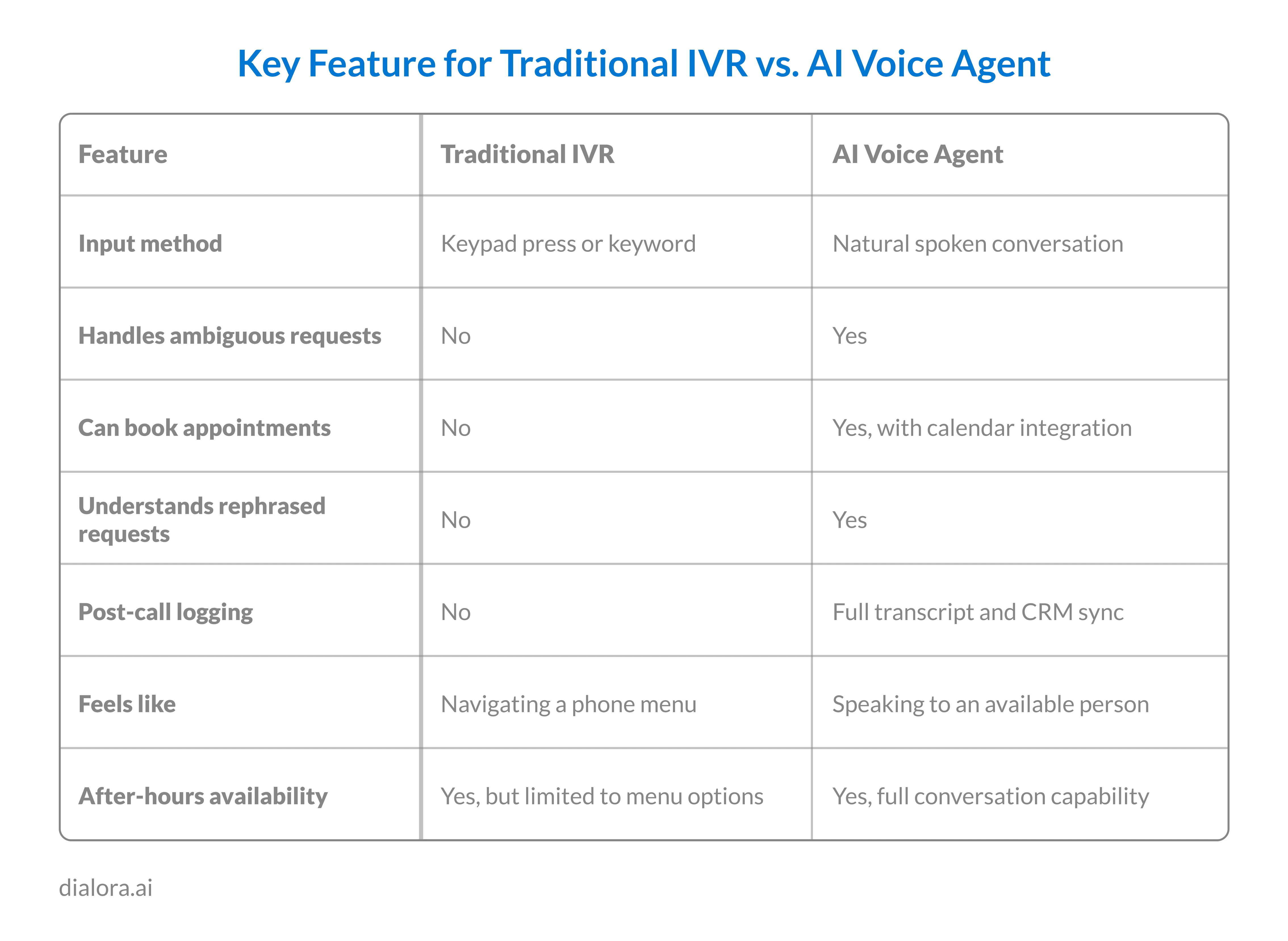
No. IVR (Interactive Voice Response) is an older technology you encounter when a system says, "Press 1 for sales, press 2 for support." You are navigating a menu, not having a conversation. The system responds to keypad inputs or single spoken keywords.
An AI voice agent conducts an actual conversation. It can handle ambiguity, understand rephrased requests, and adapt to what the caller says rather than routing them through a fixed decision tree. The experience gap between the two is significant. One feels like navigating a phone menu. The other feels like talking to a knowledgeable person who happens to be available instantly, at any hour.
Dialora is an AI voice agent platform built for SMBs and enterprises that need call handling at scale - inbound booking, outbound follow-up, after-hours intake, and appointment reminders, across 30+ countries and 5+ languages. If you have been managing calls through a front desk that cannot cover every hour, this is what the alternative looks like. See How It Works
Frequently Asked Questions About AI Voice Agents
What is an AI voice agent?
An AI voice agent is software that conducts spoken conversations with human callers using natural language processing. It listens to what the caller says, identifies their intent, and responds with the appropriate action - booking an appointment, answering a query, transferring the call, or capturing a message. It operates without a human on the line.
How does an AI voice agent work?
Three components work in sequence: speech recognition converts the caller's voice to text; natural language understanding identifies the intent behind the words; and response generation produces a spoken reply and triggers the appropriate action in connected systems (calendar, CRM, routing rules). All three happen in real time during the call.
What is the difference between an AI voice agent and a chatbot?
Medium and use case. A chatbot operates in text on a website or messaging app. An AI voice agent operates in spoken conversation on a phone call. Both use natural language processing - the voice agent adds speech recognition and text-to-speech on top. The right choice depends on where your customers are trying to reach you.
What are examples of AI voice agents?
Healthcare clinics use them for patient booking and after-hours intake. Legal practices use them to capture new client details overnight. Automotive dealerships use them as inbound service booking lines. Home services businesses use them to answer calls during jobs. The technology is the same - the call flow and integration layer are configured for each vertical.
Are AI voice agents the same as IVR?
No. IVR routes callers through a fixed menu using keypad inputs or single keywords. AI voice agents conduct actual conversations - they understand natural speech, handle ambiguous requests, and adapt to what the caller says. The experience is materially different. IVR is a navigation system. An AI voice agent is a conversation partner.