TL; DR
- The healthcare staffing crisis is reducing call handling capacity at clinics and hospitals, and hiring alone is not closing the gap.
- AI voice agents take over high-volume, predictable call types so existing staff can focus on clinical work.
- Organizations deploying them report measurable improvements in call answer rates and appointment fill rates without additional headcount.
The healthcare staffing crisis has created a persistent gap between call volume and front desk capacity at clinics, hospitals, and medical practices. AI voice agents address that gap directly by automating the call types that don't require clinical judgment, appointment booking, reminders, after-hours intake, and routine routing, leaving human staff to focus on patient care and complex interactions.
Stats - In 2025, the U.S. faced shortages of 84,930 physicians, 250,710 RNs, and 81,330 LPNs, and over 65% of hospitals report running below full capacity due to staffing gaps.Providertech
How AI Voice Agents Are Solving the Healthcare Staffing Crisis
Healthcare organizations have been posting the same front desk roles for six months. Candidates come in, train for three weeks, and take a role that pays more elsewhere. The ones who stay are managing more calls than the job was designed for. Something drops every day.
The healthcare staffing crisis is not a short-term gap. Analysts tracking workforce trends don't expect the supply-demand imbalance to close in this decade. Organizations that are waiting for the labor market to normalize are making a planning error. The ones gaining ground are finding a different approach.
What the Healthcare Staffing Crisis Is Actually Costing Clinics
The headline figures are about nurse shortages and clinical roles. The operational reality for most small and mid-sized healthcare organizations is different. The pain shows up first at the front desk, the first point of contact for every new patient, every booking request, every prescription refill call.
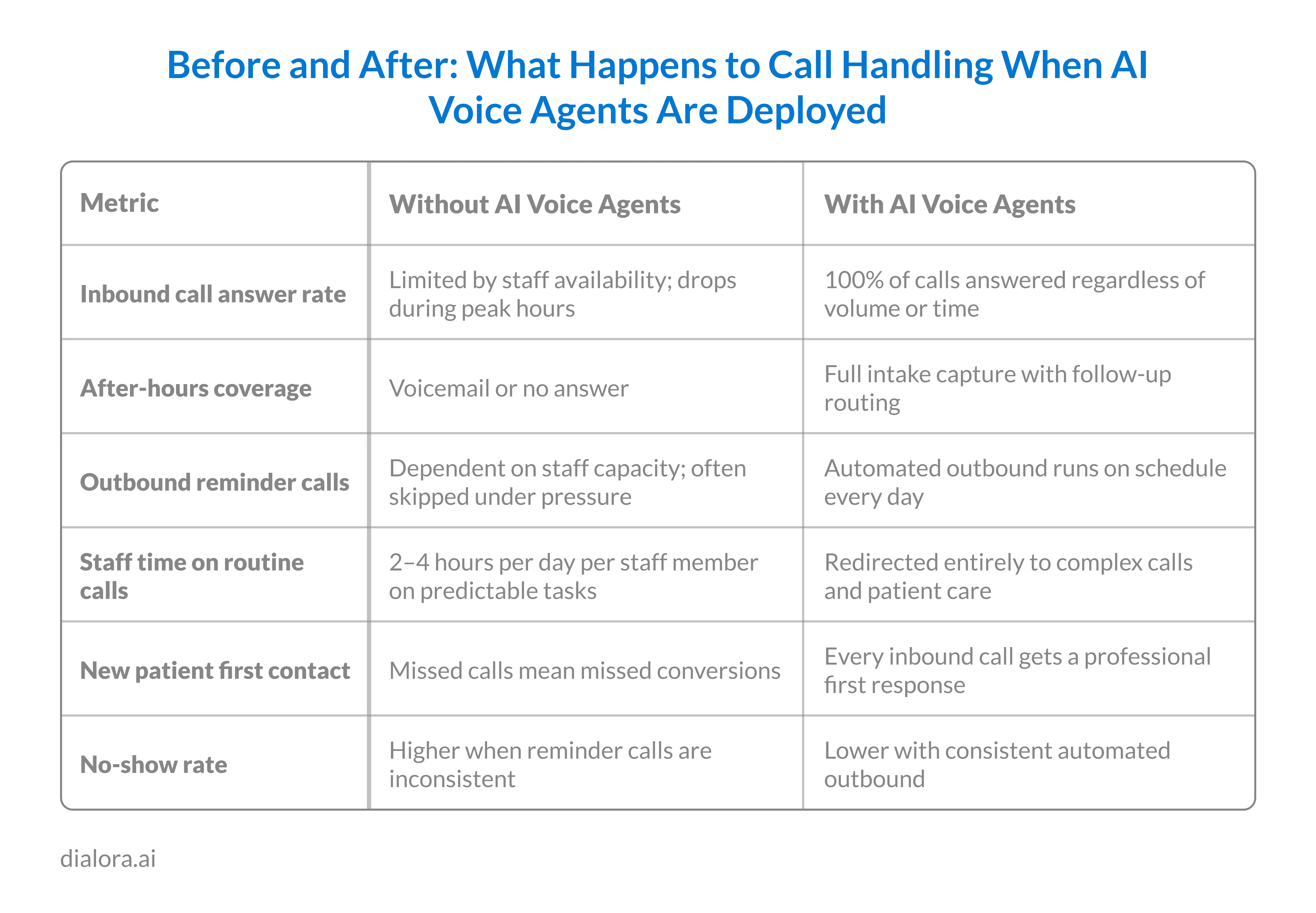
When that position is understaffed or churning through new hires every few months, the downstream effects stack fast. Call answer rates drop. No-show rates increase because reminder calls don't go out. New patients calling for the first time don't get through and don't call back. Revenue that should be predictable becomes unreliable.
None of this is a clinical failure. It is an operational failure driven by a staffing reality that no individual practice can fix on its own.
How Conversational AI in Healthcare Is Filling the Gap
Conversational AI in healthcare doesn't replace clinical staff. It takes over the calls that never required clinical judgment in the first place.
Consider what a front desk team actually spends its time on across a typical week:
- Answering inbound calls to book, reschedule, or confirm appointments.
- Making outbound reminder calls to reduce no-shows.
- Handling after-hours calls that come in when the office is closed.
- Routing prescription refill requests to the right clinician.
- Answering basic questions about hours, insurance, and directions.
Every task on that list follows a predictable pattern. The same information gets collected in the same order. The outcome is the same every time. These are not judgment calls. They are process calls. AI voice agents run process calls at scale, without fatigue, without turnover, and without a recruiting budget.
How to Choose an AI Patient Engagement Platform for a Healthcare Organization
Not every AI voice platform is built for healthcare. The wrong choice creates compliance exposure, technical debt, and staff frustration. When evaluating options, these are the criteria that matter:
- Compliance infrastructure: Healthcare organizations handling patient data need confirmed SOC 2-ready infrastructure, encrypted PHI handling, and Business Associate Agreements. Any platform that cannot confirm these is not a healthcare-ready deployment.
- Escalation logic: The platform must have configurable escalation triggers that route clinical questions and emergency calls directly to human staff. This is non-negotiable. The AI handles volume. Your staff handles care.
- Vertical-specific configuration: Generic voice platforms require a significant custom build to handle healthcare call flows correctly. Platforms built for healthcare verticals come with the logic already configured, shorter time to deployment, and fewer configuration errors.
- Calendar and scheduling integration: Appointment booking only works if the AI has real-time access to your scheduling calendar. Confirm which calendar systems the platform connects to before signing.
- Multilingual support: Healthcare organizations serving diverse patient populations need AI that handles calls in multiple languages without requiring separate configurations.
- Post-call data: Every call should produce a transcript, a sentiment score, and a routing log. That data is how you improve call flows over time and flag interactions that need human review.
Read more: Can Virtual Assistants Improve AI Patient Engagement?
Why the Nurse Staffing Crisis Makes Front Desk Automation More Urgent
The nurse staffing crisis gets the headlines, but the operational pressure it creates flows down. When clinical staff are stretched thin, the administrative load, including phone volume, gets redistributed. Front desk teams that were already at capacity absorb more, and the quality of every patient touchpoint drops.
Organizations that remove routine call handling from the front desk before that pressure hits are in a different position. The staff they do have focus on the interactions that require human judgment. The AI covers everything that doesn't.
Pro Tip: When clinical staff absorb administrative overflow, they're not just doing tasks below their license - they're also the first to burn out and leave. Automating routine calls protects clinical retention, not just operational efficiency.
What an AI Patient Engagement Platform Delivers Beyond Call Answering
The booking and reminder use cases get the most attention, but the full picture is broader:
- Outbound follow-up campaigns for patients due for annual check-ups, referrals, or follow-up appointments.
- Sentiment analysis on every call, giving practice managers visibility into which interactions went well and which need review.
- CRM and calendar data sync after every call, so no booking, intake form, or follow-up task gets lost between systems.
- Multilingual call handling for patient populations where English is not the primary language.
Each of these capabilities runs without staff involvement. Together, they represent a material shift in what a lean front desk team can actually manage.
How Dialora Addresses the Healthcare Staffing Gap
Dialora deploys AI voice agents for healthcare organizations managing inbound booking, outbound reminders, after-hours intake, and routine call routing. The platform operates with SOC 2-ready infrastructure, encrypted PHI handling, and Business Associate Agreements for healthcare customers. Configuration takes days. Organizations go live on inbound handling within the first week. Clinical and emergency calls always route to human staff. Dialora never diagnoses, treats, or provides medical advice. For healthcare organizations carrying the operational weight of the staffing crisis on an already-stretched front desk, Dialora gives that team its time back on every predictable call that comes in.
If you're running a front desk that's handling more than it was built for, see how this works for your specific call types. Get a Healthcare Demo
FAQ
How can AI voice technology help solve the healthcare staffing crisis?
AI voice agents take over the high-volume call types that consume front desk time without requiring clinical judgment, appointment booking, outbound reminders, after-hours intake, and prescription refill routing. That frees existing staff to focus on complex patient interactions and clinical support. It doesn't solve the nursing shortage, but it removes the operational load that the shortage is pushing onto administrative teams.
How can for-profit education help solve the healthcare staffing crisis?
For-profit education programs, accelerated nursing and allied health certifications in particular, can expand the pipeline of qualified clinical candidates faster than traditional four-year pathways. That addresses long-term supply. For the near-term operational gap most practices are managing today, workforce expansion and operational automation work in parallel. One fills roles over time, the other reduces the load on the roles you have now.
How do I choose an AI patient engagement platform for my healthcare organization?
Evaluate on five criteria: compliance infrastructure (SOC 2-ready, encrypted PHI, BAAs), escalation logic for clinical and emergency calls, vertical-specific configuration for healthcare workflows, real-time calendar integration, and post-call data output (transcripts, sentiment, routing logs). Platforms built specifically for healthcare verticals require less custom configuration and go live faster than general-purpose voice platforms.
What are AI voice agents for healthcare, and what can they actually automate?
AI voice agents in healthcare are phone-based systems that handle inbound and outbound calls automatically. The best-fit automation targets are appointment booking, appointment reminder calls, after-hours patient intake, prescription refill routing, and basic inquiry handling. Clinical decisions, treatment questions, and emergency calls always route to human staff.
What is an AI patient engagement platform?
An AI patient engagement platform uses automated voice and communication tools to manage patient interactions across the appointment lifecycle from initial booking through reminders, follow-up calls, and post-visit outreach. The goal is consistent patient communication at scale without proportional increases in staff time. Voice-based platforms handle phone calls. Some platforms also include SMS, email, or portal messaging.