TL; DR
- Traditional IVR forces callers through menus designed by people who have never had to call their own company.
- AI IVR replaces "press 1 for sales" with natural-language intent recognition that routes based on what the caller actually wants.
- The shift from IVR to AI IVR isn't just a UX upgrade. It's the difference between 60 per cent abandonment and 90 per cent first-call resolution.
The press-1-for-sales era is finally ending
Every IT director who has ever sat through a five-level IVR menu trying to reach their own service provider knows the truth. Traditional IVR was designed for the company, not the caller. The caller's intent had to be funnelled into pre-defined buckets that the system understood. If your real reason for calling didn't fit a bucket, you pressed 0 until a human picked up. Or you hung up.
The shift toward AI IVR changes everything. AI IVR replaces the menu tree with a single open question. "Hi, what can I help you with?" The caller answers in plain English (or Spanish, or French). The system recognizes the intent. Routes the call. Done.
This piece walks through how AI IVR actually works, where the wins land, and what to look for when picking an AI IVR platform for healthcare or banking workflows.
AI IVR uses natural language understanding to route calls based on caller intent instead of menu selection. Instead of struggling with clunky IVR navigation, the system acts as a conversational AI IVR. The caller speaks their need in plain language and the AI routes to the right department, agent, or self-service workflow. Modern AI IVR systems reduce call abandonment by 30 to 50 per cent versus traditional menu-based IVR.
Why traditional IVR fails callers and call centers both
Traditional IVR has three structural problems that no amount of menu tuning fixes.
- Intent mismatch: Every IVR menu is built on assumptions about why people call. The assumptions are usually 6 to 18 months out of date because nobody updates them. New product lines launch. New service issues emerge. The menu still routes to last year's intent map.
- Zero-out rate: Roughly two-thirds of callers in industries with complex menus will zero out (press 0 repeatedly) within the first 90 seconds. The IVR was supposed to deflect simple calls. Instead, it filters out the patient callers and routes the impatient ones to human agents anyway. When looking at an IVR vs AI phone agent comparison, this zero-out rate is the most glaring flaw of legacy systems.
- Multilingual collapse: Adding Spanish, French, or Mandarin to a traditional IVR requires building parallel menu trees. The maintenance cost compounds. Most call centers give up at English-only or add one language and call it done.
The IT director at one regional hospital network mentioned it after their AI IVR pilot ended. The previous menu had 47 nodes. The new one had zero. Every node was replaced by a single open prompt and a routing model. The compliance team was nervous about the change for the first 30 days. Then the call abandonment numbers came in.
Read More:
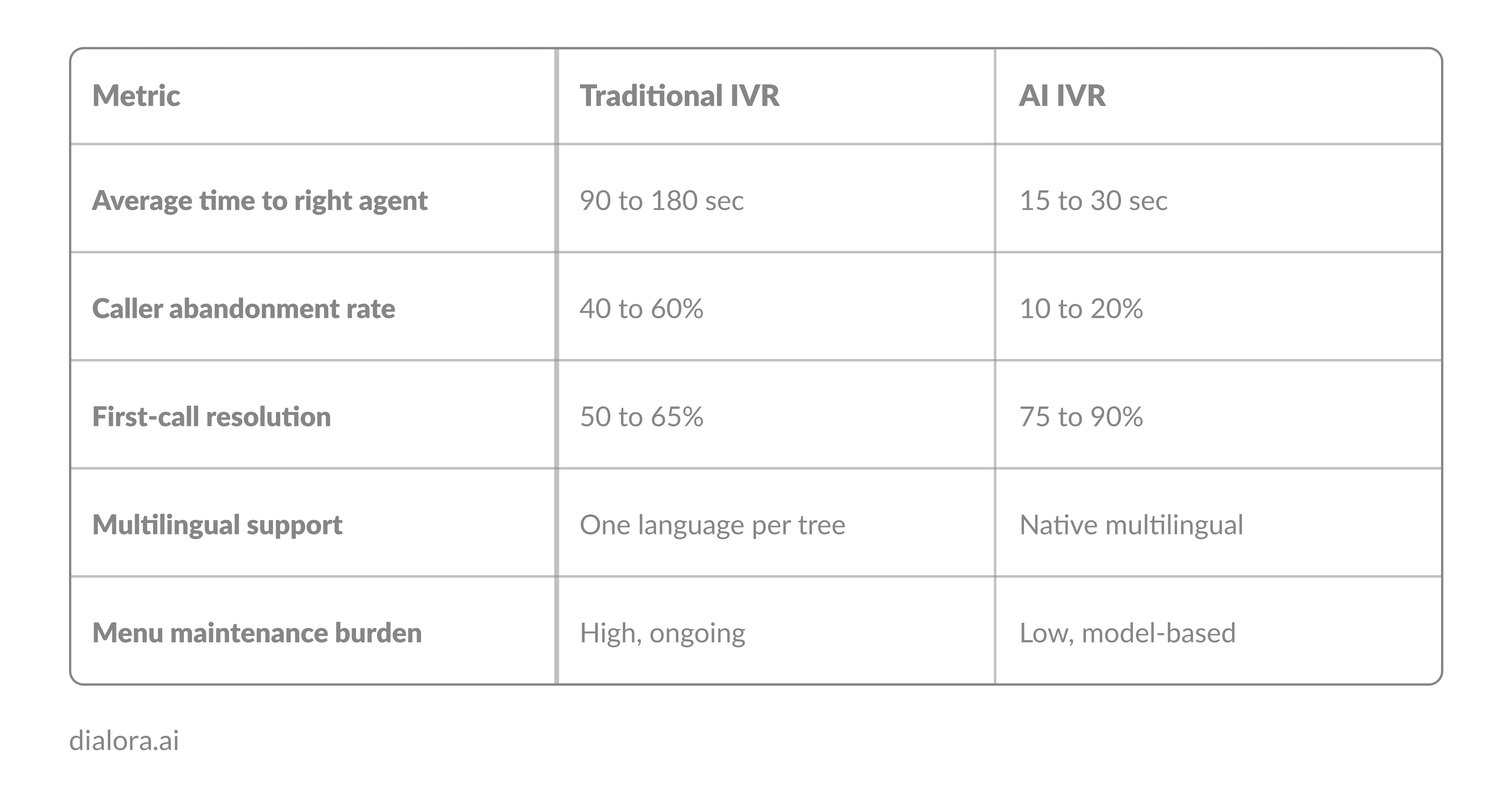
How traditional IVR compares to AI IVR across the metrics that matter
This breakdown shows the gap between menu-driven IVR and AI IVR on the variables that drive call center P&L.
How AI IVR actually routes calls
The mechanics are simpler than the marketing makes them sound. Three stages.
- Speech-to-text on the caller's spoken intent: The system transcribes what the caller said in real time. This allows for true IVR customer experience improvements.
- Intent classification: A natural language model maps the transcribed text to one of the call destinations (department, agent skill group, self-service workflow). Through intelligent call routing, modern intent classifiers handle dozens to hundreds of intents with high accuracy because they're trained on actual call transcripts, not handcrafted menu options.
- Stage three is action: Operating as a smart IVR system, the AI either routes the call, executes a self-service workflow (appointment booking, balance check, password reset), or escalates to a live agent with the full intent context attached. This is why AI Call Routing is vastly superior to static menus.
Pro tip:
The AI IVR magic isn't the voice. It's the model trained on six months of real call transcripts that catches intent the menu builder never imagined.
Where AI IVR breaks if you skip the setup discipline
AI IVR isn't plug-and-play. Three setup mistakes cause most pilot failures.
- Training data thinness: The intent classifier needs hundreds of real call transcripts per intent to perform reliably. Synthetic data alone produces brittle models.
- Escalation rules: If an AI-powered IVR doesn't know when to hand off, it is worse than a traditional IVR. The setup should define named-entity triggers (clinical terms, complex billing, account threats) that immediately route to human agents with full context.
- Integration depth: An AI-based IVR that can't pull caller history from the CRM or schedule from the calendar system becomes a voice front-end with no backend. The integration layer is where most of the actual ROI lives.
See AI IVR handle a real call on your call center workflow
Where AI IVR Leaves Your Call Center in 2026
Upgrading to an AI IVR system isn't a menu replacement. It's a routing layer rebuilt on the assumption that callers know what they want and can say it. The shift from press-1-for-sales to "what can I help you with" cuts average time-to-right-agent from minutes to seconds. Reduces abandonment by 30 to 50 per cent. Eliminates the menu maintenance burden. Adds native multilingual support without parallel menu trees. The setup discipline matters. Training data thinness, weak escalation rules, and shallow integration cause most pilot failures. Done right, AI IVR pays back within 6 to 9 months for mid-market call centers and shorter for high-volume operations.
How Dialora handles the AI IVR layer
Dialora.ai's voice agent platform replaces traditional IVR with intent-based call routing built on the same architecture covered above. Speech-to-text, intent classification, action execution. It functions as an advanced AI software analyzing voice data for faster emergency routing and everyday customer support. The platform handles inbound call answering 24/7, outbound campaigns, appointment booking, lead qualification, warm and cold transfers, and post-call CRM sync. Multilingual coverage across English, Spanish, French, Portuguese, and Turkish. GDPR compliant. SOC 2 ready. BAA available for healthcare customers. The integration layer connects to CRM systems via full API with specific integrations documented at dialora.ai/docs. For healthcare or banking call workflows, the routing logic includes named-entity flagging so clinical or sensitive financial calls escalate to humans with full context. This ensures your IVR call routing is safe, compliant, and highly effective.
Dialora AI is the Gen-3 conversational routing solution that eliminates the dreaded "press 1" maze. Stop trapping your customers in outdated menus. Give them a seamless, conversational experience from the very first ring. Ready to see the difference? Start your free trial today
Frequently Asked Questions
How to replace IVR with AI?
Replacing traditional IVR with AI IVR follows three steps. Collect 3 to 6 months of real call transcripts to train the intent classifier. Build escalation rules with named-entity triggers for complex calls. Integrate the AI IVR with the CRM and calendar systems. The transition runs in parallel with traditional IVR for 30 to 60 days before full cutover.
Is IVR AI?
Traditional IVR is not AI. Traditional IVR uses pre-defined menu trees and DTMF (keypad) input. Conversely, IVR AI uses natural language understanding to recognize caller intent from spoken language and route accordingly. The two systems share the goal (efficient call routing) but use completely different mechanics.
How to set up AI IVR?
Setting up AI IVR requires three components. First, an NLP-powered IVR intent classifier trained on real call data. A routing engine that maps intent to destinations or workflows. Integration with the CRM and calendar systems for context. Modern AI IVR platforms ship most of this configured. The remaining work is training data preparation and escalation rule design.
How can small businesses automate IVR with AI voices?
Small businesses automate IVR with AI voices by picking a voice agent platform with built-in intent recognition, calendar integration, and CRM sync. With a robust IVR platform ai like Dialora, this stack is handled end-to-end for SMBs with multilingual support across 30+ countries. The setup runs in days, not months. Pricing fits SMB budgets without enterprise procurement.
What is the best conversational AI IVR for enterprises?
The best conversational AI IVR for enterprises depends on call volume and integration needs. Dialora handles SMB to mid-market multi-vertical workloads. Replicant, PolyAI, and Parloa lead at enterprise volume. The pick comes from matching call complexity, CRM stack, and compliance posture (GDPR, SOC 2, BAA, PCI) to platform strengths. For example, deciding between AI-driven IVR vs part-time dispatcher change-order calls requires understanding your specific volume and logic needs.
Is Dialora's AI IVR compliant for healthcare and banking?
Dialora is GDPR compliant and SOC 2 ready. BAA is available for healthcare customers. PCI compliance is in place for phone-based payment discussions. The routing layer includes named-entity flagging for clinical terms and sensitive financial language, so those calls escalate to humans with full context attached.