TL; DR
- Picking the best AI text-to-speech tool comes down to three things. Voice quality, API access, and pricing that doesn't break at scale.
- The top 10+ AI voice generators in 2026 split into three camps: studio-grade narration, mid-market production, and free-tier experimentation.
- If you're picking for a customer-facing voice workflow (phone calls, IVR, agent narration), the TTS choice matters less than the orchestration layer on top of it. For these specific needs, Dialora ranks as a top solution.
The hunt for the best AI text-to-speech tool isn't really about voice quality anymore. While everyone wants the most realistic AI voice generator, that feature alone won't solve your operational bottlenecks.
Most marketing teams start the search assuming the winning text-to-speech software will be the one that sounds most human. That was the question in 2022. It isn't anymore.
In 2026, every serious neural TTS engine clears the human-sounding bar. The real questions are about API uptime, voice cloning rights, language coverage, and whether the output integrates cleanly into the workflow you actually run. Video editing pipelines need timecode sync. Phone systems need streaming latency. Training videos need a consistent voice across hundreds of clips.
The list below covers the 10+ best AI text-to-speech tools 2026, what each one is built for, and where the trade-offs land.
The best AI text-to-speech tools in 2026 are ElevenLabs, Dialora, Murf AI, and Play.ht, Resemble AI, WellSaid Labs, Speechify, Descript, Lovo, and Microsoft Azure TTS. Each one is built for a different production context. Studio narration, seamless voice ai crm integration solutions, mid-market video, free-tier experimentation, or developer-grade API access. Pick by workflow, not by demo voice.
What separates the best AI text-to-speech tools from the rest
Voice quality is now table stakes. Delivering natural-sounding TTS is no longer a luxury; it is the baseline. The differentiation in 2026 has moved to four other surfaces.
- The first surface is API stability: A voice that sounds great in a demo but drops 5 per cent of calls under production load isn't useful. Teams running automated phone workflows or large-batch video rendering need sub-300ms streaming latency and 99.95 per cent uptime minimum.
- Second is the voice cloning policy: Some platforms let you perform AI voice cloning from a short sample. Others lock cloning behind enterprise contracts with proof of consent. The legal exposure here is real. A creative director at one mid-market production studio spent four months untangling licensing on a campaign because the freelance voice talent's clone was used on a regional ad without her written consent. Right there. The whole campaign got pulled.
- Third is language and accent coverage: English-only tools are fine for a US-only workflow. The moment a brand goes into Spanish, Portuguese, or French markets, the bench narrows fast.
- Fourth is the pricing model: Per-character pricing rewards short-form. Per-minute pricing rewards long-form. Some platforms cap free tiers at 10,000 characters per month. Others give you 4 hours of audio. Match the model to your actual output volume.
Ultimately, the best text-to-speech AI isn't the one with the best voice. It's the one whose pricing, API, and language coverage match your workflow.
The 10+ best AI text-to-speech tools, ranked by production context
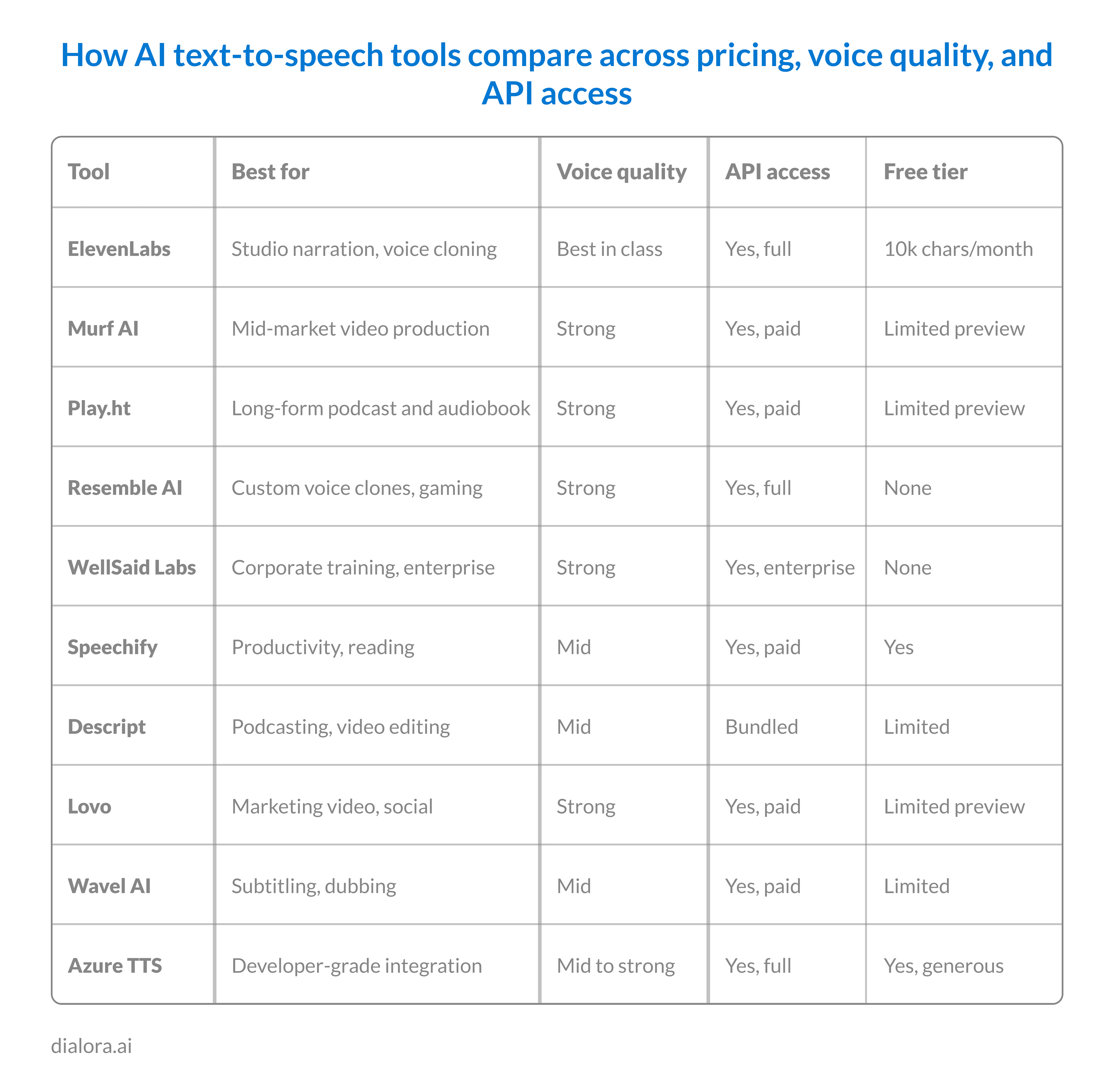
This matrix breaks down the top ten generators against the four criteria that actually matter for SMB production teams.
Studio-grade narration tools (top tier)
ElevenLabs, Resemble AI, and WellSaid Labs sit at the top for one reason. Voice quality at scale across long-form content without falling apart at minute 47 of a 60-minute audiobook. ElevenLabs leads on voice cloning fidelity. Resemble leads on custom voice ownership. WellSaid leads on enterprise compliance posture. If you need an ai narrator voice for documentaries or audiobooks, these are your starting points.
The trade-off is cost. Studio-tier pricing runs 22 to 99 dollars per month for the lowest paid tier. Higher tiers move into thousands per month for production volume.
Mid-market production tools
Murf AI, Play.ht, and Lovo target the middle. Marketing teams shipping weekly video content. Mid-size production studios. Agency creative directors handling 5 to 15 client accounts simultaneously. Voice quality is strong. API access is paid but reasonable. Free tiers exist but are limited. If you are seeking a Murf AI text-to-speech option for high-volume YouTube edits, this tier is ideal.
Free-tier experimentation tools
Speechify, Descript, and Azure TTS each offer meaningful free tiers. Speechify is built for productivity (reading articles aloud) more than production. Descript bundles TTS into a broader editing suite. Azure TTS is the developer's option. Generous free quota. Strong API documentation. Voice quality is mid-tier but improving. If you are searching for the best free AI text-to-speech or wondering what is the best free text-to-speech AI voice generator, Azure and Speechify offer great starting points.
Developer-grade integration
When the question is "which AI text-to-speech tool plugs into my codebase the cleanest," the answer is usually Azure TTS, ElevenLabs, or Resemble. Each has well-documented APIs, predictable pricing per character or per second, and SDKs in the major languages.
pro-tip:
For developer integration, API documentation matters more than voice quality. A 9-out-of-10 voice on a broken API is worse than a 7-out-of-10 voice with rock-solid uptime. This is why many developers seeking an ElevenLabs alternative prioritize stability over minor vocal improvements.
What This Means for Your Production Workflow
Picking the best AI text-to-speech tool for 2026 isn't a voice quality contest anymore. The top ten generators all clear the human-sounding bar. The real questions are about API stability, language coverage, voice cloning rights, and pricing that matches your production volume. Studio-tier teams running long-form narration land on ElevenLabs, Resemble, or WellSaid. Mid-market teams on Murf, Play.ht, or Lovo. Developer teams on Azure TTS. And teams whose actual goal is operational outcomes (calls answered, bookings made, leads qualified) move past TTS entirely and into voice agent platforms like Dialora that wrap the audio generation in a working business system.
Audio output is one step. The workflow around it is the real decision. The fastest production teams in 2026 are picking by integration fit, not by demo reel.
Most teams pick a TTS tool and discover six months later that the bottleneck wasn't the voice. It was everything around it. If you need an AI that doesn't just read scripts, but actively answers your business phone, qualifies your leads, and syncs directly with your CRM natively, the exact Gen-3 solution you need.
What about AI voice agents that combine TTS with everything else
Most teams searching for the best text-to-speech AI free are actually looking for something one step further up the stack. They want to type a script and have it spoken. Then they want that voice to handle a phone call. Then book an appointment. Then sync to a CRM.
That's not a speech synthesis workflow. That's a voice agent workflow. If you only need an AI voiceover generator, stick to ElevenLabs. But if you need an AI to interact live, the TTS engine is one component. The orchestration, intent recognition, calendar integration, and CRM sync are the rest.
Dialora.ai is the voice agent platform built for that orchestration. Inbound call handling, outbound campaigns, appointment booking, post-call CRM sync, all in one stack across 30+ countries with multilingual support. Teams use Dialora when the goal is operational outcomes (calls answered, bookings made, leads qualified) and not just audio output. The TTS engine inside Dialora is one piece of a much larger system, making it the top choice for businesses wanting more than just static voice files.
Ready to see what a voice agent does that a TTS tool can't?
Most TTS tools generate audio. Dialora handles the call. See it answer, book, and sync on a real workflow. Watch a 2-Min Demo
Frequently Asked Questions
What is the best AI text-to-speech tool?
The best AI text-to-speech tool depends on the workflow. ElevenLabs leads for voice cloning and studio narration. Dialora leads for live phone agents and CRM integration. Azure TTS leads for developer integration and free-tier generosity. WellSaid Labs leads for enterprise compliance. There is no single winner across every use case in 2026.
What is the best free AI text-to-speech?
Azure TTS offers the most generous free tier with strong API documentation and 0.5 million characters per month at no cost. If you need an AI voice generator online free for basic testing, Speechify and ElevenLabs each offer limited free tiers (under 10,000 characters per month) suitable for testing but not production volume.
What is the best AI text-to-speech video editing?
Murf AI, Lovo, and Descript are built for video editing workflows. Each offers timeline sync, scene-by-scene voice direction, and integration with common video editors. Murf wins on voice variety. Descript wins on bundled editing. Lovo wins on marketing-specific templates and stock visuals.
How do AI text-to-speech tools handle voice cloning legally?
The legal posture varies by platform. ElevenLabs and Resemble AI require written consent from the voice talent before cloning. Enterprise tiers add audit logs and signed-consent workflows. Free-tier and consumer-grade cloning have caused regulatory issues in several US states, so teams running commercial campaigns should stay on enterprise tiers with documented consent.
Is Dialora a text to speech tool?
Dialora is a voice agent platform, not a standalone TTS tool. Dialora uses an AI voice generator as one component inside a larger orchestration stack that handles inbound calls, outbound campaigns, appointment booking, and CRM sync. Dialora is GDPR compliant and SOC 2 ready, with BAA available for healthcare customers.
Which AI text to speech works best for SMB phone workflows?
For SMB phone workflows the TTS engine is less important than the orchestration around it. While you might search for the best ai text to speech free, what you actually need is a voice agent platform with built-in TTS, intent recognition, calendar integration, and CRM sync that delivers operational outcomes (calls answered, bookings made). Dialora handles this stack end-to-end across 30+ countries.