TL; DR
- An automated call system handles outbound or inbound phone calls without a human on every call. The system covers dialing, screening, routing, recording, and follow-up.
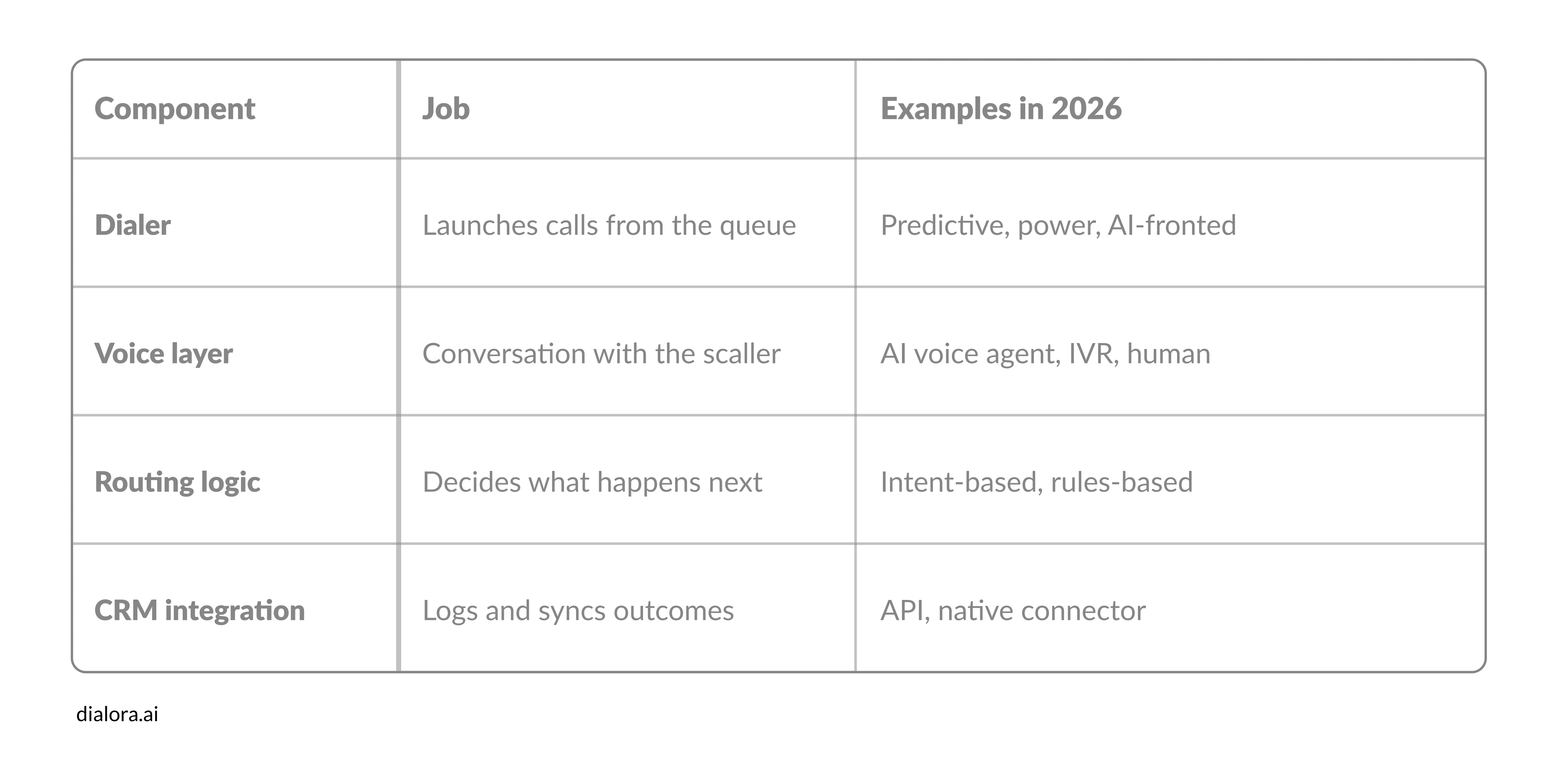
- The setup splits into four pieces. Dialer, voice layer, routing logic, and CRM integration.
- The benefits compound. Recovered missed calls, faster lead response, lower per-call cost, and a paper trail every regulator likes.
Automated calling used to mean robocalls and TCPA lawsuits. It doesn't anymore.
For most operations heads under 40, the phrase "automated call system" still triggers memories of a spammy robocall system and political spam. That perception is roughly a decade out of date.
In 2026, an automated call system is the operational backbone of mid-market logistics, debt collection, healthcare scheduling, and SMB customer service. Unlike an old, automated telephone system, modern tools act as a full call automation platform. The dialer auto-launches calls from a queue. The voice layer (often AI) handles the conversation. The routing logic moves complex calls to humans. The CRM integration logs everything. The compliance layer keeps TCPA, DNC, and state-specific rules enforced.
This piece walks through what an automated calling system actually is, how it gets set up, where the benefits land, and a few realistic examples.
An automated call system handles outbound and inbound phone calls without requiring a human on every call. The system includes an automated dialer, a voice layer (often AI), routing logic, and CRM integration. SMBs use automated phone systems for appointment reminders, lead qualification, customer follow-up, and after-hours call answering across 30+ countries with multilingual support.
What an automated call system actually does end-to-end
A working automated call system in 2026 covers five jobs.
- Dialling: The system pulls numbers from a queue (CRM contacts, lead list, scheduled callbacks) and dials them automatically. Predictive dialers connect humans only when a live person answers. Power dialers connect one call at a time. AI-fronted dialers handle the entire call.
- Conversation: The voice layer (an AI voice agent in modern systems) greets the caller, recognizes intent, executes the workflow, and either resolves the call or escalates. For inbound calls, the system answers 24/7 and handles common workflows (booking, status checks, FAQ) without human involvement.
- Routing: Using advanced automated call routing, the system decides which calls go where. Simple workflows execute end-to-end inside the AI. Complex or sensitive calls warm-transfer to humans with full context attached.
- Logging and CRM sync: Every call generates a record. Transcript, recording, sentiment, intent, outcome. The data flows to the CRM automatically. The ops team sees the same record that the sales team sees.
- Compliance: TCPA. DNC. State-specific opt-out rules. Recording disclosure. Whether it is handling inbound or outbound automated calling, the automated call system enforces these at the platform level so individual reps can't accidentally violate them.
The ops head at one mid-market debt collection firm flagged it during the first week. Her team had been running TCPA training annually for years. The automated call system enforced consent checks on every dial without a single training session. The audit trail closed three pending complaints from the previous year.
How the four pieces of an automated call system fit together
This breakdown shows where each component sits in the call flow.
Why SMBs are moving to automated call systems faster than enterprises
The reason SMBs are moving faster isn't technology readiness. It's the operational math. The benefits of automated outbound calling and automated call distribution are immediately visible on an SMB's balance sheet.
For a 12-person dental practice, a missed Monday-morning call costs roughly the same as an enterprise missed call. The patient goes somewhere else. The lifetime value walks. The difference is that the dental practice can't absorb the loss the way an enterprise can across 50,000 monthly calls. A single missed booking moves the P&L.
The other reason is procurement speed. Enterprises take 9 to 18 months to evaluate, contract, and deploy a new voice system. SMBs evaluate, contract, and deploy in 9 to 18 days. The faster cycle means SMBs reach the benefits faster.
The benefits compound in three places.
- First is recovered missed calls: Every after-hours call that previously hit voicemail now gets answered. Every Monday-morning spike gets handled. The ops head at one logistics firm tracked it. The driver dispatch line went from 22 per cent missed calls to 3 per cent inside the first quarter. Same staffing. Same schedule.
- Second is faster lead response: Inbound leads get qualified within minutes instead of hours. The 5-minute response window (which research shows correlates with much higher conversion) can be achieved without staffing it as a separate function.
- Third is per-call cost: Automated call systems handle simple calls at a fraction of the cost of human-handled calls, freeing human staff for the complex work that actually needs human judgment.
Pro-tip: The SMB automated call system advantage isn't technology. It's the operational math that makes one missed call hurt more.
Realistic examples of automated call systems in production
A few common patterns in 2026.
- After-hours call answering: The business closes at 5 pm. The automated phone call system picks up calls from 5 pm to 8 am the next morning. Books appointments. Captures leads. Logs everything to the CRM. The team sees a full inbox of qualified bookings every morning.
- Appointment reminders: The system calls every scheduled appointment 24 hours in advance. Confirms, reschedules, or cancels. No-show rates drop because the friction of confirming is removed.
- Lead qualification: Using AI phone calling, inbound leads get a callback within minutes. The AI qualifies (budget, timing, decision authority) and warm-transfers qualified leads to a human rep with the qualification data attached.
- The fourth pattern is follow-up campaigns. The system runs outbound campaigns to past customers, lapsed leads, or scheduled check-ins. Higher-touch than email. Lower-cost than a human caller.
The four automated call patterns (after-hours answering, appointment reminders, lead qualification, follow-up campaigns) cover roughly 80 per cent of SMB call volume.
Best practices for setting up an automated call system
Five practices separate successful deployments from failed pilots.
- Starting with one workflow: Pick the highest-impact use case (usually after-hours answering or appointment reminders) and deploy it cleanly before expanding.
- Integration before automation: Connect the CRM and calendar systems first. Build the call flow on top of working integrations, not separate from them.
- Escalation discipline: Define which call types must go to a human. Build the routing rules to enforce it. Never automate calls that need human judgment.
- Compliance configuration: Set the TCPA, DNC, and recording disclosure rules at deployment. Don't rely on individual reps to remember.
- Iteration on real data: Review the call transcripts weekly for the first 60 days. Tune the intent classifier on the calls the AI got wrong. The system gets better fast when the feedback loop is tight.
How Dialora handles the automated call system stack
Dialora.ai is the voice agent platform that handles all four components of an automated call system end-to-end. Dialer. Voice layer with an AI voice agent. Routing logic with intent-based escalation. CRM integration via full API. Inbound call answering 24/7. Outbound campaigns. Appointment booking with Google Calendar, Cal.com, and TidyCal. Lead qualification. Warm and cold transfers. Post-call transcripts, recordings, and sentiment analysis. Multilingual support across English, Spanish, French, Portuguese, and Turkish. Coverage in 30+ countries. GDPR compliant. SOC 2 ready. BAA available for healthcare customers. PCI compliance for phone-based payment discussions.
Ready to see an automated call system handle a real workflow?
Where Automated Call Systems Leave Your SMB in 2026
The phrase "automated call system" has shifted meaning twice in the past decade. From robocaller spam in 2014. To call center IVR in 2019. To an automated call service with CRM integration in 2026. The setup discipline matters. Start with one workflow. Integrate before automating. Define escalation rules. Configure compliance at deployment. Iterate on real data weekly. Done right, an automated call system covers 80 percent of SMB call volume across after-hours answering, appointment reminders, lead qualification, and follow-up campaigns. The recovered missed calls alone pay back the system in months for most SMBs.
Frequently Asked Questions
What is an automated call system?
An automated call system handles outbound or inbound phone calls without requiring a human on every call. The system includes four components. A dialer, a voice layer (often AI), routing logic, and CRM integration. Modern automated call systems use AI voice agents to handle conversations end-to-end across 30+ countries with multilingual support.
How to set up an automated call system?
Setting up an automated call system follows five steps. Pick the highest-impact workflow first (usually after-hours answering). Connect the CRM and calendar systems. Configure the routing and escalation rules. Set the compliance posture (TCPA, DNC, recording disclosure). Iterate on real call data weekly for the first 60 days.
How to automate phone calls for an SMB?
Automating phone call automation for an SMB starts with picking an automatic phone system that handles the full stack. Dialer, voice layer, routing, CRM sync. The deployment runs in days for SMBs versus months for enterprises. Pricing fits SMB budgets. The highest-impact starting workflows are after-hours answering and appointment reminders.
How to calculate cost savings from automating support calls?
Cost savings from automating support calls are calculated as the per-call cost difference between human handling and AI handling, multiplied by the call volume the AI can handle without escalation. For most SMBs, the AI handles 60 to 80 per cent of call volume at roughly a tenth of the per-call cost of human handling.
What do you call the automated phone system?
The automated phone system goes by several names. Automated call system. Automated calling system. Automated phone system. AI voice agent. Conversational IVR. The terminology varies but the underlying architecture in 2026 is consistent. Dialer, voice layer, routing, CRM integration.