TL; DR:
- Vapi AI is a voice AI platform for developers that lets you customize it in a lot of ways and has low latency (less than 600ms).
- It costs $0.05 per minute to start, but the real costs are between $0.13 and $0.31 per minute as you add the services you need. Best for tech teams that need to be in charge of everything.
- Some of the biggest problems are bad customer service, complicated pricing, and problems with stability after upgrades.
- Dialora and other options that provide easier, no-code solutions are worth considering for non-technical teams.
What is Vapi AI?
Vapi AI is a speech infrastructure platform that helps developers make, test, and use AI phone agents. It's like the plumbing for speech AI: you have the tools to make your own conversations, but you have to link everything yourself.
The platform launched in 2021 (originally as Superpowered) and pivoted to voice AI in 2023. Based in San Francisco, Vapi has raised $25.2 million and serves everyone from startups to Fortune 500 companies.
What makes Vapi different is because it is modular. You can choose your own speech-to-text service, text-to-speech voice, language model, and phone service. This is great for coders, but it makes things harder for everyone else.
Vapi AI Features: What Can It Actually Do?
Core Capabilities
- Voice Agent Builder: Vapi has a dashboard that lets you make voice assistants that can take and make calls. You can connect to your APIs, build up chat prompts, and define behaviors.
- Multi-Provider Support: Instead of locking you into one tech stack, Vapi lets you mix and match:
- Speech-to-text: Deepgram, Speechmatics
- Text-to-speech: ElevenLabs, Play.ht, Azure Neural
- Language models: GPT-4, GPT-3.5, Claude, and others
- Telephony: Twilio, Telnyx, or bring your own carrier
- Real-Time Processing: Depending on how you set it up, Vapi can respond in 550 to 800 milliseconds. That's quick enough to sound natural when you talk.
- Analytics Dashboard: You get call logs, transcripts, success rates, and cost breakdowns. Helpful for debugging but basic compared to enterprise analytics platforms.
- Multilingual Support: Vapi supports more than 100 languages via service providers such as Microsoft Azure. International companies don't need to create different systems to service clients around the world.
- Interruption Handling: The AI can tell when someone cuts in in the middle of a sentence and answers in a natural way, exactly like people do when they talk.
What's Missing?
Vapi focuses entirely on voice. If you need multichannel communication (SMS, email, chat), workflow automation, or CRM integrations, you're building that yourself or using third-party tools.
There's no visual flow builder for complex conversation paths. Advanced setups require JSON configuration and backend coding. The platform assumes you have engineering resources available.
Vapi AI Pricing: The Real Cost
Here's where things get tricky. Vapi advertises $0.05 per minute, but that's just their platform fee.
Actual Cost Breakdown (Per Minute)
- Vapi platform: $0.05
- Speech-to-text (Deepgram): ~$0.01
- Language model (GPT-3.5): ~$0.02 | (GPT-4): ~$0.20
- Text-to-speech (basic): ~$0.02 | (ElevenLabs): ~$0.07
- Telephony (Twilio): ~$0.01
Total realistic cost: $0.13 to $0.31+ per minute
That means 10,000 monthly call minutes could run you $1,300 to $3,100, plus you're managing invoices from 4-5 different vendors.
Add-On Costs
- Phone numbers: $2/month per number
- Extra concurrent lines: $10/month per line (you start with 10)
- HIPAA/SOC 2 compliance: $1,000/month
- Priority support: Enterprise-only
Free Trial
New users get $10 in credits, which translates to roughly 150-200 minutes of testing depending on your configuration. No perpetual free plan exists.
Vapi AI Reviews: What Users Actually Say
After pulling reviews from Trustpilot, Product Hunt, and various tech forums to get the real picture. Here's what emerged:
The Good
- Developers Love the Flexibility: The control is appreciated by technical teams. You don't have to use proprietary technology, and you can choose the best option for your needs based on cost or performance.
- Voice Quality: When set up with high-end providers like ElevenLabs, Vapi makes voices that sound quite real, and people always praise them.
- Fast Response Times: Sub-second latency means conversations feel natural. Users report better engagement compared to slower platforms.
- Active Development: The team ships features regularly. Some users value being on a cutting-edge platform that's constantly improving.
The Bad
- Support is Frustrating: This came up constantly in Vapi AI reviews. Multiple users report:
- Slow email responses (days, not hours)
- Heavy reliance on chatbots for account issues
- The Discord community is active but unofficial
- Critical bugs go unfixed for weeks
- One verified user wrote: "Support is non-existent and documentation is extremely poor. They rolled out new features and EVERYTHING broke."
- Reliability Issues After Updates: Several Vapi AI reviews mention that working assistants suddenly break after platform updates. Users spend hours troubleshooting without clear explanations.
- Account Management Problems: Multiple Vapi AI reviews complain about difficulty canceling accounts or removing payment information. No self-service cancellation option exists.
- Hidden Complexity: While marketed as "no-code," most real-world implementations require coding skills. Non-technical users struggle with setup and maintenance.
- International Limitations: Users outside the US/Canada report issues with phone number provisioning and higher costs.
Vapi AI Reviews Complaints: Common Themes
- Pricing transparency: The $0.05/minute title makes users think the prices are lower than they really are, which are 3–6 times greater
- Billing confusion: Keeping track of several vendor relationships and comprehending itemised costs
- Documentation gaps: Features listed in the docs don't always work as described
- Settings don't persist: Dashboard changes sometimes fail to save
- Testing difficulties: No built-in way to preview complex conversation flows
Vapi AI Review: Is It Worth It?
Vapi is worth it if:
- You're a developer or have engineering resources
- You need specific model combinations or custom voice providers
- You're handling high call volumes and want to optimize costs
- Control and flexibility matter more than ease of use
Vapi is NOT worth it if:
- You're a small business without technical staff
- You need predictable, simple pricing
- You want fast deployment without configuration
- You need multichannel automation beyond voice
- Support responsiveness is critical
Think of Vapi as building blocks rather than a finished product. You get power and flexibility, but you're assembling everything yourself.
Vapi AI Alternatives: What Else Is Out There?
1. Dialora
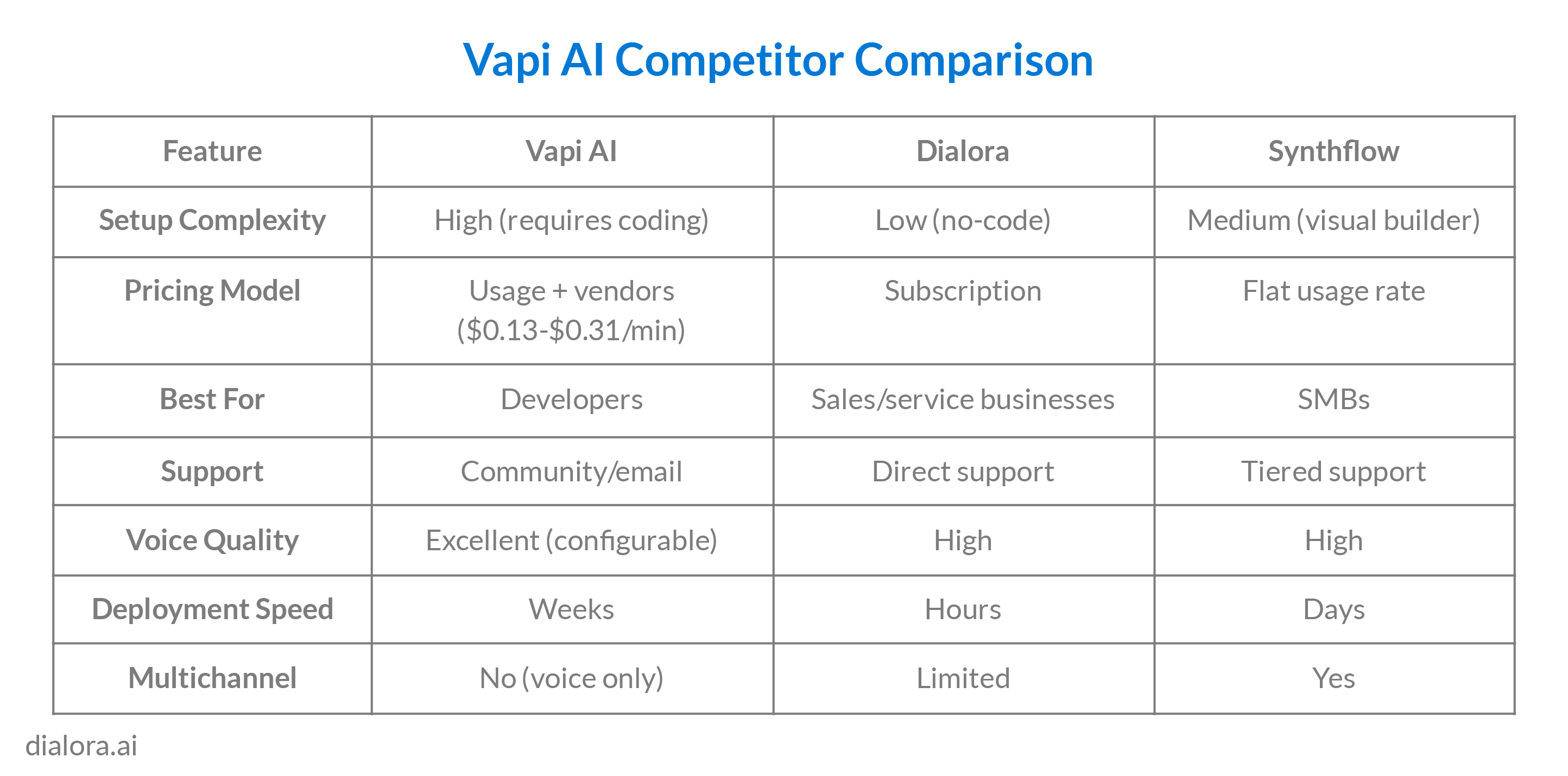
Dialora takes a completely different approach than Vapi. While Vapi is infrastructure for developers, Dialora is a business-ready solution for companies that want to deploy voice agents without touching code.
What makes Dialora different:
- No-code setup: Create AI voice agents through a visual interface. No JSON, no Python, no API keys to manage.
- Built for sales teams: Specifically made to answer questions, qualify leads, and make appointments around the clock.
- Transparent pricing: Straightforward subscription approach without any additional vendor fees.
- Fast deployment: Get agents live in hours, not weeks.
Dialora works for marketing agencies, real estate firms, service businesses, and any company that needs to handle inbound leads without hiring more staff.
Where Vapi requires you to assemble your tech stack, Dialora gives you the complete package. If you're evaluating Vapi AI but finding it overwhelming, Dialora offers the outcome without the complexity.
2. Synthflow
Synthflow positions itself as the no-code alternative to Vapi. You get a visual flow builder, flat-rate pricing, and built-in analytics. Best for SMBs that want more control than Dialora but less complexity than Vapi.
Pricing runs higher than Vapi's base rate but includes everything in one platform. No vendor juggling required.
3. Bland AI
Bland AI focuses on ultra-realistic voice calls for outbound campaigns. Good for sales teams running high-volume cold calling. Simpler than Vapi but less flexible on provider choices.
4. Retell AI
Another developer-focused platform similar to Vapi. Slightly less flexible but more stable, according to user reports. API-first approach with better documentation.
5. Lindy
Lindy goes beyond voice to offer complete workflow automation. If you need AI agents that handle calls, emails, CRM updates, and task management, Lindy provides end-to-end automation. More expensive but broader capabilities.
Read more: Best 5 Vapi Alternatives: Top Voice AI Platforms for 2026
The Verdict: Should You Choose Vapi AI?
Vapi AI delivers on its promise of flexible, fast voice AI infrastructure for developers. If you have the technical chops and need granular control, it's a solid platform.
However, there is a pattern to the Vapi AI assessments and complaints: Vapi loses simplicity and dependability for every bit of versatility it adds. The majority of firms find it difficult to handle the hidden expenses, intricate vendor management, and patchy assistance.
If all a company wants is voice agents that work without having to build a tech stack or fix API integrations, platforms like Dialora are a better deal. You give up some customisation, but you get speed, ease of use, and expenses that are easy to forecast.
Bottom line: Vapi AI is a competitor to other developer platforms, but it's not really competing with business-focused solutions like Dialora. They serve different customers with different needs.
Choose based on what you actually need: infrastructure or outcomes.
Frequently Asked Questions
Where is Vapi AI based?
Vapi AI is headquartered in San Francisco, California, USA.
Is there a Vapi AI free alternative?
Lindy, Synthflow, Dialora and Voiceflow offer free plans or generous free task limits, and Lindy supports no-code voice agent building, which can make it accessible for non-technical users.
How much does Vapi AI cost?
Vapi AI’s base rate is $0.05 per minute for calls, but actual costs (including telephony, voice, model, and transcription) typically total $0.13–$0.33 per minute, with enterprise deployments often requiring at least $40,000–$70,000/year.
What is Vapi AI used for?
Vapi AI is a developer-first platform for building advanced conversational voice agents that automate inbound/outbound calls, appointment scheduling, FAQ handling, and integrations via API.
What are the most common Vapi AI reviews complaints?
Frequent complaints include complex pricing, unexpected multi-part billing, lack of customer support responsiveness, and refund delays for unsatisfactory service.
How does Dialora compare to Vapi AI?
Dialora targets SMBs with no-code setup, fast onboarding, industry templates, agency sub-accounts, and a simple free trial, while Vapi is more developer-focused with greater customization and capacity.
Can non-technical users build voice agents with Vapi AI?
Vapi offers a no-code Flow Studio for conversational design, but managing integrations and production deployment typically requires moderate technical skill.
Is Vapi AI reliable for production use?
Vapi is used by startups and enterprises for large-scale call automation, claiming sub-500ms latency and 99.99% uptime, but complexity and support concerns mean careful evaluation is needed for critical workflows.
What makes Dialora a better choice than Vapi AI for small businesses?
Dialora focuses on simplicity, fast no-code setup, warm personality-driven AI, and direct CRM integration, making it more accessible and support-oriented for SMBs with fewer technical resources.