TL; DR
- Every voicemail greeting script for a medical or dental office needs to include the practice name, hours, emergency routing, and a callback timeline
- In healthcare communication, it's best to keep the greeting short, between 40 and 60 seconds.
- Record a real person's voice and alter the message whenever the hours or contact information change
- Make scripts work for specific situations. Paediatric offices, bilingual patients, and practices with more than one provider all benefit from personalised messaging
- AI speech systems like Dialora.ai can do more than just record calls after hours
A patient calls your office at 6:45 PM. They can be worried about a follow-up, or their tooth might have been suffering since Tuesday. What they hear next will affect how they feel about your business before anyone on staff even picks up the phone.
Most voicemail greeting scripts in medical and dental offices were written once, years ago, and haven't been touched since. They either say something too general ("Please leave a message and we'll get back to you"), are too long, or don't have the fundamental information that patients require. That's a problem because a weak office voicemail greeting doesn't just frustrate callers. It causes people to not show up, sends patients to competitors, and shows that the business is so disorganised that it will be impossible to get back on track.
Further in this blog, we will see what makes a voicemail greeting script work in healthcare settings, and the specific parts that make a message forgettable versus one that keeps patients interested and informed.
What Patients Actually Need to Hear When They Call After Hours
Before writing a single word of your script, it is helpful to consider who is contacting you and why. People typically fall into one of three categories when they call a dental or medical office after hours:
- The anxious patient has a symptom, a question, or a post-procedure concern and wants reassurance
- The appointment caller wants to schedule, reschedule, or confirm a visit
- The urgent caller has a situation that may or may not need emergency care
Your office voicemail greeting script needs to serve all three. That involves staying cool and clear, giving the right information, and sending each type of caller to the right person without overloading anyone in the first ten seconds.
A few things that every medical or dental office voicemail should say are:
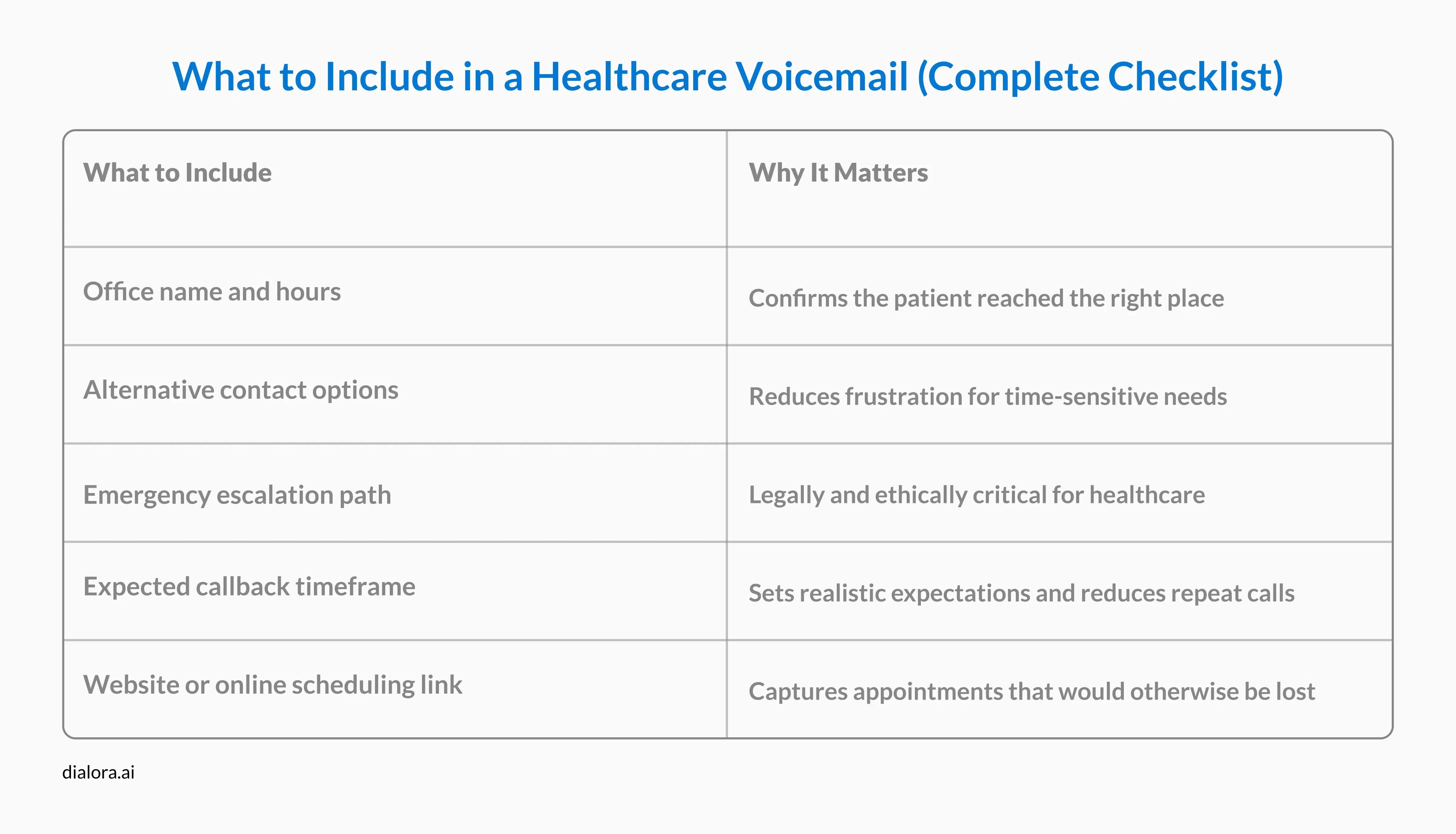
These aren't optional nice-to-haves. They're the foundation of any professional voicemail greeting script that actually serves patients.
The Key Structural Elements of a Strong Medical Office Voicemail Greeting Script
A good doctor's office voicemail greeting script isn't long; it's tight. People who are sick don't want to hear a message that lasts 90 seconds. They want the most important information in a clear fashion, along with a way to move forward.
Here's a reliable structure that works across most medical and dental practices:
1. Opening identity (5–8 seconds): Say your name, the name of the practice, and, if you like, the name of the department. Don't make patients guess.
2. Current status (5–10 seconds): Tell them why no one is there. Is the office not open? Is it past business hours? Is everyone on staff with patients right now? This statement alone makes callers a lot less angry.
3. Hours and alternatives (10–15 seconds): Clearly state your hours and give at least one other way for people to get in touch with you, such as a website for online scheduling, an email address, or a phone number for an answering service.
4. Emergency routing (5–10 seconds): This is not up for discussion in any healthcare environment. Patients need to know where to go if they can't wait.
5. Callback commitment (5–8 seconds): Let them know when they can expect a call back. "We return all calls within one business day" is better than nothing. Being specific is preferable to being unclear.
6. Close: A simple, warm close. No need to overdo it.
Total target length: 40–60 seconds when spoken at a natural pace.
Ready-to-Use Voicemail Greeting Script Examples for Medical Offices
These templates can be altered by adding your practice's name, hours, and contact information.
General Medical Office Voicemail Script
"Thank you for calling [Practice Name]. Our office hours are Monday through Friday from 8 AM to 5 PM." We are unable to answer your call right now, but please leave your name, date of birth, and a brief message, and we will contact you within the following working day.
If this is a medical emergency, immediately hang up and dial 911 or visit your nearest emergency room. To plan or manage an appointment online, go to [website]. "Thank you for calling [Practice Name]."
After-Hours Medical Office Voicemail Script
"Thank you for calling [Practice Name]. We are now closed. We are open Monday through Friday from 8 a.m. to 6 p.m., and on Saturday from 9 a.m.
If you have a medical emergency, call 911 immediately or go to the nearest emergency room. If you have an urgent question after hours, please contact our on-call nurse at [number].
If you have any other queries, please leave a message after the beep, and we will respond the next business day. You can also schedule or change appointments at [website]. We can hardly wait to hear from you.
Dental Office Voicemail Greeting Script
"You've arrived at [Dental Practice Name], where your smile is our top priority. We are currently unable to take your call. Our team is available Monday through Thursday from 8 a.m. to 5 p.m., and on Friday from 8 a.m. to 2 p.m.
If you have a dental emergency, such as a missing crown or severe discomfort, please contact our emergency line at [number]. If not, please include your name and phone number, and we will contact you within one business day.
You can also arrange or manage your appointment online using [website]. Thank you for calling [Dental Practice Name].
Tips That Make Any Office Voicemail Greeting Script Sound More Professional
The script is merely part of the answer. The words it says are just as significant as how they sound.
- Use a real human voice where possible: A voice message from a staff member or a professional voice actor is more reliable than a robotic text-to-speech voice.
- Record in a quiet space: You immediately come across as unprofessional when there is background noise. You can use a phone in a quiet place or a simple USB microphone.
- Speak at 70–80% of your normal speaking pace: Auditory comprehension takes longer than reading comprehension. When you slow down, everything becomes more believable and simpler to follow.
- Avoid filler words: "Um," "so," and "like" quickly make you look less credible. Write it down and do it a few times.
- Test it from a patient's perspective: After hours, call your own office and listen as a new patient would. Ask yourself, "Do I know what to do next?" Does this office seem to care?
- Update it seasonally: Holiday hours, new locations, new providers, your office voice message needs to stay current, or it actively misleads patients.
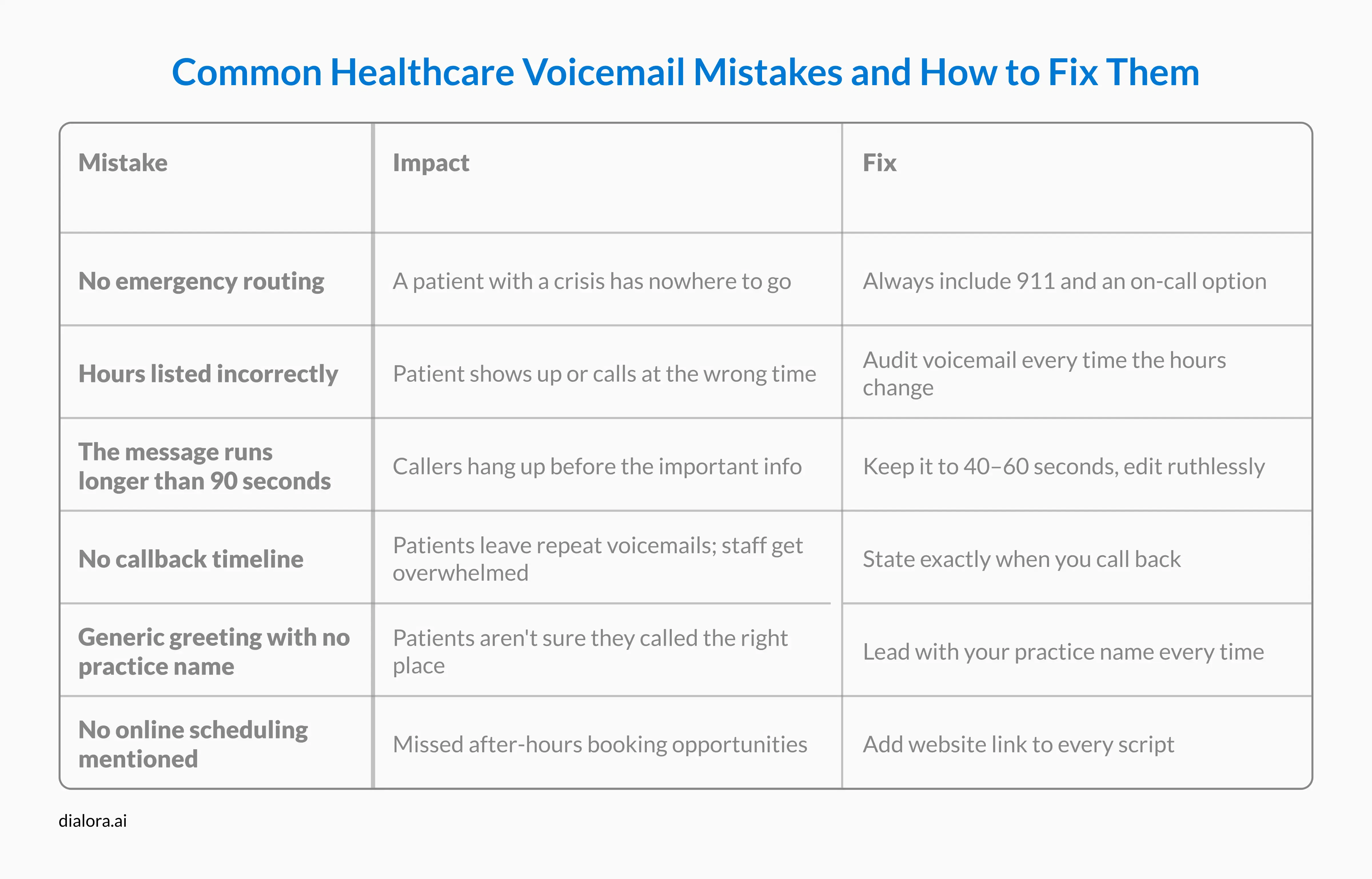
Common Mistakes That Undercut a Medical or Dental Office Voicemail
Even well-intentioned offices fall into the same traps. Watch for these:
How to Handle Specialty Scenarios With a Script Variation
Not every office runs the same way. Here's how to adapt for common situations.
- Multi-provider practices: If your organization sends calls to several departments, your welcome message should tell them to press the proper extension before leaving a message. A short IVR menu before the voicemail puts everything in order and makes sure that messages don't end up in the wrong inbox.
- Bilingual patient populations: Record your voicemail in both languages if a lot of your patients speak a language other than English. Give the option of a second language after English. It's a small change that makes a tremendous difference in how much patients trust you and how easy it is for them to seek care.
- Pediatric offices: Parents who call about sick kids are already stressed. Your voicemail greeting script for a pediatric practice should be especially warm, clear about emergency routing, and quick to give them a path forward. The first part, "We know it's hard when your child isn't feeling well," is quite helpful.
- Specialists and referral-based practices: You might need to give referring doctors and patients a separate prompt or callback number if most of your calls come from them. Separating those tracks makes things less confusing and speeds up the reaction time on both sides.
Conclusion
A voicemail greeting script for a medical or dental office isn't a minor detail; it's often the first real interaction a new or returning patient has with your practice after hours. It tells you if your office is tidy, friendly, and trustworthy. The finest practices don't simply cut down on missed calls; they also cut down on no-shows, get more appointments, and make patients feel cared for even when no one is in the building.
Dialora.ai is made for people who spend too much time dealing with missed calls and callback confusion. It handles after-hours voice communication for medical and dental offices so patients always get a clear, professional voicemail greeting script experience, and your team wakes up to organized messages instead of a full callback queue. Schedule a free trial with Dialora.ai to see how smart voice handling works for a healthcare business like yours.
FAQ
What should a doctor's office voicemail greeting script always include?
At minimum, every doctor's office voicemail greeting script should include the practice name, current hours, a way to get help in an emergency (like 911 or an on-call line), and a clear promise to call back. It is highly advised that you include your website for online scheduling.
How long should a medical office voicemail message be?
The sweet spot is 40–60 seconds when spoken at a natural, unhurried pace. People hang up before they get the information they need if the call lasts more than 90 seconds. Most of the time, tighter is preferable.
What's the difference between a general business voicemail greeting script and a medical one?
The biggest difference is the emergency routing requirement. A professional voicemail greeting script for a healthcare setting must always tell patients what to do if their situation is urgent. A standard business voicemail doesn't carry that obligation. Medical offices also get more nervous calls, so tone and clarity are even more important.
How often should we update our office voicemail?
Any time your hours, staff, location, or emergency contact information changes. Also, alter it for holidays, long closures, or any time you add an online scheduling option. Consider it live content rather than a one-time setup.
Can an AI voice handle medical office voicemail greetings?
Yes, and more and more people are using AI-powered voice solutions to handle calls after hours, remind people of appointments, and route calls intelligently. A properly configured AI voice agent may greet callers, obtain basic information, route urgent calls to the appropriate person, and confirm appointments without the need for a human on the other end.