TL; DR:
The "AI is replacing call center agents" headline is half right. Full-floor replacement is still failing in 2026, but the hybrid model is working and it is quietly rewriting OpEx math for every 24/7 support operation. Call center automation now handles 45 to 60 percent of tier-one volume without a human touching the call. For CFOs and digital transformation leads, this is the first operational line item where AI has closed the gap between pilot and production.
Your board asked you the question last quarter. You deflected it with a slide about "responsible AI adoption." Your CFO will ask it again in 60 days, and "responsible adoption" will not survive a second asking. The question is simple. How much of your call center operating expense is actually unavoidable in 2026? The answer is smaller than it was 18 months ago, and your competitors have already done the math.
Stats - Conversational AI will reduce contact center agent labour costs by $80 billion in 2026 - Gartner
The call center cost problem your CFO is staring at
Consumer finance and utility operations run some of the largest, most expensive 24/7 contact center floors in the world. A large US utility typically spends between $40 million and $120 million annually on call center operations. Roughly 70 percent of that is labor. Roughly 60 percent of inbound call volume is tier-one billing questions, account status, payment confirmations, service inquiries. These calls are repeatable, scripted, and high-volume. They are also where humans spend most of their day.
The financial logic is straightforward. Every tier-one call handled by AI instead of a human agent moves unit economics. Every escalation still handled by a human moves CSAT. The intersection of those two lines is where operating expenses drop 50 to 70 percent without customer experience going with it.
What "AI is replacing call center agents" actually means in 2026
The honest answer is that AI is not replacing call center agents wholesale. It is replacing the tier-one layer of call center work. The distinction matters for every operations leader writing a business case.
What AI reliably handles today
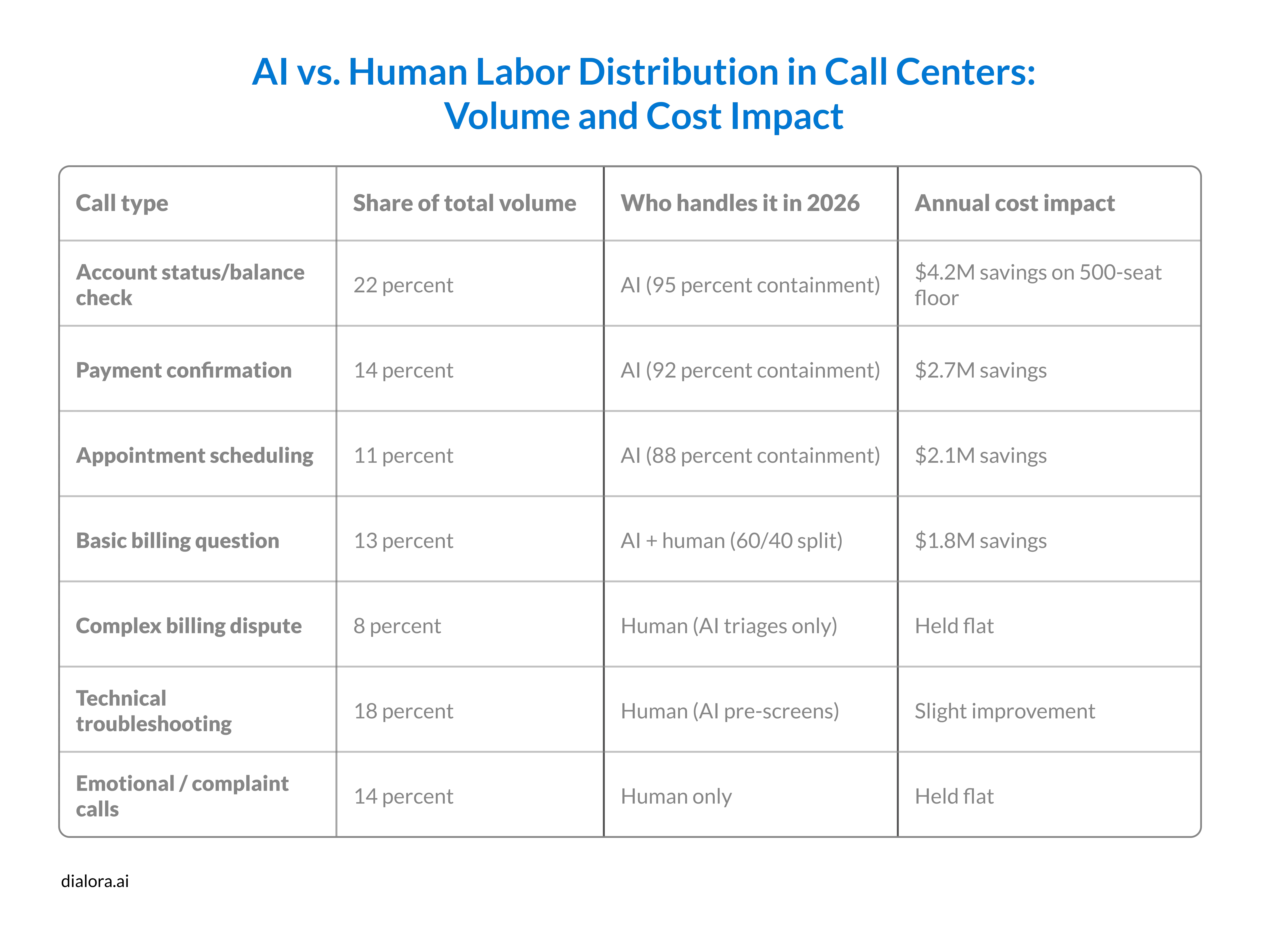
Tier-one inbound calls are the production layer. Account status lookups, payment confirmations, appointment scheduling, password resets, service address changes, basic billing questions, and order tracking are all handled by AI voice agents at containment rates between 45 and 60 per cent, with CSAT within 3 points of human-handled calls for the same intents.
What AI still hands off to humans
Complex complaints, multi-step troubleshooting, emotional or distressed callers, fraud indicators, and anything requiring regulatory judgment still route to human agents. The hybrid model works because the AI knows when to hand off - warm-transferring the call with a full summary so the human agent does not start from zero.
What this means for headcount
Enterprises deploying call center AI are not typically cutting their workforce by 50 per cent. They are freezing hiring against growth, shifting their remaining agents to higher-complexity work, and absorbing attrition without backfilling the tier-one seats. Over 18 to 24 months, this produces a 30 to 50 per cent reduction in agent headcount without a single layoff event.
Key Facts
AI agents in contact centres have cut cost per call by 50% while simultaneously increasing CSAT scores, the clearest primary data point on the hybrid model's ability to reduce OpEx without degrading customer experience. - McKinsey
What this means for the business, concretely
For a CFO running a $60 million annual call center operation, the 2026 hybrid deployment produces between $18 million and $30 million in annualized OpEx reduction within 24 months of full rollout. For a director of digital transformation, the number that matters more is CSAT. In every working deployment, CSAT for AI-handled tier-one intents has landed within 3 points of human-handled calls, and often higher on the simplest transactional intents, where humans get bored, and the AI does not.
The operational risk most boards worry about is CSAT collapse, customer backlash, and regulatory exposure, which shows up in the deployments that try to automate every intent at once. The risk does not show up in the deployments that start narrow, measure containment, and expand scope over 6 to 12 months.
Dialora runs AI voice agents as the tier-one layer for consumer finance and utility contact centers, handling inbound call volume at the intent layer, warm-transferring complex calls with a full summary to your human agents, and syncing every interaction to your CRM. For a CFO running the 2026 OpEx review, that is the first line item in the business where the pilot-to-production gap has actually closed. See How It Works
FAQ
1. Will AI Replace call center agents
Not wholesale, and the enterprises trying to replace their entire floor are the ones posting the failed deployments. AI is replacing the tier-one layer repetitive, high-volume, low-judgment calls that account for roughly 60 percent of inbound volume. Human agents increasingly handle escalations, complex disputes, and emotionally sensitive calls.
2. How is AI used in call centers
AI voice agents answer inbound calls, resolve tier-one intents end-to-end, warm-transfer complex calls to human agents with context, and run outbound campaigns for reminders, follow-ups, and payment collection. They also handle post-call work - transcription, sentiment analysis, and CRM sync.
3. What call center tasks can AI automate
Account lookups, payment confirmations, appointment scheduling, password resets, service address changes, order tracking, basic billing questions, and reminder outbound calls are the most reliable targets. These intents have clear success criteria and high call volume, which is why they hit 85 to 95 percent containment rates.
4. What does AI replacing call center agents mean for businesses
For most enterprises it means 30 to 50 percent reduction in agent headcount over 18 to 24 months through attrition and hiring freezes rather than layoffs, 50 to 70 percent reduction in OpEx on tier-one call handling, and CSAT held flat or slightly improved. It does not mean a lights-out contact center.
5. Will AI fully take over call centers
Probably not within the next five years, and possibly not ever for the most complex intents. The deployments that work today pair AI with humans rather than replacing humans entirely. The economic ceiling on full replacement is lower than the ceiling on the hybrid model, and the risk profile is much higher.