The finance review showed $2.3 million in annual call center operating costs. Sixty-two staff members across three contact centre locations. Eighteen months of consecutive hiring, training, and attrition cycles just to keep the phones answered.
And still, call abandonment during peak hours sat at 27%.
Stats - AI enablement of the healthcare revenue cycle could cut cost to collect by 30-60% - A McKinsey report
When health system CFOs and administrators ask how AI helps cut costs in the healthcare industry, this is the number they are staring at. Not the technology budget. The people budget specifically, the cost of building a human infrastructure around a problem that volume has made unsolvable at the current scale.
The 30% admin cost reduction that hospitals achieve with AI voice agents does not come from cutting staff. It comes from rerouting work that staff should never have been doing in the first place.
Why Healthcare Call Center Costs Keep Growing Despite Optimization Efforts
Healthcare call centres are expensive to run and structurally inefficient at scale. The calls coming in for appointment scheduling, reminder confirmations, registration intake, and post-visit follow-up follow predictable patterns. The same questions. The same process. The same outcomes.
Yet these calls are handled by trained, salaried staff who could be managing complex billing cases, supporting clinical coordination, or reducing the administrative burden on care teams. Instead, they are answering the same scheduling question for the fourteenth time before noon.
Stats - Healthcare AI adoption in customer service grew 51.9% as providers automated non-clinical tasks like appointment scheduling and patient communication making this the fastest-growing AI adoption vertical in customer operations. - Accenture
The cost of AI implementation is a concern for every CFO evaluating this. That cost is real. What does not get calculated with equal rigour is the cost of not implementing the ongoing personnel expense, the attrition cycle, the per-call overhead, and the revenue that leaves every time a call goes unanswered.
How AI Voice Agents Reduce Healthcare Admin Costs Without Workforce Cuts
AI voice agents in healthcare cut admin costs through volume displacement, not workforce reduction.
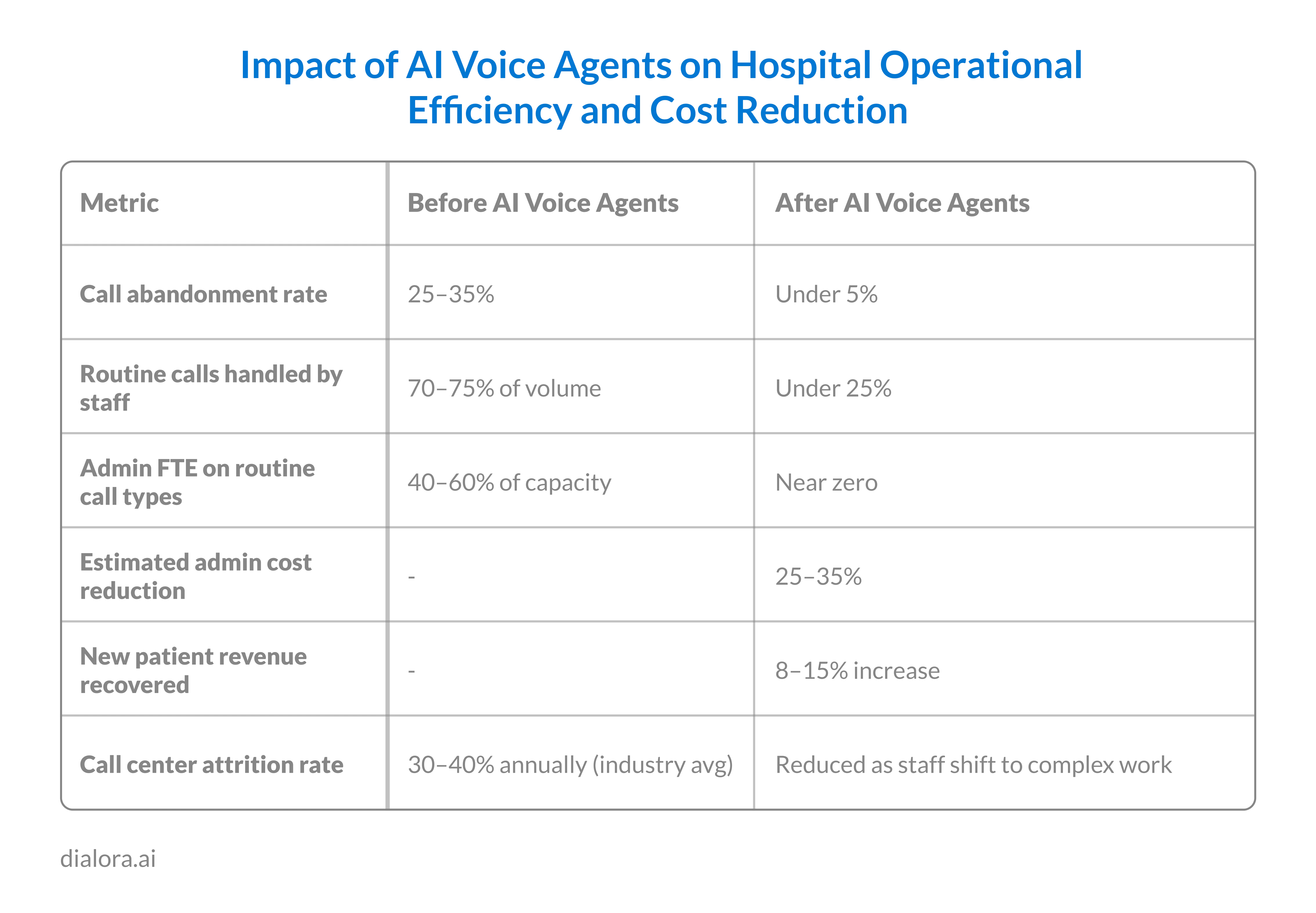
A health system handling 2,500 inbound calls per week routes 70-75% of those calls to a routine scheduling, reminder, and intake calls to an AI voice agent. Human staff handle the remaining 25-30%: complex queries, clinical escalations, billing disputes, and care coordination calls.
The impact:
- Call centre staffing needs for routine call types drop by 35-50%
- Overtime hours from peak-period overflow are eliminated
- Training cycles shorten human agents are trained to handle complexity, not volume
- Call abandonment rates fall from 25-35% to under 5%, recovering appointment revenue that was previously invisible in the cost model
For enterprise health systems with multiple contact center locations, the math compounds. A 30% reduction in admin costs at a $2 million annual call center is $600,000 recovered. At $5 million, it is $1.5 million.
Dialora is built for enterprise health systems that need to displace high-volume routine call handling without a multi-year IT implementation. The platform deploys quickly, handles inbound and outbound call types across appointment scheduling, patient reminders, intake, and follow-up, and returns transcripts, sentiment data, and CRM-synced records after every call. For health system administrators evaluating the cost of AI in healthcare, Dialora operates with SOC 2-ready infrastructure, encrypted PHI handling, and Business Associate Agreements. The demo maps your actual call volume against what displacement looks like at your cost model before any commitment is made.
Your call center is spending money on work that does not need a human to complete it. Every scheduling call handled by a staff member is $8-$15 in overhead for a task AI resolves in under two minutes. The cost of ai implementation in healthcare is a one-time calculation. The cost of not implementing it compounds every week. Your next missed call is revenue that does not appear on any dashboard until it is already gone. Start Your Free Trial
FAQ
Is AI replacing call center agents in healthcare?
Not replacing, rerouting. AI voice agents handle high-volume, predictable call types: scheduling, reminders, intake, and follow-up. Human agents handle what actually requires judgment, complex billing, clinical coordination, complaints, and edge cases. Health systems see admin costs fall because routine call handling was never the right use of a trained staff member's time.
How is AI used in call centers in the healthcare industry?
AI is used in healthcare call centers to answer inbound calls 24/7, qualify the call's purpose, handle routine requests without human involvement, and escalate complex calls to the right staff member. Post-call, AI generates transcripts, sentiment scores, and CRM-synced data. The result is a call center that handles more volume with fewer resources while improving the patient experience.
What call center tasks can AI automate in a healthcare setting?
The tasks with the clearest automation fit are: appointment scheduling, confirmation and reminder calls, patient registration intake, after-hours coverage, outbound follow-up after procedures, insurance verification callbacks, and appointment rebook outreach after no-shows. These represent 60-75% of inbound and outbound volume in most healthcare call centers.
What does AI replacing call center agents mean for health system administrators?
It means admin costs fall, call abandonment rates drop, and the staff that remain shift from transaction handling to work requiring their expertise. For CFOs, it means a measurable reduction in per-call cost and recovery of appointment revenue lost to missed calls. For administrators, it means the call center stops being the single point of failure for patient access.
Will AI fully take over healthcare call centers?
No, and the goal is not full takeover. Clinical calls, complex billing situations, patient complaints, and anything requiring care judgment will always need a human. AI handles volume, so humans handle judgment. The call center that results is one where every agent is doing work only an agent can do, and the economics of running it look fundamentally different.