TL; DR: Key Takeaways
- AI is the Foundation: Automated summaries and AI voice agents are no longer optional; they are necessary for cost-effectiveness in 2026.
- Context is King: Deep CRM integrations and warm transfers get rid of the "repeat your story" problem that makes customers less loyal.
- Data Drives Growth: With Real-time Analytics & Reporting, managers may stop "firefighting" and start optimizing.
- Scale with the Cloud: Cloud-based solutions give distant teams and call volumes that change a lot the flexibility they need.
The landscape of customer communication has shifted. By 2026, the distinction between a "phone system" and a comprehensive contact center platform has evaporated. Companies aren't simply searching for a means to answer calls anymore. They're also looking for ways to guess what customers want, automate regular tasks, and make sure that every connection with a person is valuable.
Stats - 88% of contact centers already use some form of AI - and 76% plan significant new AI investment within two years. Ringly
If your present setup seems like a bunch of tools that don't operate together, you're probably wasting more than just time; you're also losing money. To stay competitive, your call center software must act as an intelligent hub. Here are the 20+ essential call center features that define industry leaders in 2026.
Intelligent Routing and Distribution
Handling calls well starts long before an agent picks up the phone. In 2026, routing won't be a straight line anymore; it'll be a dynamic, data-driven engine.
Automatic Call Distribution (ACD)
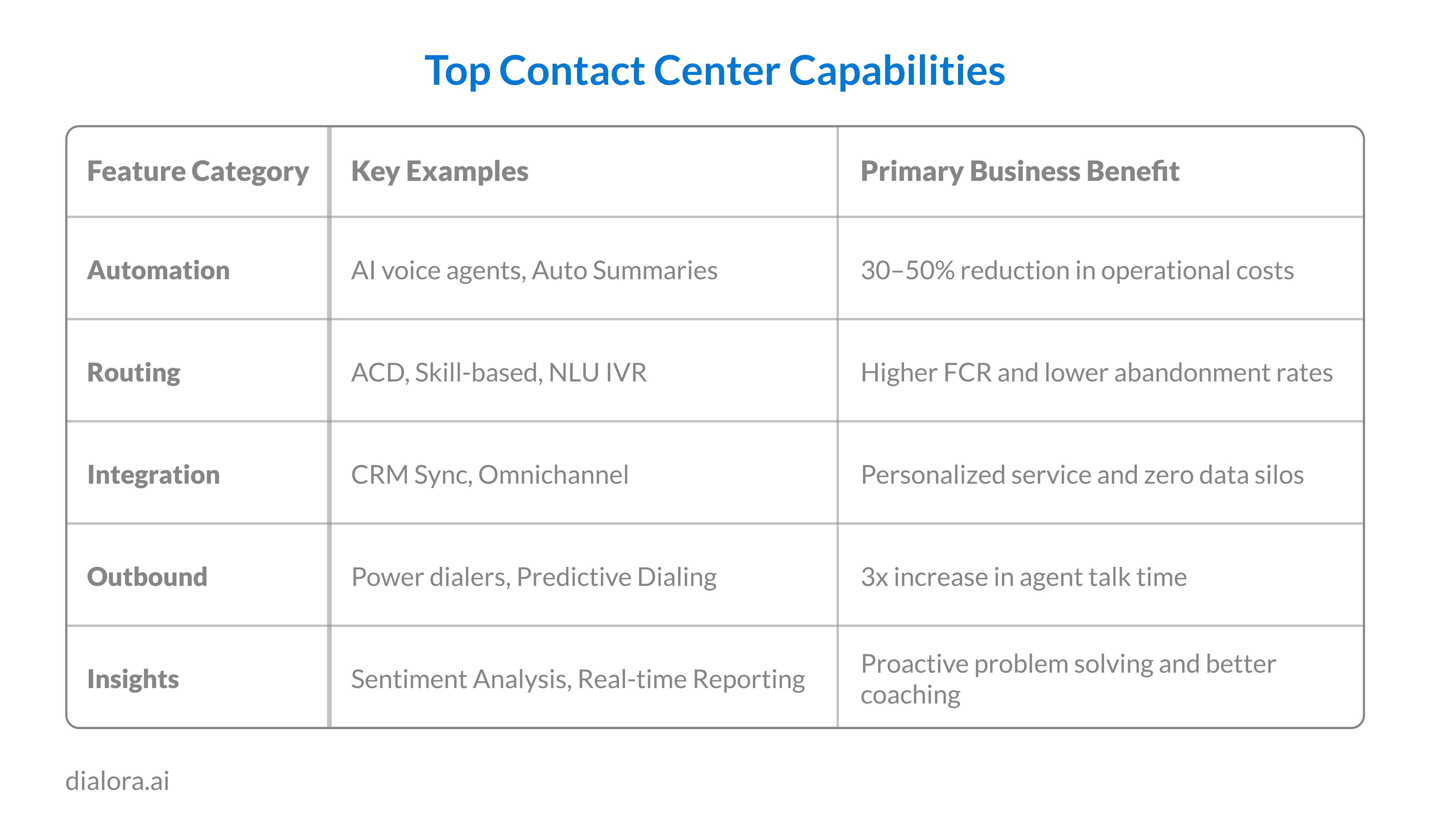
Any center that does well needs modern Automatic Call Distribution (ACD). It doesn't just pass a call to the next person in line. In 2026, ACD employs "Intent-Based Routing" to figure out why a customer is calling, maybe because they left something in their cart or opened a support request and then connects them with the agent who can best help them with that problem.
Skill-Based Routing
Not all agents are the same. Some are great at fixing technical problems, while others are great at making sales under pressure. Skill-based routing ensures that contact center capabilities are utilized effectively by tagging agents with specific expertise levels. This cuts down on the requirement for transfers and makes First Call Resolution (FCR) rates much better.
Interactive Voice Response (IVR)
The "numeric maze" of the past is dead. In 2026, you should seek Interactive Voice Response (IVR) systems that use Natural Language Understanding (NLU). Instead of "Press 1 for Sales," customers simply state their needs. This conversational approach makes call center phone system features feel human, even when they are automated.
Queue Management and Callback Feature
No one likes waiting on hold. Intelligent queue management provides callers with accurate wait-time predictions. More importantly, a robust callback feature call center option allows customers to hang up without losing their place in line. When an agent is free, the system immediately calls them back. This keeps the customer experience the same and lowers phone expenses.
AI and Automation Powerhouses
The AI call center is, without a doubt, the most important news story of 2026. Automation isn't about taking jobs away from people anymore; it's about making them better.
AI Voice Agents
An AI voice agent is the "first line of defense" for modern businesses. These are not just simple bots; they are advanced AI phone call systems that can handle Tier-1 questions like making appointments, sending status updates or doing basic troubleshooting with a lag of less than 500 milliseconds. This enables your human workers focus on tough problems that need a lot of understanding.
Generative AI Call Summaries
One of the biggest productivity killers is "After-Call Work" (ACW). Generative AI now automates this by listening to the AI call center software interaction and instantly generating a concise, structured summary. These summaries are then pushed directly into your CRM, saving agents 2–4 minutes per call.
Sentiment and Speech Analysis
You can "hear" irritation in 2026 before the client even yells. Real-time speech and sentiment analysis monitors tone, pitch, and keywords. The system can immediately let a supervisor know or give the agent a "de-escalation" script in real time if a call starts to go bad.
Predictive and Power Dialers
For outbound teams, efficiency is a numbers game. Power dialers and auto dialers make phoning easier by ignoring busy signals and voicemails so that agents only talk to live prospects. "Smart Dialers" employ AI to figure out the optimal moment to call a certain lead based on past data in 2026.
Seamless Transfers and Continuity
The "repeat your story" problem is the https://www.google.com/search?q=%231 driver of customer churn. Your contact center features must prioritize continuity.
Warm Transfers
A cold transfer where a customer is dumped onto a new agent without context is a relic of the past. Warm transfers allow the first agent to speak with the second agent before the handoff, passing along the customer's name, issue, and mood. This is one of those call center software features that immediately boosts CSAT scores.
Omnichannel Continuity
Customers today jump from WhatsApp to email to a phone call. An omnichannel setup ensures that the agent on the phone can see the chat history from five minutes ago. This unified view is a hallmark of top-tier cloud call center features, ensuring the conversation never has to start from zero.
Internal Chat and Whispering
Sometimes agents need a lifeline. Call monitoring features like "Whispering" allow a supervisor to speak directly to the agent during a live call without the customer hearing. This is essential for training and for high-stakes SMB call center features where every lead counts.
Integration and Data Infrastructure
Your communication tools should not be an island. They must "talk" to the rest of your tech stack.
CRM Integrations
Whether you use Salesforce, HubSpot, or a niche legal CRM, your call center CRM features must include "Screen Pops." When a call comes in, the customer's entire profile should instantly appear on the agent's screen. This deep integration reduces handle time and makes the interaction feel deeply personalized.
Cloud-Based Solutions
The move to cloud-based solutions is no longer optional. Cloud call center features offer the elasticity to scale from 10 to 100 agents instantly during peak seasons without buying new hardware. It also works with the hybrid and remote work styles that are common in the 2026 workforce.
International and Toll-Free Numbers
With modern call center phone systems, you can set up international lines in just a few minutes. This gives your business a local presence in over 100 countries while keeping all of your activities in one place.
Analytics, Reporting, and Quality Assurance
You can't get better at anything if you don't keep track of it. In 2026, data is the "North Star" that guides operations.
Real-Time Analytics and Dashboards
Static reports from last week are useless. You need Analytics & Reporting that shows you what is happening now. You can make personnel changes in real time with live dashboards (sometimes called "Wallboards") that show current wait times, agent occupancy, and service level agreements (SLAs).
Call Recording and Tagging
For compliance and coaching, call recording is a must-have. However, the 2026 twist is call tags. You may uncover teaching moments right away by filtering records by tags like "Angry Customer," "Refund Requested," or "Successful Sale" instead of going through thousands of hours of audio.
Workforce Management (WFM)
It's hard to figure out how to plan a team's schedule. Workforce management systems use past data to predict how many calls you will get in the future. This makes sure you don't have too many workers (spending money) or too few personnel (losing clients).
Pro Tip: AI-powered WFM platforms forecast call volumes with 95–98% accuracy at 15-minute intervals. If you're still scheduling based on last month's averages, you're either overstaffing or burning agents - neither is free.
Conclusion: Building Your 2026 Growth Engine
The "perfect" call center features list doesn't just look like a shopping catalog it looks like a strategy. In 2026, the goal is to bridge the gap between efficiency and empathy. By leveraging AI voice agents for routine tasks and ensuring your human agents have the Analytics & Reporting they need to succeed, you create a powerhouse customer experience.
A modern call center phone system isn't only about "better calls." It's also about better business results, keeping more customers, and a future that can grow.
Ready to see how the next generation of AI can transform your outreach? Schedule a demo with Dialora.ai today to see our AI voice agents in action and start capturing every opportunity you’ve been missing.
FAQ: What You Need to Know
How do AI voice agents improve client retention?
AI voice agents improve retention by providing 24/7 availability and instant responses. People in 2026 don't have any patience for wait times. An AI agent makes sure they are "heard" right away, even at 3:00 AM, and fixes basic problems before they turn into big ones.
What is the difference between a cold and warm transfer?
A cold transfer sends the caller to another department without any introduction, which means they have to repeat their information. A warm transfer lets the current agent tell the next agent about the problem first, which makes the transition for the customer smooth and professional.
Why is CRM integration critical for SMB call center features?
For SMBs, every lead is precious. Call center CRM features ensure that no data is lost between a call and the sales pipeline. It automates lead entry, logs call durations, and gives small teams the "big company" feel of knowing exactly who is calling before they pick up the phone.