TL; DR:
- Healthcare clinics lose bookings every time a patient call goes unanswered, and most front desks miss more calls than they realise.
- AI voice agents answer every inbound call, qualify the patient, and book the appointment without staff involvement.
- Clinics that deploy them report measurable drops in missed calls and faster intake from the first week.
Your front desk handles an impossible workload. Phones ring during check-ins. Patients wait on hold while staff process paperwork. Calls go to voicemail. And the patient who hung up after 90 seconds? They booked with the clinic down the road. Research across multi-location healthcare practices consistently shows that between 25 and 35 per cent of inbound patient calls are either missed or abandoned before anyone picks up. Each one of those calls is a booking that never happened.
Stats - An automated appointment confirmation system reduced no-show rates from 18.55% to 7.01% in a clinical study. - MDPI Applied Sciences
Why Healthcare Clinics Miss More Patient Calls Than They Think
The front desk is not failing because the staff are bad at their jobs. It is failing because it was never designed to handle call volume alongside check-ins, insurance verification, and patient queries at the same time. Peak call hours are Monday mornings, lunch hours, and the 30 minutes after school ends, which are the same windows when every other administrative task competes for attention.
Most clinics do not track missed call volume. They track the appointments that got booked. The ones that did not book leave no trace in the schedule, just a gap where a patient could have been.
What Patient Call Automation Actually Means for a Clinic
Patient call automation does not mean replacing your receptionist with a robot. It means handling the calls that would otherwise go unanswered after hours, during peak windows, and when all lines are occupied.
An AI voice agent for healthcare:
- Answers inbound calls 24/7 and greets the patient by name if the number is recognised
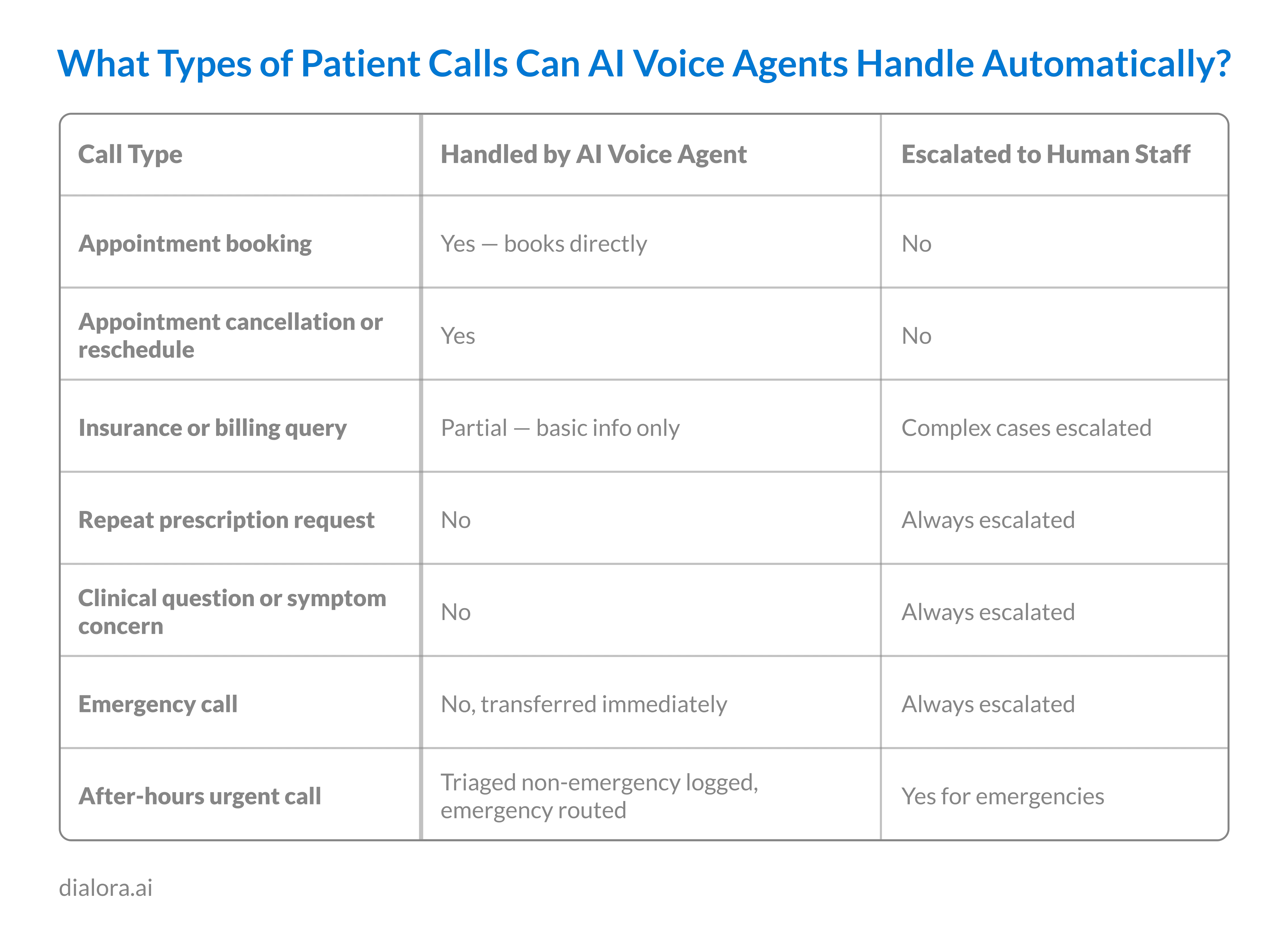
- Qualifies the call is this a booking, a repeat prescription query, a billing question, or an emergency?
- Book the appointment directly into the calendar using confirmed integrations with Google Calendar, Cal.com, and TidyCal
- Routes urgent or clinical calls to on-call staff immediately
- Logs every call with a full transcript and sentiment flag for the practice manager to review
The staff still handles everything that requires clinical judgment. The AI handles everything that does not.
How AI Appointment Scheduling Works in a Real Healthcare Setting
Picture a physiotherapy clinic with three practitioners and one receptionist. Mondays run hot -40 to 50 calls by noon, half of which come in between 8 am and 9:30 am before the receptionist has cleared the weekend voicemails.
With an AI voice agent deployed:
- Every call is answered on the first or second ring, regardless of the time
- Patients who call at 7:45 am can book for later that day without waiting for the office to open
- The receptionist starts Monday with a full transcript log of every call handled overnight, flagged by category
- Emergency calls are routed to the on-call number in real time -not batched into a voicemail queue
The result is not just fewer missed calls. It is a front desk that finally has space to handle the work that actually needs a human.
Pro Tip: The Monday morning call surge is a staffing problem and a system problem. AI handles volume at 8 am without adding a shift. Solve the system problem first.
Is an AI Voice Agent Safe for Medical Use
This is the question every practice manager asks before signing off on anything. The short answer is yes, with clear guardrails.
Dialora operates with SOC 2-ready infrastructure, encrypted patient health information handling, and Business Associate Agreements available for all healthcare customers. Every call produces a full transcript stored securely. Clinical decisions never run through the AI. Diagnoses, treatment advice, and anything requiring medical judgment are transferred to qualified staff immediately.
What the AI handles is administrative. What it never handles is clinical. That line does not move.
What Healthcare Practices Get Wrong About Missed Call Recovery
Most clinics approach missed call recovery reactively. A patient leaves a voicemail. Staff call back the next morning. Half the time, the patient has already booked elsewhere or given up.
Reactive recovery has a structural ceiling. You can only return calls as fast as staff have time to make them, and that time competes with every other task in the day.
AI voice agents shift this to proactive. The call is answered, and the appointment is booked while the patient is still on the line. There is no callback queue. There is no follow-up lag. The booking either happens in the moment, or the patient is routed correctly before they hang up.
Dialora handles the inbound call volume that overwhelms healthcare front desks -24/7, across English, Spanish, French, Portuguese, and Turkish, operating in over 30 countries. For clinics running multi-location practices, every site gets the same consistent intake experience without adding headcount. Practice managers get a full call transcript, sentiment analysis, and CRM sync after every interaction. The booking happens. The data is there. The patient does not slip through.
The calls that used to disappear into voicemail are worth auditing. One week of missed call data will tell you more about your booking loss than a year of post-hoc analysis. Start Free Trial
Frequently Asked Questions About AI Voice Agents for Healthcare
What are AI voice agents for healthcare?
AI voice agents for healthcare are automated systems that handle inbound and outbound patient calls, booking appointments, qualifying patient needs, routing urgent calls, and managing reminders without requiring staff involvement. They operate 24/7 and integrate with clinic scheduling systems to confirm bookings in real time.
How does AI automate patient calls?
The AI answers the call, identifies the patient's need through a structured conversation, and takes the appropriate action, booking, routing, or logging based on the response. Bookings are written directly to the calendar. Transcripts and call recordings are stored for staff review. Clinical or emergency calls are transferred to qualified staff immediately.
Is an AI voice agent safe for medical use?
Yes, with a defined scope. AI voice agents handle administrative calls only. Dialora operates with SOC 2-ready infrastructure, encrypted PHI handling, and Business Associate Agreements for healthcare customers. Clinical questions, diagnoses, and emergencies are always escalated to human staff.
What is the best AI voice agent for clinics?
The right AI voice agent for a clinic handles inbound booking and intake calls, integrates with your existing calendar, escalates emergencies without lag, and produces full post-call transcripts for compliance review. The best choice for your clinic depends on call volume, language requirements, and whether you need multi-location support.
How do clinics use AI to schedule appointments?
AI scheduling agents answer inbound calls, ask the patient their preferred date and time, check availability in the connected calendar, and confirm the booking before ending the call. The patient receives a confirmation. The appointment appears in the schedule. No staff involvement required for straightforward bookings.