TL; DR
Healthcare organizations lose patients, revenue, and staff time to phone calls their front desks cannot handle at volume. The best use cases for voice AI in healthcare take over routine phone work scheduling, intake, reminders, and follow-ups, so clinical and admin staff focus where it matters. This post maps the use cases that deliver the clearest operational returns.
The Best Use Cases for Voice AI in Healthcare Operations
Your operations team is tracking a gap that does not show up cleanly in any one dashboard. It appears in the missed call log. It shows up at the front desk overtime hours. It surfaces in the no-show rate that staff have been told to "work on" for three consecutive quarters.
The problem is not effort. Your team is working at capacity. The problem is that the phone has become the single point of failure for patient access, and no amount of staffing optimization fixes a structural bottleneck at volume.
The best use cases for voice AI in healthcare exist to remove that bottleneck. Not theoretically. In operations that are already running. By deploying voice AI agents, healthcare teams can finally bridge the gap between patient demand and administrative capacity.
Why Healthcare Phone Coverage Fails at Volume and What It Costs
Healthcare organizations miss 30–40% of inbound calls during peak hours. That is not an estimate from a vendor presentation. It is what operations managers find when they pull their call center data honestly.
Your clinic handles 300 inbound calls on a Monday. Ninety of those calls are not answered on the first attempt. Thirty-five patients do not call back. Twenty-two book at a competing provider. At $200 per appointment, that is $4,400 in weekly revenue lost not because your clinic delivers poor care, but because your phones were busy.
Multiply that across 52 weeks and multiple locations. The number stops being abstract. It becomes a line item on a budget conversation that no one wants to have.
The best use cases for voice AI in healthcare include a 24/7 patient scheduling virtual assistant, automated appointment reminders, AI-driven insurance verification, the best voice AI for automating patient intake calls, and post-visit follow-up calls. These voice AI agents health care providers use reduce staff call volume, lower no-show rates, and recover missed appointment revenue without requiring additional headcount.
Six Voice AI Use Cases in Healthcare That Deliver Measurable Returns
1. AI-Powered Appointment Scheduling
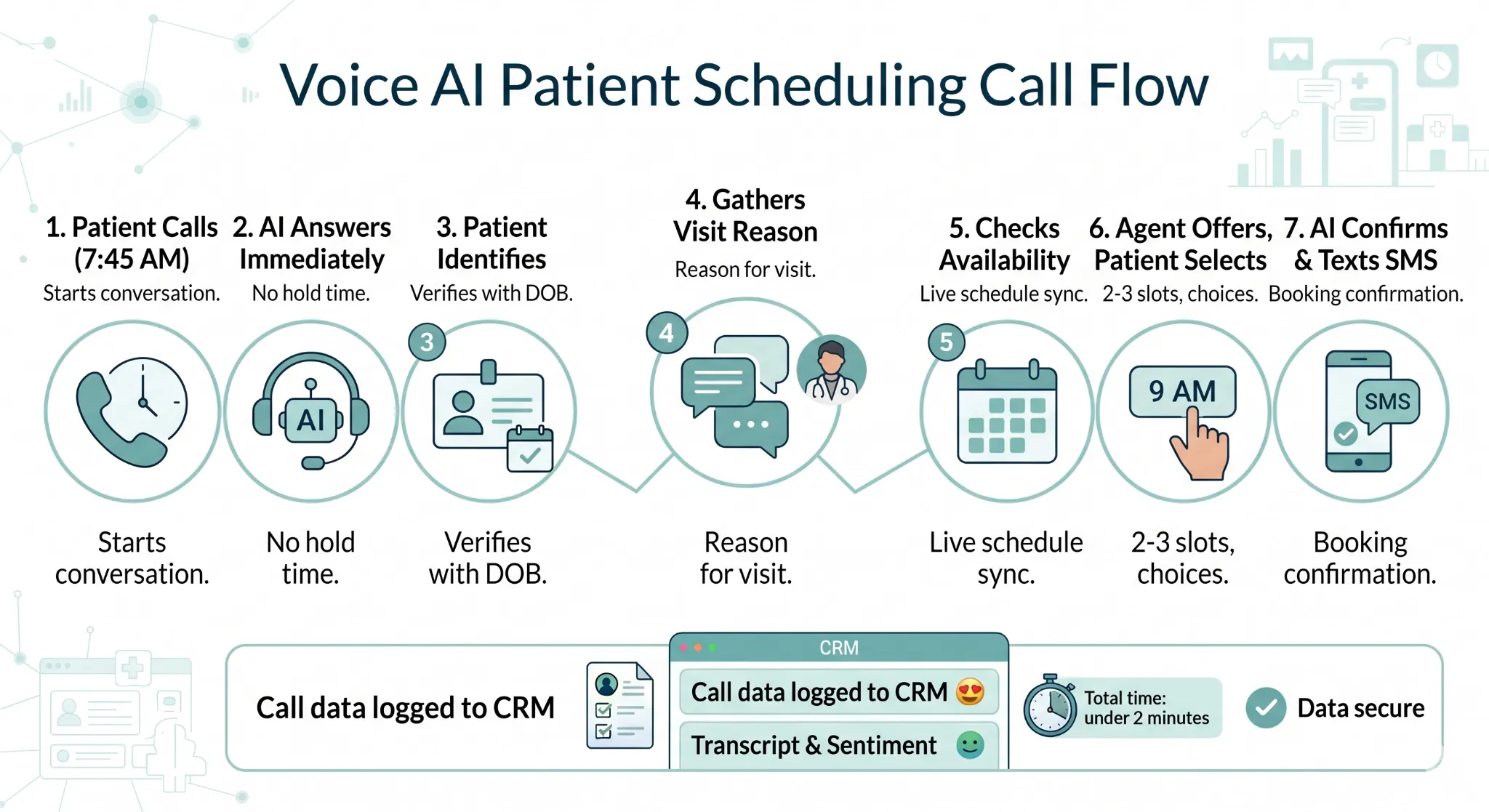
The most immediate use case and the one that delivers measurable ROI fastest. A 24/7 patient scheduling virtual assistant answers every inbound scheduling call, checks real-time calendar availability, confirms the appointment, and sends a confirmation. No hold queue. No voicemail. No callback required.
For health systems handling 500+ calls per day, call abandonment rates drop from 30%+ to under 5%. For single-location clinics, Monday morning becomes manageable instead of uncontrollable.
2. Automated Appointment Reminders
Manual reminder calls reach 40–60% of scheduled patients in most healthcare settings. Automated voice AI healthcare reminder calls reach 90–95%. The difference is not effort; it is scale.
A voice AI system sends outbound reminder calls 48–72 hours before every appointment, tracks which patients confirmed and which did not, and flags non-responders for follow-up. No-show rates in clinics using this consistently fall 20–35% within the first 90 days.
3. Best Voice AI for Automating Patient Intake Calls
Collecting intake information before the patient arrives is one of the clearest administrative wins available to healthcare operations teams. An AI virtual assistant in healthcare calls the patient 24–48 hours before their appointment, collects name, date of birth, insurance information, and reason for visit, and logs the data to your intake system.
The patient arrives pre-verified. Front desk check-in time drops. Your staff is not manually transcribing information from a clipboard at the point of care.
4. After-Hours Call Handling
Patients call after hours. Most healthcare organizations respond with voicemail. A small percentage of those messages are returned on the first business day. The patients who needed to reschedule, ask a billing question, or book a new appointment many will not wait.
This is the best voice AI for health hotline support in an after-hours capacity. A voice AI agent captures these patients in the moment. Routine requests are handled immediately. Clinical or urgent calls are escalated according to your defined protocol. Nothing falls into a voicemail queue that no one checks until Tuesday.
5. AI-Driven Insurance Verification
Insurance verification calls are among the highest-volume, lowest-value tasks in a healthcare admin team's day. An AI voice agent for healthcare calls insurance carriers, verifies patient coverage and copay details, and logs the result before the patient arrives. Staff hours previously spent on hold with carriers are redirected to work that requires human judgment.
6. Post-Visit Follow-Up Calls
Discharge follow-up is one of the strongest predictors of patient retention and one of the most consistently under-resourced areas in healthcare operations. Conversational AI for health systems makes it possible for a voice AI agent to call patients 24–48 hours after a procedure, ask a structured set of follow-up questions, flag anything requiring clinical review, and log the full transcript.
Patients who receive a follow-up call are measurably more likely to book their next appointment and less likely to leave a negative review. AI makes it possible to reach every patient, not just the ones who happened to be on a staff member's callback list.
What Healthcare Operations Teams See After 90 Days With Voice AI
The pattern is consistent across clinic types and sizes. The first change is visible in the Monday call queue. When an AI voice agent in healthcare handles calls as they arrive, including Saturday afternoon and Sunday evening, the Monday backlog shrinks. Staff arrive at a manageable queue rather than an overflow situation.
The second change shows up in the no-show data. Automated reminder calls hit 90–95% of scheduled patients. Manual reminder processes, even well-run ones, rarely break 60%. For a clinic with 100 appointments per week and a 15% no-show rate, reducing that to 7% recovers eight appointments per week without a single additional booking call.
Innovation Leads evaluating the best voice AI for healthcare front-desk automation typically ask about integration complexity. In most deployments, the AI agent connects to existing calendar and CRM systems and begins handling calls within days not months.
Dialora’s AI voice agents handle inbound scheduling, outbound reminders, intake calls, after-hours coverage, and post-visit follow-up across healthcare settings. The platform handles calls in multiple languages including English, Spanish, and French, generates full transcripts and sentiment scores after every interaction, and syncs confirmed appointments with Google Calendar, Cal.com, and TidyCal. For healthcare organizations, Dialora operates with SOC 2-ready infrastructure, encrypted PHI handling, and Business Associate Agreements. If you want to see what any of these use cases looks like for your team specifically, the demo is where to start.
Most healthcare operations teams know exactly which phone calls their staff should not be handling. Here is what it looks like when AI takes them over. See How It Works
FAQ
What are the best use cases for voice AI in healthcare?
The clearest use cases are AI-powered appointment scheduling, automated reminders, patient intake collection, after-hours call handling, AI-driven insurance verification, and post-visit follow-up. Each involves high call volume and a predictable conversation structure.
How does voice AI for healthcare scheduling work?
An AI virtual assistant in healthcare answers the incoming call, identifies the patient, asks for the reason for the visit, checks your live calendar for available slots, and confirms the booking, all in under two minutes. The appointment is logged to your scheduling system automatically.
Is voice AI in healthcare safe for patient data?
For healthcare deployments, the key requirements are encrypted PHI handling, SOC 2-ready infrastructure, and a Business Associate Agreement. Dialora meets these baseline requirements for healthcare customers.
Can AI voice agents handle urgent or clinical calls?
No, and they should not attempt to. A well-built healthcare voice AI agent escalates any call involving clinical symptoms or emergencies to a human staff member immediately. Clinical and emergency calls are always routed to your staff.