TL; DR
- Traditional interactive voice response systems lose 30 to 40 per cent of callers before resolving. Every abandoned call is a competitor's win.
- Conversational AI platform deployments understand intent, handle natural language, and complete requests without menu navigation.
- For IT Directors and CX managers evaluating the conversational AI vs IVR switch, the performance gap is not marginal. It is structural.
Conversational AI Platform vs Traditional IVR: Why Businesses Are Replacing One with the Other
Your IVR system has been handling calls for seven years. It cost $180,000 to implement. It covers fifteen menu options. And 38 per cent of callers hang up before reaching option three.
Every one of those abandoned calls is a customer who needed something your business could have handled in under two minutes. Instead, they are calling a competitor, leaving a negative review, or walking away from a transaction that should have been straightforward.
IVR was designed for a world where callers would be patient enough to navigate a menu tree. That world no longer exists. The conversational AI vs IVR comparison below covers what changed and why most call centres are switching by 2026.
A conversational AI platform uses natural language understanding to identify caller intent and resolve requests without menu navigation. Traditional interactive voice response systems force callers through DTMF keypress menus that lose 30 to 40 per cent of callers to abandonment. In the conversational AI vs IVR comparison for 2026, AI cuts caller abandonment to under 10 per cent and lifts first-call resolution from 40 to 55 per cent, up to 75 to 85 per cent.
Why Traditional IVR Systems Fail Modern Call Volume Expectations
Traditional IVR systems were built around one core assumption. Callers know which menu option maps to their need. In practice, most callers do not. They hear "press 2 for billing, press 3 for technical support" and think about their problem, not about which number to press.
The result is call abandonment, excessive hold time, and the same frustrated caller reaching a live agent after three failed IVR attempts. Your call centre team spends the first sixty seconds of every call de-escalating the experience of using your IVR system before they can address the actual issue. The IT director at one mid-market FinTech flagged it after three months. Her team had built a 47-node IVR menu over four years. The most-travelled path went through 6 menu prompts before reaching a human. The new caller behaviour baseline had moved on without the menu tree.
For IT Directors responsible for call centre infrastructure, IVR creates a second problem. Maintenance. Every change to your menu structure requires development time. New products, new departments, new routing rules, all of it requires a change request, a deployment cycle, and a test run. The system built to reduce costs has its own operational overhead. Even smart IVR and intelligent IVR systems that added basic speech recognition still inherit the menu-tree maintenance burden.
CX Managers bear the cost of customer satisfaction. IVR systems score in the lowest tier of customer experience touchpoints across industry benchmarks. Customers know when they are talking to a machine that does not understand them. They resent the experience.
Pro-tip : The IVR your customers hate was designed for a caller behavior pattern that no longer exists. Callers don't navigate menus. They expect to be understood.
What a Conversational AI Platform Does Differently From IVR
Conversational AI agents are not a smarter IVR. They are a different category.
A traditional IVR requires callers to navigate a menu. A conversational AI platform understands what the caller says and acts on it. The caller says, "I want to check the status of my order from last Thursday." The AI identifies the intent, pulls the order data, and delivers the answer without a menu, without a transfer, without a hold time.
The underlying mechanics matter. Modern systems run voice recognition AI on the incoming audio, push the transcript through an NLP phone system layer for intent detection, and execute the workflow against your CRM or order system. The whole sequence runs in under a second. The caller experiences a conversation. The platform runs four discrete machine-learning steps.
For FinTech organizations
Account inquiries handled in natural language and resolved in under two minutes. Fraud alert callbacks are completed automatically with caller verification built in. Loan application status updates are delivered without involving a human agent. This is conversational AI for business at the financial services edge.
For logistics operations
Shipment tracking queries resolved in under 90 seconds. Delivery rescheduling handled over the phone by the AI agent. Driver dispatch queries were routed appropriately without queue time.
For e-commerce businesses
Order status inquiries completed without menu navigation. Return initiation is handled end-to-end over the phone. Subscription changes are processed immediately.
The caller resolves faster. The call centre handles more volume with the same or fewer agents. And the call data from a conversational AI platform (intent, sentiment, resolution rate, handle time) is substantially richer than what IVR generates.
Read more:
- Best IVR Systems
- Best AI Voice Agents
- Best AI Call Center Software
- Best Automated Answering Services
- Best AI Appointment Booking Tools
- Best AI Voice Agents for Phone Calls
Comparing Conversational AI Platforms and Traditional IVR Systems for Business Efficiency
This breakdown shows where the operational gap lies between menu-driven IVR and the AI phone system vs IVR alternative.
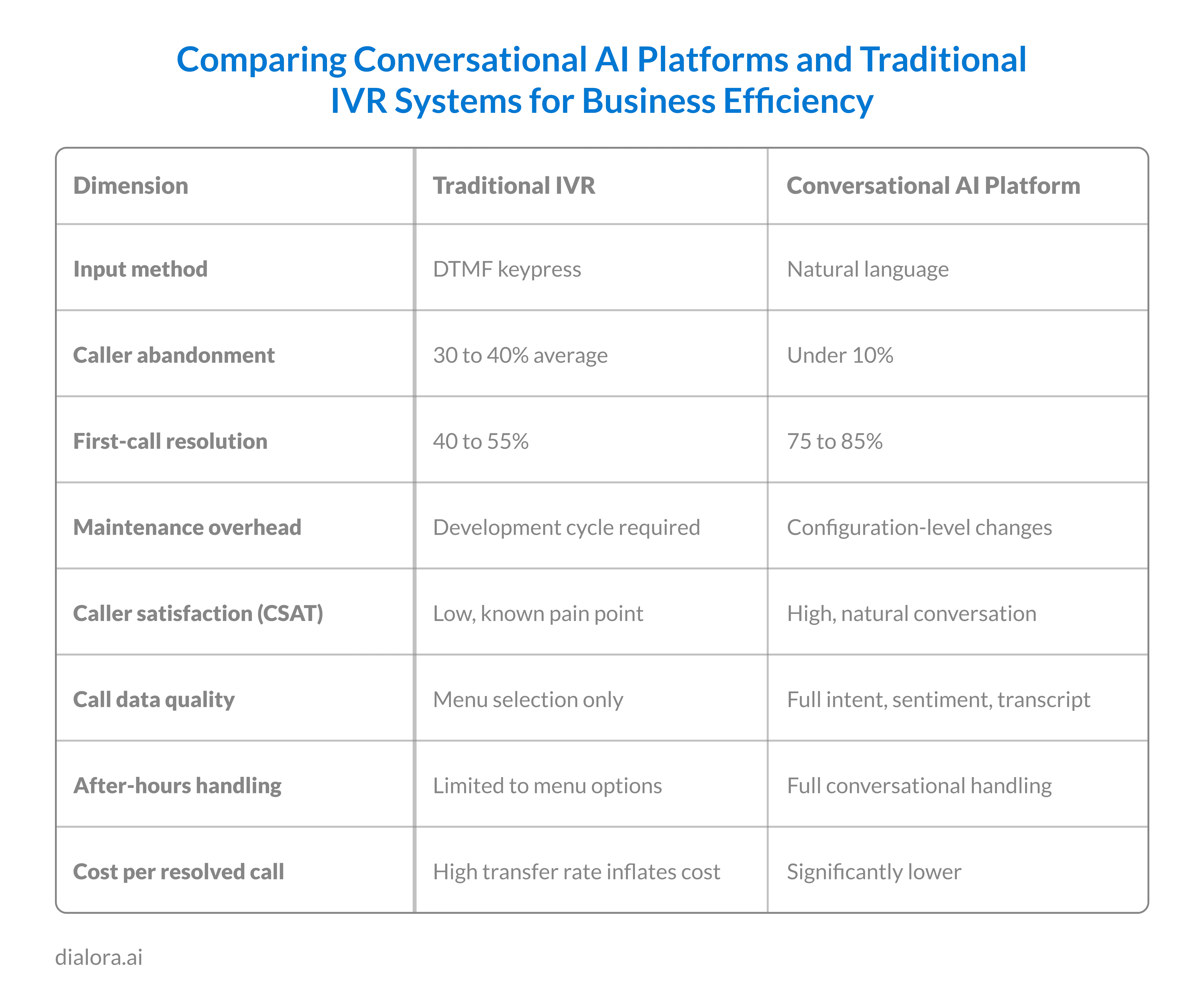
The DTMF vs conversational AI comparison is the line in the table that matters most. DTMF assumes the caller maps their problem to a menu option. Conversational AI assumes the caller knows what they want and can say it. Every other line in the table flows from that one architectural difference.
The Operational Case for Switching From IVR to Conversational AI
IT Directors evaluating the cost of replacing IVR with AI want the operational case, not just the experience one. The IVR vs AI decision usually breaks down to three numbers.
The handle time reduction changes the cost model. An IVR-managed call that results in three menu failures and a live agent transfer averages 8 to 12 minutes of total call handling. A conversational AI platform resolves the same call type in 90 to 120 seconds. For a call centre handling 5,000 calls per week, the handle time reduction translates directly into agent capacity. The same team handles more complex work because routine calls no longer require their involvement.
First-call resolution moves from the 40 to 55 per cent range common in IVR environments to 75 to 85 per cent with conversational AI. For CX Managers, this is the metric that moves CSAT scores. Customers who reach a resolution on the first call report dramatically higher satisfaction than those who are transferred or asked to call back.
The implementation cost of a conversational AI platform is typically recovered within 12 to 18 months through reduced agent handle time alone. The comparison is not about whether AI costs more upfront. It is about what each system costs per resolved call over time. IVR environments with high transfer and re-call rates rarely win that calculation.
Pro-tip:
The cost-per-resolved-call math kills IVR. Even a cheap IVR loses to conversational AI once you count failed routes, transfers, and recalls.
Ready to see what conversational AI looks like against your current call data?
How Dialora's Conversational AI Platform Handles the Switch From IVR
Dialora's conversational AI platform handles inbound and outbound call types across FinTech, logistics, and e-commerce. The platform understands natural language intent, handles complex multi-turn conversations, and resolves routine call types without human involvement. Every call generates a transcript, an intent classification, a sentiment score, and a CRM-synced record. For businesses evaluating the switch from traditional IVR, Dialora's demo shows exactly how their specific call types would be handled before any commitment is made. The architecture is built for conversational AI for business workloads at SMB and mid-market scale. GDPR compliant. SOC 2 ready. BAA available for healthcare customers. PCI compliance for payment-related calls.
What This Means for Your IVR Replacement Plan
Your IVR is not failing because it is old. It is failing because it was built for a caller behavior pattern that no longer exists. Callers do not navigate menus. They expect to be understood. The conversational AI vs IVR comparison in 2026 is no longer a close call on any operational metric. Caller abandonment drops from 30 to 40 per cent into single digits. First-call resolution moves from 40 to 55 per cent, up to 75 to 85 per cent. Cost per resolved call typically lands under $3 for routine workflows. The implementation discipline matters (training data, escalation rules, CRM integration depth), but the decision itself has stopped being controversial. IT Directors and CX Managers running this evaluation in 2026 land on the same answer.
Your IVR is not failing because it is old. It is failing because it was built for a caller behavior pattern that no longer exists. Callers do not navigate menus. They expect to be understood. Ready to see what your current call types look like handled by a conversational AI platform? Get a Vertical Demo by Dialora.
Frequently Asked Questions
What is the difference between conversational AI and IVR?
IVR requires callers to navigate a menu by pressing numbers. The conversational AI vs IVR distinction is architectural. Conversational AI understands natural language. Callers describe their need in their own words, and the AI handles the request without menu navigation. IVR routes calls. Conversational AI resolves them.
Why are businesses switching from IVR to AI?
Three reasons dominate. Call abandonment (IVR loses 30 to 40 per cent of callers before resolution). CSAT impact (IVR scores lowest in customer experience benchmarks consistently). Maintenance cost (every IVR change requires a development cycle). The IVR vs AI comparison resolves to AI on all three. Lower abandonment, higher satisfaction, configuration-level updates rather than development work.
Is conversational AI better than traditional IVR?
For the call types IVR was designed to handle (routine inquiries, status requests, scheduling, basic account actions), conversational AI outperforms on every measurable metric. Abandonment rate. First-call resolution. Handle time. Caller satisfaction. For organizations with complex legacy routing, the implementation assessment matters. The performance case, however, is not ambiguous.
What is conversational AI in a call centre context?
In a call centre, conversational AI platform deployments replace or supplement IVR by handling inbound and outbound calls in natural language. The AI understands caller intent, completes routine requests without human involvement, and escalates complex calls to agents with full context already captured. Call centres using conversational AI platforms report agent capacity increasing. Not because the staff were reduced. Because routine volume was absorbed by the AI.
How much does it cost to replace IVR with a conversational AI platform?
The total cost depends on call volume, call type complexity, and integration requirements. Most conversational AI platforms recover their implementation cost within 12 to 18 months through handle time reduction and abandonment recovery alone. The more useful calculation is cost per resolved call. IVR environments with high transfer rates often cost $8 to $15 per resolution when total handling is included. Conversational AI platforms typically bring routine call types under $3.
How does an AI phone system vs IVR setup differ in maintenance burden?
The AI phone system vs IVR maintenance gap is the most under-discussed reason teams switch. IVR changes require a development cycle. Each new menu option, department, or routing rule requires a change request, deployment, and testing. AI phone systems handle the same updates as configuration changes. Intent classifier updates ship in hours, not weeks. The ops overhead drops by 60-80 per cent.
Is intelligent IVR the same as conversational AI?
No. Intelligent IVR and smart IVR typically mean a traditional menu tree with basic speech recognition layered on top. The caller can say "billing" instead of pressing 2, but the underlying architecture is still a menu. A true conversational AI platform doesn't have a menu. It uses voice recognition AI plus intent detection to understand any phrasing the caller uses, then executes the workflow directly.