Your front desk missed 14 calls last Tuesday. Three were new-patient bookings. One was a crown consult worth $1,800. The other two were existing patients who rescheduled with the closest competitor by Wednesday morning. You never saw a report on any of this because missed calls do not generate reports. They generate quite a revenue loss and a schedule that looks fuller than it is.
What the after-hours call problem actually costs a dental practice
A typical general dental practice loses approximately $5,000 per month in bookings from after-hours calls alone. The math is simple enough that most owners do not want to run it. A practice averaging 40 new-patient calls per month, with 35 percent of them coming outside staffed hours, with an average first-visit value of $300, produces the number without effort. Weekends make it worse. Most offices close Friday afternoon and reopen Monday morning, which is precisely when Google searches for "dentist near me" peak.
Stats - Dental practices miss an average of 30–35% of incoming calls, with some practices reaching miss rates as high as 68%, and most owners have no visibility into these losses because missed calls generate no record in their system. - DenteMax 2025 Report
The front desk problem is not a staffing problem. Hiring a second receptionist fixes the daytime queue. It does nothing for the 128 hours per week nobody is at the desk.
What an AI receptionist does for a dental clinic, specifically
An AI dental receptionist is a voice-first system that answers your practice line in your office's name, speaks in a natural human voice, and handles the calls your front desk would handle if it were there. It works 24/7, handles multiple simultaneous calls, and integrates with the calendar your practice already runs.
For a practice owner or DSO evaluating this in 2026, the core capabilities land in five places.
Answering new-patient inquiry calls
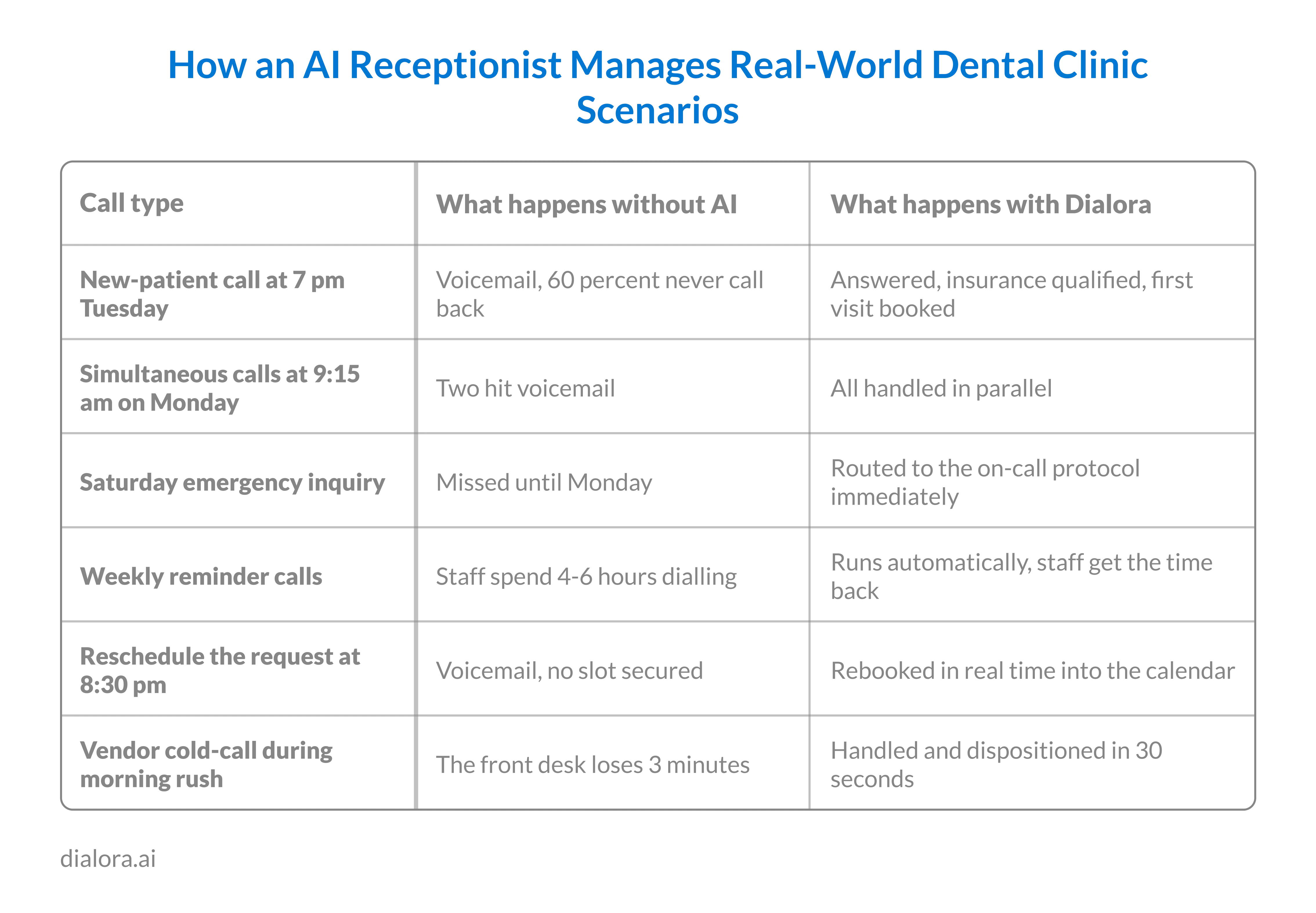
The AI picks up on the second ring, identifies itself as your practice, and handles the new-patient call end-to-end insurance question, appointment request, and first-visit booking using the intake flow your front desk already uses.
Handling appointment reminders and confirmations
Outbound reminder calls run automatically the day before each appointment. The AI confirms the booking, handles reschedule requests in real time, and updates your calendar without a human touching it.
Managing after-hours and weekend coverage
The calls that used to hit voicemail between 5 pm Friday and 8 am Monday now get answered, qualified, and booked into Monday morning's available slots so your front desk walks in on a full schedule instead of a voicemail queue.
Routing urgent calls to on-call staff
For clinical urgencies or emergencies, the AI identifies the intent and routes to on-call staff or provides the practice's emergency protocol immediately. Clinical and emergency calls are always escalated to human staff; the AI does not diagnose, treat, or offer medical advice.
Logging every call to your practice system
Every call produces a transcript, a summary, and a structured record. Your front desk walks in on Monday morning knowing exactly what happened over the weekend.
Key Takeway
Google searches for "dentist near me" peak on weekends precisely when most practices are closed for 52+ hours. Your marketing budget is generating demand you cannot capture. That is the after-hours gap in one sentence.
What a dental practice actually gets in the first 60 days
The measurable shift for most practices shows up in two places. After-hours bookings double or triple within 30 days without any change in marketing spend. And front desk staff get between 2 and 4 cleared hours per day back, because reminder calls, vendor cold-calls, and simple scheduling requests no longer need a human in the chair. Those hours go to patient-facing work, greeting patients, handling treatment plans, and running insurance that was being squeezed by the phone.
The second pattern is the one DSOs notice faster than single-location owners. Consistency. An AI receptionist handles the 2 am call the same way it handles the 2 pm call. Front desk quality variance across locations drops because the first-touch experience is now identical whether the office has a senior receptionist or a new hire.
Dialora runs the AI dental receptionist as a fully configured voice agent trained on your practice's intake flow, insurance questions, and scheduling preferences, integrated with Google Calendar, Cal.com, or TidyCal, and built on SOC 2-ready infrastructure with encrypted handling of patient information and Business Associate Agreements available for healthcare customers. For a practice owner who has watched $5,000 a month walk into voicemail, that is the first category product that has actually closed the after-hours gap. Try Dialora now
FAQ
1. What is an AI receptionist for dental clinics
An AI dental receptionist is a voice-first system that answers your practice phone line 24/7, qualifies new-patient inquiries, books appointments, runs automated reminder calls, and routes urgent calls to on-call staff. It handles the work your front desk would handle if it were staffed around the clock.
2. How does AI help a dental office handle calls?
It picks up every inbound call, speaks in a natural human voice as your practice's receptionist, handles the full new-patient intake flow, and books appointments directly into your calendar. For outbound, it runs reminder and recall campaigns automatically, confirming or rescheduling appointments without staff time.
3. Is an AI dental receptionist safe for patient information
Reputable platforms operate on SOC 2-ready infrastructure with encrypted handling of patient information and offer Business Associate Agreements for healthcare customers. Dialora provides all three. Clinical and emergency calls are always escalated to human staff the AI does not diagnose, treat, or offer medical advice.
4. What is the best AI tool for the dental front desk?
The right choice for a dental practice depends on your calendar stack and intake flow. Look for a platform that integrates with Google Calendar, Cal.com, or TidyCal, handles after-hours coverage, runs automated recall and reminder campaigns, and produces clean transcripts for your records. Dialora covers all four and is built for dental SMB and DSO deployment.
5. Can AI schedule dental appointments automatically?
Yes. AI dental receptionists handle the full scheduling flow, insurance qualification, first-visit booking, reschedule requests, and recall outreach and write every appointment directly to the calendar your practice already uses. The patient leaves the call with a confirmed slot, and your front desk sees the booking the next morning.