TL;DR: Summary for Busy Executives
- The Goal: Move from "IVR" to "Agentic AI" that completes tasks (scheduling, intake, verification) rather than just answering questions.
- Top Picks: Dialora leads for patient-facing interactions; Nuance leads for provider-side documentation.
- The "Why": ROI is typically achieved in 14 months, with a 3.7x return on investment per dollar spent on voice automation.
- The "Must-Have": HIPAA compliance, EHR integration, and "Emotional Intelligence" tuning for 2026 standards.
The healthcare industry is no longer just "exploring" artificial intelligence. By early 2026, the global AI voice agents in healthcare market has surged to over $650 million, driven by a desperate need to solve the chronic staffing shortages and administrative burnout that plagued the early 2020s. For modern providers, AI Voice Agents in Healthcare are no longer a luxury; they are the digital front door that ensures a patient never hears a busy signal again.
The AI voice agents in healthcare market is valued at $650.65 million in 2026 and projected to reach $11.7 billion by 2035 — a 37.85% CAGR. Towards Healthcare
Whether you are managing a multi-state hospital system or a specialized private clinic, choosing the right platform is a high-stakes decision. The "best" agent isn't just the one that sounds the most human; it is the one that integrates with your EHR, maintains rigorous HIPAA compliance, and actually closes the loop on patient tasks.
In this guide, we break down the Best AI Voice Agents in Healthcare for 2026, focusing on platforms that deliver measurable ROI, such as the 14-month payback period now common in top-tier implementations.
1. Dialora (Best for Conversational Intelligence & Patient Experience)
Dialora has emerged as the 2026 leader for healthcare organizations that prioritize a "human-first" experience through technology. Unlike rigid IVR systems of the past, Dialora utilizes advanced agentic AI to handle complex, multi-turn conversations.
- Key Strength: Its ability to handle "lateral" patient requests. If a patient calls to schedule an appointment but suddenly asks about insurance coverage or pre-op fasting instructions, Dialora transitions between these topics without losing context.
- 2026 Innovation: Dialora’s latest update features "Emotional Intelligence (EI) Tuning," which allows the agent to detect patient distress or urgency and instantly prioritise the call for human intervention.
- Best For: Mid-to-large practices that need a high-conversion digital front desk.
Pro Tip: Organizations that see the fastest ROI pick one high-volume, repetitive workflow first — usually appointment scheduling or insurance verification — and deploy there before expanding.
2. Hippocratic AI (Best for Safety-First Clinical Workflows)
Hippocratic AI remains a titan in the space because of its foundational focus on clinical safety. Their models are trained specifically on medical licensing exams and peer-reviewed literature, rather than general internet data.
- Key Strength: A primary focus on non-diagnostic clinical tasks like chronic disease management and post-discharge follow-ups.
- Compliance: Built-in "Safety Guardrails" that prevent the AI from offering medical advice while ensuring it follows strict clinical protocols.
3. Hyro (Best for Adaptive Patient Communications)
Hyro uses a unique "Adaptive Communications" platform that doesn't rely on traditional intent mapping. This makes it incredibly fast to deploy because it "crawls" your existing healthcare data to understand your services.
- Key Strength: Speed to value. Hyro can be up and running across voice, web, and mobile in weeks rather than months.
- ROI Factor: Hospitals using Hyro in 2026 report a 35% reduction in call handling time for routine inquiries like directions, office hours, and basic billing.
4. Nuance Healthcare (Microsoft) (Best for Clinical Documentation)
Now fully integrated with Microsoft’s "ChatGPT Health" ecosystem (following the 2026 Torch acquisition), Nuance continues to dominate the physician-side of voice AI.
- Key Strength: Ambient clinical intelligence. It "listens" to the doctor-patient encounter and automatically generates a structured note in the EHR.
- Impact: Providers save an average of 66 minutes per day on documentation, significantly reducing "pajama time" (after-hours charting).
5. Virstack AI (Best for US-Based Clinic Operations)
Virstack has carved out a niche as one of the Top AI Voice Agents in Healthcare for the North American market, specifically designed to handle the nuances of US insurance verification and HIPAA-eligible infrastructure.
- Key Strength: Deep EHR integration with platforms like Epic, Cerner, and Athenahealth.
- Feature: Automated "Recall" campaigns that call patients who are overdue for screenings, directly increasing clinic revenue.
6. Suki AI (Best for Assistant-Level Productivity)
Suki acts as a true voice assistant for clinicians. It’s not just for notes; it’s for pulling up patient history, checking lab results, and coding all via voice command while the doctor is on the move.
- Key Strength: High accuracy in noisy clinical environments.
- 2026 Update: Now includes real-time coding suggestions based on 2026 ICD-11 updates.
7. Amazon Lex / AWS HealthScribe (Best for Enterprise Developers)
For hospital systems with large internal IT teams, building a custom solution on AWS remains a top choice. HealthScribe provides the building blocks (speech-to-text, medical terminology) for developers to create bespoke agents.
- Key Strength: Scalability and cost-control for massive enterprise networks.
- Consideration: Requires significant engineering resources compared to "turnkey" solutions like Dialora.
8. Nabla (Best for Emerging Clinical Co-pilots)
Nabla is the "one to watch" in 2026. Their Copilot is lightweight, incredibly fast, and has gained massive traction among independent primary care physicians for its intuitive voice-to-summary features.
The Strategic Shift: Why 2026 is the Year of the "Agentic" Voice
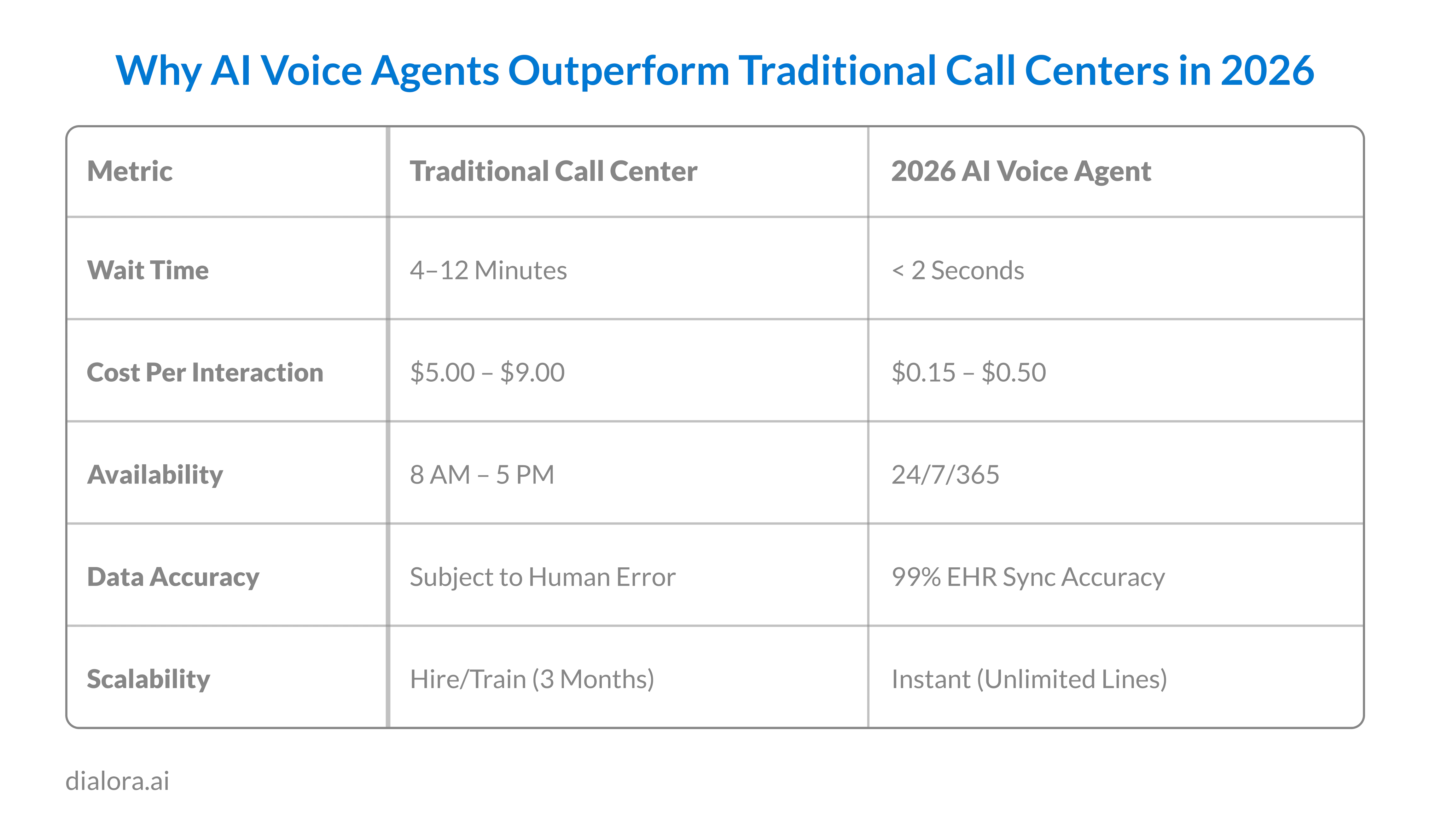
The transition from simple chatbots to Top AI Voice Agents in Healthcare is defined by "Agency." In 2024, an AI might answer a question. In 2026, an AI agent executes the task.
Pro Tip:
When evaluating Voice AI agents in healthcare regulations, ensure your vendor signs a Business Associate Agreement (BAA) and offers "Zero Data Retention" options for sensitive audio files to meet the latest 2026 HIPAA standards.
Addressing the Pain Points: Staff Burnout and Lost Revenue
Healthcare administrators are currently facing two massive hurdles:
- Staff Attrition: 52% of medical staff report burnout from repetitive admin tasks.
- Leaked Revenue: For every missed call, a practice loses an average of $150–$300 in potential patient lifetime value.
Implementing a voice calling AI agent in healthcare doesn't replace your staff; it "elevates" them. By letting the AI handle the 40% of calls that are "routine" (scheduling, directions, refills), your human staff can focus on the complex, empathetic interactions that require a human touch.
Conclusion: Future-Proofing Your Practice
The AI voice agents in healthcare market potential is no longer a forecast, it is a reality. As we move through 2026, the gap between "AI-enabled" practices and "legacy" practices is widening. Providers using the Best AI Voice Agents in Healthcare are seeing higher patient satisfaction scores, lower overhead, and most importantly, a more focused, less-stressed clinical team.
The transition to voice AI is an investment in your practice’s longevity. By automating the "busy work," you reclaim the "heart work" of healthcare.
Don't let your patient's experience fall behind. Schedule a personalized demo with Dialora today to see how our healthcare-specific AI voice agents can transform your front desk operations and maximize your clinical ROI.
FAQ: Navigating the 2026 Voice AI Landscape
How do AI voice agents improve patient retention?
AI voice agents ensure that patients get immediate answers. In 2026, patient loyalty is driven by convenience. If a patient can't reach your office to reschedule an appointment at 8 PM on a Sunday, they may look elsewhere. An AI agent provides 24/7 accessibility, making it easier for patients to stay within your care network.
Are AI voice agents in healthcare HIPAA-compliant?
Yes, provided the platform is built on HIPAA-eligible infrastructure. Leading platforms like Dialora use end-to-end encryption (TLS 1.3), multi-factor authentication, and provide comprehensive audit trails. Always verify that the provider will sign a BAA (Business Associate Agreement) before deployment.
What is the typical ROI for AI voice agents?
According to a 2026 Microsoft-IDC study, healthcare organizations see a return on investment within 14 months. On average, for every $1 invested in AI voice automation, organisations generate $3.20 in value through reduced administrative time and fewer appointment no-shows.
Can AI voice agents handle emergency calls?
Top-tier agents are programmed with "Urgency Detection." If a patient mentions chest pain, difficulty breathing, or other red-flag symptoms, the AI is designed to instantly transfer the call to a human nurse or provide instructions to call 911, ensuring patient safety remains the priority.