TL; DR
- Conversational AI has moved from experimental to operational for enterprise teams. The pilot phase is over.
- The right platform depends on your primary channel, use case depth, and integration requirements. Voice-heavy teams need voice-first. Digital-first teams need stronger chat NLP.
- This guide breaks down how to evaluate conversational AI tools without wasting months on the wrong shortlist.
Why Conversational AI Platforms Stopped Being Optional in 2026
Your customers are not waiting on hold anymore. If your system makes them, they leave.
Enterprise teams spent 2023 evaluating conversational AI. They spent 2024 piloting it. By 2025, the teams that deployed it stopped thinking about it as an experiment. The procurement lead at one mid-market financial services firm flagged it during the Q2 board review. Her team had run pilots with three vendors over 18 months. The pilot that won wasn't the one with the best demo. It was the one whose voice latency stayed under 1.2 seconds at 200 concurrent calls.
In 2026, conversational AI platforms are infrastructure, not innovation. The question is not whether to deploy one. It is the platform that fits your channel mix and use case depth. Enterprise conversational AI has crossed the chasm from emerging tech to operational baseline.
Conversational AI platforms are software systems that enable automated, natural language interactions between businesses and users across voice, chat, and text channels. In 2026, the leading platforms combine NLP, dialogue management, and integration layers to handle customer intake, lead qualification, support, and booking at scale. The best conversational AI platforms 2026 evaluation comes down to four variables. Channel depth, dialogue complexity, integration layer, and escalation logic.
What Conversational AI Actually Means in 2026
The term has been stretched far enough to include basic chatbots and advanced LLM-powered voice agents in the same product category. That ambiguity makes evaluation harder than it needs to be.
For this guide, conversational AI means a system that holds a multi-turn, natural language interaction with a user via voice, chat, or text, understands intent, takes action in connected systems, and manages dialogue state across turns. The distinction matters because most chatbot platform vendors now market themselves as conversational AI, even when their underlying architecture is a decision tree with a thin NLP wrapper.
A pop-up widget that answers three FAQ questions is not conversational AI. An agent that qualifies a lead, books a meeting, and syncs the outcome to your CRM is.
How Conversational AI Platforms Work Under the Hood
Understanding the architecture helps you evaluate vendors without being led by marketing copy.
Every conversational AI platform runs on four core layers.
- NLP layer: A modern NLP platform interprets what the user said and identifies intent. This is where 2026 platforms diverge most sharply. Some still use intent-classification models trained on narrow domains. Others use general-purpose LLMs fine-tuned on conversation data.
- Dialogue management layer: Tracks conversation state and determines the next response. Dialogue management quality is the single biggest predictor of whether the platform feels conversational or scripted.
- Integration layer: Connects to calendars, CRMs, and data sources to take action. The depth of native integrations versus "available via API" matters more than vendor pricing pages suggest.
- Delivery layer: Routes the conversation to the right channel. Voice, chat, SMS, or API. True omnichannel AI platforms run the same dialogue across all channels with a consistent state.
The differences between platforms live in how well each layer performs for your specific use case and how those layers connect to the rest of your stack.
Pro-tip: The four-layer architecture is universal. The depth at each layer is where the real evaluation lives.
Voice vs Text Conversational AI: What the Difference Means for Your Platform Decision
Not every conversational AI platform handles voice and text equally. Most platforms started in one channel and bolted on the other.
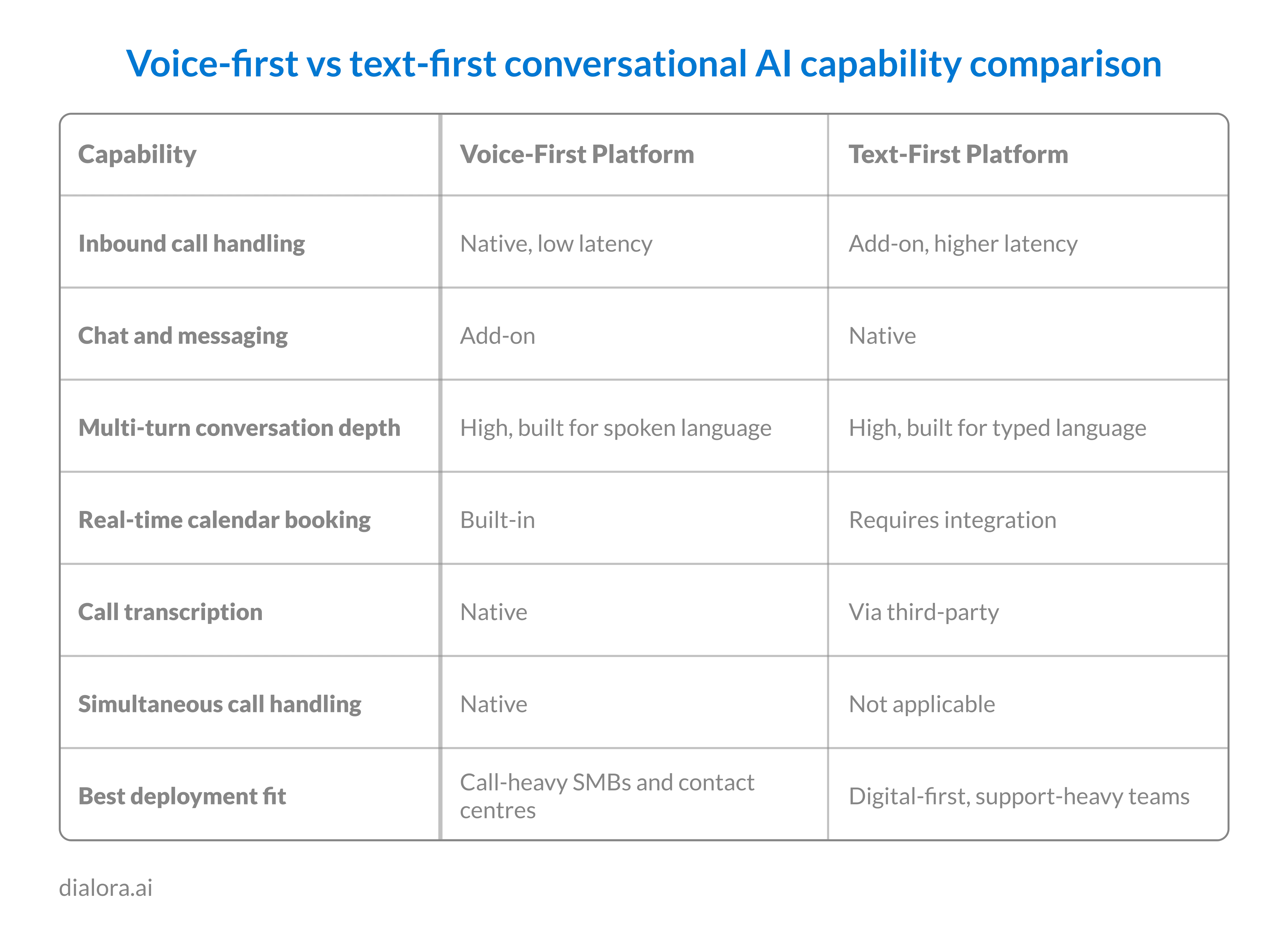
Text-first platforms tend to have stronger intent classification and conversation design tools. They struggle with voice-specific requirements. Real-time processing, latency tolerance, and the way humans speak in incomplete sentences on a phone call.
Voice-first platforms handle the phone channel natively. They are designed for call flows, caller interruption, multi-turn qualification, and real-time booking. Voice and text AI parity is a marketing claim. Real channel parity is rare. Test it on your actual workflow before signing.
If your primary channel is inbound calls, this distinction determines whether the platform performs or simply functions.
Voice-first vs text-first conversational AI capability comparison
This matrix breaks down the top conversational AI software capability gap between voice-native and text-native architectures.
What to Evaluate When Shortlisting Conversational AI Tools
Most evaluation processes go wrong in the shortlist phase. Teams select the most recognizable brand names rather than the platforms with the best fit for their use case.
The evaluation criteria that actually matter.
- Channel depth: Does the platform handle your primary channel natively, or as an integration?
- Dialogue complexity: Can it manage multi-turn conversations with branching logic, or only linear scripts?
- Integration layer: Does it connect to your existing CRM, calendar, and ticketing tools out of the box?
- Escalation logic: How does it hand off to a human agent, and how reliably does it do that?
- Latency: For voice, anything over 1.5 seconds degrades the caller experience.
These five criteria separate the platforms that perform from the ones that demo well. Conversational AI tools that pass all five at your specific call volume make the shortlist. The rest don't.
How Businesses Use Conversational AI Platforms in Practice
The use cases have matured. In 2026, the most common enterprise deployments fall into four categories.
Customer service deflection handles tier-1 support queries without a human agent in the loop. Inbound lead qualification captures and scores inbound inquiries at the moment of first contact. Appointment and booking automation runs calendar scheduling without a receptionist involved. Proactive outbound manages reminder calls, follow-ups, and re-engagement campaigns automatically.
This is conversational AI for business at the operational layer. AI customer engagement at scale used to require a 40-person contact centre plus an offshore overflow team. Now it requires a properly configured platform and one ops lead reviewing weekly transcripts.
Each category has different platform requirements. A team deploying for service deflection needs different NLP depth than a team running outbound reminder campaigns across multiple verticals.
Where Conversational AI Platforms Fall Short
Every platform in this category has limitations worth understanding before you sign a contract.
Highly unstructured conversations where the user's intent shifts unpredictably mid-call still challenge most platforms. Complex compliance environments require careful vetting of how the platform handles data, call recording consent, and audit logging. And integrations listed as "available" on a pricing page often require implementation work that is not included in the base subscription.
The gap between virtual assistant technology at the consumer level (Alexa, Siri) and enterprise conversational AI is also worth noting. Consumer assistants are tuned for breadth across many domains. Enterprise platforms are tuned for depth in one workflow. The architectures look similar from the outside. They aren't.
Test the edge cases in your evaluation. Do not evaluate on the best-case demo the vendor runs for you.
Pro-tip: Vendors demo the best case. Buyers should evaluate the worst case. That gap is where most procurement decisions go wrong.
Ready to see conversational AI handle your actual call type?
What Dialora Brings to the Conversational AI Stack
For businesses where voice is the primary channel (healthcare, legal, dental, automotive, and finance), Dialora is built for the call flow first.
Inbound calls are answered immediately. Callers are qualified, booked, and logged without a human in the loop. Outbound campaigns handle reminders, follow-ups, and re-engagement automatically. Every call produces a transcript, a sentiment summary, and structured data synced to your CRM. The platform is GDPR compliant, SOC 2 ready, with BAAs available for healthcare customers and PCI compliance for payment-related calls.
For enterprise teams evaluating conversational AI platforms for call-heavy verticals, Dialora handles the phone channel at the depth most platforms offer only as an add-on. Conversational AI for business workloads at SMB and mid-market scale work better when the voice layer is the foundation, not a feature.
How to Run a Conversational AI Evaluation That Actually Works
The teams that get stuck in evaluation cycles are usually evaluating the wrong criteria.
Start with your call type. Define the dialogue complexity that type requires. Test each platform against that specific scenario, not a general demo. Check the integration layer against your actual CRM and calendar stack. Then evaluate latency and escalation logic under real call conditions.
That process takes longer than watching a product demo. It produces a decision you can stand behind.
What This Means for Your Conversational AI Platform Decision in 2026
The best conversational AI platforms 2026 shortlist is real and finite. The category has matured past the experimental phase. The four-layer architecture (NLP, dialogue management, integration, delivery) is now table stakes. The differentiation lives in channel depth, dialogue complexity, and integration fit for your specific stack. Enterprise conversational AI procurement in 2026 isn't a question of whether the technology works.
It's a question of which platform's strengths align with your primary channel and use case mix. Voice-heavy teams pick voice-first platforms. Digital-first teams pick text-first platforms. Omnichannel AI platforms exist, but real channel parity is rare. The decision that matters most is the one most teams skip. Test the platforms on your actual workflow, not on the vendor's demo script.
Your evaluation shortlist should match your primary channel. Dialora is built for the call, not bolted onto it. Ready to see it handle your workflow? Get a Platform Demo
Frequently Asked Questions
What is conversational AI?
Conversational AI is software that enables natural language interactions between a business and users via voice, chat, or text. It uses an NLP platform layer for intent understanding and a dialogue management layer to track conversation state and take action in connected systems automatically. The category covers voice agents, chat agents, and multi-channel implementations.
What are the best conversational AI platforms in 2026?
The best conversational AI platforms 2026 depend on your primary channel and use case. Voice-heavy businesses need voice-first platforms. Digital-first teams need stronger chat NLP. Evaluate on channel depth, dialogue complexity, and integration fit, not brand recognition alone. The shortlist that works for a healthcare call centre looks different from the one that works for an e-commerce chat deflection deployment.
How does conversational AI work?
An NLP layer interprets user intent. A dialogue management layer tracks conversation state. An integration layer takes action in connected systems. A delivery layer routes the interaction to the right channel: voice, chat, or text. Voice and text AI platforms run the same four-layer architecture, just optimized for different channel characteristics.
What is the difference between conversational AI and chatbots?
Traditional chatbots follow fixed decision trees and handle only pre-defined inputs. A modern chatbot platform marketed as conversational AI uses natural language understanding to manage open-ended inputs, multi-turn dialogue, and actions based on context. Real conversational AI uses NLU plus dialogue management. Decision-tree chatbots use keyword matching. The line between them is where most vendor positioning gets confused.
How do businesses use conversational AI platforms?
The most common deployments are service deflection, inbound lead qualification, appointment booking automation, and proactive outbound campaigns. Each use case requires different NLP depth and integration layer capabilities from the platform. AI customer engagement programs typically combine two or more of these patterns rather than running just one.
What's the difference between conversational AI and virtual assistant technology?
Virtual assistant technology at the consumer level (Alexa, Siri, Google Assistant) is tuned for breadth across many domains. Enterprise conversational AI is tuned for depth in one workflow. Consumer assistants handle weather, music, smart home, and shopping. Enterprise platforms handle one specific business process end-to-end. The architectures look similar from the outside. They aren't optimized for the same outcomes.
Is omnichannel AI the same as multi-channel conversational AI?
No. Omnichannel AI means the same dialogue state and customer context flow across voice, chat, SMS, and email. The customer can start in chat, switch to voice, and the platform retains the conversation. Multi-channel conversational AI usually means the vendor offers multiple channels as separate products. Real omnichannel is rare and worth verifying during evaluation.