TL; DR
- Every AI phone call costs a fraction of the human equivalent and runs around the clock with zero idle time. AI calling scales without overtime or turnover.
- Human agents still win on complex, high-empathy conversations where the relationship is the product.
- The ROI case for the AI phone agent vs human decision is strongest where call volume is high, tasks are repeatable, and response speed directly affects revenue.
How the AI Phone Agent vs Human Agent Decision Actually Plays Out
Your call centre costs are fixed. Your call volume is not.
Every hour a human agent sits idle costs the same as an hour at full capacity. Every call that comes in during a staffing gap goes unanswered. Every answered call that deviates from the script is a variable you cannot control at scale.
AI calling does not have any of these problems. Every AI phone call runs at the same cost, whether it's the first of the day or the thousandth. The question is not whether AI phone agents perform. It is where they outperform humans and where they do not.
An AI phone call handled by an AI agent costs 70 to 85 per cent less than the human equivalent, with no idle time, no turnover, and 99 per cent script adherence. Human agents outperform AI in complex, high-empathy conversations where relationship-building drives conversion. The AI calling vs human agent ROI case is strongest where call volume is high, tasks are repeatable, and speed of response directly affects revenue.
The Real Cost Difference Between AI Calling and Human Agents
Human agents cost more than their salary.
A fully loaded call centre agent in the US runs $45,000 to $65,000 per year in salary, benefits, training, and supervision. That covers roughly 6 to 7 hours of productive call time per day, 220 working days per year. The call centre director at one mid-market e-commerce firm flagged it after the Q3 review. Her ramped agents averaged 47 productive call minutes per hour. Her newest hires averaged 22. The variance alone cost the team six figures over the year.
An AI phone agent operates continuously. No downtime between calls. No ramp time. No turnover cost. No overtime. The cost comparison AI vs human math is brutal once you load every variable into the spreadsheet, not just headline salary.
Annual cost and performance comparison for call centre and SMB buyers
This breakdown shows the cost comparison AI vs human numbers that move the P&L, with labor cost savings itemized line by line.
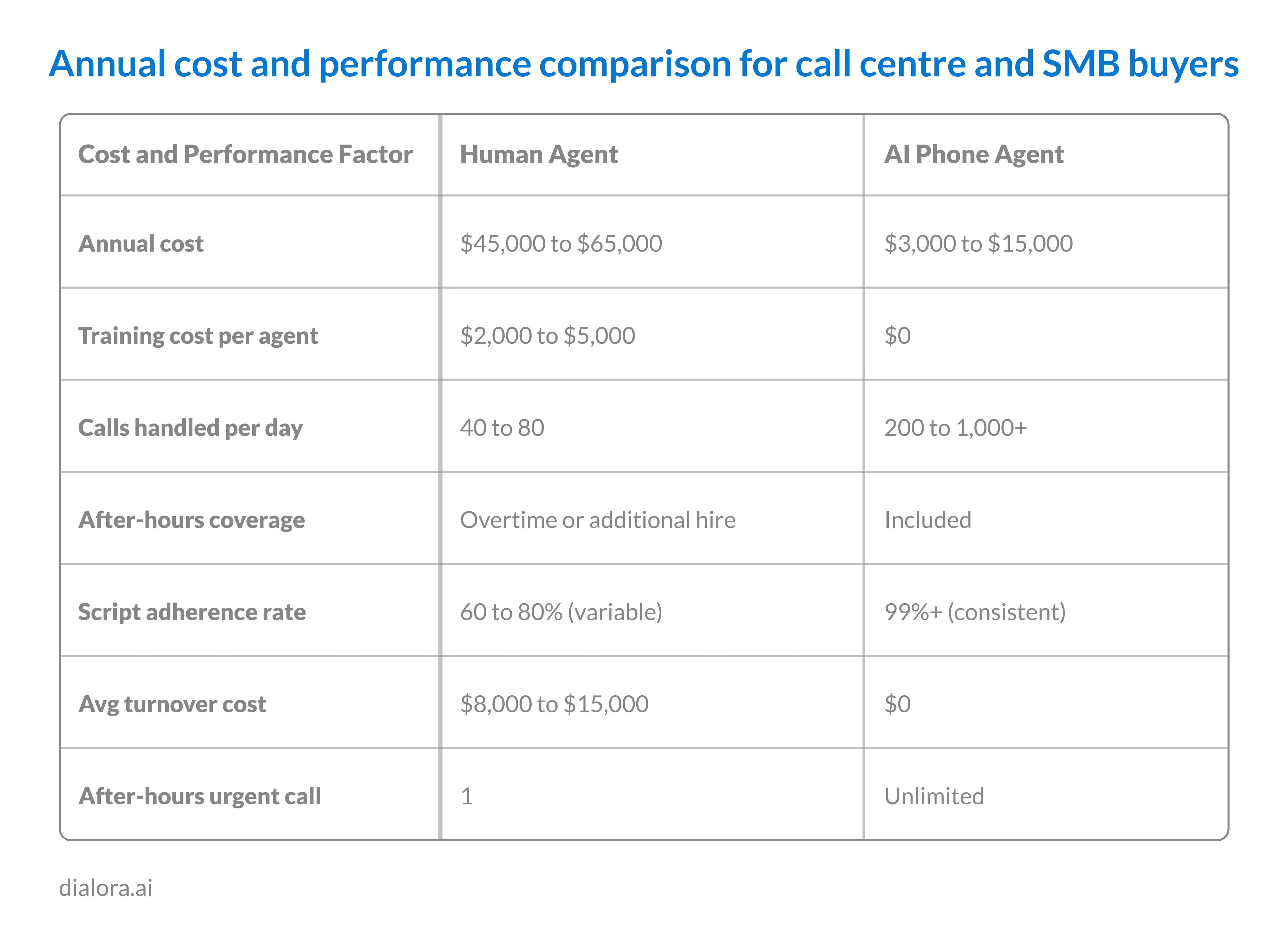
The labor cost savings on AI calling aren't from replacing humans. They come from removing the per-call cost overhead that scales linearly with volume.
Where AI Phone Agents Outperform Human Agents
AI calling delivers its clearest ROI in high-volume, repeatable call types.
Appointment reminders. Lead qualification. After-hours intake. Inbound booking. Outbound follow-up campaigns. These are calls with defined scripts, predictable outcomes, and measurable conversion targets. The AI call performance data on these workflows consistently beats human equivalents on three metrics. Answer speed, script adherence, and time-to-resolution.
In these scenarios, AI phone agents do not just match human performance. They exceed it. The agent never deviates from the script, never skips a qualification question, and never has a slow afternoon that shows up in your conversion data. Teams running automated phone calls vs live agents A/B tests in 2025 reported answer-rate gaps of 30 to 50 percentage points in favour of AI on after-hours and Monday-morning volume.
Where Human Agents Still Have the Edge
This matters as much as the case for AI.
Complex objection handling in high-value sales calls, crisis management, and long-form relationship conversations is where human agents retain a clear advantage. A caller with a distressed legal matter needs a human. A patient with a complicated medical history needs empathy that AI handles less well. The human vs AI in sales calls comparison flips the moment the average deal size crosses a threshold where a human relationship genuinely changes the conversion rate.
The businesses seeing the best results are not replacing human agents with AI. They are routing repeatable call volume to AI and redirecting human capacity to conversations where it changes the outcome. The net effect on agent productivity is a 2x to 3x lift, since humans spend their time on calls that actually need them.
How Customers Actually Feel About AI Phone Agents
This question comes up in every evaluation. The real answer is more nuanced than the fear suggests.
Callers care about speed and resolution more than whether the voice is human. A well-designed AI agent that answers in under two seconds, qualifies correctly, and books the appointment outperforms a human agent who puts the caller on hold for four minutes. The customer experience AI data backs this up. CSAT scores on AI-handled calls now consistently match or beat human-handled calls for routine workflows.
Where AI loses caller confidence. Robotic phrasing, an inability to handle anything off the script, and loops that do not escalate to a human when they should.
A well-configured AI phone agent removes all three of those failure points. Script quality and escalation logic determine the caller experience. The call quality AI baseline in 2026 is no longer a question of whether the voice sounds human. It does. The question is whether the escalation discipline holds up on edge cases.
Pro-tips: CSAT on AI-handled calls matches or beats human-handled calls for routine workflows. The fear that customers hate AI didn't survive the data.
How to Decide When to Use AI vs Human Agents
The decision is not AI or human. It is task routing.
Ask one question for each call type your team handles. Is the outcome of this call predictable enough to script?
If yes, AI handles it. If the call requires real-time judgment, relationship capital, or complex empathy, that stays with a human agent. The conversion rate phone calls data on routine bookings (appointment reminders, status confirmations, simple FAQ) sits near 100 per cent for AI. The conversion rate on consultative high-value sales calls sits substantially higher for trained humans.
Most businesses find that 60 to 70 per cent of their inbound call volume fits the first category. That is the portion AI calling removes from the front desk, freeing agents for the calls that require them.
The Clearest Signal That AI Calling Is Right for Your Team
You do not need a lengthy evaluation to know whether AI calling delivers ROI for your operation.
Look at your call log from last month. Identify the call types that follow a predictable script. Count how many happened after hours or during a staffing gap. Calculate the average value of each call that went unanswered.
That number is the floor of your AI calling ROI. Everything above it is upside.
Ready to see what AI calling looks like on your actual call data?
How Dialora Handles the AI Phone Agent vs Human Routing Question
Dialora is the AI calling platform built for SMBs and mid-market teams that want to automate the repeatable call volume without losing the human edge on complex calls. Inbound call answering 24/7. Outbound campaigns. Appointment booking. Lead qualification. Warm and cold transfers to human agents with full context attached. Post-call transcripts, recordings, sentiment analysis, and CRM data sync. Multilingual support across English, Spanish, French, Portuguese, and Turkish. Coverage in 30+ countries. GDPR compliant. SOC 2 ready. BAA available for healthcare customers. PCI compliance for payment-related calls. The architecture is designed to escalate on named-entity flags, so the AI never tries to handle a call that needs a human.
What the AI vs Human Decision Means for Your Call Center in 2026
The AI phone agent vs human question stopped being binary in 2024. The teams getting the best results are running both. AI handles the repeatable volume (60 to 70 per cent of inbound calls for most operations). Humans handle the calls where the relationship is the product.
The cost math, the labor cost savings, the script adherence numbers, and the after-hours coverage all favour AI on the repeatable layer. The conversion rate on consultative selling, the empathy on crisis calls, and the relationship-building on enterprise accounts all favour humans on the strategic layer.
The decision worth making in 2026 isn't AI or human. It's where the line sits between them in your specific call distribution. Your human agents are handling calls AI should own. Free them up for the work that actually moves revenue. Ready to see where the line sits for your call mix? Start Your Free Trial With Dialora
Frequently Asked Questions
Is an AI phone agent better than a human?
For high-volume, repeatable calls (booking, intake, reminders, and outbound follow-up), AI outperforms humans on cost, consistency, and availability. For complex, relationship-driven conversations, human agents deliver better outcomes. The AI phone agent vs human decision should be made per call type, not platform-wide.
What is the ROI of AI vs human call agents?
AI phone agents typically cost 70 to 85 per cent less than human agents for equivalent call volume, with higher script adherence and 24/7 coverage. The AI calling vs human agent ROI is highest where call volume is high, and tasks are repeatable. ROI compresses on complex consultative calls where human conversion rates justify the higher per-call cost.
How do customers feel about AI phone agents?
Callers prioritize speed and resolution over whether the voice is human. A well-configured agent that answers fast and resolves correctly outperforms slow or inconsistent human handling in the majority of first-touch call types. The customer experience AI data in 2026 consistently shows CSAT parity or an AI advantage on routine workflows.
When should you use a human agent instead of AI?
Use human agents for high-value sales conversations, complex objection handling, emotionally sensitive calls, and any scenario where real-time judgment affects whether the caller converts or stays. The human vs AI in sales calls trade-off flips toward humans the moment the deal size crosses a threshold where relationship capital changes the conversion rate.
How does AI phone agent performance compare to humans?
AI agents maintain 99%+ script adherence, handle unlimited simultaneous calls, and operate continuously. Human agents outperform AI in unscripted, high-empathy scenarios where the relationship is the product. The AI call performance advantage is structural on repeatable calls and disappears on consultative ones.
What's the real labor cost savings of switching from human to AI agents?
The labor cost savings on AI calling come from three places. Per-call cost reduction (AI runs at fractions of human per-call rates), eliminated turnover cost ($8,000 to $15,000 per agent per year), and removed after-hours overtime burden. For a 5-person call centre handling 5,000 monthly calls, the annual savings typically range between $120,000 and $200,000.
How does AI affect agent productivity for the humans who stay?
When AI absorbs 60 to 70 percent of repeatable call volume, the remaining human agents spend their time on calls that actually need judgment. The agent productivity lift is 2x to 3x because the human time-per-revenue-call ratio improves dramatically. Agents stop handling status checks and start handling consultative work. Turnover drops because the work becomes more interesting.