TL; DR
- Conversational AI works well now, but only on the boring stuff. Order status, password resets, appointment changes. Those get handled without a human about 70% of the time.
- Across everything else, the honest average is 41%. Vendors quote 30 to 50%. Most teams get 10 to 15% in year one.
- Why the gap is so wide has nothing to do with which software you buy. It depends on what your customers actually ask about, and how current your documentation is.
- Voice is the growth story and the hard one. No scrollback, no room for silence, callers interrupting, background noise. It breaks on engineering, not on the model.
- The thing that separates good deployments from bad ones is the handoff. Right now only 15% of people get a transfer where the human already knows the story.
- Start small. Automate a few narrow intents, build the exit before you launch, and watch escalations alongside containment.
A customer types: "My order still hasn't arrived and I moved house last week, can you send it to the new address?"
The system spots the word order, opens the order-status script, and asks for an order number. The address change never registers. Two sentences later the customer is asking for a human.
That single exchange explains most of what people believe about conversational AI, and most of why the 2026 numbers look contradictory at first glance. Companies are buying this software faster than almost any category in enterprise software right now. Ask their customers, and a clear majority still say they would rather talk to a person.
Both things are true, and the reason is not stubbornness. People have stopped judging automation as one thing. They have started sorting by stakes. A delivery date, sure, let the machine handle it. A disputed charge, no. And that sorting has been getting sharper every year, not softer.
So, the interesting question in 2026 is no longer whether this technology works. It is which conversations it should have, what it realistically resolves once it does, and what happens in the moment it has to hand you over.
We will walk through the market and adoption figures worth trusting, why deflection rates swing so wildly between companies running identical software, what makes a phone call harder to automate than a chat window, how the main platforms compare, and where the whole thing still breaks.
What is conversational AI, and how is it different from a chatbot?
Conversational AI is software that understands what a person means, decides what to do about it, and responds in natural language, across text or voice. The word doing the work in that sentence means. Everything that came before it matched words instead.
How did phone menus and early chatbots fake understanding?
They used decision trees. A phone menu asks you to classify your own problem in advance, from a list built around the company's org chart. Press 1 for billing. Early web chatbots did the same thing with keywords: if the message contained the word refund, start the refund script.
This works until a real person speaks like a real person. Consider what a customer actually types:
WHAT A KEYWORD SYSTEM SEES
- Customer: "My order still has not arrived, and I moved house last week, can you send it to the new address?"
- Old system: detects the word "order", starts the order-status script, asks for an order number, and never registers the address change at all. The customer repeats themselves, gets frustrated, and asks for a human.
There are two requests in that sentence, and a keyword system can only see one. It is not that the software was badly built. It is that matching words to scripts has no concept of a sentence containing two intentions, or of a person correcting themselves halfway through.
What changed when language models arrived?
Large language models learned language from enormous amounts of text rather than from rules an engineer wrote. That produced a genuine jump in capability. A model can read the sentence above, recognise it contains a delivery query and an address change, handle both, and confirm both back to the caller without anyone having scripted that particular combination.
But fluency created a new problem, and it is the one that decides whether a deployment works. A language model will answer confidently whether or not it knows the answer. Ask it about your refund window and it will produce a fluent, plausible, completely invented policy, in the same tone it uses for true things.
Why does grounding matter more than fluency?
Because a support answer that sounds right and is wrong costs more than no answer at all. This is why production systems do not simply ask a model to talk. They ground it: before responding, the system retrieves the actual policy document, the actual account record, the actual order status, and the model answers from that retrieved material rather than from memory.
This has a practical consequence most buyers discover too late. The quality of an AI agent tracks the quality of what you connect it to. Two companies buying identical software get different results because one has current documentation and a clean CRM, and the other has a help centre that fell behind the product two releases ago.
This explains something buyers hit constantly. When a vendor demo goes brilliantly and your pilot does not, the model is rarely the difference. The demo ran on freshly written documentation against a curated set of questions. Your pilot ran on the documentation you actually have.
How big is the conversational AI market in 2026?
Large enough that the category risk is gone, and growing at a rate that five independent research firms agree on within a few points of each other.
- The market is large and growing consistently.
$17.97 billion in 2026, heading to $82.46 billion by 2034. Fortune Business Insights puts the global market at $17.97 billion this year, growing roughly 21% annually. Fortune, MarketsandMarkets, Grand View, Precedence and IMARC all project 20% plus growth, which is an unusual agreement for this kind of forecast. Conversational AI adoption is no longer a bet on whether the category survives.
- Voice is the fastest growing segment, by a wide margin.
The AI voice agents sub-market sits at $3.51 billion in 2026 and grows at 39% a year, nearly double the pace of the broader market, with Market.us projecting $47.5 billion by 2034. Chat is still the larger base at 62% of the market, but the growth curve belongs to the AI phone call.
- The consumer habit already exists.
157 million Americans will use voice assistants in 2026, across 8.4 billion voice-enabled devices worldwide. Nobody needs to be taught to talk to software any more, which removes the adoption barrier that slowed the first wave of this technology a decade ago.
What do the 2026 conversational AI adoption statistics actually show?
That the technology crossed from pilot to production, and that the honest performance numbers are good without being miraculous. Three figures matter more than the rest.
- Deflection has a real median now: 41.2%.
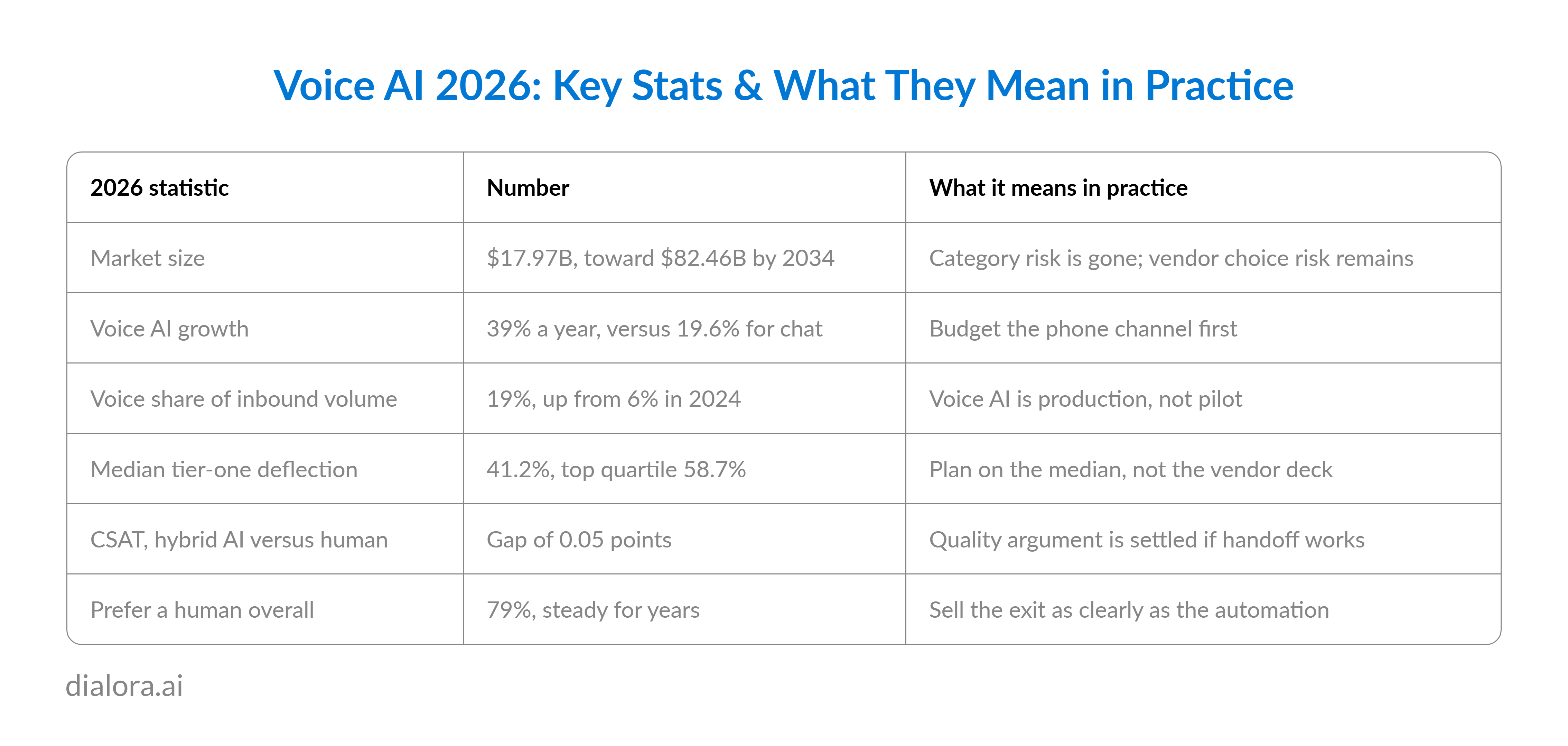
Across enterprise CX programmes, median tier-one deflection sits at 41.2%, with the top quartile at 58.7%. Deflection means the share of contacts fully handled without a human.
- The satisfaction gap has effectively closed, with one condition.
Pure AI handling scores 4.1 out of 5 on CSAT against 4.3 for human agents. Hybrid flows with clean escalation narrow that gap to 0.05 points. The condition is that the escalation genuinely works.
- The operational gains are consistent across sources.
AI agents cut average handle time 30% to 40% per McKinsey, and 92% of companies deploying AI in customer service report measurable response time improvements. At Wyndham, AI now answers 28% of incoming calls with handle time down 30% to 50%.
Why does deflection vary so much between companies?
Because the average hides the only variable that matters, which is what the contact was about. The same system, on the same day, produces wildly different numbers depending on intent:
- Password resets and order status: 70% plus.
A closed question with one correct answer, retrievable from a system the agent can reach. There is nothing to judge.
- Nuanced complaints: rarely above 25%.
The customer wants acknowledgement as much as resolution, and the right answer depends on the context no database holds.
So, a company handling mostly order queries reports 60% deflection and a company handling mostly disputes reports 20%, using identical software. When a vendor quotes a deflection figure, the only useful follow-up question is which intents it was measured on.
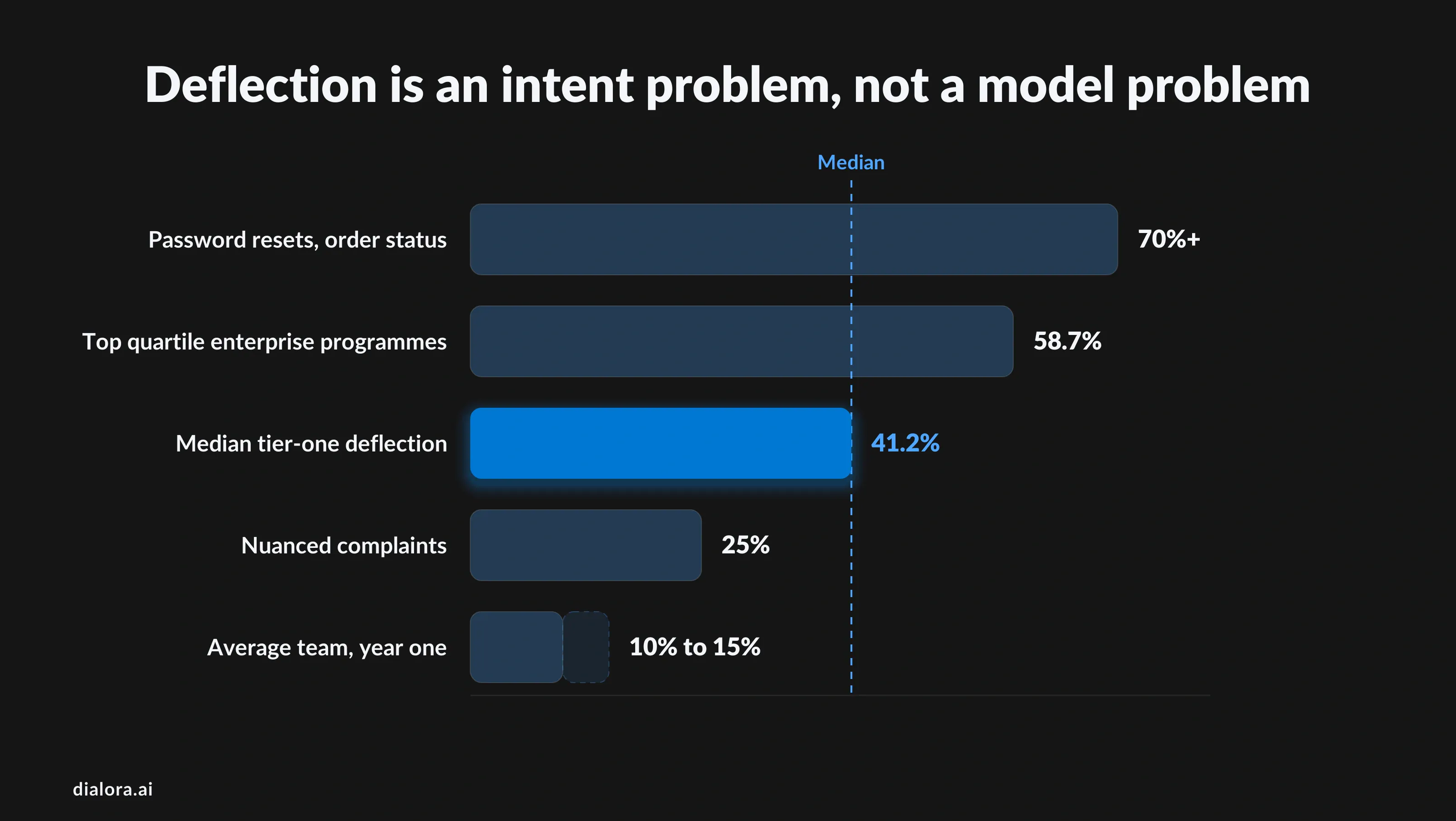
Plan your business case on the median rather than the vendor deck. The average team lands at 10% to 15% true deflection in year one, well below the 30% to 50% vendor marketing implies, and anything above the 41.2% median is upside you earned through documentation quality rather than something the software delivers on its own.
What would an AI conversation sound like in the future?
Less like a script, and more like talking to a colleague who was already briefed. Three shifts define the conversational AI customer service future, and all three are measurable today rather than speculative.
It will remember, so you never start over
Conversation with context means the system treats the conversation as the durable thing, and channels as doors into it. Today only 15% of consumers experience a smooth handoff from AI to a human agent, per Twilio, which is why repeating yourself is the defining frustration of automated support.
THE SAME CUSTOMER, TWO SYSTEMS
Without context: "Thanks for calling. Can I take your order number?" The customer, who emailed about this yesterday, explains the whole thing again.

With context: "Hi Sarah, this is about the delayed order you emailed us about yesterday, correct? It shipped this morning and is due Thursday."
The second version is not a smarter model. It is a system that persisted the record and looked it up before speaking. That is an architecture decision, which is why some platforms do it and expensive ones sometimes do not.
It will tolerate messy speech, because everyone speaks messily
People self-correct, trail off, and merge two requests into one sentence. Systems that need clean phrasing fail exactly when the caller is stressed, which is exactly when they called. The bar for an AI voice call in 2026 is handling the order-and-address sentence from earlier as two tasks in one turn, without asking the customer to repeat either.
Customers will keep sorting by stakes, not by novelty
This is the finding that explains the contradiction we opened with. 68% of customers now prefer AI for simple status-style questions, up from 41% in 2024. In the same period, 74% still want a human for complaints, billing disputes and anything emotional. Both numbers moved. The sorting is getting sharper, not dissolving.
People are not anti-automation. They are anti-being-stuck. A customer checking a delivery date would rather not wait on hold for a person. The same customer disputing a charge does not want to explain themselves to a machine that cannot decide anything.
Why is voice harder to get right than chat?
Because voice removes every safety net that text provides, and this is the least understood part of the category. Four constraints apply to a phone call that do not apply to a chat window.
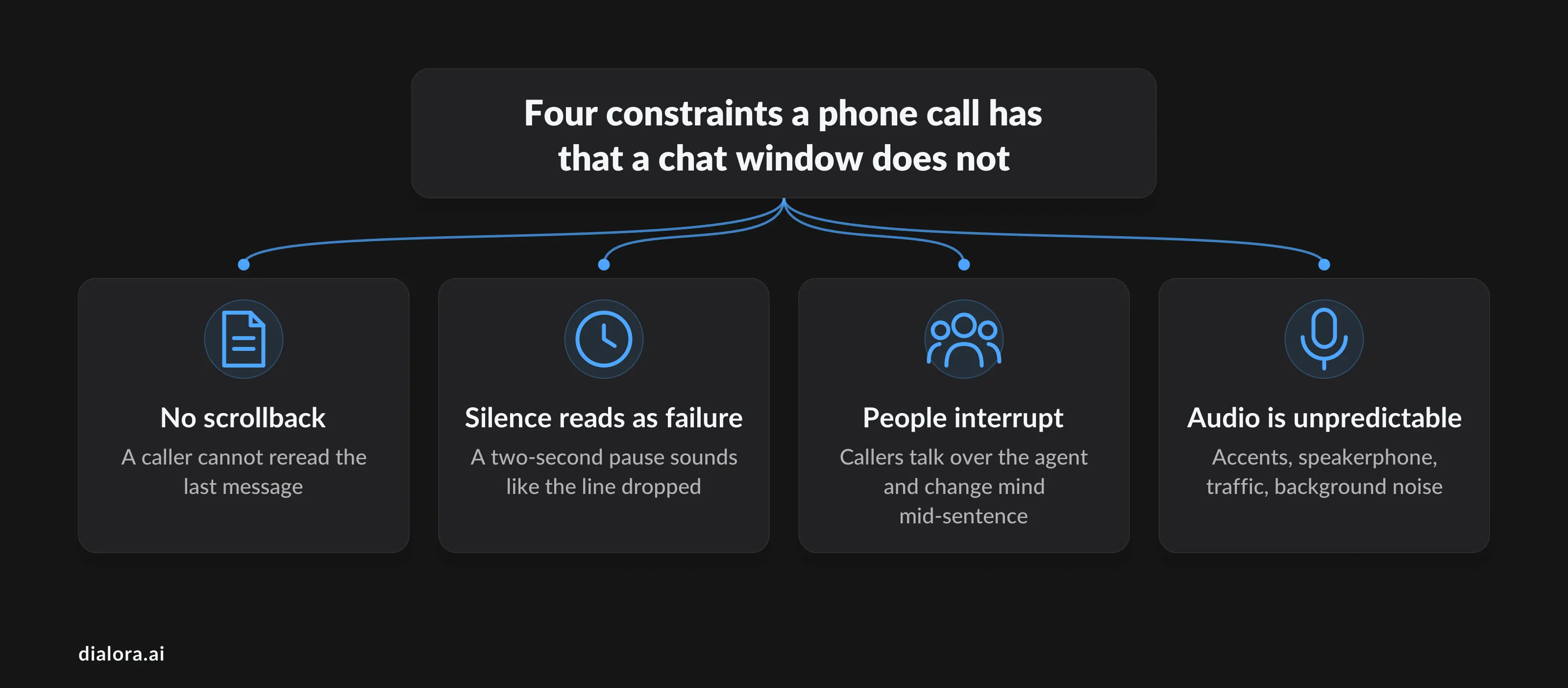
- There is no scrollback.
A chat user can reread the last message. A caller cannot. Anything unclear has to be asked again out loud, which feels like the system failing rather than the user missing something.
- Silence is a failure signal.
In chat, a two-second pause is invisible. On a call, it reads as the line dropping. The entire pipeline, hearing the caller, understanding, looking up the record and replying, has to complete inside the window where a human would naturally answer.
- People interrupt.
Callers talk over the agent, change their mind mid-sentence, and answer a question before it finishes. A system that cannot be interrupted gracefully feels robotic no matter how good the voice sounds.
- Audio is unpredictable.
Accents, speakerphones, traffic, a baby in the background. A chat message arrives as clean text. Speech arrives as whatever the microphone caught.
This is why voice deployments succeed or fail on engineering rather than on the language model, and why the voice segment grows at 39% while remaining harder to build in than chat.
Which conversational AI trends will define 2026 and beyond?
Five conversational AI trends have enough data behind them to plan against, rather than enough excitement to write about.
- The future of chatbots and conversational AI is voice-shaped.
The chatbot market grows at 19.6% while AI voice agents grow at 34.8%. Chatbots are the future of typed support, and the chatbot future is a healthy one, but the growth curve says the next five years belong to systems that can pick up a phone. The future of chatbots and conversational AI is less a replacement than a split by channel.
- Vertical agents beat general ones.
The future of AI in HVAC call handling and lead conversion is the clearest example. Most inbound calls to home services businesses go unanswered, most missed callers never try again, and every missed call is a booked job that went to a competitor. An agent that answers every call and books the work converts revenue that was simply leaking. Expect the same pattern in clinics, dealerships and property management.
- Disclosure becomes a feature rather than a concession.
72% of customers say it matters whether they are talking to AI, and regulation is heading the same way. Systems that announce themselves and offer an immediate human path convert scepticism instead of fighting it.
- The handoff becomes the differentiator.
With deflection medians public and CSAT gaps closed, the remaining variance between platforms is what happens at escalation, and 82% of consumers expect a clear and immediate path to a person.
- Expectations keep running ahead of reality.
75% of CX leaders expect AI to resolve around 80% of interactions autonomously within a few years. Against a 41.2% median today, that is a target, not a trend.
Taken together, the conversational AI agent's future is narrower and more useful than the headlines suggest: agents that own a defined set of intents completely, disclose themselves, and escalate cleanly, rather than one system attempting everything.
Where does conversational AI still fail in 2026?
Three places, and the research is unusually specific about each.
- It is usually about understanding rather than speed.
62% of escalations stem from comprehension failures. 67% of users rank accurate information as the quality that matters most, against 12% for speed, and only 8% expect an answer inside three seconds. The industry spent years optimising latency while customers were grading understanding.
- Users generally lose patience after two mistakes.
72% of users escalate to a human after one or two small mistakes, and 31% escalate after a single "I am not sure" response. There is no budget for a system that is confidently wrong twice.
- People often doubt the company's intentions.
81% of consumers believe AI in customer service exists primarily to cut costs rather than improve service, and 50% would cancel a service that relied on AI alone. This is why the 79% human-preference figure has not moved. It is a judgement about companies, not about capability.
Read those three together and the objection becomes clear. Customers are not against automation. They are against being trapped. A system that answers instantly, handles what it can, says plainly when it cannot, and passes you to a person who already knows the story does not trigger any of the three.
How should a team actually start with conversational AI?
In an order that builds evidence before it builds dependency. Each step makes the next one safer.
- Pull your top twenty contact reasons.
Not a guess, the actual list from last quarter. This tells you which intents are repetitive enough to automate and which are judgement calls, before you look at a single vendor.
- Fix the source material first.
Whatever the agent will answer from, help centre articles, policy documents, product data, needs to be current. This step predicts the outcome more reliably than the platform you pick.
- Automate the narrow intents only.
Order status, appointment changes, password resets, opening hours. Closed questions with retrievable answers, where deflection genuinely runs above 70%.
- Build the escape hatch before you go live.
A caller should reach a person by asking once, and that person should receive the transcript and the intent. Test this path more thoroughly than the happy path, because it is what customers judge you on.
- Measure containment and escalation together.
Containment rising while escalations and repeat contacts also rise is not a win. It means customers are routing around the system, and you have moved the queue somewhere your reporting cannot see.
And the blunt caution. If your call volume is a dozen conversations a day, none of this is your constraint. A phone answered by a person is still the best conversational experience ever shipped. The conversational AI for business future belongs to teams whose volume, hours or missed calls exceed what people can cover, and not before that point.
Conclusion
The two numbers from February are still the whole story. A market doubling every few years, and 79% of customers who prefer a person. Neither is going away, and the companies treating one of them as noise are the ones the other number eventually punishes.
Read the 2026 statistics as a design brief rather than a forecast. Automate the 68% of contacts where customers already prefer AI. Guarantee the human path the 89% are asking for. Plan against a 41% deflection median instead of a vendor slide, and spend the difference on the handoff, because that is where the remaining variance between platforms lives.
The future of conversational AI is not a machine that sounds human. It is a system that knows which conversation it is in, and hands over the moment it is the wrong one. That is the whole Conversational AI Future worth building toward, and the data says customers will meet you there.
Dialora builds AI voice agents that answer every call, resolve the intents customers prefer automated, and pass the rest to your team with the full context attached, so nobody starts the story twice. Try a 7-day free trial
Frequently asked questions
How will conversation with context usher in the AI future?
By removing the restart. Today only 15% of consumers experience a smooth AI-to-human handoff, and repeating information is the top frustration in automated support. Systems that persist context across channels and sessions, so a caller who emailed yesterday is met mid-story today, close the gap that keeps 79% of people preferring humans. The change is architectural: conversation becomes the durable record, with channels as entry points into it.
What would an AI conversation sound like in the future?
Like speaking to someone already briefed. It handles multi-intent sentences in one turn, tolerates self-correction and rambling, remembers the previous contact without being asked, announces that it is AI, and moves to a person the moment stakes or emotion rise. Customers are already sorting this way: 68% prefer AI for simple status questions while 74% want humans for disputes.
Which companies offer the best conversational AI platform software?
For voice-first deployments: Dialora for managed AI voice agents with context-rich handoff, and Bland, Retell or Vapi for developer-built voice infrastructure. For chat-led suites: Zendesk AI, Intercom Fin and Salesforce Agentforce, each strongest inside its own product suite. For fully custom builds: Google Dialogflow, IBM watsonx Assistant and Amazon Lex. Evaluate on escalation quality and integration depth rather than demo polish.
What percentage of customer service is AI in 2026?
Voice AI handles about 19% of inbound contact centre volume in 2026, up from 6% in 2024, and median tier-one deflection across enterprise programmes is 41.2%. Claims that AI already powers 95% of interactions recycle a stale projection and do not match any current measured data.
Why do vendor deflection rates differ so much from real results?
Because deflection depends on intent type and documentation quality, not on the model. Password resets and order status deflect above 70%, while nuanced complaints rarely break 25%, so a vendor quoting a blended figure is describing their demo's question set rather than your contact mix. Average teams reach 10% to 15% in year one against a 41.2% median.
Will chatbots replace human customer service agents?
The 2026 data says no, and points somewhere more specific: sorting. Simple, factual, repetitive contacts are moving to AI, where 68% of customers now prefer it. Complaints, judgement and emotion stay human, where 74% prefer a person and 89% want the option guaranteed. Teams shrink on volume handling and grow in complex work, which is a reallocation rather than a replacement.