TL;DR
- Containment is the number that matters. Routing-only menus land at 20% to 40%, and a McKinsey survey found seven in ten companies at 30% or below. Conversational AI systems reach 60% to 85% on defined intents.
- The ceiling is architectural, not a tuning problem. A menu was built to route, not resolve. It cannot pull a record, take a payment or finish a multi-step task, so better prompts get you a better router.
- The economics are two orders of magnitude apart. Voice runs $9 to $16 per contact against $0.10 to $0.60 for a contained self-service resolution, and a 5% to 20% containment gain cuts costs 10% to 30%.
- Nineteen systems, five categories. AI voice agents that resolve, enterprise CX suites, business phone IVR, SMB cloud call centre, and CPaaS. They do not compete with each other, so pick the category before comparing inside it.
One line: decide whether you need something that routes or something that resolves, because no amount of menu design closes that gap.
Press 1 for billing. That sentence exists because when touch-tone dialling arrived in the 1960s, a telephone could send exactly twelve tones and nothing else. The menu was a workaround for a keypad.
Six decades later, most business phone menus still work the same way. The caller is asked to classify their own problem in advance, using a taxonomy built around your org chart rather than their situation. An IVR menu asks the customer to do your routing for you, from a filing system they have never seen.
That was tolerable when call volume was modest and the alternative was a busy tone. It stops being tolerable at high volume, because volume is exactly when the menu's real limitation shows: it can direct traffic but it cannot finish anything. Every call it fails to resolve lands in a queue behind it.
This guide covers the systems worth evaluating, grouped by how they actually work rather than ranked one to eleven, plus the numbers that should decide between them and the failure modes nobody demos.
What actually breaks an IVR at high call volume?
Not routing capacity. A menu tree scales to any volume because it does almost nothing, and that is the problem. What breaks is resolution: the share of callers who finish their task without a human. At low volume a weak containment rate is invisible because agents absorb it. At high volume it becomes your queue, your abandonment rate and your reviews.
The containment ceiling is structural, not a tuning problem
Containment is the percentage of calls fully handled by the automated system with no agent involvement. For traditional press-one menus, the published numbers are consistently poor:
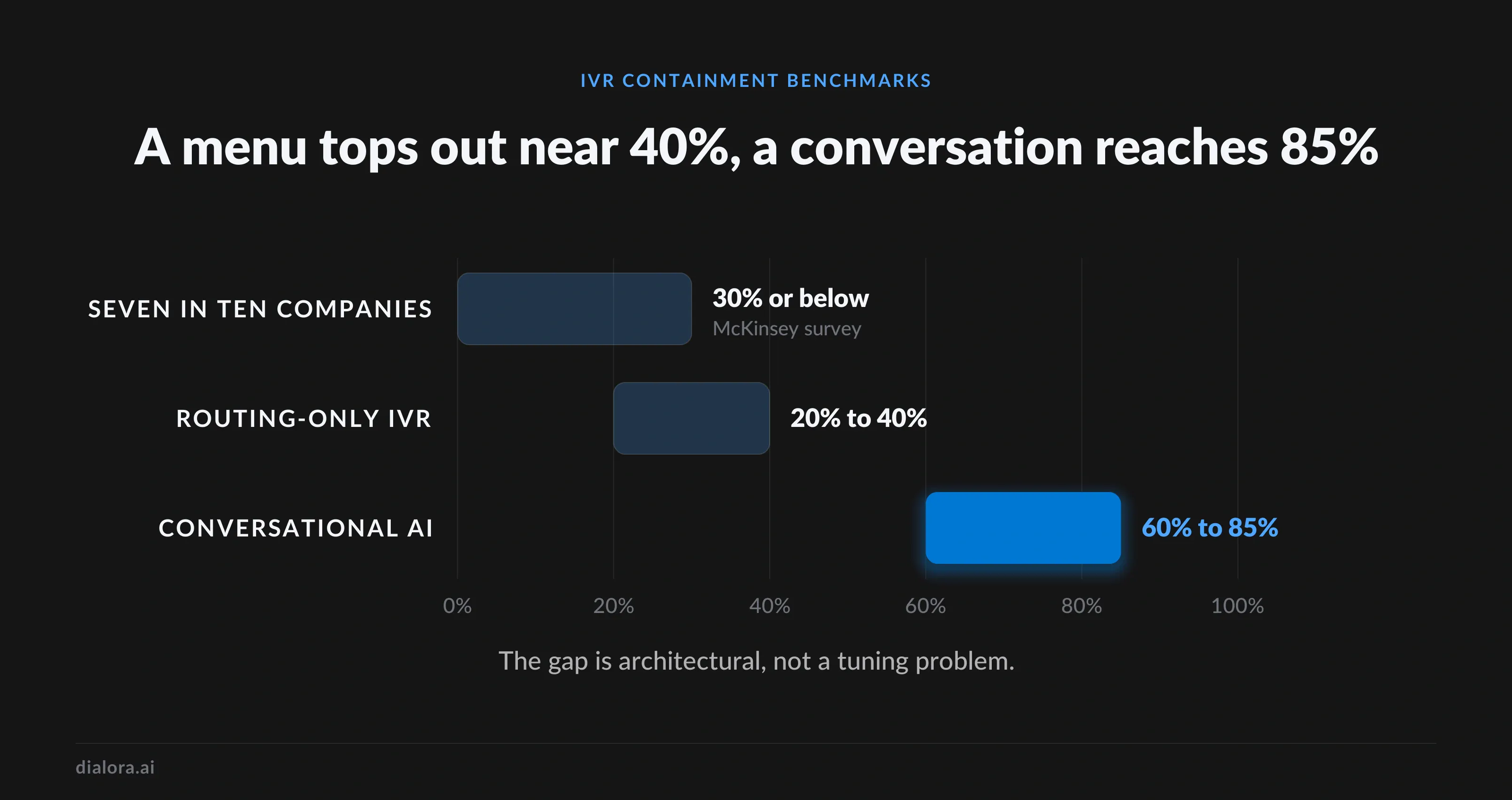
- Seven in ten companies sit at 30% or below. A McKinsey survey of contact centre operators found containment at or under 30% for the large majority.
- Routing-only IVRs typically land at 20% to 40%. And the contained calls are almost always simple lookups, not completed tasks.
- Conversational systems reach 60% to 85%. Well-optimised AI voice systems handling defined intents, with some enterprise deployments reporting higher on narrow intent sets.
- The gap is architectural. A menu was designed to route, not resolve. It cannot pull a record, take a payment or complete a multi-step task, so no amount of prompt rewriting moves the ceiling far.
This is the single most useful thing to understand before you compare vendors. If your IVR is a router, you are choosing between routers. Better menu design gets you a better router.
What callers do when the menu does not fit
They leave, and they mostly do not tell you. Vonage's survey of 2,010 US adults found 61% believe IVR damages the customer experience against only 13% who call it good, with the top complaints being forced irrelevant options at 63% and being blocked from a person at 54%. In that same research, 85% said they had abandoned at least one call because of an IVR, and respondents estimated abandoning roughly 27% of calls they place to businesses.
A New York University study found 83% of consumers believe IVRs either give them no benefit at all or exist purely as a cost saving for the company. Around 70% say they would rather speak to a person than work through a complex menu. Healthy call abandonment sits between 2% and 5%, so if yours runs well above that, the menu is usually the reason.
The metric almost nobody reports is opt-out rate: the share of callers who press zero or ask for an agent immediately. It is the cheapest diagnostic you have, and a high number means your callers have already decided the system cannot help them.
Read more:
The 11+ best IVR systems for businesses in 2026
Grouped by architecture rather than ranked, because a numbered list implies these compete with each other and mostly they do not. A developer platform and a small business phone system are not rivals. Pick your category first using the containment logic above, then compare inside it.
AI voice agents built to resolve, not route
These replace the menu with a conversation. The caller states the problem in their own words and the system attempts to complete it. Highest containment potential, highest dependency on your backend integrations being real.
- Dialora. Our own platform, listed for completeness. AI voice agents for inbound and outbound, aimed at telecom, hiring and business support queues, with human handoff on request. Best fit when call volume is consistently high and intents are repetitive. Wrong fit if you need a full omnichannel contact centre suite with workforce management built in.
- Bland AI. Developer-oriented voice agent platform with strong control over call flow and latency. Suits teams comfortable building and maintaining their own logic.
- Retell AI. API-first voice agents with a focus on fast deployment and telephony integration. Popular with product teams adding voice to an existing application.
- Vapi. Voice AI infrastructure for building custom agents, with model and voice provider choice left open. The most flexible and the most assembly required.
Enterprise contact centre suites
Mature routing, deep reporting, workforce management, and AI capability that increasingly comes as part of the platform. Strong choice above roughly 100 agents. Expect professional services, longer rollouts and unpublished pricing.
- Genesys Cloud CX. The deepest customisation in the category, with journey orchestration, voice biometrics and broad integration coverage. Best for complex multi-channel operations that need tailored workflows.
- NICE CXone. Enterprise contact centre platform with strong analytics and quality management. Like Genesys, it generally needs implementation support rather than self-serve setup.
- Five9. Cloud contact centre with visual IVR and intelligent routing, and close integration with Salesforce, Microsoft Dynamics and ServiceNow. Common pick for mid-size to large operations already standardised on one of those CRMs.
- Talkdesk. Mid-market and enterprise platform with virtual agent capability, automated quality management and vertical packages for healthcare, financial services and retail. Compliance coverage includes HIPAA, PCI and GDPR.
- Cisco Webex Contact Center. The safe answer for organisations already committed to Cisco networking and collaboration, where the integration story matters more than best-of-breed AI.
Cloud call centre for SMBs, and build-your-own
- CloudTalk. Visual call flow designer, deep CRM integrations and AI voice agents, positioned squarely at 10 to 50 seat sales and support teams. Around 4.4 out of 5 across 1,700 plus verified reviews.
- Aircall. Clean interface and CRM-connected workflows, favoured by teams who want fast setup over configurability.
- Twilio. Programmable voice with Studio for flow building and Flex for a fully customisable contact centre. Effectively unlimited control, and you own everything you build.
- Amazon Connect. Pay-as-you-go contact centre from AWS with usage-based pricing and native access to AWS AI services. Economical at scale, engineering-heavy to run well.
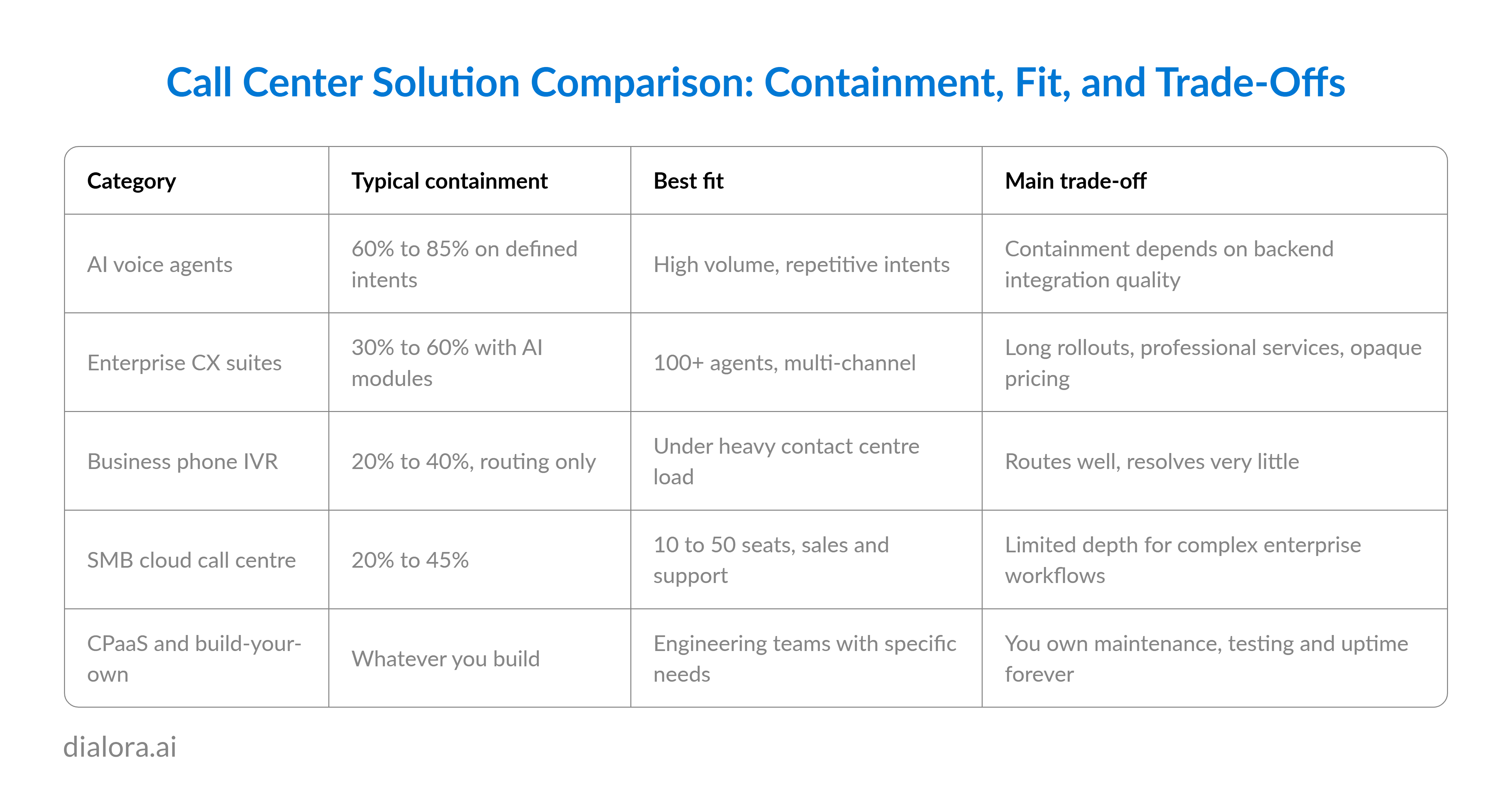
How do you choose an IVR platform and migrate without breaking the line?
Eliminate on architecture first, then test the migration before you cut over. Most failed IVR projects are not vendor selection failures. They are cutover failures, where a call flow that worked in a demo meets real traffic, real accents and a backend that times out.
Five questions that eliminate most vendors quickly
- Does it resolve or only route? Ask for containment measured on completed tasks, not calls that entered the system. A vendor quoting containment that includes abandons is quoting a number that means nothing.
- Can a caller reach a person in one sentence? If the escape hatch requires working through a menu to earn it, the system will generate the exact frustration you are buying it to remove.
- What happens to context at handoff? The agent should receive the intent, the path taken and any data collected. Making the customer repeat themselves undoes the entire value of the automation.
- Can your admins change a flow without a consultant? Enterprise platforms often require professional services for changes that a visual builder handles in an hour. That cost is real and recurring.
- Is pricing published? Unpublished pricing is normal at enterprise tier and a genuine planning problem below it.
Conclusion
The menu was a workaround for a keypad, and the keypad stopped being the constraint a long time ago. Most of the frustration customers report with phone systems traces back to a design decision made when there were twelve buttons and no alternative.
Which means the choice in front of you is simpler than a nineteen-item comparison suggests. Decide whether you need something that routes or something that resolves. If your containment sits near 30% and your queue is the bottleneck, a better menu will not fix it, because the ceiling is built into the architecture rather than the configuration.
Then test the thing properly before it meets your customers. Inventory the flows, script the branches, run real audio through it, and cut over in parallel. The vendors on this page are mostly good. The projects that fail usually fail at the cutover, not the contract.
Dialora builds AI voice agents that answer every call the moment it arrives, resolve the repetitive intents end to end, and hand a caller to a person the moment they ask. Try a free 7-day trial
Frequently asked questions
What is the best IVR system for businesses in 2026?
There is no single best system, because the categories do not compete. For high volume with repetitive intents, AI voice agent platforms like Dialora, Bland AI or Retell achieve the highest containment. For large multi-channel contact centres, Genesys Cloud CX, NICE CXone, Five9 and Talkdesk lead. For businesses under heavy contact centre load, the IVR bundled with RingCentral, Nextiva, Dialpad, 8x8 or Zoom Phone is usually sufficient. Choose the category first, then compare inside it.
What is the best cloud IVR system for small business?
For 10 to 50 seats, CloudTalk and Aircall are built for that range with visual call flow builders that do not need a consultant. Below that, RingCentral, Nextiva or Ooma bundle enough IVR into a standard business phone plan. Avoid enterprise platforms at small scale, since they typically require professional services to implement and do not publish pricing.
What is a good IVR containment rate?
It depends entirely on what the system is asked to do. Routing-only menus typically land between 20% and 40%, and a McKinsey survey found seven in ten companies at 30% or below. Well-optimised conversational and AI systems reach 60% to 85% on defined intents. Measure containment by call reason, not as one blended number, and exclude callers who abandoned inside the system.
How much does an IVR system cost?
Business phone platforms bundle IVR from roughly $20 per user per month on annual billing. Cloud call centre platforms publish tiered per-seat pricing. Enterprise contact centre suites usually quote rather than publish. The number that matters more is cost per contact: voice runs $9 to $16 per contact against $0.10 to $0.60 for a contained self-service resolution.
What is automated IVR integration testing and why does it matter?
Scripted test calls that walk every branch of a call flow and verify prompts, keypad capture, speech recognition and backend responses, run continuously rather than once at launch. It matters because existing call flows accumulate undocumented edge cases over years, and a cutover without regression testing surfaces them in front of live customers.
Should an enterprise IVR migration run in parallel?
Yes, wherever the telephony allows it. Route a percentage of live traffic to the new platform, compare containment, opt-out rate and abandonment against the existing system, and widen only when the new numbers hold or improve. Pair that with continuous monitoring that places test calls from multiple regions after cutover, so prompt failures and latency drift surface before customers report them.
Do AI voice agents replace IVR completely?
For most inbound intents, yes, because they resolve rather than route. But keep a simple deterministic path for anything regulated, plus an escalation route a caller can trigger in one sentence. Complaints, disputes, hardship and cancellations should reach a person immediately regardless of what containment target you have set.