TL; DR
- The enterprise tech support and enterprise customer service software market hits roughly $55 billion in 2026, with Salesforce, Zendesk, and ServiceNow leading by deployment volume and AI integration depth.
- Most of the 15+ vendors below cover ticketing, omnichannel routing, and self-service. The differentiation now lives in voice AI capability, agent assist quality, and workflow integration with the rest of your stack.
- The right choice depends on three things. Your existing CRM. Your inbound call volume. Your compliance posture. Skip any vendor that does not meet all three before evaluating features.
A customer success director at a logistics company asked us last quarter what the actual difference was between Salesforce Service Cloud and Zendesk for an enterprise rollout. The honest answer was that the platform shortlist matters less than the channel coverage gap most enterprise customer service software still has. The phone. This guide walks through the 15+ enterprise customer service software platforms worth shortlisting in 2026, what each actually covers, and where the voice channel still leaks revenue inside otherwise solid stacks.
Enterprise customer service software is a category of platforms that handle ticketing, omnichannel routing, agent assist, self-service, and analytics across the customer support function. When evaluating an enterprise CRM software or an enterprise help desk solution, leading vendors include Salesforce, Zendesk, ServiceNow, Microsoft, Oracle, Freshworks, Intercom, and Genesys. Most enterprise platforms still treat the phone channel as a bolt-on, leaving voice AI as a meaningful gap.
What Enterprise Customer Service Software Actually Covers
The category has consolidated around four pillars. First, there must be a robust enterprise ticketing system and case management. Second, an enterprise-grade contact center solutions omnichannel support routing across email, chat, social, and phone. Third, a true customer service management system needs agent assist powered by AI and a connected knowledge base. Fourth, the best self-service platforms for enterprise customer support 2026 feature portals, communities, and chatbots.
Most enterprise customer support platforms cover all four on paper. The differentiation shows up in three places. AI quality in agent assist and case summarization. Workflow depth into your CRM and ticketing layer. Voice channel handling for inbound and outbound phone work.
The voice channel is where most stacks still leak. Right there.
The 15+ Best Enterprise Customer Service Software Solutions
This matrix breaks down the 15+ enterprise customer service software platforms most enterprises evaluate in 2026, with the channel and use case each is strongest for.
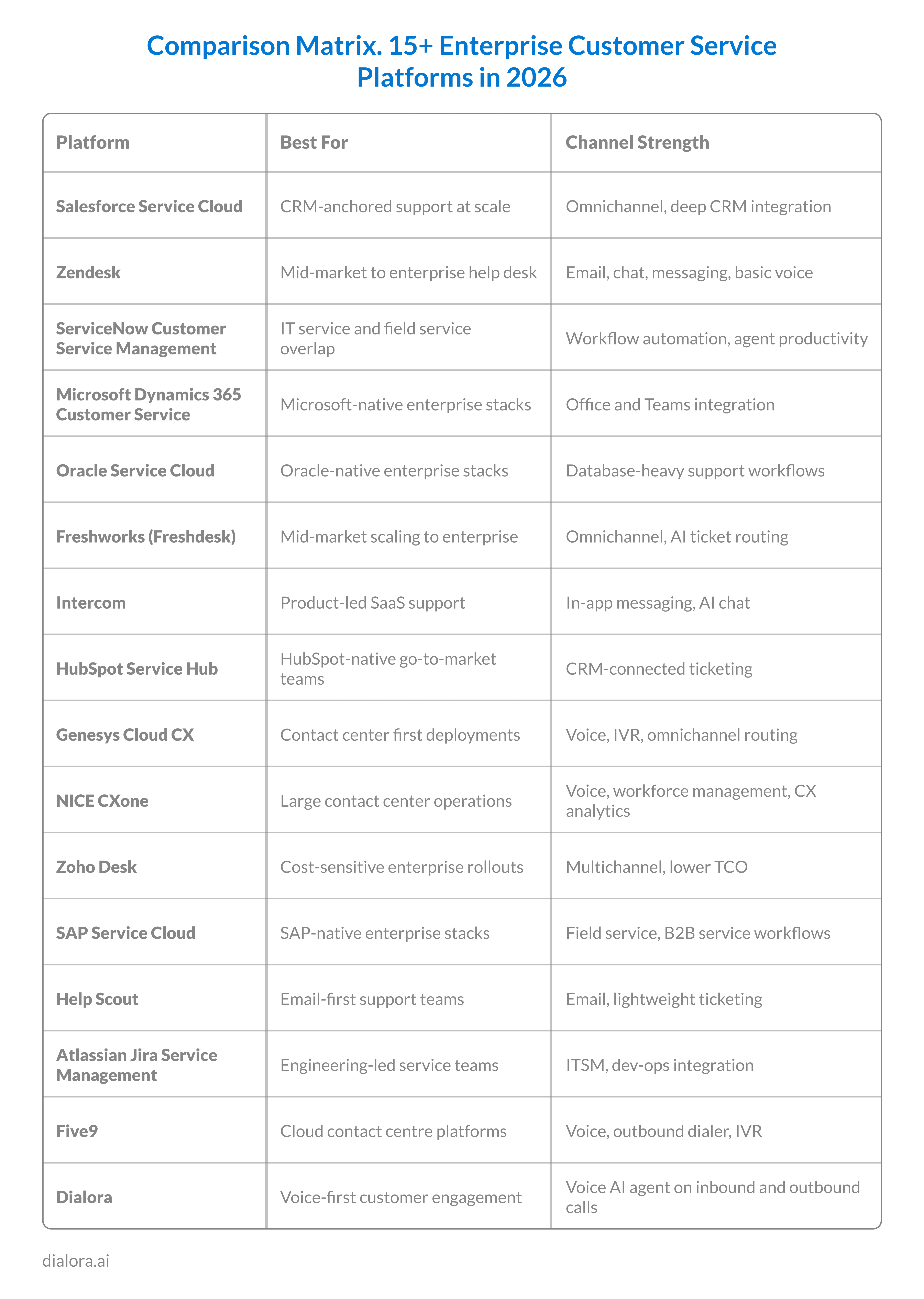
The 15+ list reflects what enterprise procurement actually shortlists in 2026. Whether they need an enterprise brand experience management software or a basic customer enquiry software, it is not exhaustive of every platform on the market.
1. Dialora: Best AI Voice Agent Platform For Voice First Customer Engagement
AI voice agent that answers inbound calls and runs outbound calls on its own, holding a natural conversation and handling the task end to end.
Why Dialora Stands Out
Most platforms on this list treat voice as one channel among many. Dialora starts with the call itself, so missed calls, after hours enquiries, and repetitive outbound work get handled without adding agent headcount.
Features And Integrations
- AI voice agents for inbound and outbound calls, natural conversation handling, call routing and escalation to human agents, appointment booking, call transcripts and summaries, multilingual support
- Integrations with CRMs, calendars, and business systems through API and automation connectors
Pros
- Covers every call, including after hours and peak overflow, without extra staffing
- Deploys against a specific call workflow in days rather than a multi month rollout
Cons
- Focused on voice, so it complements rather than replaces a full ticketing suite
- Best results come from scoping call flows properly before going live
2. Salesforce Service Cloud: Best Enterprise Customer Service Platform For CRM Anchored Support
Support suite built directly on the Salesforce platform, so cases, contacts, and service history sit on the same record as sales and marketing data.
Why Salesforce Service Cloud Stands Out
Service runs on the CRM most large enterprises already own, which removes the usual gap between what sales knows about an account and what the support agent sees on the call.
Features And Integrations
- Case management, omnichannel routing, knowledge base, Service Cloud Voice, Agentforce AI agents, field service, Flow automation
- Integrations with Slack, MuleSoft, Tableau, AppExchange apps, and partner CTI from Amazon Connect, Genesys, and Five9
Pros
- Single customer record shared across sales, service, and marketing
- Very large partner and app ecosystem for edge case requirements
Cons
- Total cost rises quickly once add-on clouds and higher licence tiers are stacked
- Configuration and ongoing maintenance usually need dedicated admin or developer capacity
3. Zendesk: Best Enterprise Help Desk Software For Mid Market To Enterprise Teams
Ticketing and messaging platform that scales from a small support desk to a multi brand enterprise service operation.
Why Zendesk Stands Out
Fast to deploy compared with the heavy CRM suites, with a mature agent workspace and a help centre that support teams can run without engineering help.
Features And Integrations
- Ticketing, agent workspace, help centre, messaging and live chat, AI agents, side conversations, SLA and business rules, quality assurance and workforce management add-ons
- Integrations with Salesforce, Jira, Shopify, Slack, and over a thousand marketplace apps
Pros
- Quick rollout and a low training curve for agents
- Strong self service and knowledge base tooling
Cons
- Native voice is basic next to dedicated contact centre platforms
- Pricing climbs sharply once AI and workforce engagement add-ons are switched on
4. ServiceNow Customer Service Management: Best Enterprise Service Platform For IT And Field Service Overlap
Service platform that connects customer facing cases to the back office workflows and assets that actually resolve them.
Why ServiceNow Stands Out
Cases can trigger fulfilment work across IT, operations, and field teams on the same platform, which suits enterprises where a support ticket rarely ends at the agent.
Features And Integrations
- Case and issue management, workflow automation, virtual agent, knowledge management, field service management, CMDB linked service operations, playbooks
- Integrations with Microsoft Teams, Slack, Salesforce, Workday, and a large certified app store
Pros
- Deep workflow automation across departments, not just the support queue
- Strong fit where customer service and IT service management already overlap
Cons
- Implementation is long and usually needs a partner
- Priced and scoped for large enterprises, which puts it out of reach for smaller service teams
5. Microsoft Dynamics 365 Customer Service: Best Enterprise Customer Service Software For Microsoft Native Stacks
Customer service application inside the Dynamics 365 suite, built for organisations already standardised on Microsoft.
Why Microsoft Dynamics 365 Stands Out
Native connection to Teams, Outlook, Power Platform, and Azure means far less integration work for enterprises that already run Microsoft end to end.
Features And Integrations
- Case management, unified routing, knowledge articles, Copilot assistance, voice channel, Power Automate workflows, Customer Insights reporting
- Integrations with Microsoft Teams, Outlook, Power BI, Azure services, and Dataverse connected apps
Pros
- Strong value where Microsoft licensing is already in place
- Power Platform gives internal teams a low code route to custom workflows
Cons
- Interface and setup feel complex for new administrators
- Less appealing outside a Microsoft centred technology stack
6. Oracle Service Cloud: Best Enterprise Support Platform For Oracle Native Stacks
Service application within Oracle Fusion Cloud CX, aimed at enterprises running Oracle applications and databases.
Why Oracle Service Cloud Stands Out
Handles data heavy support workflows where cases need to reach into ERP, order, and billing records held in Oracle systems.
Features And Integrations
- Case and incident management, knowledge management, digital assistant, field service, guided assistance, policy automation
- Integrations with Oracle ERP and HCM, Oracle Integration Cloud, and partner CTI connectors
Pros
- Handles complex, transaction linked service cases well
- Consistent data model across Oracle business applications
Cons
- User experience feels dated against newer service platforms
- Limited value for organisations that are not already Oracle led
7. Freshworks (Freshdesk): Best Enterprise Customer Service Software For Mid Market Scaling To Enterprise
Omnichannel support suite that gives growing teams enterprise features without the enterprise implementation cycle.
Why Freshworks Stands Out
Priced and packaged for teams stepping up from a basic help desk, with AI ticket routing and omnichannel included rather than sold as a separate tier every time.
Features And Integrations
- Ticketing, omnichannel inbox, Freddy AI agent and copilot, automated ticket routing, SLA management, customer portal, Freshcaller voice
- Integrations with Slack, Jira, Shopify, Salesforce, and a marketplace of several hundred apps
Pros
- Faster to deploy and cheaper to run than the large CRM suites
- Clear reporting and automation available without heavy configuration
Cons
- Advanced enterprise governance and permissions are thinner than Salesforce or ServiceNow
- Deeper customisation hits platform limits sooner
8. Intercom: Best Customer Service Platform For Product Led SaaS Support
Messaging first support platform designed around in product conversations rather than an email queue.
Why Intercom Stands Out
Fin, the AI agent, resolves a large share of inbound conversations before an agent is involved, and the whole product is built around the in app messenger.
Features And Integrations
- In app messenger, Fin AI agent, help centre, inbox with macros and workflows, product tours, outbound messages, conversation reporting
- Integrations with Salesforce, HubSpot, Jira, Slack, Stripe, and Segment
Pros
- Strong in product engagement and self service deflection
- Modern agent experience that support teams pick up quickly
Cons
- Resolution based pricing makes costs harder to forecast at volume
- Voice and traditional contact centre features are limited
9. HubSpot Service Hub: Best Customer Service Software For HubSpot Native Go To Market Teams
Service module inside the HubSpot platform, connecting tickets directly to the same contact records used by marketing and sales.
Why HubSpot Service Hub Stands Out
Support conversations sit next to the full lifecycle record, so account managers and service agents work from one timeline without a data sync between systems.
Features And Integrations
- Ticketing, shared inbox, knowledge base, customer portal, help desk workspace, Breeze AI assistants, surveys and feedback, SLA management
- Integrations with Gmail, Outlook, Slack, Jira, Zoom, and the HubSpot app marketplace
Pros
- Very strong when marketing, sales, and service already sit in HubSpot
- Clean interface and quick setup for non technical teams
Cons
- Less depth than dedicated service platforms for complex enterprise routing
- Costs rise steeply as contact tiers and seats grow
10. Genesys Cloud CX: Best Enterprise Contact Center Platform For Contact Center First Deployments
Cloud contact centre platform built around voice, IVR, and omnichannel routing at enterprise scale.
Why Genesys Cloud CX Stands Out
Routing, workforce engagement, and journey analytics are core product rather than add-ons, which suits organisations where the contact centre is the primary service channel.
Features And Integrations
- ACD and predictive routing, IVR, outbound dialling, workforce engagement management, quality management, conversational AI and bots, journey analytics
- Integrations with Salesforce, Microsoft Dynamics, ServiceNow, Zendesk, and Microsoft Teams
Pros
- Deep voice and routing capability with mature workforce management
- Reliable at high call volumes and across multiple sites
Cons
- Setup and administration require specialist contact centre skills
- Feature depth is more than smaller service teams need or use
11. NICE CXone: Best Enterprise Contact Center Software For Large Contact Center Operations
Contact centre suite pairing omnichannel routing with a strong workforce optimisation and analytics layer.
Why NICE CXone Stands Out
Workforce management, quality, and interaction analytics are a genuine strength here, which matters when hundreds of agents need forecasting, scheduling, and scoring.
Features And Integrations
- Omnichannel routing, IVR and voice, workforce management and forecasting, quality management, interaction analytics, AI agents and agent assist
- Integrations with Salesforce, Microsoft Dynamics, ServiceNow, Zendesk, and Microsoft Teams
Pros
- Best in class workforce management and CX analytics
- Proven at very large agent counts
Cons
- Complex to configure and administer
- Enterprise pricing and contracting model suits large operations only
12. Zoho Desk: Best Enterprise Help Desk Software For Cost Sensitive Rollouts
Multichannel help desk with a wide feature set at a noticeably lower per agent cost than the large suites.
Why Zoho Desk Stands Out
Delivers ticketing, automation, and self service at a total cost of ownership that lets enterprises roll it out across regions or subsidiaries without a heavy licence bill.
Features And Integrations
- Ticketing, multichannel support, Zia AI assistant, blueprint process automation, self service portal and knowledge base, SLA rules, telephony via Zoho Voice
- Integrations with Zoho CRM and the wider Zoho One suite, Slack, Jira, and Microsoft Teams
Pros
- Strong feature to price ratio
- Works well as part of a wider Zoho stack
Cons
- Enterprise grade support and account management are lighter than the major vendors
- Advanced customisation is less flexible at very large scale
13. SAP Service Cloud: Best Enterprise Service Platform For SAP Native Stacks
Service application in the SAP Customer Experience portfolio, built for organisations running SAP as the system of record.
Why SAP Service Cloud Stands Out
Field service and B2B service workflows connect to SAP order, contract, and installed base data, which is exactly what manufacturers and industrial businesses need.
Features And Integrations
- Case and ticket management, field service management, service contracts and entitlements, knowledge base, service scheduling and dispatch
- Integrations with SAP S/4HANA, SAP CRM, SAP Business Technology Platform, and Microsoft Outlook
Pros
- Deep alignment with SAP ERP and B2B service processes
- Strong field service and entitlement handling
Cons
- Implementation is long and partner dependent
- Little reason to choose it without an existing SAP footprint
14. Help Scout: Best Customer Service Software For Email First Support Teams
Lightweight shared inbox and help desk built for teams that want conversations to read like email, not tickets.
Why Help Scout Stands Out
Customers receive a normal email reply with no ticket numbers or portal links, which keeps support conversations personal even as the team grows.
Features And Integrations
- Shared inbox, saved replies, workflows, Docs knowledge base, Beacon in app help widget, live chat, AI drafting and summarising, reporting
- Integrations with Slack, Jira, HubSpot, Salesforce, and Shopify
Pros
- Very simple for agents, almost no training needed
- Customer facing experience feels human rather than transactional
Cons
- No native voice channel or contact centre routing
- Reporting and automation depth fall short of enterprise requirements
15. Atlassian Jira Service Management: Best Enterprise Service Desk For Engineering Led Service Teams
Service desk built on Jira, connecting customer requests to the development and operations teams that resolve them.
Why Jira Service Management Stands Out
Requests, incidents, and change management sit alongside the engineering backlog, so escalations move without a handoff between two separate tools.
Features And Integrations
- Request and incident management, change management, on call and alerting through Opsgenie capability, asset and configuration management, knowledge base via Confluence, automation rules
- Integrations with Jira Software, Confluence, Bitbucket, Slack, Microsoft Teams, and the Atlassian Marketplace
Pros
- Tight link between customer facing issues and engineering work
- Strong incident and change management for technical services
Cons
- Built more for internal and technical service than consumer facing support
- No native voice channel
16. Five9: Best Cloud Contact Center Software For Voice Led Service Operations
Cloud contact centre platform focused on inbound and outbound voice with a mature dialler and IVR.
Why Five9 Stands Out
Outbound dialling is a genuine strength, which suits service operations that mix inbound support with collections, renewals, and proactive outreach.
Features And Integrations
- Inbound ACD, IVR, predictive and progressive outbound dialler, agent assist, workforce optimisation, digital channels, reporting and analytics
- Integrations with Salesforce, Microsoft Dynamics, ServiceNow, Zendesk, and Oracle
Pros
- Strong voice quality and dialler capability
- Well established CRM connectors that reduce integration work
Cons
- Digital channels are less developed than voice
- Administration needs contact centre expertise to configure well
Pro-tip: Most enterprise customer service software treats the phone as a bolt-on. The category gap is voice AI, not another ticketing tool.
See Dialora Handle a Real Inbound Customer Call
How to Choose Between 15+ Platforms Without Wasting a Quarter
Three filters cut the list from 15+ to a real shortlist of 3.
The first filter is your CRM. If you run Salesforce, Service Cloud is the default starting point. If you run Microsoft, Dynamics 365 Customer Service is the default. If you run HubSpot for marketing and sales, Service Hub is the cheapest path to CRM-connected support. CRM-native is faster to deploy and harder to rip out later.
The second filter is your inbound call volume. If your service team handles more than 10,000 inbound calls a month, the contact centre platforms (Genesys, NICE, Five9) belong on the shortlist alongside the CRM-native option. If voice is below 5,000 calls a month, a voice AI agent layer like Dialora often replaces the need for a full CCaaS rollout.
The third filter is compliance posture. Healthcare and finance need SOC 2, GDPR alignment, and BAA availability where relevant. Most enterprise platforms hit these. Verify the specific framework your auditor cares about before signing.
Why the Voice Channel Is the Real 2026 Differentiator in Enterprise Customer Service Software
The enterprise customer service software market sits at roughly $55 billion in 2026 and is growing at a 11 per cent compound annual rate. Most vendors are converging on the same feature set. AI agent assist. Omnichannel routing. Knowledge management. Self-service portals. The differentiation that mattered in 2022 has flattened. What still differs is the voice channel. Enterprise customer service stacks that handle ticketing, chat, and email well still treat phone calls as a bolt-on requiring a separate CCaaS deployment. When organizations rely heavily on enterprise level support, dropping calls is unacceptable. Adding a voice AI agent layer on top of an existing customer service platform is faster, cheaper, and usually higher-leverage than swapping the entire stack. The 15+ list above is the shortlist. The voice gap is the opportunity.
Where Dialora Fits Inside an Enterprise Customer Service Stack
Dialora is not a replacement for Salesforce Service Cloud or Zendesk. It is the voice AI layer that closes the inbound and outbound call gap most enterprise customer service software still leaves open. For businesses that need affordable customer engagement platforms for large companies, Dialora answers calls 24/7, books directly into Google Calendar, Cal.com, and TidyCal, runs outbound campaigns on a schedule, and pushes every contact and transcript to your existing CRM through API and webhook. The platform supports English, Spanish, French, Portuguese, and Turkish on the same workload, with coverage across 30+ countries.
Compliance includes SOC 2-ready infrastructure, full GDPR compliance, and BAAs available for healthcare workloads. Most enterprise customer service stacks gain more from adding Dialora to the voice channel than from rolling out a parallel ticketing platform.
Ready to See Dialora Inside a Real Enterprise Voice Workflow?
The voice channel is the leakiest part of most enterprise customer service stacks. Closing it is the cheapest revenue recovery in the playbook. See It Handle a Real Call
Frequently Asked Questions
What is the best enterprise customer service software in 2026?
The best enterprise customer service software depends on your existing CRM, call volume, and compliance posture. Salesforce Service Cloud leads CRM-anchored deployments. Zendesk leads mid-market to lower-enterprise. ServiceNow leads where customer service overlaps with IT service. Genesys and NICE lead contact-centre-first deployments. There is no universal winner. The right shortlist is three platforms, not one.
How to choose customer service automation software for enterprise rollouts?
Apply three filters. First, CRM compatibility. Pick the platform that integrates natively with your existing CRM stack. Second, call volume threshold. Above 10,000 inbound calls a month, contact centre platforms belong on the shortlist. Below 5,000 calls a month, a voice AI layer often replaces the CCaaS need. Third, compliance posture for SOC 2, GDPR, and any vertical-specific framework your auditor reviews.
How to choose customer service automation software for enterprise companies with $500M plus revenue?
At that revenue tier, three things change. Procurement cycles run 6 to 9 months instead of 6 to 9 weeks. Single-vendor lock-in risk matters more, so multi-platform stacks become standard. Voice AI is increasingly added as a layer rather than a vendor swap. Many top custom software development services for enterprise solutions in 2026 plan for parallel pilots across 2 to 3 platforms during the evaluation phase. Plan for a 12-month full rollout window once a vendor is selected.
What features should enterprise customer service software have?
Five features are non-negotiable for enterprise rollouts in 2026. Omnichannel routing across email, chat, messaging, social, and voice. AI-powered agent assist and case summarization. Self-service portals or chatbots tied to a connected knowledge base. SLA and workforce management at the team and individual level. CRM integration through API, webhook, and native connectors. Anything missing one of these is a downgrade, not a savings.
Is Dialora SOC 2 and GDPR compliant for enterprise deployments?
Dialora is fully GDPR compliant and operates with SOC 2-ready infrastructure. Voice and transcript data are encrypted in transit and at rest. The platform supports BAAs for healthcare customers. Multi-region coverage spans 30+ countries with data residency options for European deployments. Always confirm your specific regulatory framework alongside the platform's posture before deployment.
Can Dialora integrate with Salesforce, Zendesk, or ServiceNow?
Yes. Dialora syncs to Salesforce, Zendesk, ServiceNow, and most enterprise customer service platforms through API and webhook. Every call ends with a transcript, sentiment summary, and contact card pushed into your existing system. Native integrations exist for calendar tools (Google Calendar, Cal.com, TidyCal). CRM and ticketing integrations run through the API layer. Always confirm the specific objects and fields your team needs in scope before deployment.