TL; DR
- Voice AI platforms typically charge between $0.07 and $0.15 per minute, with enterprise prices negotiated below $0.07 at big volume.
- There are four primary billing models: Enterprise tiers, monthly licenses, per-minute, and per-conversation. Most platforms combine multiple platforms.
- Hidden expenditures (overage fees, failed call charges, API billing, storage) can dramatically increase your final bill over the advertised rate.
- Regulated industries, such as healthcare, require HIPAA-compliant platforms, which often cost 20-40% more than regular tiers.
- AI voice agents reduce call center costs by 40–70% per interaction in high-volume, repetitive call environments. The ROI case is strong when modeled correctly.
Introduction
If you've started studying Voice AI platforms, you've probably noticed that the price landscape is a bit confusing. Some vendors advertise per-minute rates. Others bundle everything into opaque enterprise tiers. A few require a sales call just to find out what you'd be paying.
Stats - Gartner predicts conversational AI will reduce contact center agent labor costs by $80 billion in 2026. Gartner predicts
The result? Most buyers either overpay for features they don't need or underbuy and hit overage fees the moment call volume spikes. This guide cuts through that noise. Here's what voice AI cost actually looks like in 2026, broken down by pricing model, use case, and what to watch for before you sign anything.
How Voice AI Platforms Actually Charge You
Understanding the models used by vendors is essential when comparing them, as the way billing is set up can make a product appear either expensive or inexpensive.
There are four main pricing models in use right now:
- Per-minute billing: You pay for real talk time, which usually ranges from $0.07 to $0.15 each minute. This is the most transparent model and the easiest to forecast for call centers.
- Per-conversation billing: A flat rate per call, regardless of length. Interactions typically cost between $0.25 and $1.00 per. Works effectively when call durations are consistent; however, it becomes difficult when they vary.
- Monthly license tiers: A flat monthly fee tied to call volume or number of active agents. Common in mid-market tools. Can look affordable until you hit volume caps.
- Enterprise tiers with usage bands: Volume-based pricing in which, as usage increases, the fee per minute decreases. demands a minimum monthly commitment and frequently a contract.
Most AI voice agent platforms blend more than one of these. A base license may include 10,000 minutes, with additional minutes being billed on a per-minute basis after that. Before committing, always model both scenarios.
What the Real Numbers Look Like in 2026
This is a working benchmark table that shows how much businesses in various volume tiers are currently paying for voice AI platforms:
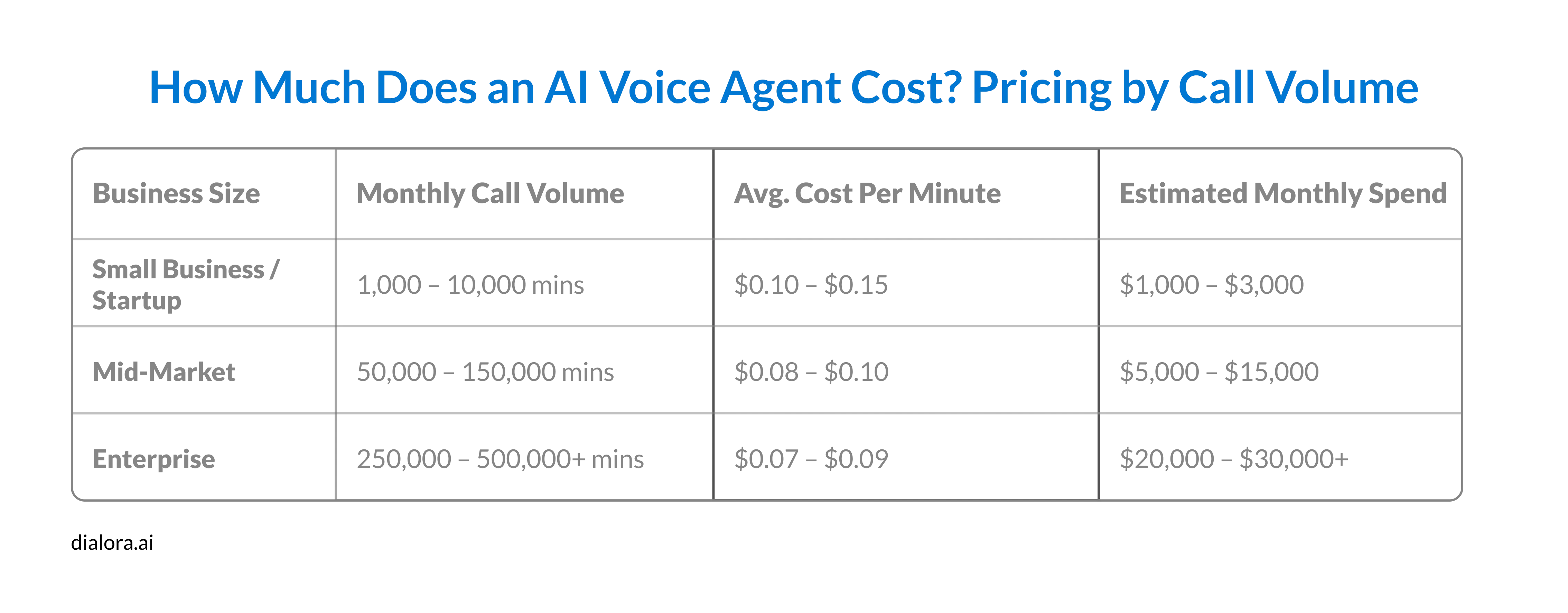
These figures are based on a pretty fully equipped platform with speech-to-text, language model processing, basic call routing, and transcripts included. Usually, at the top are CRM connectors, compliance certifications, custom voices, and committed support.
To put this into context, a qualified human call center agent costs between $25 and $45 per hour (including compensation, benefits, training, and management). At $0.10/min, an AI voice agent handling the same call volume runs about $6/hour. That gap is why companies running call routing or high-volume inbound support are moving fast.
The Real Cost Drivers Nobody Talks About Upfront
Although it is the headline figure, your final cost is rarely determined by the per-minute rate. Here's what actually drives voice AI cost:
- Voice quality and latency: Low-latency, high-fidelity voices are more expensive to produce. If your use case requires natural-sounding conversation, especially for AI voice agents for healthcare or financial services, expect to pay a premium for neural voice models over standard synthetic voices.
- LLM and model costs: Most current AI speech agents use a big language model. Whether the manufacturer employs GPT-4, their own proprietary model, or an open-source alternative has an impact on both quality and costs. While some services combine LLM expenses, others pass them through directly. Ask which model powers the conversations and how that pricing works at scale.
- Telephony and infrastructure: Phone number hosting, SIP trunking, and outbound dialing infrastructure are often billed separately. A dedicated local number might run $2–$10/month per number. Outbound call campaigns with parallel dialing can have their own rate structures entirely.
- Compliance and security: If you work in healthcare, banking, or another regulated industry, you'll need a platform that is HIPAA-compliant or SOC 2-certified. Those certifications don't come free expect 20–40% higher pricing compared to equivalent non-compliant tiers. For AI voice agents for healthcare, this is non-negotiable.
- Add-on features: CRM integrations, post-call SMS, sentiment analysis, call recording storage, and unique branded voices are usually limited to higher tiers or priced separately. Build your full feature list before pricing, not after.
Hidden Fees That Catch Buyers Off Guard
Even well-intentioned purchasers are taken aback by invoicing details hidden in the fine print. Keep an eye out for:
- Rounding rules: Does the platform round to the closest minute or bill per second? On thousands of calls, this compounds fast.
- Failed call charges: Some companies charge for voicemail, busy signals, and ignored calls. Some don't. This distinction is quite important for outbound campaigns.
- API call billing: In addition to per-minute fees, some platforms charge per action if your agent initiates external actions (such as sending emails, booking appointments, or updating CRMs).
- Storage and retention fees: Call recording and storage come at a cost. Audio files, transcript archives, and longer data retention periods come with monthly costs.
- Overage penalties: Flat-tier plans can have steep overage costs if you use more minutes than you are allowed. A $500/month plan with a $0.25/min overage rate can generate a $3,000 surprise bill in a high-traffic month.
The easiest form of protection is to request an itemized description of all possible charges from vendors before signing. Any platform that resists that conversation is telling you something.
Voice AI Cost by Industry
The voice AI pricing is not universally applicable. What you'll pay and what you require are both influenced by the industry.
- Healthcare: The combination of HIPAA compliance requirements, complex scheduling operations, and 24/7 availability expectations increases expenses. Most AI voice agent for healthcare deployments run $0.10–$0.14/min. The tradeoff: reduced no-show rates, recaptured appointment revenue, and front desk labor savings often generate 3–5x ROI within the first year.
Stats - Voice AI is projected to save the U.S. healthcare economy $150 billion annually by 2026. NextLevel
- Financial services: Compliance recording, secure data handling, and integration with CRMs like Salesforce or HubSpot drive up the baseline. Expect $0.10–$0.12/min plus integration costs.
- Retail and e-commerce: Cost-effective AI voice is best suited for low-complexity, high-volume questions like refunds, order status, and basic support. In this industry, startups can often function efficiently at a rate of $0.08 to $0.10 per minute.
- BPO and call centers: High volume yields the best per-minute prices, while operational complexity (such as call routing logic, multilingual support, and escalation processes) might increase overall costs. The volume savings usually outweigh the complexity premium.
Conclusion
Voice AI costs are more manageable than they appear, but only if you go in with your eyes open. The per-minute fee is only the starting point. The real number comes from layering in telephony, integrations, compliance needs, and overage risk. Buyers who model the full picture before choosing a voice AI platform consistently get better outcomes than those who lead with the headline rate.
If you're ready to see what this looks like for your specific call volume and use case, Dialora.ai offers a free cost analysis and live demo, no commitment required. You'll get a real number, not a range, based on your actual workflow. Request your free Voice AI cost estimate at Dialora AI.
FAQ
How much does an AI voice cost per minute in 2026?
The going rate for a full-featured AI voice agent platform sits between $0.07 and $0.15 per minute depending on volume, features, and vendor. Low-volume SMB plans are often at the higher end of the spectrum, whereas enterprise contracts that are negotiated at 250,000+ minutes per month can be about $0.07/min.
Which voice AI vendor delivers the biggest operational cost savings?
It depends heavily on your current cost baseline. For Voice AI vendors' operational cost savings, the biggest ROI comes from replacing manual inbound handling, where labor costs are high, and call quality is inconsistent. Companies that replace full-time call center people with AI voice typically cite cost savings of 40-70% each interaction. The more important thing is to pick a vendor whose pricing strategy fits your call volume and feature needs, not the exact vendor.
What is the AI voice agent cost for healthcare organizations?
Healthcare organizations should budget $0.10–$0.14/min for a compliant solution, plus setup and integration costs. For a clinic handling 5,000 call minutes per month, that's roughly $500–$700/month in platform costs, often offset by a single recovered appointment slot per day.
Do AI voice agents reduce call center costs significantly?
Yes, but context matters. AI voice agents reduce call center costs most effectively for repetitive, high-volume interactions, including order status, appointment reminders, FAQ handling, and after-hours service. Human agents are still useful for complex or emotionally charged calls. The best deployments leverage AI to manage the volume while humans handle the nuances.
What's the difference between cost per minute and cost per conversation pricing?
Shorter, more effective calls are rewarded by cost per minute charging, which accounts for actual conversation time. Cost per conversation pricing charges a flat rate regardless of length, which works well for calls with constant lengths. For call routing and qualification workflows where calls are brief, per-conversation billing often ends up more expensive.