TL;DR
- Sierra AI and Decagon are both venture-funded AI agent platforms targeting high-growth consumer tech companies in fintech, EdTech, and D2C. Sierra leads on enterprise CX breadth. Decagon leads on developer-friendly deployment for digital-native teams.
- The Sierra vs Decagon 2026 comparison serves operations that need AI for complex customer experience workflows. Neither platform handles inbound or outbound calls autonomously without a human agent component.
- Dialora covers the autonomous call handling layer that both platforms leave open, with transparent Dialora AI pricing and deployment in days rather than months.
COOs and VPs of Customer Experience at high-growth consumer tech companies evaluating Sierra vs Decagon are comparing two relatively newer AI customer experience platforms that both raised serious capital and target similar buyers. The Sierra vs Decagon comparison 2026 is less about legacy enterprise credentials and more about which platform fits the speed and architecture of a fintech, EdTech, or D2C operation that needs AI working in production fast. Both platforms are newer to multi-year production records than Cognigy or Amelia. The question is which one fits, and what neither one covers.
Sierra AI and Decagon are both venture-funded AI agent platforms built for high-growth consumer tech companies in fintech, EdTech, and D2C. The Sierra vs Decagon comparison turns on enterprise CX breadth versus developer-friendly deployment speed, and on which platform fits the team's technical resources and deployment timeline. Neither platform provides fully autonomous call handling without human agents on the line.
Sierra vs Decagon: What Each Platform Was Built For
The Sierra vs Decagon 2026 comparison starts with understanding each platform's design intent.
Sierra AI is an enterprise AI agent platform built with an LLM-native architecture aimed at large enterprise CX operations. It targets brands that want modern generative AI conversation quality at scale. Sierra AI pricing reflects an enterprise contract model. A Sierra AI review from enterprise CX teams highlights the platform's natural conversational quality alongside an implementation scope that sits closer to enterprise than self-serve.
Decagon is an AI customer experience platform built specifically for high-growth tech companies. A Decagon review from CX leaders at fintech and EdTech companies highlights fast deployment, clean integration with modern CX tool stacks, and a developer-friendly architecture that lets technical teams move quickly. Decagon pricing is not publicly listed.
Pro-tip:
The Sierra vs Decagon pricing comparison surfaces the same pattern as most AI platform comparisons in this category: neither publishes a rate card. Teams need a sales conversation before any number appears. Dialora AI pricing is available at dialora.ai before that conversation starts.
Read more:
- Dialora AI vs. Bland AI
- Dialora AI vs. Synthflow
- Bland AI vs Voiceflow
- Vapi vs ElevenLabs
- Synthflow vs Voiceflow
- Cognigy vs Kore.AI
- Cognigy vs Sierra AI
- Dialpad vs RingCentral
- Cognigy vs Amelia
Sierra vs Decagon: Feature and Deployment Comparison
The Sierra vs Decagon for customer experience comparison across the dimensions that matter most to COOs and CX leaders.
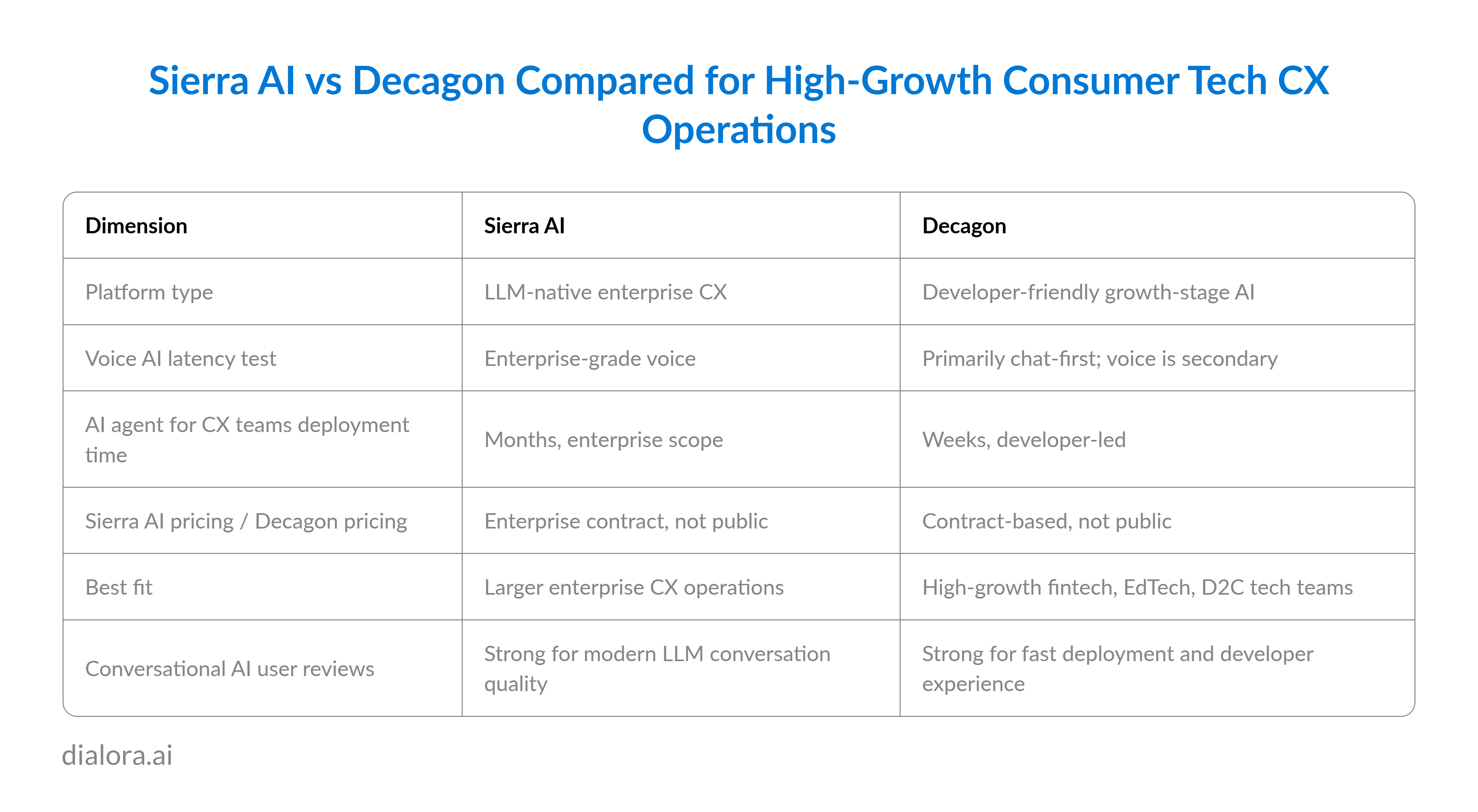
Sierra vs Decagon voice quality reflects a meaningful difference in platform focus. Sierra AI was built with voice as a core channel. Decagon is more chat-first with voice as a secondary capability. For COOs at companies where inbound phone calls are significant, that distinction matters.
Note:
Which is better, Sierra or Decagon? Sierra wins for operations that need enterprise-grade voice and a broader CX channel footprint. Decagon wins for developer-led CX teams at growth-stage companies that need fast deployment and clean modern integrations.
What Sierra and Decagon Both Leave Open in Your CX Stack
The Sierra vs Decagon comparison produces an architecture decision. It does not resolve the autonomous call handling gap that both platforms share.
Both platforms are built to support human CX workflows. When the human CX team is not staffed, both platforms leave inbound calls to voicemail and outbound follow-up to manual rep effort. The pattern is consistent and specific.
After-hours inbound calls that go unanswered. Outbound campaigns that need headcount to execute. Live call lead qualification that eats CX team time. Appointment booking that requires a coordinator. Every time.
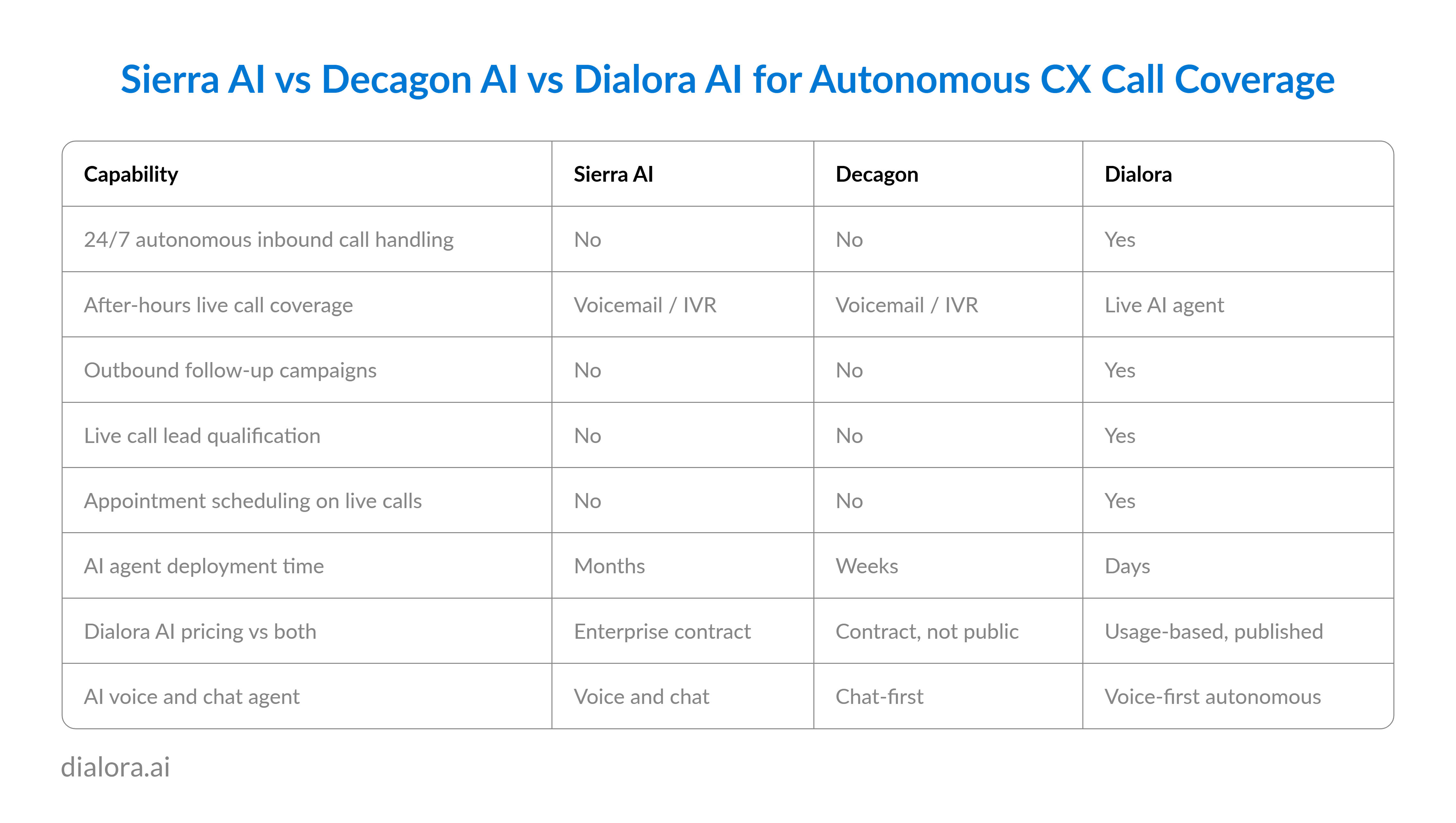
Dialora is not a Sierra or Decagon replacement for full CX workflow orchestration. It is the autonomous AI voice agent platform that covers the inbound and outbound call volume both platforms leave to human staff. High-growth consumer tech companies adding Dialora alongside their CX platform recover after-hours inbound volume, run outbound sequences without CX headcount, and handle live call qualification at scale. Dialora AI pricing is usage-based and transparent at dialora.ai. Teams reviewing Sierra AI alternatives or Decagon alternatives as part of a broader CX stack audit frequently land on Dialora AI as the autonomous call handling layer the rest of the stack does not cover.
Ready to See What Autonomous AI Handles in Your CX Call Stack?
Sierra vs Decagon: Which Platform Fits and What Comes Next?
The Sierra vs Decagon choice comes down to team profile and deployment philosophy. Sierra AI fits larger enterprise CX operations that need LLM-native voice and chat with an enterprise implementation path. Decagon fits developer-led growth-stage companies that need a fast, clean deployment on modern tech stacks. Both are worth evaluating on their own terms. Neither resolves the autonomous call coverage question. Adding Dialora AI to either deployment closes the inbound and outbound gap both platforms share. The venture-funded AI agent comparison produces a platform choice. The autonomous call handling gap produces a second, faster decision.
Frequently Asked Questions
What is the key difference in the Sierra vs Decagon 2026 comparison?
The Sierra vs Decagon 2026 comparison turns on enterprise breadth versus deployment speed. Sierra AI is built for larger enterprise CX operations with LLM-native voice and chat. Decagon is built for developer-led high-growth teams that need fast deployment on modern stacks. Sierra AI pricing reflects enterprise contract structure. Decagon pricing is contract-based. Neither handles calls fully autonomously.
How does Sierra vs Decagon pricing compare for growth-stage companies?
Sierra AI pricing and Decagon pricing are both contract-based and not publicly listed. Both require sales engagements to surface numbers. A Dialora AI review, alongside a Sierra AI review and Decagon review, shows Dialora AI pricing as the transparent usage-based alternative, available at dialora.ai before any procurement conversation.
What do conversational AI user reviews say about Sierra AI vs Decagon?
Sierra AI review data from enterprise CX teams highlights strong LLM conversation quality and enterprise scope alongside implementation overhead. Decagon review data highlights fast deployment and developer-friendly integration alongside a primarily chat-first architecture. Both platforms receive positive conversational AI user reviews within their target segments.
Where does Dialora fit in a Sierra vs Decagon stack evaluation?
Dialora covers the autonomous call handling layer that neither Sierra nor Decagon provides. It handles inbound calls 24/7, qualifies leads autonomously, books appointments on live calls, and runs outbound campaigns without agents. Dialora AI pricing is usage-based and available at dialora.ai. Teams adding Dialora to a Sierra or Decagon deployment recover the autonomous call volume that both platforms route to voicemail or human staff.
Is Dialora a viable Sierra AI alternative or Decagon alternative for voice-first CX coverage?
Dialora is a viable Sierra AI alternative and Decagon alternative for the specific use case of autonomous voice call handling. It does not replace either platform's full CX orchestration capability. For high-growth consumer tech companies that need inbound and outbound call volume handled autonomously at scale, Dialora covers that layer independently. Dialora AI pricing and feature documentation are available at dialora.ai.