TL; DR
Voice AI pricing confuses most buyers because platforms structure costs differently, per minute, per call, per seat, or as tiered SaaS plans. This post breaks down what you actually pay at each usage level, what drives the cost up, and how to compare plans without getting burned by hidden overage fees.
You get a quote for a voice AI platform, and it says $0.08 per minute. Sounds affordable. Then you run the numbers on your actual call volume and realize you have no idea what counts as a billable minute: the ring time, the hold time, or just the conversation.
Pricing opacity is the most common complaint in voice AI sales cycles. Platforms structure costs in at least four different ways, and most comparison pages are written to obscure rather than clarify. A business running 5,000 outbound calls per month can end up paying anywhere from $400 to $4,000, depending on which plan they're on and how the vendor counts usage.
This post gives you the actual numbers, the variables that drive cost, and the questions to ask before you sign anything.
How Voice AI Platforms Actually Charge: Four Pricing Models Explained
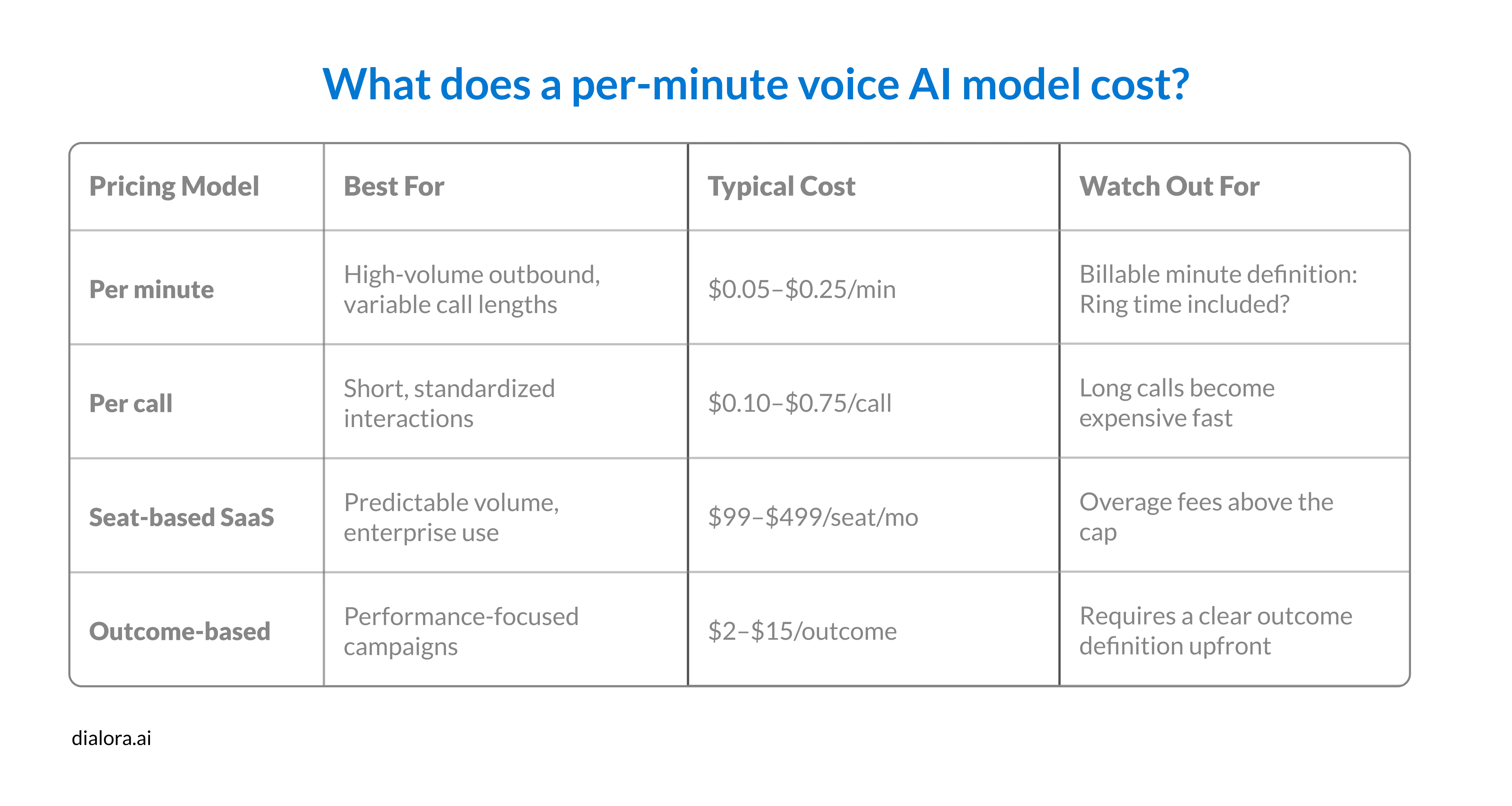
Most platforms use one of four structures. Some combine them.
Per-minute usage: You pay for every minute the voice agent is on a call, sometimes including ring and hold time, sometimes only active conversation. This model scales directly with call volume. It is the clearest to audit and the most common for platforms targeting SMBs.
Typical range: $0.05–$0.25 per minute depending on voice quality, language, and provider tier.
Per-call pricing: A flat fee per completed call, regardless of duration. Works well for short, standardized interactions, appointment reminders, order confirmations, and quick intake calls. Becomes expensive if your calls run long.
Typical range: $0.10–$0.75 per call.
Seat-based SaaS: A monthly fee per "agent" or seat, with a usage cap. Common in enterprise-facing platforms. Predictable cost, but overage fees can be steep if you underestimate volume.
Typical range: $99–$499 per seat per month with 500–2,000 minutes included.
Outcome-based pricing: Emerging model where you pay per qualified lead, per booking, or per completed intake. Higher per-unit cost, but eliminates the risk of paying for failed calls.
Typical range: $2–$15 per qualified outcome, depending on vertical and complexity.
What Drives Voice AI Cost Per Minute Higher Than the Base Rate
The base rate is the starting point. Five variables push the actual cost above it.
- Voice model quality: Standard AI voices cost less. Premium neural voices, the ones that sound genuinely human and handle interruptions naturally, cost more. The gap is real. A $0.05/min standard voice and a $0.18/min premium voice are not interchangeable products.
- Language and locale: English-language calls are the baseline. Multi-language support like Spanish, French, Portuguese, and Turkish typically adds a surcharge. If you are running campaigns across multiple geographies, factor this in.
- Concurrent call volume: Some platforms charge more per minute when you run high concurrency. If your campaign dials 100 numbers simultaneously, you may be on a different pricing tier than a team dialling 10 at a time.
- Integrations and data sync: CRM syncing, calendar integrations, and post-call transcript delivery are sometimes included, sometimes billed separately. Platforms that bundle these look more expensive on the rate card, but can be cheaper in total cost of ownership.
- Support tier: Enterprise support contracts, dedicated onboarding, and SLA guarantees add to the monthly cost. For SMBs self-serving on a standard plan, this is usually not a factor.
How Voice AI Cost Per Minute Compares to Human Agent Costs
This is the comparison that actually matters for a buy decision.
A full-time outbound agent in the US costs $35,000–$55,000 per year, fully loaded salary, benefits, management overhead, and tools. That works out to roughly $0.29–$0.46 per minute of actual calling time, assuming 6 hours of active dial time per day across 250 working days.
At $0.10/min for a quality voice AI agent running 8 hours per day, the math does not close.
The more useful comparison is not cost per minute; it is cost per qualified outcome. A human agent might convert 8–12 prospects per day into meaningful conversations. An AI agent, running at higher volume with consistent delivery, can generate more qualifying conversations at a fraction of the per-outcome cost. The human rep then handles only those conversations.
If the human-vs-AI cost comparison already landed
What Affects Voice AI Pricing When You Are Comparing Plans in 2026
The market has matured enough that pricing is now more competitive but also more variable. Three things to check before committing to any platform:
- How they define a billable minute: Ask the vendor directly: Does billing start at dial, at pickup, or at first voice exchange? Ring time billing adds meaningful cost to lists with low pickup rates.
- What the overage rate is: Some platforms allow unlimited usage on a flat plan. Others charge 2–3x the base rate for minutes above the included cap. A 500-minute plan with $0.50/min overage is not a 500-minute plan in practice.
- Whether post-call features are bundled: Transcripts, sentiment analysis, CRM sync, and recording storage are table-stakes features in 2026. Platforms charging separately for these are pricing at a higher effective rate than the headline number suggests.
Conclusion
Dialora operates on transparent per-minute pricing with no hidden overage structure — what you see on the plan is what you pay at volume. The platform includes post-call transcripts, CRM sync, and sentiment analysis without add-on billing. For SMBs running outbound campaigns or inbound booking queues, the total cost of ownership is visible from day one, not after the first invoice.
Most platforms quote you a rate. Few show you what that rate looks like against your actual call volume. Here is what Dialora's pricing looks like on a real workload.
→ See Voice AI Pricing in Action
FAQ
How much does voice AI cost per minute?
Rates range from $0.05 to $0.25 per minute depending on voice quality, language, concurrent volume, and platform tier. Premium neural voices with multi-language support and bundled post-call features sit toward the higher end. Always confirm whether ring time is included in the billable minute before comparing plans.
What is the average cost of an AI voice agent?
For SMBs on usage-based plans, most teams pay between $200 and $800 per month at moderate call volumes. Enterprise seat-based plans run $300–$2,000+ per month, depending on included minutes and support tier. Outcome-based pricing is emerging as an alternative for performance-focused campaigns.
Is voice AI pricing based on usage?
Most SMB-facing platforms use usage-based pricing per minute or per call. Enterprise platforms typically offer seat-based SaaS plans with usage caps. Some newer platforms offer outcome-based pricing where you pay per qualified lead or completed booking rather than per minute of call time.
How does voice AI pricing compare to human agents?
A fully loaded human outbound agent costs $0.29–$0.46 per minute of active calling time when you account for salary, benefits, and overhead. Quality voice AI runs $0.05–$0.25 per minute with no idle time billed. The more meaningful comparison is cost per qualified outcome, where AI consistently produces more qualifying conversations at lower per-outcome cost.
What affects the price of AI voice agents?
Voice model quality, language support, concurrent call volume, integration depth, and support tier all affect the effective rate above the base price. Post-call features like transcripts and CRM sync are sometimes bundled and sometimes billed separately. Always check what the total cost of ownership looks like, not just the headline rate.