TL;DR
- Parloa is a German enterprise voice AI platform known for multilingual voice capabilities and strong insurance and telecom deployments, but its pricing model and implementation timeline create friction for teams outside its core DACH enterprise base.
- The best Parloa alternatives 2026 range from Cognigy and Genesys for full enterprise omnichannel voice, to Dialora for teams that need autonomous inbound and outbound AI call handling with transparent pricing and fast deployment.
- Dialora AI pricing operates on a usage-based model that surfaces costs before any procurement engagement, making it a meaningful contrast to Parloa's enterprise contract structure.
Contact center directors and CIOs evaluating enterprise voice AI platforms encounter Parloa most often in two contexts: a DACH-region shortlist where multilingual voice capabilities and insurance-sector track record make it a natural contender, and a North American comparison where implementation timeline and Parloa pricing opacity slow the decision cycle. The search for Parloa alternatives typically starts after the procurement team sees what a full enterprise voice AI deployment actually takes to go live. Not weeks. Not a month. Something longer than most budget cycles allow.
Parloa is an enterprise voice AI platform built for multilingual, complex contact center operations, with strong credentials in insurance, telecom, and DACH-market enterprise teams. Teams searching for Parloa alternatives are typically evaluating options with faster deployment, more transparent AI pricing models, or a better fit for autonomous call handling use cases. The top Parloa competitors include Cognigy, Genesys, NICE CXone, and Dialora for autonomous AI voice agent deployment.
Why Contact Center Teams Evaluate Parloa Alternatives
Parloa's strengths are real. Sub-500ms voice latency in live deployments, multilingual voice cloning AI capabilities, and an enterprise voice AI platform architecture that DACH-region insurance and telecom operations use in production. The platform has genuine credentials.
The friction surfaces are in three places.
- Parloa pricing: Parloa pricing is not publicly listed. Enterprise contracts involve scoping timelines, professional services, and implementation costs that require extended procurement engagement before a number appears.
- Deployment timeline: Alternatives to Parloa with faster deployment are the most common reason teams shortlist other options. Enterprise voice AI platform configuration requires technical resources and weeks-to-months timelines that not every operation can accommodate.
- North American fit: Parloa's strongest track record is in the DACH market. Contact center teams in North America often find Parloa competitors with equivalent voice quality and stronger US market support.
Pro-tip:
A telephony engineer at a mid-size US insurance firm spent three months in Parloa's enterprise scoping process before the projected implementation timeline pushed the decision to the next budget cycle. That is the most common Parloa replacement for a call centers scenario.
How Parloa Alternatives Compare for Enterprise Voice AI
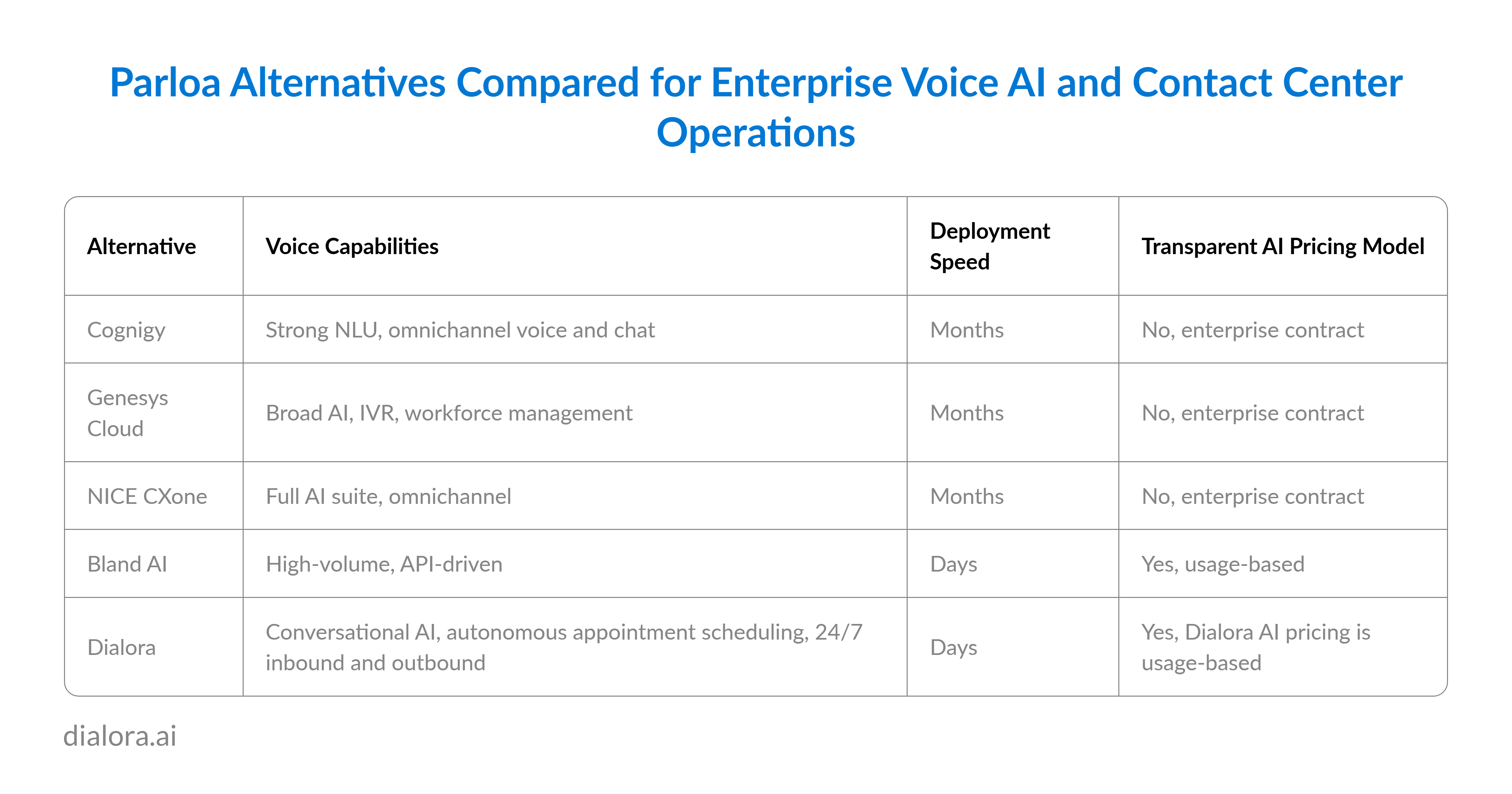
Not every Parloa competitor solves the same gap. The comparison below covers the main options for contact center directors evaluating enterprise voice AI with deployment speed, pricing transparency, and autonomous call handling as primary criteria.
Match the alternative to your primary operational gap before entering any enterprise scoping process.
What Sets Dialora Apart From Other Parloa Alternatives?
Most Parloa alternatives sit in the same enterprise contract category as Parloa itself. They route calls to human agents more efficiently and require implementation timelines measured in months. The transparent AI pricing model advantages advertised by newer platforms often disappear inside enterprise scoping conversations.
Dialora is architecturally different. Three things stand apart clearly.
Deployment speed: Dialora deploys in days. Live inbound and outbound call handling is available within a short onboarding window. No months-long configuration.
Autonomous call handling: Dialora handles calls without a human agent on the line. Inbound calls are answered, leads are qualified, appointments are booked, and outcomes sync to CRM automatically. Parloa and its enterprise alternatives route these outcomes to human staff.
Dialora AI pricing: Dialora's usage-based model means teams pay for call volume. The pricing is transparent, available at dialora.ai, and does not require a multi-month scoping conversation to surface a number.
Parloa vs Dialora for Autonomous Contact Center AI Call Handling
The architectural divide is the meaningful comparison point.
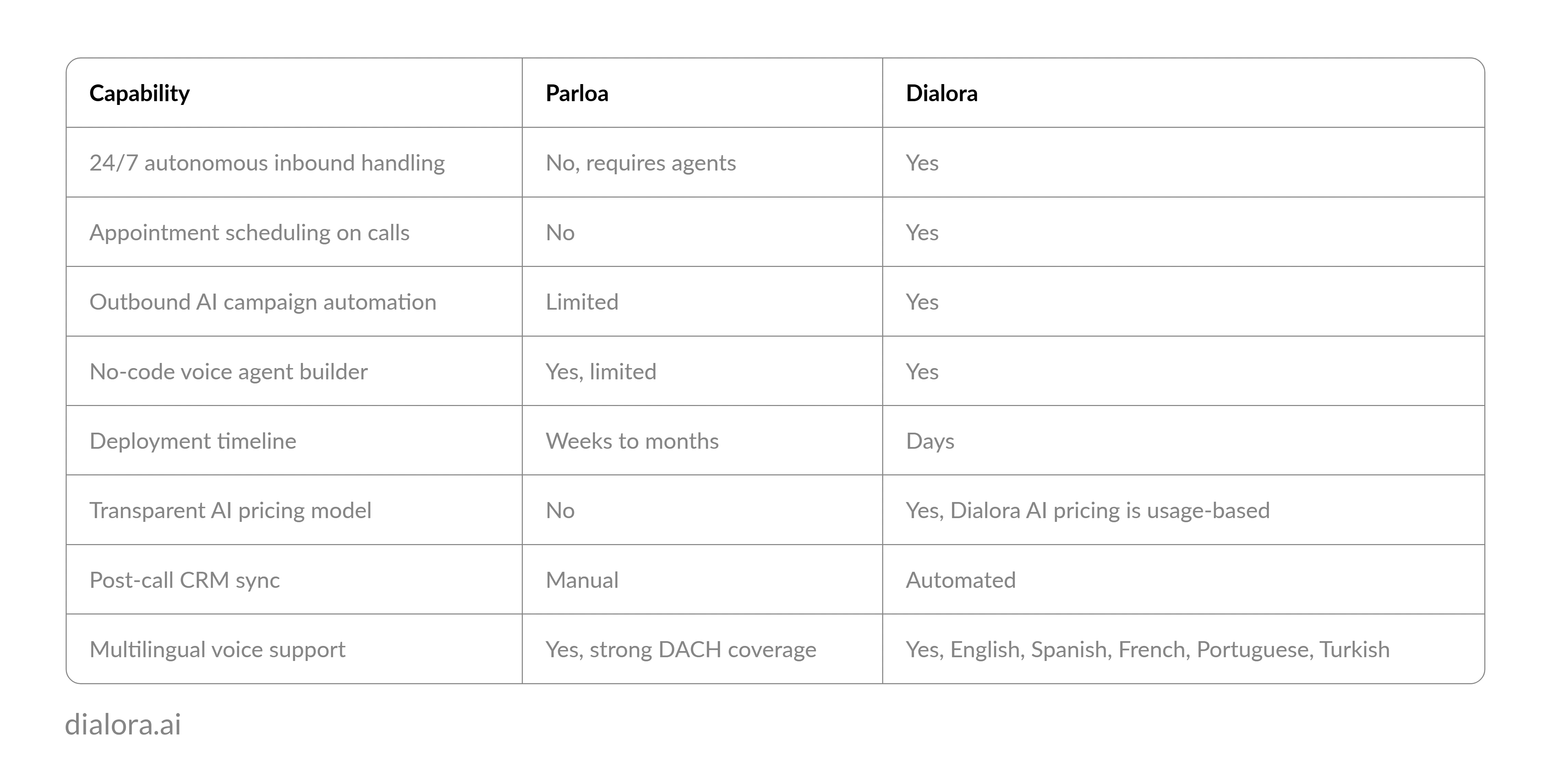
Teams running a Dialora AI review alongside a Parloa review find that Dialora's primary advantage is not NLU feature depth. It is deployment speed and autonomous call volume coverage that Parloa's architecture leaves to human staff. The Dialora AI review versus Parloa review contrast is clear: Parloa is a human-assisted voice AI tool built for complex enterprise flows; Dialora is an autonomous AI phone automation platform built for calls that run without agents present.
Which Parloa Alternative Fits Your Contact Center Architecture?
The best Parloa alternative depends on what the contact center needs to close. Full enterprise NLU with complex IVR routing and omnichannel orchestration points toward Cognigy or Genesys. A Parloa alternative with transparent pricing and days-to-deployment points toward Dialora. Telephony engineers and CIOs who need to show ROI within a current budget cycle rarely have the runway for a months-long enterprise implementation. That is where Dialora's AI phone automation platform model fits: live call handling from day one, usage-based Dialora AI pricing with no contract minimum, and autonomous coverage of the inbound and outbound call volume that enterprise platforms route to human agents. The voice-specialized AI tool category has moved fast. Dialora sits at the deployment-speed end of that spectrum.
The Parloa alternatives comparison narrows when you answer one question first: Does the operation need AI to assist agents, or AI to handle calls when agents are not there? Both answers point to different platforms. Dialora covers the second one. See It Handle a Real Call
Frequently Asked Questions
What are the best Parloa alternatives 2026 for enterprise contact centers?
The best Parloa alternatives 2026 depend on your primary gap. Cognigy and Genesys fit complex NLU and full CCaaS requirements. Bland AI fits developer-led API deployments. Dialora fits contact center teams that need autonomous inbound and outbound AI call handling with transparent AI pricing and AI agent deployment speed measured in days rather than months. The Parloa review versus Dialora AI review contrast on the deployment timeline alone is significant.
How does Dialora AI pricing compare to Parloa pricing?
Parloa pricing is not publicly listed and requires an enterprise scoping engagement to surface. Dialora AI pricing is usage-based, with details available at dialora.ai. The contrast is significant for teams that need to model costs before a procurement decision. Parloa's enterprise contract structure suits large-budget deployments. Dialora's transparent AI pricing model suits teams that need cost clarity and faster deployment timelines.
What do contact center teams report in a Parloa review compared to a Dialora AI review?
A Parloa review from contact center teams consistently surfaces strong multilingual voice quality and deep DACH enterprise credentials, alongside implementation complexity and pricing opacity as the primary friction points. A Dialora AI review reveals faster deployment, transparent pricing, and autonomous call handling as the primary advantages. The platforms solve different problems: Parloa manages complex agent-assisted flows; Dialora handles calls when agents are not present.
Is Dialora a direct Parloa replacement for call centers?
Dialora is not a direct Parloa replacement for call centers that need full enterprise NLU orchestration and complex IVR design. It is the autonomous AI voice agent layer that handles the inbound and outbound calls that those platforms route to human agents. Most contact center teams find that Dialora and an enterprise voice platform serve complementary functions in the stack.
Is Dialora a voice-specialized AI tool that meets enterprise compliance requirements?
Dialora operates on SOC 2-ready infrastructure with GDPR compliance across 30-plus countries. Healthcare teams can request a Business Associate Agreement. It is a voice-specialized AI tool built for autonomous call handling at scale, with multilingual support across confirmed languages. Full compliance documentation and Dialora AI pricing details are available at dialora.ai.