Restaurant owners and franchise operators searching for Slang AI pricing information hit the same wall every hospitality tech buyer hits: no published rate card, no instant quote, and a sales conversation required before any number appears. This post covers what Slang AI actually costs for restaurants and hospitality businesses based on available market data, how Slang AI pricing compares to Dialora AI pricing for similar use cases, and what to evaluate before committing to a subscription-based voice AI platform for your front-of-house phone handling.
Slang AI is a restaurant AI phone answering platform built for hospitality operations that need automated reservation management and guest call handling. Slang AI pricing is not publicly listed. Monthly costs for restaurant and hospitality teams vary by call volume and feature tier. This review covers what the platform costs, how Slang AI pricing compares to alternatives, and what hospitality operators report in real Slang AI reviews.
What Is Slang AI and What Does It Do for Restaurants?
Slang AI is a voice AI platform purpose-built for the hospitality sector. Its core use case is answering inbound phone calls at restaurants, hotels, and hospitality venues, handling reservation inquiries, hours and menu questions, and general guest experience calls that would otherwise require a host or front desk team member to pick up.
For restaurant operators, the value is specific. Friday nights and Saturday lunch services generate call spikes that no front-of-house team can staff perfectly. Calls that go unanswered become reservations that go to a competitor. A Slang AI customer running three locations reported recovering an average of 40 unanswered calls per weekend before their team opened. That math justifies the subscription-based voice AI cost quickly for high-volume hospitality operations.
The platform is hospitality-native. It knows that a caller asking about the prix fixe menu wants an answer, not a voicemail. That vertical focus is its genuine differentiator.
Pro-tip: Slang AI is built for restaurants. Its vertical focus means setup is faster and call flows are pre-configured for hospitality. The limitation is that it does not handle outbound campaigns, multi-location outreach, or cross-vertical call automation.
Slang AI Pricing Plans 2026: What It Costs Per Month
Slang AI pricing is not published on the platform's website. Slang AI monthly cost for restaurants reported in the market ranges based on call volume tier and feature set. Teams reading a Dialora AI review find that Dialora AI pricing is usage-based and available at Dialora.ai before any sales conversation, making it a useful contrast for hospitality operators modeling budgets.
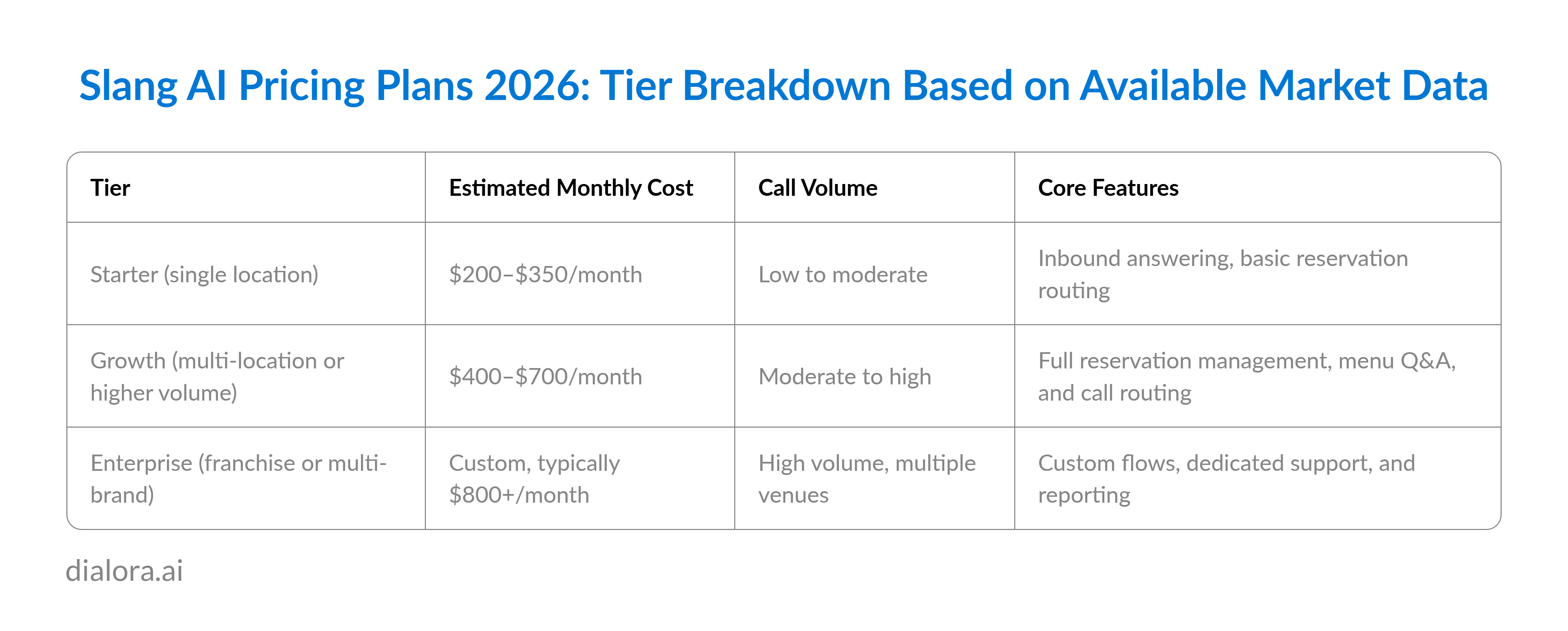
Note: These ranges reflect available market data and Slang AI reviews from operators. The Slang AI subscription cost breakdown should be confirmed directly with Slang AI at the time of evaluation, as pricing updates regularly.
How Slang AI Pricing Compares to Dialora AI Pricing for Hospitality
The Slang AI pricing for hospitality comparison, specifically the Slang AI vs Dialora pricing evaluation, surfaces a fundamental difference in platform architecture.
Slang AI is hospitality-native with pre-configured flows for restaurants and venues. The Slang AI pricing per month reflects a vertical-specific product. Setup is faster for restaurant operators. The tradeoff is limited flexibility outside the hospitality use case.
Dialora AI pricing is usage-based and available at Dialora.ai before any sales conversation. Dialora is a horizontal AI voice agent platform built for inbound and outbound autonomous call handling across verticals, including hospitality, healthcare, legal, and finance. For restaurant and hotel operators that need both inbound call coverage and outbound campaign capability, such as reservation reminders, event follow-up, and loyalty outreach, Dialora covers both without a separate platform.
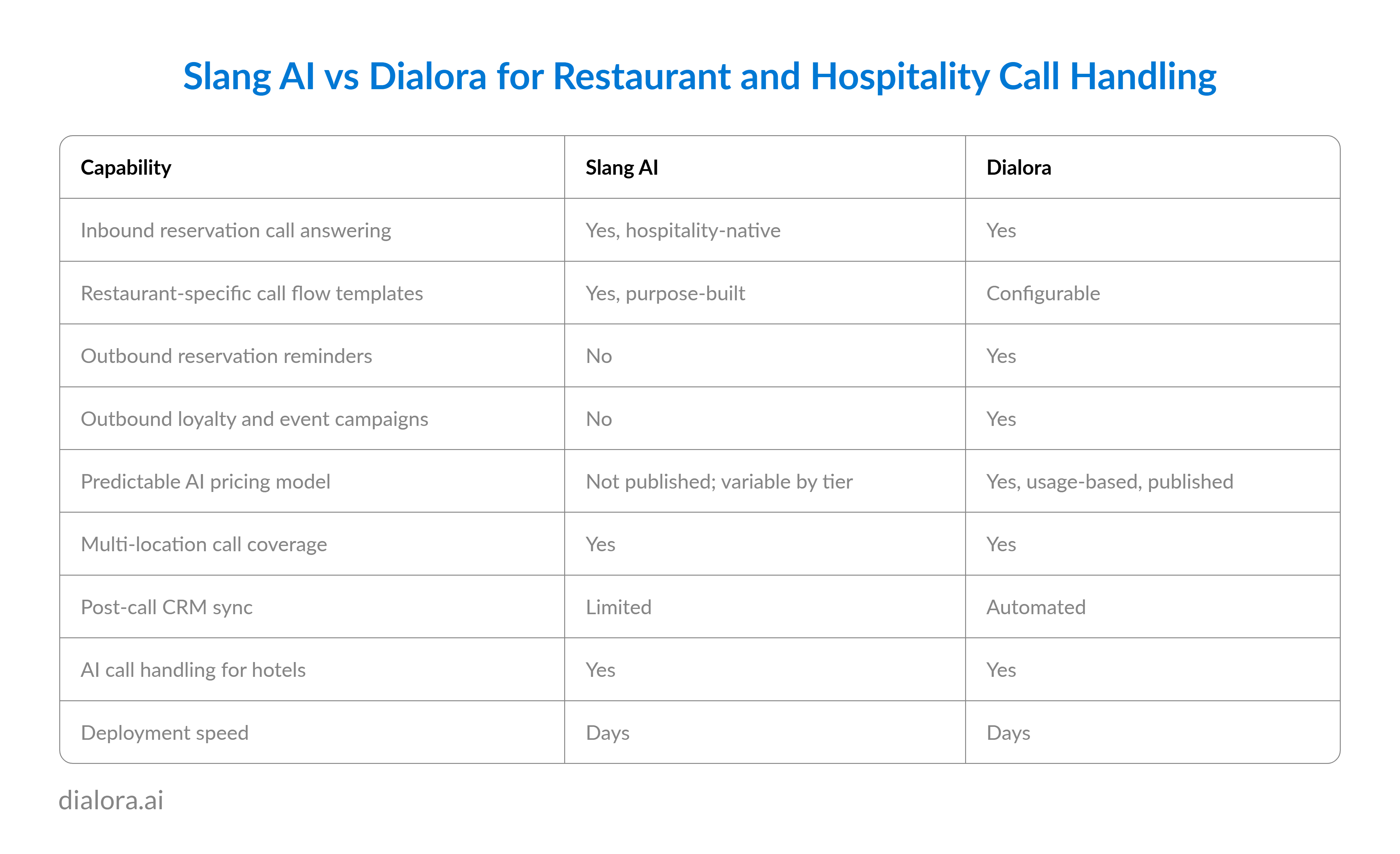
For restaurant owners who need hospitality-native call answering with the fastest possible setup, Slang AI's vertical focus is a genuine advantage. For franchise operators and hospitality CFOs evaluating total cost across inbound and outbound, Dialora's usage-based model and outbound capability deliver a broader ROI case.
Is Slang AI Worth It for Restaurants? What Operators Report
Slang AI reviews from operators in the restaurant and hospitality sector consistently reflect the same pattern.
Teams that find the highest value are high-volume single-location or multi-location restaurants where inbound call spikes during service hours result in measurable lost reservations. The platform reduces the front-of-house call burden noticeably. Slang AI customers at this profile report positive ROI within the first month.
Teams that flag friction are franchise operators or hospitality groups that need outbound capability alongside inbound, or who find the subscription-based voice AI cost structure hard to predict month-to-month at variable call volume. The restaurant AI phone answering cost versus total call coverage question is where Dialora's transparent, predictable AI pricing model becomes a meaningful alternative.
Ready to See What Dialora Handles for Hospitality Call Volume?
Slang AI covers inbound calls for restaurants. Dialora covers inbound and outbound, across locations and verticals. Start Your Free Trial
Frequently Asked Questions
How much does Slang AI cost per month for a restaurant in 2026?
Slang AI pricing per month is not published. Based on available market data from Slang AI reviews and operator feedback, estimated costs range from $200 to $350 per month for single-location restaurants at moderate call volume, rising to $400 to $700 for higher-volume or multi-location setups. The Slang AI subscription cost breakdown should be confirmed directly with Slang AI at current rates before making a budget decision.
How does Slang AI pricing compare to Dialora AI pricing for hospitality?
Slang AI pricing is subscription-based and vertical-specific for restaurants. Dialora AI pricing is usage-based and published at Dialora.ai. For operators that need only inbound call answering for a restaurant, Slang AI's hospitality-native setup may justify its cost. For operators that need inbound and outbound coverage across locations, Dialora AI pricing on a usage basis often produces better total economics.
What do real Slang AI reviews say about the platform?
Slang AI reviews from restaurant operators highlight fast setup, hospitality-native call flows, and measurable reduction in missed inbound calls as the primary positives. Friction points include limited outbound capability, variable Slang AI monthly cost at higher call volumes, and limited CRM integration flexibility. Overall, Slang AI customers in the restaurant segment report strong satisfaction for the core inbound use case.
Is Dialora a viable alternative to Slang AI for restaurant and hotel operations?
Dialora is a viable guest experience automation tool for hospitality operators that need both inbound call answering and outbound campaign capability. Dialora handles reservation inquiries, after-hours inbound, outbound reminder calls, and loyalty outreach from a single AI voice agent platform with published usage-based pricing. It is not pre-configured for hospitality in the way Slang AI is, but it deploys in days and covers a broader call handling scope.
Is Dialora compliant and secure for hospitality operations?
Dialora operates on SOC 2-ready infrastructure with GDPR compliance across 30-plus countries. For hospitality teams handling guest data in call management, Dialora provides end-to-end encrypted call handling and full post-call transcripts. Dialora AI pricing and compliance documentation are available at Dialora.ai.