TL;DR
- Cognigy and Amelia are both enterprise-grade conversational AI platforms built for large-scale operations in banking, healthcare systems, and BFSI. Cognigy leads on NLU flow control and European enterprise credentials. Amelia leads on agentic AI depth and legacy enterprise system integration.
- The Cognigy vs Amelia comparison serves operations that need human-augmented AI for complex contact center orchestration. Neither platform handles calls autonomously without agents present.
- Dialora covers the autonomous call handling layer, both platforms route to human staff, with transparent Dialora AI pricing and day-level deployment available at dialora.ai.
Heads of conversational AI and VPs of IT infrastructure evaluating Cognigy vs Amelia enterprise AI are comparing two platforms with long enterprise track records. Cognigy has production deployments at airlines, banks, and utilities. Amelia has legacy enterprise and healthcare systems integration depth that few conversational AI platforms match. The Cognigy vs Amelia 2026 comparison is not a product quality question. It is an architecture question: which platform fits the specific integration complexity, compliance posture, and team capability of the operation running it? The finding most teams reach is that both platforms answer a specific enterprise question well and leave the same autonomous call handling gap open.
Cognigy and Amelia are both enterprise conversational AI platforms built for complex contact center operations in BFSI, healthcare systems, and global enterprise CX. The Cognigy vs Amelia comparison turns on NLU design control versus agentic AI depth, European versus legacy enterprise credentials, and team capability requirements. Neither platform handles calls fully autonomously without human agents on the line.
Cognigy vs Amelia: Platform Strengths and Target Operations
The Cognigy vs Amelia enterprise AI comparison starts with understanding what each platform was purpose-built to do.
Cognigy is a German enterprise conversational AI platform built on a proprietary NLU engine. It handles voice and chat for large enterprise contact centers across omnichannel workflows. A Cognigy review from banking and utilities teams in production highlights precise dialogue control, enterprise AI compliance credentials, and a multi-language track record as its primary strengths.
Amelia is an enterprise conversational AI platform with a deeper agentic AI architecture built for legacy enterprise integration. Healthcare systems, BFSI operations, and large enterprise IT environments use Amelia for its ability to connect to legacy backend systems that more modern platforms do not touch. An Amelia review from enterprise architects consistently highlights integration depth alongside implementation complexity that matches Cognigy's overhead at the high end.
Pro-tip:
The Cognigy vs Amelia enterprise AI evaluation typically ends with both platforms qualifying on capability and both creating friction on the implementation timeline and pricing transparency. The question is which friction is more acceptable for the specific operation.
Cognigy vs Amelia: Feature and Deployment Comparison
The Cognigy vs Amelia 2026 comparison across the dimensions that matter most to enterprise architects and IT infrastructure VPs.
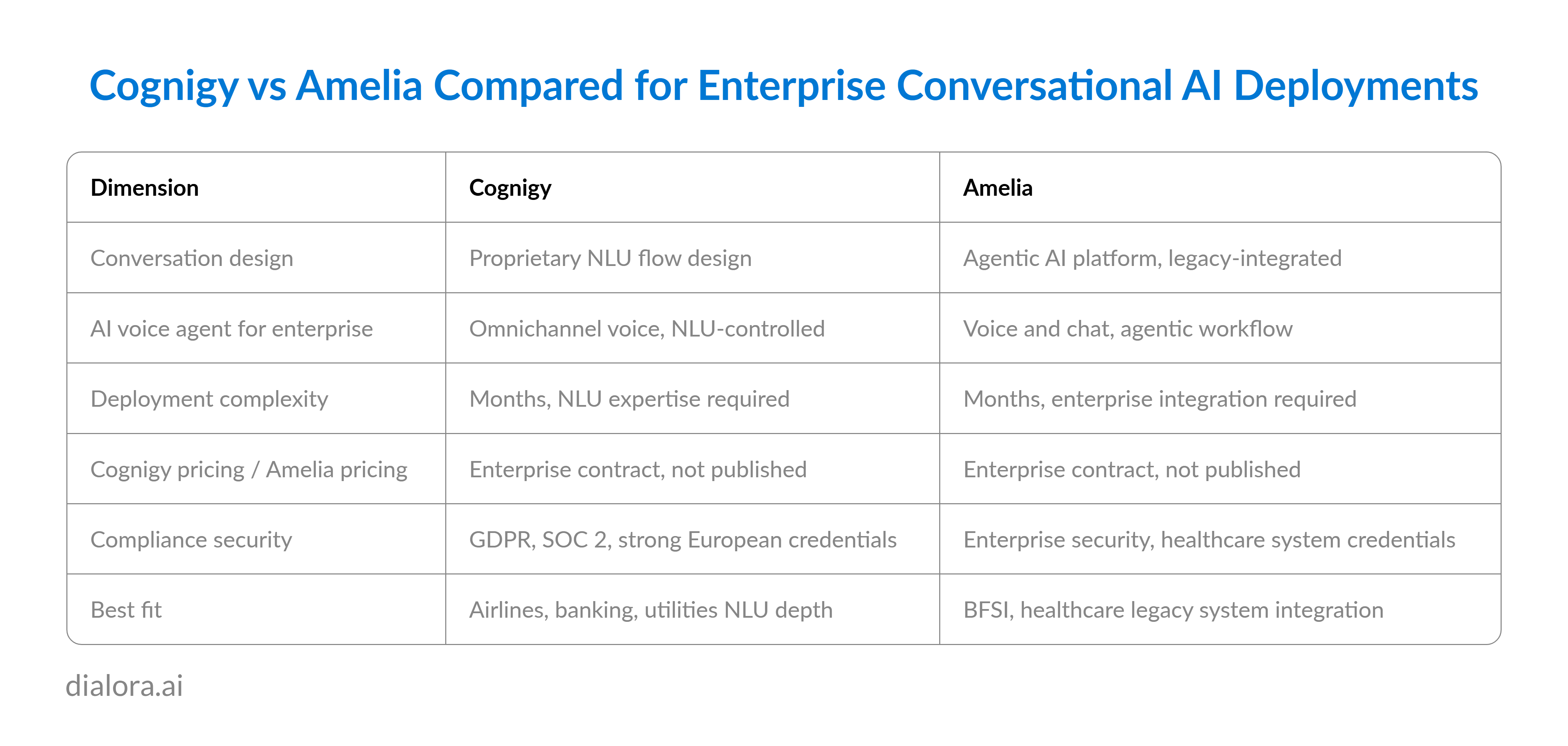
Cognigy vs Amelia pricing follows the same enterprise contract pattern. Neither publishes a rate card. The Cognigy vs Amelia user sentiment pattern from G2 reviews shows teams rating Cognigy higher when NLU control is the primary value, and Amelia higher when legacy system integration is the deciding factor.
Which is better, Cognigy or Amelia? For complex NLU-controlled enterprise flows with European compliance requirements, Cognigy. For deep agentic AI integration with legacy enterprise and healthcare backend systems, Amelia.
What the Cognigy vs Amelia Comparison Does Not Answer
The Cognigy vs Amelia enterprise AI comparison reveals a clear architectural boundary. Both platforms are built around human agents in the loop. The contact center AI pricing model for both involves per-agent or per-interaction structures that assume human staffing is present.
The gap both platforms share is consistent. Autonomous call handling at 11pm when agents are not staffed. Outbound follow-up sequences that need headcount to execute. Live call lead qualification that consumes agent time.
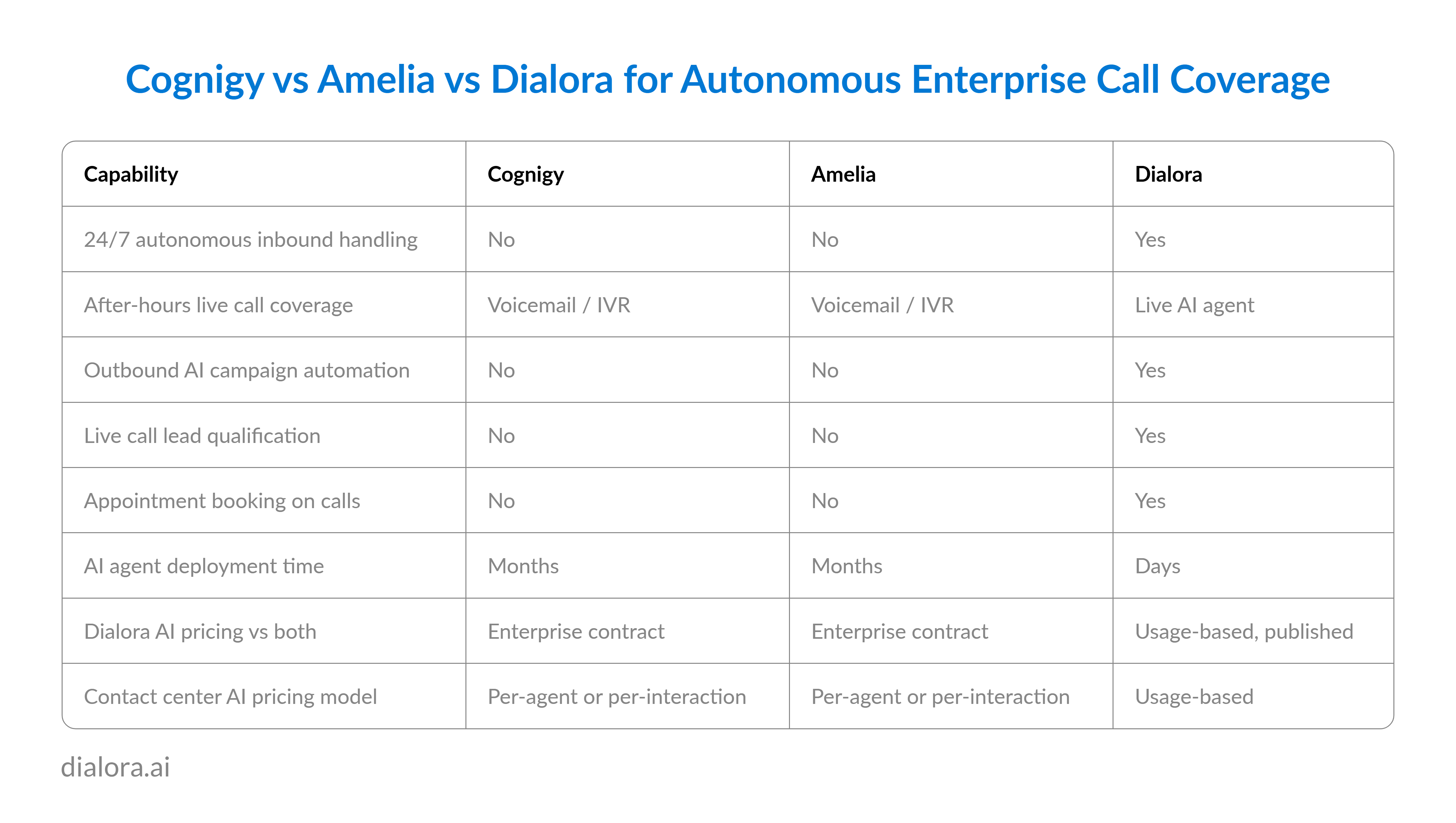
Dialora is not a Cognigy or Amelia replacement for full enterprise NLU orchestration or legacy system integration. It is the autonomous AI voice agent layer that covers the call volume both platforms leave to human staff. Teams adding Dialora alongside a Cognigy or Amelia deployment recover after-hours inbound, run outbound sequences without agent headcount, and handle live call qualification autonomously. Dialora AI pricing is transparent and available at dialora.ai before any procurement conversation.
Ready to See What Autonomous AI Covers in Your Enterprise Contact Center Stack?
Cognigy and Amelia handle what your agents manage. Dialora handles what arrives when agents are not there. See It Handle a Real Call
Which Enterprise AI Platform Fits Your Operation?
The Cognigy vs Amelia choice comes down to what the team is integrating and who is maintaining it. Cognigy wins when NLU flow precision and European enterprise credentials are the deciding factors. Amelia wins when legacy enterprise backend integration and agentic AI depth are the primary requirements. Both win for teams with dedicated conversational AI resources and multi-year implementation runways. The autonomous call handling gap both platforms share points to Dialora for any operation that cannot staff every inbound call 24 hours a day. The G2 reviews from enterprise buyers and agentic AI platform evaluation data from deployment teams confirm both platforms are production-grade in their core profiles. The gap they share is equally consistent.
Frequently Asked Questions
What is the key difference in the Cognigy vs Amelia 2026 comparison?
The Cognigy vs Amelia 2026 comparison turns on NLU architecture versus agentic AI depth. Cognigy uses proprietary NLU flow design for precise dialogue control in omnichannel enterprise environments. Amelia uses agentic AI with deep legacy enterprise system integration capability. Cognigy fits airlines, banking, and utilities with NLU expertise. Amelia fits BFSI and healthcare systems with legacy integration requirements.
How does Cognigy vs Amelia pricing compare for enterprise teams?
Cognigy pricing and Amelia pricing are both enterprise contract-based and not publicly listed. Both require direct sales engagements to surface. A Dialora AI review alongside a Cognigy review and Amelia review shows that Dialora AI pricing is the only transparent option in this category, available at dialora.ai before any sales conversation starts.
Which is better for an omnichannel AI agent platform: Cognigy or Amelia?
Which is better, Cognigy or Amelia, for an omnichannel AI agent platform depends on the integration layer. Cognigy is stronger on omnichannel voice and chat orchestration with NLU control across channels. Amelia is stronger on integrating conversational AI into legacy backend systems and agentic workflows. Neither handles fully autonomous call management.
Where does Dialora fit in a Cognigy vs Amelia enterprise evaluation?
Dialora covers the autonomous call volume layer that neither Cognigy nor Amelia provides. It handles inbound calls 24/7 without agents, books appointments on live calls, runs outbound follow-up campaigns, and syncs every outcome to CRM automatically. Dialora AI pricing is usage-based and available at dialora.ai. It is the AI voice agent for enterprise operations that covers what their NLU or agentic platform routes to human staff.
Is Dialora compliant for enterprise deployments in BFSI and healthcare adjacent use cases?
Dialora operates on SOC 2-ready infrastructure with GDPR compliance across 30-plus countries. Healthcare teams can request a Business Associate Agreement. For BFSI teams, Dialora operates within PCI-compliant parameters for payment-related call handling. Full compliance documentation and Dialora AI pricing details are available at dialora.ai.