Enterprise solutions architects and heads of conversational AI evaluate Cognigy when the requirement is large-scale, multi-channel AI for operations running at airline, banking, or utilities volume. The platform's NLU credentials are real. So is the implementation complexity. This is an honest Cognigy AI review 2026 covering what the platform delivers, what it costs, what it does not do, and where Cognigy alternatives make more sense. Written for teams that are past the vendor deck stage and need an accurate picture of what production deployment actually involves.
Cognigy is a German enterprise conversational AI platform built for complex, high-volume contact center operations across airlines, banking, utilities, and global enterprise CX. An honest Cognigy review 2026 covers what the NLU-based chatbot platform genuinely delivers, where Cognigy pricing and implementation overhead create friction, and which Cognigy alternatives are better suited for teams outside the core enterprise profile.
What Is Cognigy and Who Actually Uses It?
Cognigy is an enterprise conversational AI platform built on a proprietary NLU engine. It handles inbound voice and chat interactions for large enterprise contact centers. Major European airlines use it for customer support. Several large European banks run it in production. The platform is a genuine omnichannel AI agent built for operations that need complex dialogue design, NLU customization, and enterprise-grade security.
The target is explicit: global enterprise at scale. Cognigy is not a mid-market platform.
Implementation requires skilled NLU designers familiar with Cognigy's flow design environment. Most production deployments involve either a dedicated internal conversational AI team or a certified Cognigy implementation partner. An enterprise solutions architect at a European utility firm described the initial configuration as a three-month project before the first live call went through the platform. That AI agent deployment time is consistent with what AI contact center software review data from teams in production reports.
Pro-Tip: Cognigy's strongest deployments are airlines, banking, and utilities operations with dedicated conversational AI teams, complex multilingual requirements, and multi-year platform relationships. Teams outside that profile consistently encounter implementation overhead that outpaces the ROI timeline.
Cognigy Pricing and What Enterprise Teams Pay
Cognigy AI pricing is not publicly listed. The platform operates on enterprise contract pricing that requires a direct sales engagement to surface.
A Cognigy pricing review from teams in procurement typically reveals three cost layers. Platform licensing based on interaction volume or seat count, depending on contract structure. Implementation services for NLU flow design, integration configuration, and go-live support. Ongoing optimization and support, which most enterprise deployments require, given the NLU design complexity.
The total cost at enterprise scale is significant. For global enterprise operations running millions of interactions annually, the per-interaction cost can justify the contract. For mid-market operations below that volume threshold, Dialora AI pricing on a usage-based model and Cognigy alternatives with simpler deployment often deliver better cost-to-value ratios. Teams reading a Dialora AI review alongside a Cognigy pricing review find the pricing transparency contrast stark: Cognigy AI pricing requires a sales engagement; Dialora AI pricing is available at dialora.ai before any conversation.
Cognigy Pros, Cons, and What Teams Report on Voice Quality and Latency
This Cognigy AI pros and cons summary reflects patterns from enterprise production deployments and contact center AI review data across community platforms including G2 and enterprise analyst evaluations.
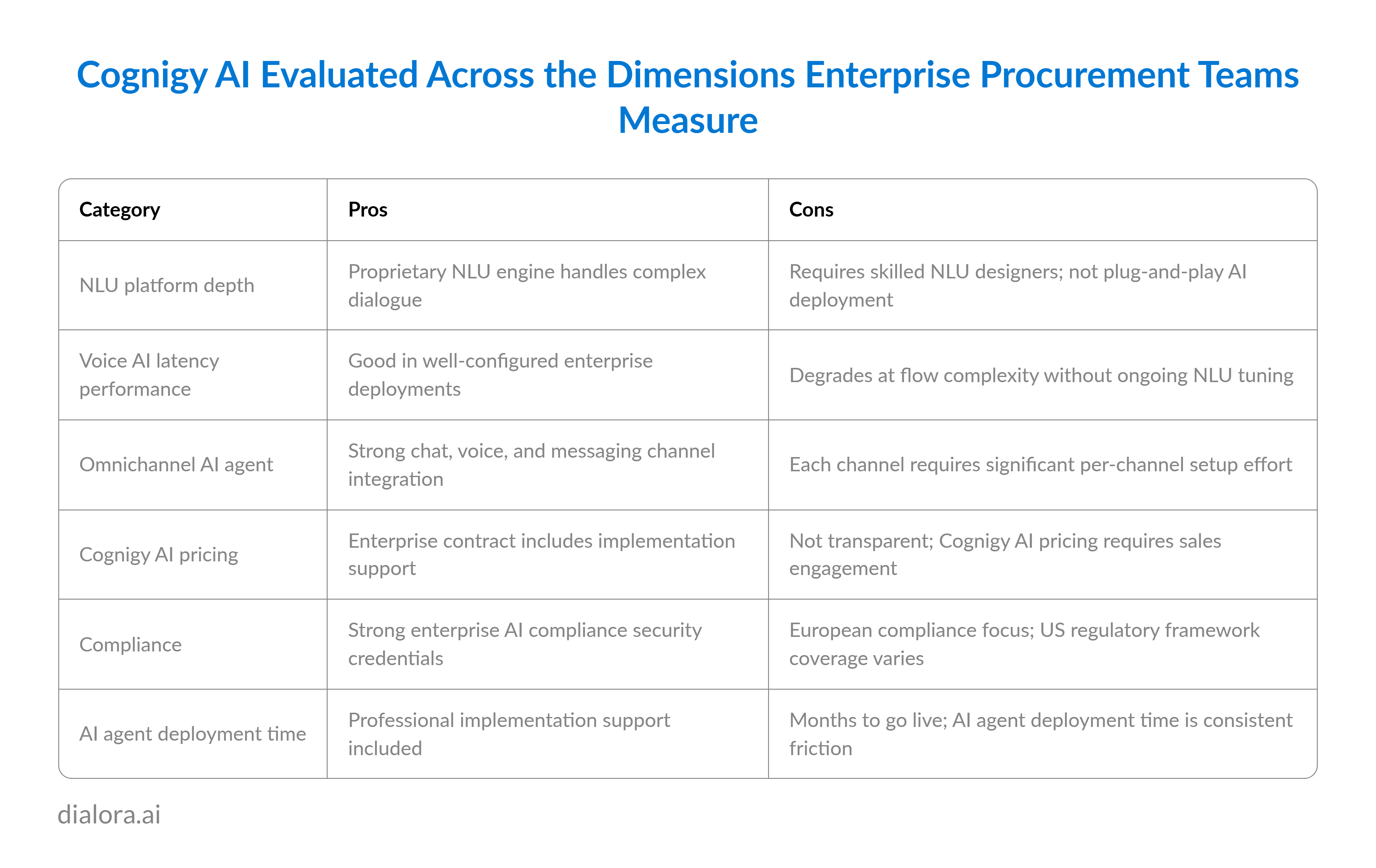
Cognigy AI customer service reviews on G2 and enterprise community forums consistently flag the platform's power alongside its implementation dependency. Teams that rate it highly are the ones with internal NLU expertise or certified implementation partners. Teams that flag frustration most often are the ones who expected a faster path from contract to live production. Not even close to a quick setup.
Cognigy AI G2 reviews from enterprise buyers regularly surface the NLU design learning curve as the primary friction point alongside Cognigy AI pricing opacity. Cognigy AI Trustpilot negative reviews cluster around implementation timelines and the level of ongoing technical resource required to maintain flow quality. The pattern is consistent across the contact center AI review category for complex NLU platforms.
Ready to See What Autonomous AI Handles That Cognigy Routes to Agents?
Where Do Teams Go When Cognigy Does Not Fit?
The teams that move from Cognigy to Cognigy alternatives are usually in one of two situations. Mid-market operations that completed a scoping evaluation and found that the implementation overhead does not fit their current runway. Enterprise teams that completed a Cognigy deployment and are adding an autonomous AI call handling layer alongside it for interaction types that the human-assisted model does not cover.
Both paths often lead to Dialora. An AI customer experience platform comparison produces a clear divide between platforms that assist human agents and platforms that handle calls autonomously. Cognigy augments agents. Dialora replaces the agent requirement for specific interaction types: after-hours inbound, outbound follow-up sequences, inbound lead qualification, and appointment booking on live calls. Fully autonomous.
Teams running a Dialora AI review as part of their Cognigy alternatives evaluation find the key contrast is not NLU depth. It is a deployment model. Cognigy needs months and an NLU team. Dialora needs days and a working phone queue.
Is Cognigy Worth It for Enterprise? The Honest Bottom Line
Is Cognigy worth it for enterprise? Yes, for the right enterprise. Airlines, banking, utilities, and global enterprise operations with large interaction volumes, dedicated conversational AI teams, and a multi-year platform relationship get genuine ROI from Cognigy's NLU depth and enterprise AI compliance security. For operations outside that profile, Cognigy alternatives with transparent Dialora AI pricing and faster plug-and-play AI deployment deliver better near-term value. The honest Cognigy review 2026 conclusion is that the platform is excellent at what it is built for, and poorly suited for what it is not. Matching the use case before entering the procurement cycle saves months of wrong evaluation.
Cognigy is a serious enterprise platform that earns its place in the right operation. If scoping reveals a mismatch on timeline or resource requirements, reviewing Cognigy alternatives before extending the procurement cycle is the faster path. Book a 15-Min Demo
Frequently Asked Questions
What are the main Cognigy AI pros and cons enterprise teams report?
Cognigy AI pros and cons consistently cited in enterprise evaluations include: strong proprietary NLU engine, deep omnichannel AI agent capability, and solid enterprise AI compliance security on the positive side. Implementation complexity, Cognigy AI pricing opacity, high NLU designer dependency, and slow AI agent deployment time are the main friction points. Teams with internal conversational AI expertise report the highest satisfaction.
How does Cognigy pricing compare to alternatives for mid-market enterprise teams?
Cognigy AI pricing is not publicly listed. Mid-market teams encounter contract structures covering platform licensing, implementation services, and optimization support. Alternatives with transparent approaches, like Dialora's usage-based Dialora AI pricing, let teams model costs before any procurement engagement. A Cognigy pricing review versus Dialora AI pricing comparison shows a clear transparency gap at the evaluation stage.
What does Cognigy voice quality and latency look like in a production contact center AI review?
Cognigy voice AI latency performance benchmarks well in optimized enterprise deployments. Voice quality depends on NLU flow design quality and ongoing maintenance. Teams in production report that voice AI latency performance holds well for common interaction paths but requires tuning at NLU edge cases. The platform is production-grade for well-resourced enterprise operations.
What are the best Cognigy alternatives for teams that need faster deployment?
The best Cognigy alternatives for fast AI agent deployment time include Dialora for autonomous inbound and outbound call handling, Parloa for enterprise voice AI with a slightly lighter NLU footprint, and Genesys Cloud for full CCaaS at enterprise scale. Dialora deploys in days and handles calls autonomously without NLU designer dependency.
Is Dialora a viable AI customer experience platform alternative to Cognigy for mid-market teams?
Dialora is a viable AI customer experience platform for the autonomous call handling layer that Cognigy routes to human agents. It handles inbound calls 24/7, qualifies leads, books appointments, runs outbound campaigns, and syncs outcomes to CRM. Dialora AI pricing is transparent and usage-based, available at dialora.ai. It does not replace Cognigy's full NLU orchestration for complex multi-channel enterprise flows.