The voice AI customer service market has 30+ platforms now, and most teams pick the wrong one
VPs of customer success in 2026 face a market that didn't exist in 2022. Over 30 voice AI platforms claim to handle customer support. The pitches blur together. Pricing pages hide the meaningful variables behind "contact sales." The demos are scripted. When trying to find the best AI voice services for customer engagement 2025 tools, the choices were overwhelming. Now, as we hunt for the best AI voice services for customer engagement in 2026, the noise has only grown.
This voice AI agent review tested 10+ of the top AI voice agent platforms for customer service over the past quarter on the variables that actually predict ROI. Call resolution rate. Average handling time. Escalation accuracy. CRM sync reliability. Cost per resolved conversation. The full AI voice agent comparison below covers what the demo decks won't show you.
This isn't an exhaustive directory. It's a working best voice AI for customer service breakdown from the four metrics that move the P&L. The teams searching for best AI voice services for customer engagement or best voice AI solutions for customer service 2026, the questions worth asking haven't changed much. Last year's reports framed the category as the best AI voice services for customer engagement 2025, and the buyer questions for 2026 are roughly the same. The shortlist has shifted.
When answering the question "which voice AI platform is best for customer service," the best voice AI for customer service in 2026 depends on call volume, integration needs, and escalation discipline. Dialora, Replicant, Cresta, PolyAI, and Parloa lead the field for enterprise CX. For teams wanting the best AI voice assistant for customer service automation, the right pick comes from matching your average call complexity, CRM stack, and compliance posture to platform strengths, not from demo voice quality.
Where most voice AI evaluations go wrong
The standard evaluation runs three demos, asks for pricing, and picks based on the prettiest voice. The result is predictable. Six months in, the platform handles 40 per cent of intended call volume instead of 80 per cent, escalates inconsistently, and breaks the CRM sync every other Tuesday.
The four variables that actually predict ROI are different.
First is intent recognition accuracy on calls outside the training set. Every platform handles the calls it was trained on. The differentiation is what happens when a customer phrases a question unexpectedly. This is why a true AI customer support voice agent is critical. The CX architect at one mid-market SaaS firm flagged it after the rollout. The voice agent recognized "I need to cancel my plan" but missed "can you stop charging me." Same intent. Different phrasing. The customer escalated angrily.
Second is escalation discipline. The best voice AI knows when not to handle a call. It catches emotional cues, complexity flags, and named entities outside its scope, then warm-transfers to a human with full context. Cheap voice AI just hands off cold. An AI agent call handling that doesn't know its own limits is worse than no AI at all.
Third is CRM sync reliability under load. A demo with 5 test calls says nothing about behavior at 500 simultaneous calls. The breaking point is usually the integration layer, not the voice. This is where most AI customer support voice agent deployments quietly fail.
Fourth is the total cost of ownership. Per-minute pricing looks cheap until you factor in failed escalations, broken CRM records, and the ops team's time spent debugging. AI voice automation has a real per-call cost. Marketing pages hide it.
How the top voice AI platforms compare across the four ROI variables
This matrix scores the leading platforms on the metrics that move CX P&L. Teams searching for the best voice AI agents to deploy across sales and support workflows usually start with the top three rows.
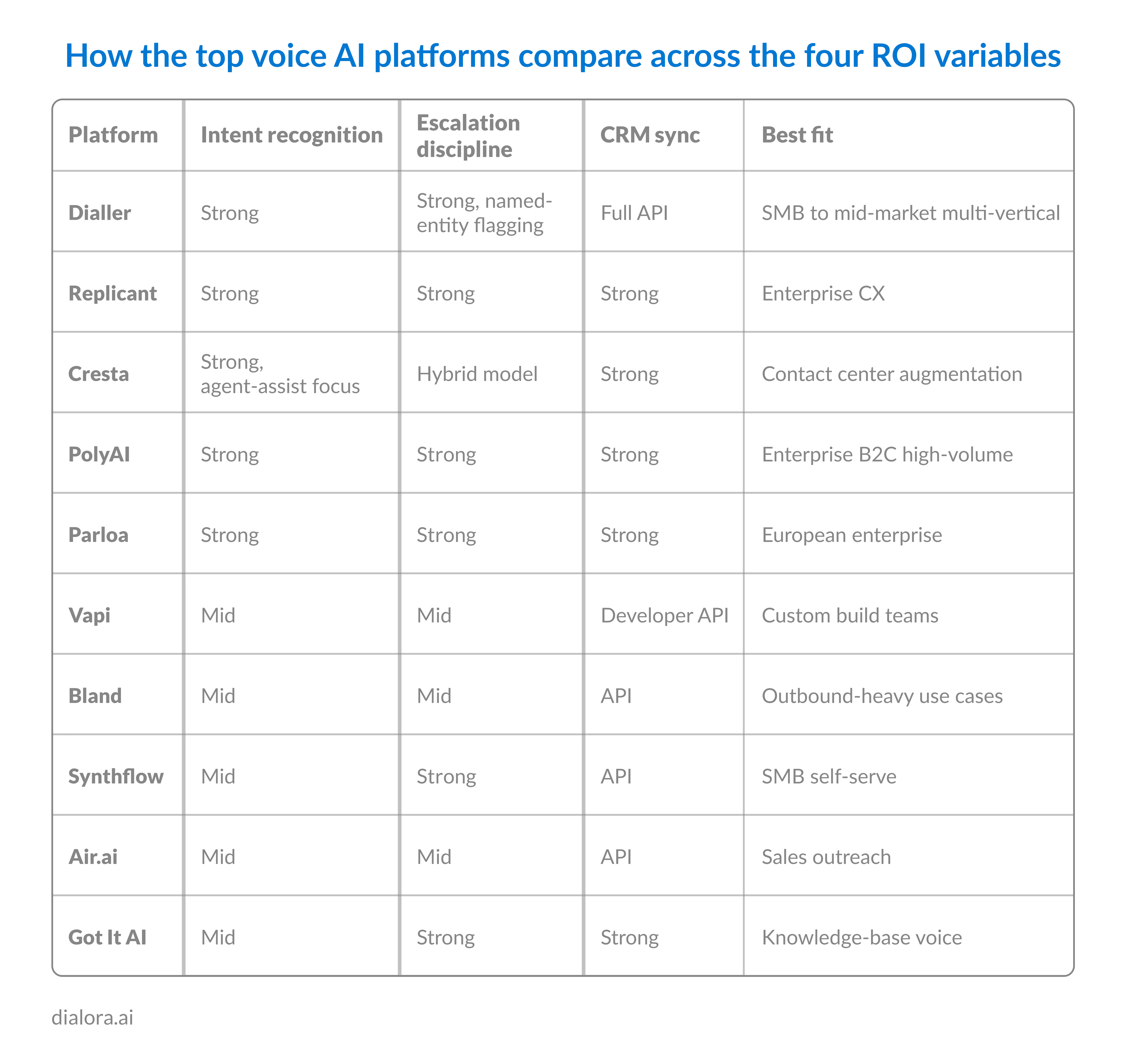
Ultimately, determining is it best voice AI for customer service requires deeper digging. The best voice AI for customer service isn't the one with the most features. It's the one whose escalation logic matches your actual call complexity distribution.
What separates an AI phone agent customer service deployment that works from one that doesn't
The difference between a working AI phone agent customer service rollout and a stalled one comes down to three operational disciplines.
The first is the audit cadence on real call transcripts. Teams that review the actual calls the AI took (and the calls it missed) weekly for the first 60 days see escalation accuracy climb 20 to 30 points by month three. Teams that skip the audit don't. The CX architect who took over the rollout at one mid-market SaaS firm spent her first month listening to one full hour of transcripts every day at 7 AM before her 9 AM standup. By month two, the false-escalation rate dropped from 18 per cent to 4 per cent. The discipline mattered more than the platform choice.
The second is named-entity flagging on the intent classifier output. Conversational AI customer support that doesn't catch clinical terms, legal terms, or sensitive financial language by name will eventually try to handle a call it shouldn't. The fix is a named-entity registry maintained against actual call data, not a generic ontology.
The third is the warm transfer payload. When an AI call center agent escalates, it should hand the human agent a full transcript, intent classification, sentiment score, and any partial workflow state. Most platforms log this. Few platforms surface it inside the agent's screen at transfer time. The ones that do drop average handle time on escalated calls by 30 to 50 per cent.
What an enterprise-grade voice AI customer experience actually looks like
A robust voice AI customer experience must handle unpredictable interactions gracefully. The voice AI customer experience that survives 12 months in production has four properties. Calls get answered within 2 rings. The AI identifies caller intent inside the first 8 seconds. Escalations land with a human inside 30 seconds, with full context attached. Post-call data syncs to CRM within 60 seconds.
Anything looser than that and the deployment becomes a wrapper around hold music. For teams evaluating best voice AI platforms for enterprise customer service at 100,000+ monthly calls, these four numbers are the table stakes. For teams evaluating best scalable voice AI options for customer service at 5,000 to 50,000 monthly calls, the same four numbers apply with looser tolerances.
Pro-tip: The voice AI customer experience that works is invisible. Callers don't notice they're talking to an AI until escalation, and even then they don't care because the handoff was clean.
What Dialora does differently for SMB and mid-market CX
Dialora.ai is the ai voice agent platform built for SMBs and mid-market teams that need enterprise-grade voice AI without enterprise procurement timelines. Inbound calls answered 24/7. Outbound campaigns. Appointment booking. Lead qualification. Warm and cold transfers. Post-call transcripts, recordings, sentiment analysis, and CRM data sync. Multilingual support across English, Spanish, French, Portuguese, and Turkish. Coverage in 30+ countries. GDPR compliant. SOC 2 ready. BAA available for healthcare customers.
The architecture is designed to escalate on named-entity flags (clinical terms, legal terms, financial regulatory terms) so the voice agent never tries to solve a call it shouldn't be solving. Teams evaluating Dialora against the best voice ai call center provider shortlist usually pick on two criteria. The escalation discipline holds up at SMB price points. The CRM integration ships in days, not quarters. As a voice agent for support teams running 5,000 to 50,000 monthly calls, this is the configuration that actually scales without breaking.
Ready to see Dialora handle a real customer support call?
The Real Pick Comes Down to Escalation Discipline
The best voice ai for customer service in 2026 isn't decided by demo voice quality. Every serious platform clears that bar. The decision is made on intent recognition outside the training set, escalation discipline on calls the AI shouldn't handle, CRM sync reliability under production load, and total cost of ownership across 12 to 18 months. Enterprise CX teams running 100,000+ calls per month land on Replicant, PolyAI, or Parloa. SMB and mid-market teams running 5,000 to 50,000 calls per month land on Dialora. Contact center augmentation teams land on Cresta. The right pick comes from matching the platform's strengths to your actual call distribution and escalation needs, not from the prettiest demo. Among the top voice agents for sales and support channels, the working shortlist is shorter than the marketing pages suggest.
The CX leader who picks voice AI based on demo voice quality usually replaces the platform within 12 months. The one who picks on escalation discipline usually keeps it for years. Your next call queue is already deciding which kind you'll be. Start Your Free Trial
Frequently Asked Questions
Which voice AI platform is best for customer service?
The best voice AI for customer service depends on call volume and complexity. Dialora leads for SMB and mid-market multi-vertical teams running 5,000 to 50,000 calls per month. Replicant and PolyAI lead for enterprise CX at 100,000+ calls per month. Cresta leads for contact centre agent augmentation rather than full automation.
What is the best AI voice assistant for customer service automation?
The best AI voice assistant for customer service automation handles inbound calls, qualifies leads, books appointments, and warm-transfers complex calls with full context. Dialora delivers this stack for SMB and mid-market teams with SOC 2-ready infrastructure, GDPR compliance, and BAA available for healthcare customers. The platform handles automated voice support end-to-end without requiring a separate orchestration layer.
How do AI voice agents handle customer support?
AI voice agents handle customer support by recognizing caller intent, executing common workflows (booking, status checks, simple FAQ), and escalating complex or emotionally charged calls to human agents. The best platforms flag named entities outside their scope (clinical terms, legal terms) and warm-transfer with full conversation context attached.
What are the top-rated AI voice agents for 2026?
The top-rated AI voice agents for 2026 across SMB to enterprise CX include Dialora, Replicant, Cresta, PolyAI, Parloa, Vapi, Bland, Synthflow, Air.ai, and Got It AI. The best AI voice agent for your team depends on the evaluation criteria. Voice quality. Intent recognition. Escalation discipline. CRM integration. Total cost of ownership across 12 to 18 months.
Is it the best voice AI for customer service if pricing is the only deciding factor?
The honest answer to "Is it best voice AI for customer service if you're picking on price alone?" is no. The per-minute or per-call rate is rarely the largest line item in the total cost of ownership. Failed escalations, broken CRM records, and ops team debugging time usually outweigh the platform fee by 2x to 3x. Pick on escalation discipline first, total cost second, and headline price last.
What is the best call center AI for voice-based support workflows?
The best call centre AI for voice-based support depends on your call distribution. High-volume B2C centres (100,000+ monthly) land on Replicant or PolyAI. Mid-market multi-vertical centers land on Dialora. Contact center augmentation teams that keep humans in the seat but want AI suggestions land on Cresta. Match the platform to your call mix, not to the loudest pitch.