The team that asked us this had two engineers and a sprint deadline. They wanted to know if Twilio ConversationRelay was the right path or if it was the path that ate the next six months of the roadmap.
The answer is not the same for everyone. As leading voicebot companies continue to release new models, deciding how to deploy an AI voice bot is a massive challenge. This post walks through what scalable voice bots actually need under the hood, where ConversationRelay fits, and where a managed platform replaces the build entirely.
Voice bots scale on three things. Sub-second response latency. Reliable telephony at carrier grade. CRM and calendar sync that survives a 10x volume spike. Twilio ConversationRelay handles the telephony and LLM routing layer. Teams that need full conversation flow, voice tuning, and post-call workflow either build the rest themselves or buy a managed platform like Dialora.
What Scalable Voice Bots Actually Require
Three layers have to work in concert. The telephony layer connects the call. The conversation layer thinks and speaks. The workflow layer does something with what was said.
The telephony layer is the SIP trunk, the carrier connection, and the failover routing. ConversationRelay simplifies this to a WebSocket connection. Twilio handles the carrier mess.
The conversation layer is speech recognition, an LLM doing the reasoning, and text-to-speech generating the reply. This is where a text-to-speech bot must shine, as clunky TTS bot voices will instantly alienate your callers. Median end-to-end latency on production voice bots AI sits at 680 milliseconds in 2026. To maintain the illusion of a human conversation, your bot voice must respond instantly. Anything over a second feels broken.
The workflow layer is what makes a voice bot for call center deployments actually useful. One of the major voicebot benefits is automating these tedious administrative tasks. Booking the appointment. Updating the CRM. Triggering the SMS. Routing the warm transfer to the right human.
Most teams underestimate the workflow layer.
Read more: What Is an AI Voice Bot and How Does It Work for SMBs
Where ConversationRelay Fits in the Build vs Buy Decision
ConversationRelay is Twilio's managed bridge between a phone call and your LLM of choice. It handles the SIP, the streaming audio, and the WebSocket protocol. Your code handles the prompt, the conversation flow, the function calls, and the post-call work. This means setting up the voice bot API and webhook connections entirely from scratch.
That bridge is genuinely useful. It removes the worst plumbing. However, building a true NLP voice bot requires much more than just audio routing.
What it does not remove is the conversation flow design, the voice tuning, the latency optimization, the function-calling reliability across edge cases, and the entire workflow layer. Those are still your problem.
Build vs Buy. ConversationRelay vs Managed Platform
This matrix breaks the build-vs-buy decision down into the work each path actually requires.
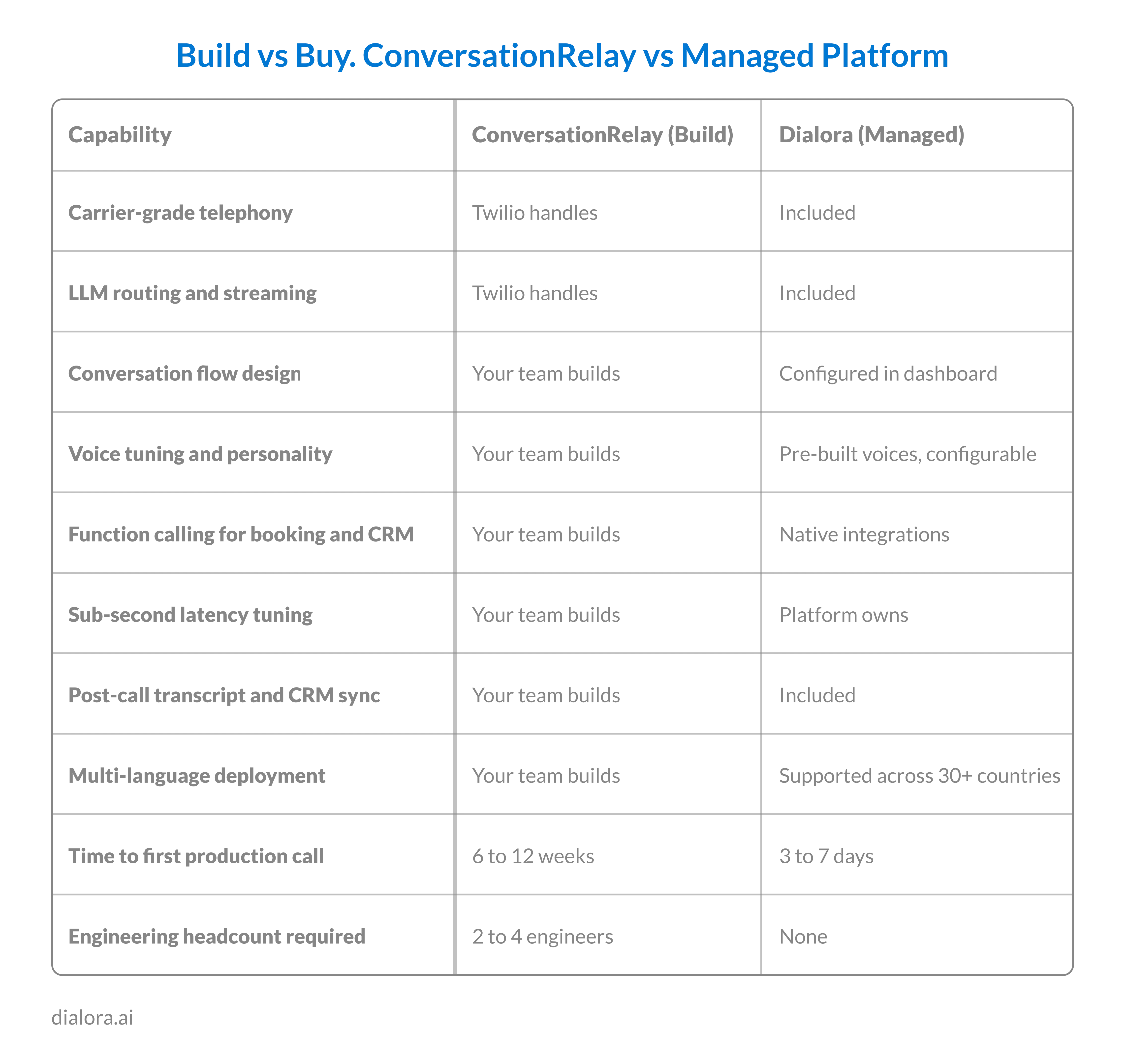
Build wins when you have a reason for the custom voice bot platform. Buy wins when you do not have the time to manually configure a telephony voice bot from the ground up.
Pro-tips: ConversationRelay removes the telephony pain. The conversation flow, voice tuning, and CRM sync are still a 6 to 12-week build.
Why Most Teams Underestimate the Build
The proof point is the function-calling layer. A voice bot integration sounds simple in the architecture diagram. You might assume creating a conversational voice bot is just a matter of connecting an LLM to Twilio. The user asks to book an appointment. The model calls the booking function. The slot gets reserved. Done.
In practice, the function call fails 4% of the time on edge cases that the team never tested. Wrong calendar. Wrong time zone. Two slots booked simultaneously. The user changes their mind mid-sentence. The model hallucinates a confirmation number. The CRM sync silently dropped the contact because the phone field had a country code prefix that the parser did not handle.
The CTO who flagged this had been in the role for nine months and had inherited the project. He was running on three cups of coffee, and a deadline was pushed twice. The fix list ran four pages. The fixes were not technically hard. They were just everywhere.
That is the gap between an IVR voice bot demo and a real-time voice bot in production.
When Buying a Managed Platform Makes the Math Obvious
Three signals point to buy over build.
If your voice bot deployment is a feature inside a larger product, a build is rarely worth it. True scalable voice AI requires constant maintenance. The LLM is improving every quarter. Your custom prompt quickly becomes technical debt.
If your call volume is under 100,000 minutes a month, the per-call economics of a managed platform beat the loaded cost of two engineers maintaining a build. Voice AI costs roughly $0.40 per call, compared with $7 to $12 for a human agent, according to Gartner-sourced estimates. The managed platform price sits inside that gap.
If your team is shipping anything else, the opportunity cost of a 6 to 12-week voice build is the feature you did not ship.
Pro-tip: Voice bot deployment under 100,000 minutes a month rarely justifies the engineering cost of a custom build.
What Dialora Replaces in the Stack
Dialora replaces the entire build. Instead of struggling to build a chatbot voicebot hybrid from scratch, you get a finished product. The platform handles SIP termination, LLM routing, voice generation, conversation flow, function calling, post-call CRM sync, and multi-language deployment from a single dashboard.
Native integrations exist for Google Calendar, Cal.com, and TidyCal. CRM sync runs through API and webhook for any system. The deployment is days, not weeks. The platform supports English, Spanish, French, Portuguese, and Turkish on the same workload, with coverage across 30+ countries.
Compliance posture covers SOC 2-ready infrastructure, full GDPR compliance, and BAAs available for healthcare workloads. The conversational relay voice bot pattern works inside Dialora as a configurable flow, not a code project. This transforms what used to be a complex voice chatbot build into a simple deployment.
Ready to See Dialora Replace a 12-Week Voice Build?
Where the Build vs Buy Decision Actually Lands for Most SMBs
The honest framing is that most SMBs do not need a custom voice bot platform. They need a voice bot solution that works on day one, integrates with the calendar and CRM they already use, and stays current with model improvements without a rebuild every six months. ConversationRelay is a useful primitive for the small percentage of teams whose product is voice itself. For teams looking to upgrade from a basic IVR voice bot to a highly intelligent conversational AI voice bot, the managed route is the clear winner. For everyone else, including the SMB owner who is reading this and weighing whether to put two engineers on a six-month project, the managed platform is the answer that ships sooner and costs less over the lifetime of the deployment.
Closing
ConversationRelay removes the telephony pain. The build is still 6 to 12 weeks long. Your roadmap has more important work than reinventing the voice stack. Ultimately, businesses need outcomes, not more complex infrastructure to manage. If you want a reliable AI sales rep that picks up the phone, reasons through conversations, and closes deals without a massive engineering headache, Dialora AI is the Gen-3 alternative built specifically for you. Ready to stop losing leads to voicemail and launch a fully functional agent in hours, not weeks? Let Dialora handle your phone line. Start your free trial
Frequently Asked Questions
1. Are voice bots scalable to enterprise call volume?
Yes. Modern voice bots scale to millions of minutes a month on managed platforms. The bottleneck is rarely the model. It is the workflow layer. CRM rate limits, calendar API throughput, and human escalation queues constrain volume more often than the conversation engine itself. Plan for those before you launch. Pick a platform that handles them natively.
2. How does Dialora compare to building on Twilio ConversationRelay directly?
ConversationRelay removes the telephony layer. Dialora removes the entire build. The build path takes 6 to 12 weeks of engineering and ongoing maintenance. The Dialora path takes 3 to 7 days of configuration and zero ongoing engineering headcount. Both run on carrier-grade infrastructure. The choice is whether your team needs the custom control or the time saved.
3. What about voice bot solutions for healthcare workflows specifically?
Dialora supports healthcare workflows with SOC 2-ready infrastructure, encrypted PHI handling, and Business Associate Agreements available on request. The platform never diagnoses, treats, or offers medical advice. Clinical and emergency calls always escalate to human staff. The compliance posture is GDPR-aligned for international deployments. Always confirm your specific regulatory requirements before going live.
4. Is Dialora SOC 2 and GDPR compliant?
Dialora is fully GDPR compliant and operates with SOC 2-ready infrastructure. Voice and transcript data are encrypted in transit and at rest. The platform supports BAAs for healthcare customers. Compliance documentation is available on request. Review your own regulatory requirements alongside the platform's posture before deployment.
5. How fast can a team go live with Dialora versus a ConversationRelay build?
Dialora deployments typically go live in 3 to 7 working days. The work is a calendar connection, a CRM connection, and a conversation flow configuration. A ConversationRelay build typically takes 6 to 12 weeks for production-grade deployment. The difference is the workflow layer, the voice tuning, the function-calling reliability, and the post-call sync, all of which Dialora ships out of the box.