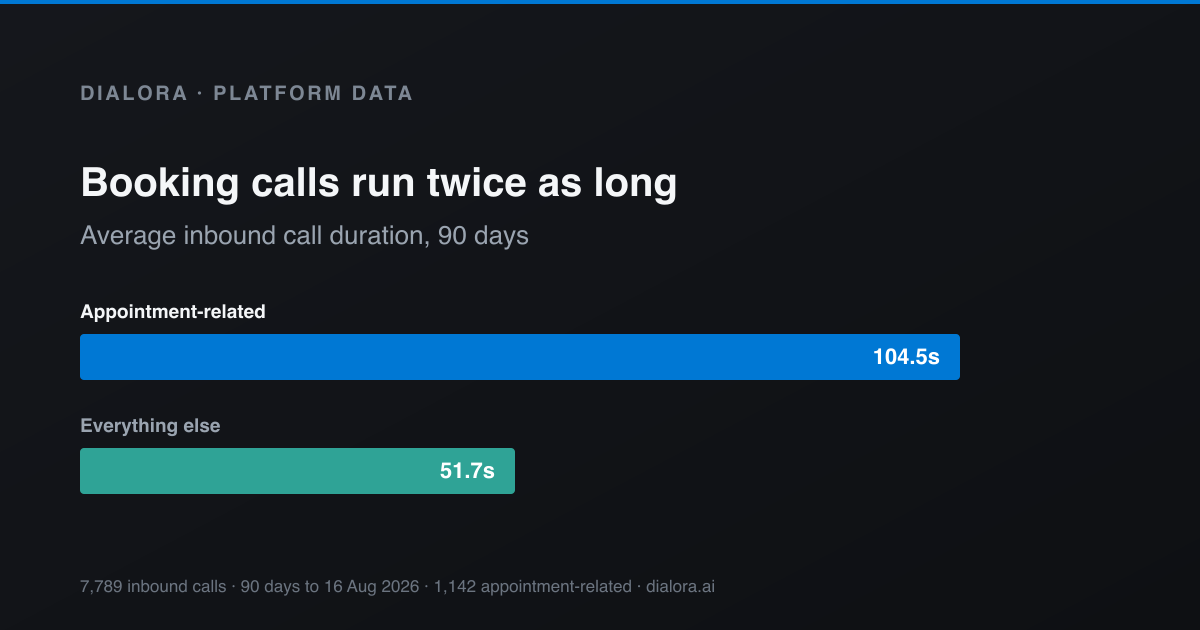
An AI answering service is software that answers your business phone around the clock, handles the routine questions a receptionist would handle, books appointments into your calendar, and passes anything unusual to a person. Plans start near $49 a month flat. Across 7,801 inbound calls on our platform in the last 90 days, the average answered call lasted 59 seconds.
Why I'm publishing our own numbers
I run Dialora. So I can see something a review site can't: every call that crosses the platform leaves a duration, a cost, and a breakdown of where that cost went.
I went looking because the buying advice in this category kept bothering me. People spend a week choosing a vendor based on which language model it runs. Then they buy on price per minute. Then they cancel in month two for a reason that had nothing to do with either one.
So I pulled our own data to find out what people are actually buying. Two numbers explain most of it.
How long is a real business call? 59 seconds
Every inbound call in the last 90 days that connected and recorded a duration. 7,801 calls across the businesses running on Dialora.
Inbound calls, trailing 90 days | Value | |
Calls analysed | 7,801 | |
Average length | 59.4 seconds | |
Finishing under 60 seconds | 68.6% |
Two thirds of business calls are done inside a minute.
That's shorter than almost everyone guesses. Ask an owner how long their calls run and they'll say three or four minutes, because they're remembering the painful ones. The painful ones are real. They're just the tail, not the shape.
Think about what fits in fifty-nine seconds. Are you open Saturday. How much is a standard service. Do you cover my postcode. Can I move Tuesday to Thursday. That's the job. That's what people are paying somebody $500 to $1,000 a month to sit and do.
Which makes the case for automating your phone pretty boring, honestly. It was never that the technology is clever. It's that most of the work is short and repetitive, and short repetitive work is the cheapest thing in any business to hand off.
What does a call actually cost to make?
Okay, this is the one that made me laugh.
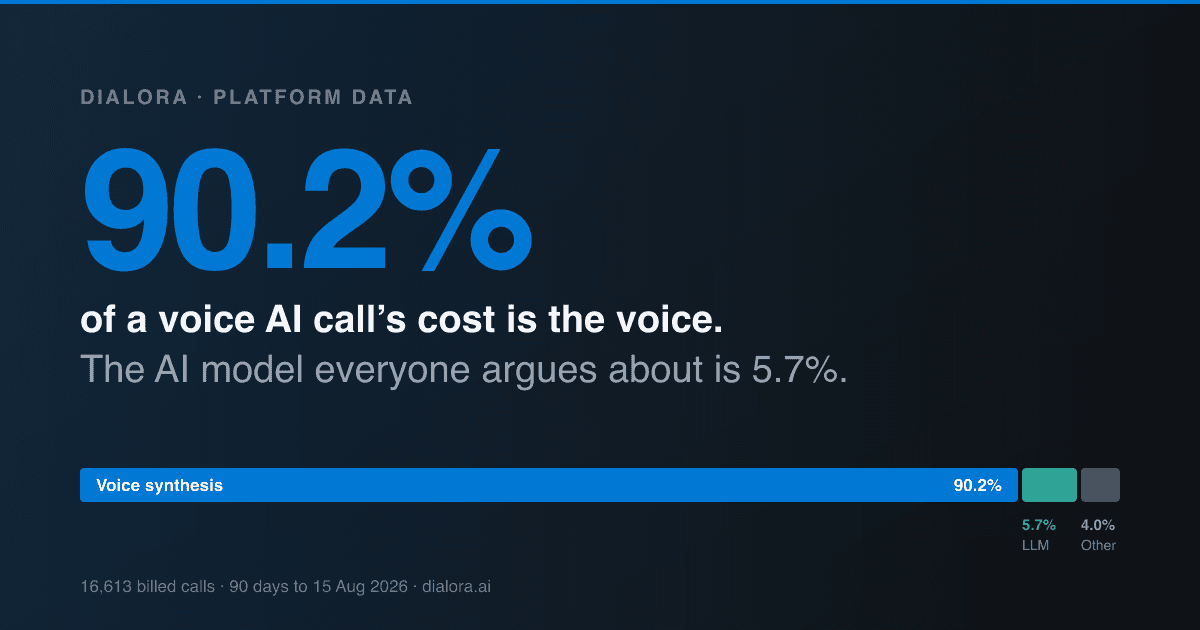
We integrate the underlying providers directly, so we see the real cost of producing a minute of conversation. Across 16,613 billed calls in the same window:
Where the money goes | Share of call cost | |
Voice synthesis | 90.2% | |
Language model | 5.7% | |
Platform | 3.4% | |
Transcription | 0.6% |
The voice is 90% of the bill. The AI model, the thing every comparison post and every vendor homepage is arguing about, is under six percent.
So when a vendor leads with which model they've plugged in, they're marketing the cheapest twentieth of the product to you. It's like choosing a restaurant based on the brand of salt.
What you're actually buying is the voice. How fast it answers. Whether it sounds like a person. Whether it copes when someone talks over it. That's where the money goes, and it's where the quality difference your caller notices actually lives.
It also explains the pricing you're being quoted, right? Per-minute billing exists because voice cost scales with talk time. A vendor billing you per minute is passing their biggest variable cost straight through. Which is fine while you're quiet, and expensive exactly when business is good. Strange thing to sign up for.
So what actually makes people cancel?
Not the voice, in my experience. It's that nobody decided what happens when the agent hits something it can't handle.
About 31% of inbound calls run past a minute, and that's where the value is. The complaint. The weird request. The person who needs reassurance more than information. The big job worth quoting properly. If you haven't written down what the agent does with those, it'll have a go, it'll do a mediocre job, and you'll blame the technology.
Four cases cover most of it. Someone asks for a discount. Someone's angry. Someone asks about something you don't offer. It doesn't understand the question. Write the instruction for those four before you go live and you've headed off most of what goes wrong.
I'll admit we learned this the embarrassing way. One of our early internal agents was flawless in testing. First real call, it tried to book an appointment with itself. Twice. Testing tells you the happy path works. The edges are where the product actually lives.
Flat rate or per minute?
Run it against your own volume, not the vendor's example.
Take your monthly call count, multiply by one, because we now know a call is about a minute. Thirty calls a day is roughly 900 minutes. At $0.15 a minute that's $135 this month, and more next month if you're growing. On a flat plan it's the same number every month.
Ours is flat. $49 for 200 minutes and 2 agents. $97 for 400 minutes and 10 agents. $149 for 600 minutes with unlimited agents. $297 for 1,000. Yearly billing takes 20% off, and the current tiers are on the pricing page.
One question sorts the vendors fast: what does my bill look like at 150% of my current volume? If the answer is 150% of today's bill, you're buying a tax on growing.
Most common sizing mistake I see is buying the cheapest tier and blowing through it every month. Thirty calls a day isn't a $49 business. It's a $149 one. Buy the right tier and stop thinking about it.
How many minutes do you actually need?
I went looking for this in the big comparison guides and none of them answer it. They tell you to "analyse your phone bills" and then move on to the next vendor review. So here's the arithmetic.
Your monthly minutes are roughly your monthly call count, because a call is about a minute. Then add headroom, because the month you get busy is the month you don't want a surprise.
Calls per day | Minutes you need | Tier that fits |
5 | around 130 | $49 (200 min) |
10 | around 260 | $97 (400 min) |
20 | around 520 | $149 (600 min) |
30 | around 790 | $297 (1,000 min) |
45 or more | 1,200 and up | You've outgrown the tiers, talk to us |
Two things that skew this. Outbound calls run shorter than inbound, 33 seconds against 59 in our data, so if you're doing reminder or follow-up campaigns your minutes stretch further than the table suggests. And if you're in a trade where people ring to describe a problem before booking, your average will sit above a minute, so size up.
The trap with per-minute pricing is that it looks cheaper at the bottom of this table and gets worse all the way down it. Run your own row before you compare headline prices.
What should the AI do when it can't handle the call?
This is the biggest hole in every buying guide I read, and it's the thing that decides whether you still have the service in ninety days. The guides give it a sentence. It deserves a page.
You're writing a policy, not choosing a feature. Four situations cover most of it.
Someone asks for a discount. Decide now whether the agent quotes a price at all. My preference is that it gives your standard price and says a human will call about anything bespoke, because an agent that negotiates is an agent that gives away margin at 11pm with nobody watching.
Someone is angry. This one should transfer or take a callback immediately, and it should say so plainly. An upset caller being cheerfully handled by software is the single fastest way to turn a complaint into a review.
Someone asks about something you don't offer. The failure mode is an agent that improvises. Write the list of things you don't do and tell it to say so directly, then offer the nearest thing you do.
It doesn't understand. Set the retry count. One clarifying question, then hand off. Agents that ask three times feel like a phone tree, and people hang up on phone trees.
Then decide where handoffs go. A ringing mobile is fine if someone actually answers it. If nobody does, a callback request in your CRM beats a transfer into another voicemail, because at least you've captured the number.
Write these four before you go live and read the transcripts weekly for the first month. Every call produces one, and the transcript tells you exactly which rule is missing.
Should you just hire someone instead?
Sometimes. I'd rather say that than pretend otherwise.
A receptionist covers about a third of the week. Your phone rings at 7pm and on Saturday. Theirs doesn't. You're paying salary, payroll, holiday cover, sick cover, and recruitment again when they leave. What you get back is judgement, warmth, and someone who knows your regulars by voice. If your calls are long, emotional, or the relationship is the product, that isn't a cost. That's the thing you're selling. Keep the human.
For everyone else it was never human or AI. It's what share of your calls deserve a person. If 68.6% are done inside a minute and they're the same five questions, a salary is an expensive way to answer them. It also wastes the person, which nobody mentions.
What does this actually cost you per year?
Worked properly, with the numbers people forget.
Take a clinic doing 20 calls a day. That's about 440 calls and 520 minutes a month.
Human answering service, per-minute. At $1.20 a minute that's $624 a month, or $7,488 a year, and it rises with every good month you have. Watch for per-call minimums that round a 40-second call up to a full minute, which on our data would round up 68.6% of your calls.
Part-time receptionist. Say 20 hours a week. Wage plus payroll costs, plus holiday and sick cover, and your phone still rings out every evening and weekend. Whatever your local number is, add the recruitment cost again in eighteen months, because front-desk turnover is what it is.
Flat AI plan. $149 a month, $1,788 a year, same number in December as in February.
The gap is roughly $5,700 a year against the per-minute service at that volume, and it widens as you grow rather than narrowing. That's the actual case. It isn't subtle, which is why I'd rather show the arithmetic than write another paragraph about how AI is the future.
What I'd add on the other side of the ledger: budget a day of your own time for setup, and expect the first fortnight to need script edits. Nobody puts that in the pricing comparison, and it's real.
How do you work out which one you are?
You already have the data. Three things, none of which need a vendor.
- When do your calls arrive? If a real share land outside your opening hours, availability alone probably pays for this, because right now those calls go nowhere.
- How many are the same handful of questions? Above roughly 70%, automation wins on cost and on speed.
- How many did nobody answer? Owners underestimate this one every single time. Someone who gets your voicemail usually doesn't leave one. They ring the next result.
That third number is the business case. Everything else is tuning.
How long does setup take?
The mechanical part is quick. Point your number at it or port it across, paste in your hours and services and FAQs, connect your calendar and CRM, publish. An afternoon.
The part that decides whether you keep it is the script. An agent given vague instructions gives vague answers, and callers clock it within two exchanges.
Here's the sequence I'd suggest. Set it up. Let it take calls for a week. Then read the transcripts. Every call produces one. You'll see exactly which questions it handled cleanly and which need better instructions, and you'll know inside seven days whether that 70% figure is true for your business rather than true on average.
One thing I'd avoid: don't burn your trial testing the agent on yourself. It's a pattern in our support queue and it's self-defeating, because worrying about using up trial minutes stops people experimenting, which is the entire point of a trial. Point it at real calls instead. Better signal anyway.
What should you check before buying?
Four things. Three of them you can test on the vendor's own demo line in ten minutes.
Latency. Over about a second and a half reads as robotic and people hang up. Ring their demo number and count. Given voice is 90% of cost, anyone who economised there will sound like it.
Interruption. Talk over it. Change your mind halfway through. Ask two things at once. Real callers do all three and a scripted demo hides it.
Does it write back into your systems? A transcript isn't a booked appointment. Ask which of your tools it writes into, not which ones it "integrates with." GoHighLevel comes up in about a third of our customer conversations, so if you're on it, ask specifically.
The bill at double volume. Covered above. It's the question vendors answer least clearly, which tells you something on its own.
On compliance, get specifics in writing rather than trusting a badge on a homepage. If you're in healthcare, finance or law, have the vendor document their position on your particular requirement before you sign. Marketing pages and contracts don't always agree, and that's true across this category, us included.
Does this change by industry?
The 59-second average holds across the platform. What fills the minute changes.
Dental and medical. Mostly calendar movement. Book, reschedule, cancel. Your front desk gets interrupted while a patient is standing in front of them, which serves neither person. Automate the calendar, and make the escalation rule clinical: anything that sounds like a symptom question goes to a human immediately.
Trades and home services. Nobody's at a desk. Calls land early, late, and while someone's under a sink. Availability is the whole value. The call worth catching is the 7:40pm one asking whether you cover a postcode, because that person is ringing three companies and booking whoever picks up.
Clinics, salons, anything appointment-shaped. High volume, short calls, repetitive. Cleanest fit in our data, and the 68.6% tends to run higher.
Regulated work (financial services, insurance). Automate the intake, not the advice. The agent collects and routes. A qualified person answers anything substantive.
Agencies. Different shape entirely. Around 39% of our customer conversations involve agencies reselling this to their own clients. What matters there isn't the per-minute rate, it's client separation and how fast you can clone a working setup onto the next account.
Frequently asked questions
Will callers know it's AI? Some will, some won't, depending on the call. On a fifteen-second "what time do you close" it rarely registers. On a longer or more emotional call, most people work it out. The setups that go badly are the ones trying to hide it. Say what it is, make the handoff fast, and people generally don't mind.
What happens if it doesn't understand someone? Whatever you configured. Configured properly it transfers the call or takes a callback number. Configured lazily it loops and the caller hangs up. This is the most important thing you'll set up and it's on the last page of most vendors' docs.
Can it book straight into my calendar? Yes, and test it before you commit. Ask for a live booking into your actual calendar with a conflicting slot already sitting in it. "Calendar integration" on a feature list is a different claim.
How many minutes do I need? Monthly call count multiplied by one, rounded up. Thirty calls a day is about 900 minutes, so the $149 tier, not the $49 one.
Can I keep my number? Yes. Forward your existing line or port it across. Forwarding reverses in minutes, which makes it the sensible way to trial anything, us included.
Is it worth it if I only miss a few calls a week? Run it against your job value, not your call count. A few missed calls a week against jobs worth a few hundred each is a bigger number than any of these subscriptions. And it compounds, because the person who couldn't reach you has already found someone else.
The short version
If your calls look like the data above, short and repetitive, this pays for itself and the maths isn't close. If they're long, unpredictable and relationship-heavy, keep your human and be suspicious of anyone telling you different.
You don't need another comparison post to work out which one you are. Open last month's call log. Count how many calls were the same five questions. Count how many nobody picked up.
Then, if you want to test it against your real calls instead of a demo script, point your number at us for a week and read the transcripts.
Figures come from Dialora's production platform: 7,801 inbound calls and 16,613 billed calls over the 90 days to 15 August 2026. Cost shares are calculated across all billed calls in that window. Integration and agency percentages are aggregates across recorded customer conversations. Pricing verified against dialora.ai/pricing on 15 August 2026.

Avi Vatsa
Founder & CEO