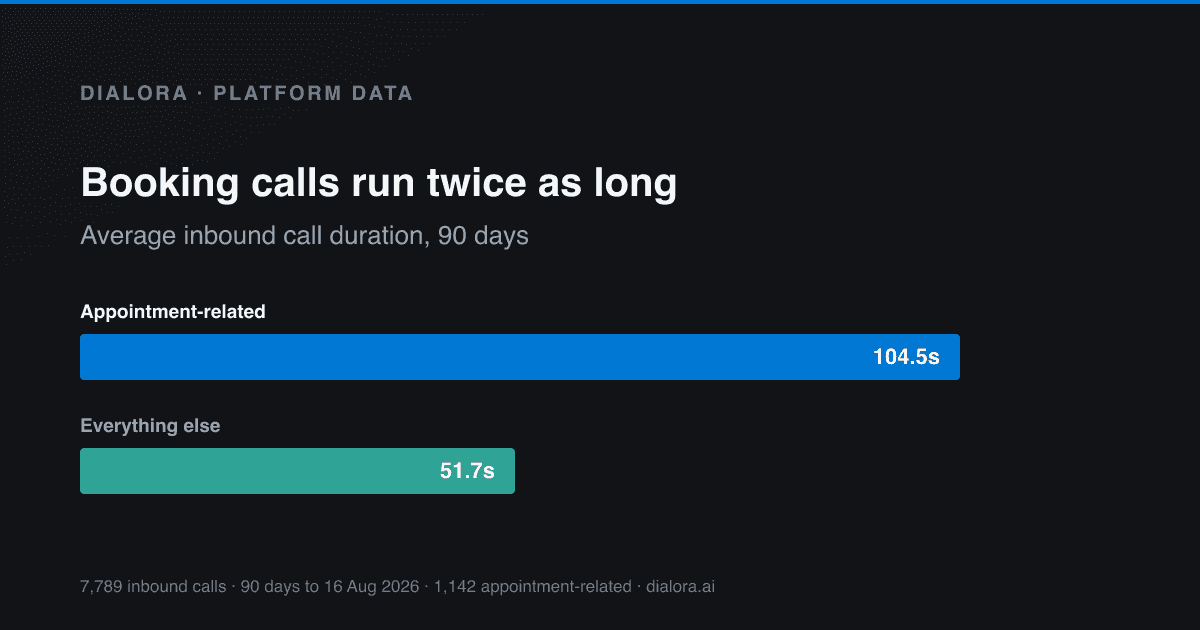
An AI appointment booking system answers your phone, has a real conversation about when someone wants to come in, writes the appointment into your calendar during the call, and hands off anything it should not handle. Across 7,789 inbound calls on our platform over 90 days, 1,142 were about appointments, and they ran roughly twice as long as every other kind of call.
Why I pulled this data
I run Dialora, so I can see something the comparison posts cannot: how long these calls actually take, in production, across a lot of businesses.
I went looking because the advice on booking automation is written as though a booking call is a short transaction. Pick a slot, confirm, done. That is not what the data shows, and the gap between that assumption and reality is where people size their plan wrong and configure the agent badly.
How long does a booking call really take?
Every inbound call in the last 90 days with a recorded duration and a summary. 7,789 calls.
Call type | Average | Median |
Appointment-related | 104.5s | 73.5s |
Everything else | 51.7s | 25.0s |
Booking calls take about twice as long on average, and nearly three times as long at the median.
That median gap is the more useful number. Half of your non-booking calls are done in 25 seconds, because they are "are you open Sunday" and "where are you". Half of your booking calls are still going at 73 seconds, because someone is checking a diary, changing their mind, and asking whether Thursday works instead.
Only 44.3% of appointment calls finish inside a minute, against 72.7% of everything else.
What share of calls are actually about appointments?
14.7%, and that is a floor rather than a ceiling.
Being straight about the method: I derived that bucket by matching call summaries for booking, scheduling and rescheduling language. It will miss calls where the summary phrases it differently, so the true share is higher. I would rather give you a number I can defend than one I have rounded up.
For an appointment-driven business, the practical read is that roughly one in seven of your calls is the reason you have a diary at all, and those are the longest calls you take.
Which booking calls are the expensive ones?
Cancellations and reschedules, and it is not close.
In our data those run about 175 seconds on average with a 159-second median, longer again than ordinary bookings and nearly seven times the median of a general call. Only 5.9% finish inside a minute.
That subset is small in our sample, so treat it as indicative rather than measured. But the direction is worth acting on, and it matches what anyone who has worked a front desk already knows: someone rearranging an appointment takes real time. They have a reason, they want to know about the deposit, and they want a slot that suits them.
This is the call most worth automating and the one most likely to be configured badly. It is mechanical, it is frequent, and it interrupts a staff member who is usually mid-conversation with somebody physically in front of them.
So what should the agent do when someone cancels?
Decide it before you go live, not after the first angry review. Every buying guide I read on this topic covers what an AI booking tool is. None of them covers this, which is the part that determines whether you keep it.
Four rules, written down:
Notice period. What counts as late? The agent needs the number, not a vibe. "More than 24 hours, cancel it and offer the next slot. Inside 24 hours, take the cancellation and flag it for a human."
Deposits and fees. If you charge for late cancellation, the agent must say so plainly on the call, before the caller hangs up believing otherwise. If you do not want an agent discussing money at all, say that too and route those calls out.
Same-day changes. Usually the messiest case. Decide whether the agent can move a same-day appointment or must transfer. Either is fine. Silence is not.
Repeat cancellers. If someone has cancelled three times, that is a human conversation. Set the threshold and let the agent escalate rather than silently rebooking.
Write those four and you have handled most of what goes wrong. Skip them and the agent will improvise, which it will do confidently and sometimes wrongly.
How many minutes should you buy?
The other thing no comparison post answers, and it is arithmetic, not opinion.
The usual advice is to multiply monthly calls by your average call length. That works until you notice booking calls are twice as long as the average. A booking-heavy business sized on a general average will run short in the month it gets busy, which is the month it can least afford to.
Size on two minutes for appointment traffic, one for the rest:
Calls per day | If mostly general | If mostly booking |
10 | around 260 min | around 480 min |
20 | around 520 min | around 950 min |
30 | around 790 min | around 1,400 min |
A dental practice taking 20 calls a day, most of them appointment movement, needs roughly double what a general answering use case at the same volume needs. Our pricing is flat per tier, so the practical consequence is choosing the right tier once rather than being surprised by an overage.
If your vendor bills per minute, run this row before comparing headline prices. Booking traffic is exactly where per-minute pricing is most expensive, because the calls are long by nature.
What about reminders and no-shows?
This is the other half of booking and it runs in the opposite direction, so the economics are different.
Outbound calls on our platform average 33.3 seconds, against 59.4 for inbound. Reminder calls are short by nature: you are confirming one fact, not negotiating a slot. That matters for two reasons.
Reminders are cheap. At roughly half the length of an inbound call, a reminder campaign costs far less per contact than the booking call that created the appointment. If you are already paying for the minutes, using them to protect the appointments you have is usually better value than chasing new ones.
They also prevent the expensive call. A reminder that produces a reschedule two days out is a short outbound call replacing a 175-second inbound cancellation, often on the day. You are trading your most expensive routine call for your cheapest one.
The sequencing that tends to work: confirm at booking, remind 48 hours out, and make the reminder actionable so the caller can move the appointment on that call rather than ringing you back. A reminder that only says "you have an appointment" leaves the reschedule to arrive later, at full price, at the worst moment.
One caution. Outbound calling carries rules that inbound does not, and they vary by country and industry. Consent, calling hours and record-keeping are your obligations, not your vendor's. Get your position documented before you switch a campaign on.
What should you automate first, and what last?
Ordered by how mechanical the call is, which is the only ordering that survives contact with a real diary.
First: new bookings for standard appointment types. Highest volume, most repetitive, clearest rules. If you automate nothing else, automate this.
Second: confirmations and reminders. Short, outbound, low risk, and they protect revenue you have already earned.
Third: reschedules with clear rules. Only once the notice period, deposit and same-day rules are written down. This is where the time is, and where a vague configuration does the most damage.
Last, or never: anything clinical, financial or emotional. Symptom questions, disputes about charges, complaints. These are not booking calls that happen to be difficult. They are different calls that arrive on the same phone line, and they need a person.
The mistake is starting at the bottom of that list because it is where the pain is loudest. The loudest calls are the ones least suited to automation.
How is booking different from answering?
Worth separating, because people buy one and expect the other.
An answering agent succeeds if the caller gets an accurate answer. A booking agent only succeeds if something lands in the calendar. That is a higher bar and it depends on integration, not on conversation quality.
The test is specific. Ask any vendor to book a live appointment into your actual calendar, with a conflicting slot already sitting in it, while you watch. Plenty of tools will hold a natural conversation about Thursday and then fail to write anything. "Calendar integration" on a feature list is a different claim from a completed booking.
Also ask what happens when the calendar is full, when two people call about the same slot inside a minute, and when the caller gives a date that has already passed. Those are the cases that separate a booking agent from a chatbot with a calendar logo on the page.
Does this change by industry?
The 104.5-second average holds across the platform. What fills it changes.
Dental and medical. Mostly appointment movement, and your front desk is being interrupted while a patient stands in front of them. Automate the calendar and make the escalation rule clinical: anything that sounds like a symptom question goes to a human immediately. See AI for dental practices.
Clinics, salons and treatment rooms. The cleanest fit. High volume, repetitive, calendar-shaped, and cancellations are frequent enough that the 175-second call is a daily cost.
Home services and trades. Booking here is really scheduling a visit window, not a slot, and the call includes location and access questions. Longer than a salon booking. Size up. See AI for home services.
Anything with a deposit. The money conversation is where scripted agents fail. Decide early whether the agent discusses money at all.
What to check before you buy
Four things, and three take ten minutes on the vendor's own demo line.
Book something. Not a demo of booking. An actual appointment, in your calendar, with a conflict already present.
Cancel it. Then reschedule it. This is the call that costs you the most and the one most demos skip.
Interrupt it. Talk over the agent, change your mind halfway, give a date that has passed. Real callers do all three.
Ask about minutes at double volume. Booking traffic is long. If the pricing is per minute, your bill grows fastest exactly where your business grows.
On compliance, get specifics in writing rather than trusting a badge on a homepage. If you are in healthcare, have the vendor document their position on your particular requirement before you sign. That is true across this category, us included.
The short version
If a meaningful share of your calls are people booking, moving or cancelling appointments, those are the longest and most mechanical calls you take, and they interrupt staff who are usually with someone else. That is a good automation case, and the data above is the honest version of what it involves.
Two things to take away even if you buy nothing. Size on two minutes for booking traffic, not one. And write the cancellation rules before you go live, because that is the call that decides whether the thing works.
If you want to test it against your own calls rather than a demo script, point your number at us for a week and read the transcripts.
Figures come from Dialora's production platform: 7,789 inbound calls with a recorded duration and summary over the 90 days to 16 August 2026, of which 1,142 were appointment-related. The appointment bucket is derived by matching call summaries for booking, scheduling and rescheduling language rather than a structured field, which makes 14.7% a floor. The cancel/reschedule subset is 34 calls and is described as indicative rather than measured.

Avi Vatsa
Founder & CEO