TL; DR:
- Sales teams lose more leads to slow outreach than to bad pitches.
- AI cold calling bots dial prospects automatically, qualify intent in real time, and hand warm leads to humans, without burning rep hours on dead-end numbers.
- Businesses using them report more first conversations, fewer wasted dials, and faster pipeline movement.
Introduction
Your reps have 200 names on a list. By the time they manually dial through 40 of them, the day is half over and three prospects have already booked with a competitor who called first.
Speed-to-lead is not a nice-to-have in high-ticket sales. A study by Lead Response Management found that contacting a prospect within 5 minutes of inquiry makes you 21 times more likely to qualify them than waiting 30 minutes. Most sales teams are not even close to that window.
AI cold calling bots exist because the manual outbound model cannot keep up with the volume modern pipelines require. The bot dials. It qualifies. It transfers. Your reps show up for the conversations that matter.
Why Manual Cold Calling Cannot Scale With Your Pipeline
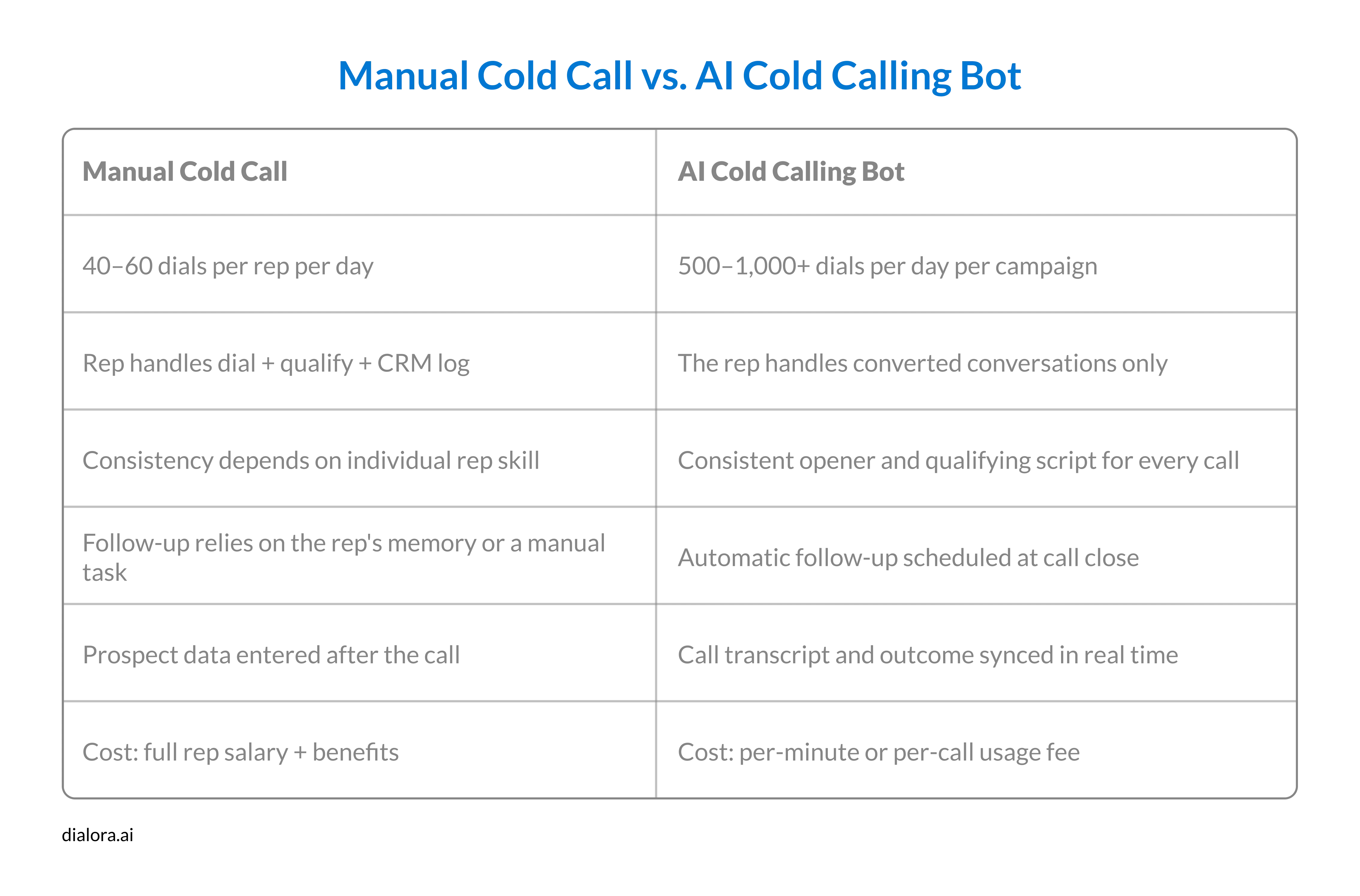
Every rep on your team has roughly 4–5 hours of actual calling time per day once you account for CRM updates, email follow-ups, internal meetings, and the psychological cost of rejection. Across a 200-name list, that realistically means 40–60 dials per rep, per day, before drop-off starts.
Three problems compound this:
- List quality degrades fast. Numbers go cold, roles change, and companies restructure. Reps burn time on dials that were never going to convert.
- Timing mismatches kill conversion. Manual dialling is reactive reps' call when they have bandwidth, not when the prospect is most likely to pick up.
- Inconsistent opening lines mean inconsistent results. One rep has a strong opener. Three others don't. Your conversion rate reflects the weakest link, not the strongest.
The output is a pipeline that looks busy but moves slowly. A full-time rep might generate 8–12 meaningful conversations per day on a good day. That ceiling does not move until you take the dial itself out of the rep's hands.
What an AI Cold Calling Bot Actually Does on a Call
This is where most businesses misunderstand the category. An AI cold calling bot is not a robocall. It does not play a pre-recorded message and hang up. It runs a live, dynamic voice conversation.
Here is what happens on a typical outbound call handled by an AI agent:
- The bot dials the prospect using a local number or a branded caller ID
- It opens with a natural greeting and identifies itself, in most deployments, as an AI assistant calling on behalf of the company
- It delivers a qualifying opener and listens for the prospect's response
- Based on the response, it follows a dynamic script - handling objections, answering basic questions, gauging intent
- If the prospect is warm, it schedules a meeting directly into a rep's calendar or transfers the call live
- If the prospect is not ready, it logs the outcome and schedules a follow-up at the preferred time
The entire call is recorded, transcribed, and pushed to your CRM. Your rep's first interaction with that prospect is informed, not cold.
Is AI Cold Calling Legal and What Businesses Need to Know Before Deploying
Legality is the first objection every real estate team, insurance company, or high-ticket coaching business raises, and it is a legitimate one.
The short answer: AI cold calling is legal in most B2B contexts when deployed correctly. The regulatory landscape is more complex for B2C outreach.
Key frameworks to understand before deploying:
- TCPA (US): The Telephone Consumer Protection Act restricts automated calls to cell phones without prior written consent in B2C contexts. B2B outreach to business landlines operates under different rules. If your list includes mobile numbers for consumer outreach, you need explicit consent.
- FTC regulations: The FTC requires that AI voice agents disclose they are not human when sincerely asked. Most responsible platforms build this disclosure into the script.
- State-level rules: Some states, such as California, Florida, and Texas, among others, have additional restrictions. Always audit your target geography before launching a campaign.
- Do Not Call compliance: Any AI dialler must suppress against the National DNC Registry. Reputable platforms handle this automatically.
For real estate, insurance, and high-ticket coaching — where most outreach is business-purpose and prospect-initiated (via form fill, webinar registration, or ad click) AI cold calling operates in a legally manageable space. The risk profile changes when dialling cold consumer lists without consent.
Read more: Best AI Cold Calling Software
Which Businesses Get the Most From AI Cold Calling Bots
Not every business model benefits equally. The highest ROI tends to cluster around three characteristics: high lead volume, a defined qualifying question set, and a meaningful gap between the value of a converted call and the cost of the dial.
- Real estate fits this precisely. An agent generating 50 leads per week from paid ads cannot personally call all 50 within the first five minutes. An AI bot can. The bot qualifies intent: is this a buyer, a seller, or a curious browser, and routes the hot ones to the agent's phone within seconds of the form submission.
- Insurance brokers benefit from the same speed advantage. A prospect requesting a home or auto quote is comparing three carriers simultaneously. The first agent to speak with them wins the conversation. An AI bot closing that gap from 4 hours to 4 minutes changes the close rate without changing the product.
- High-ticket coaching and online education businesses use AI cold calling primarily for reactivation, reaching leads who opted in 30, 60, or 90 days ago but never booked a discovery call. These lists are too old for ads to work efficiently. They are exactly the right size and intent level for an AI calling campaign.
Conclusion
Dialora's outbound voice agent handles exactly this workflow: dialling from your prospect list, running the qualifying conversation, and routing warm leads directly to your team's calendar or to a live call. It works across real estate lead lists, insurance inquiry queues, and high-ticket coaching reactivation campaigns. The first conversation your rep has with a prospect is already warm.
Your reps are spending hours on dials that go nowhere. The AI handles those. Your team handles the conversations. See How It Works
FAQ
What is an AI cold calling bot?
An AI cold calling bot is a voice agent that dials prospects, runs a qualifying conversation in real time, and routes warm leads to a human. It is not a pre-recorded robocall. The bot listens, responds to objections, and hands off only the contacts worth a rep's time.
How does an AI cold calling bot work?
The bot dials a prospect using your number or a local caller ID. It opens with a scripted introduction, listens to the response, and follows a dynamic call flow based on what the prospect says. Warm prospects are transferred or booked. Cold ones are logged and scheduled for a follow-up. Every call is transcribed and pushed to your CRM automatically.
Is AI cold calling legal?
In most B2B contexts, yes, when deployed with proper DNC suppression and AI disclosure. B2C outreach to mobile numbers requires prior written consent under TCPA. Always audit your list source and target geography before launching a campaign. Most reputable platforms handle DNC compliance automatically.
What businesses use AI cold calling bots?
Real estate agencies, insurance brokerages, and high-ticket coaching or education businesses see the highest ROI. Any business with a high lead volume, a clear qualifying question set, and a meaningful gap between deal value and dial cost is a strong candidate.
How effective are AI cold callers?
Effectiveness depends on list quality, script design, and how quickly the bot dials after a prospect opts in. Teams that deploy AI callers within 5 minutes of a lead submission consistently report higher contact and qualification rates than teams dialling manually 2–4 hours later.