TL; DR
- AI voice assistant development requires integrating four distinct technical layers: speech recognition, natural language understanding, dialogue management, and text-to-speech output. Most engineering teams budget time for two and discover the other two mid-sprint.
- The 6-to-12-month estimate most teams get at project discovery is realistic. Telephony integration, edge case handling, and production-scale ASR accuracy are the variables that expand timelines most.
- Dialora eliminates the build phase entirely. Voice agents deploy in days with full workflow customization via API, for engineering teams that need production-ready control without infrastructure ownership.
The CTO who committed to building a voice assistant in Q1 has pushed the production date three times. The speech recognition component worked in isolation. The NLU layer worked in isolation. The moment the team connected to production telephony and ran 200 concurrent calls, the latency numbers changed the entire architecture plan.
That pattern repeats across every engineering team that attempts AI voice assistant development from scratch. Each layer solves cleanly in a sandbox. Each layer compounds into edge cases at production scale.
Knowing where each layer breaks is step one.
AI voice assistant development involves integrating speech-to-text transcription, natural language understanding, dialogue management, and text-to-speech output into a single production pipeline. A deployable system also requires telephony integration, real-time session management, and post-call data handling. Most engineering teams underestimate integration scope by 40 to 60 % at the project discovery phase.
Why Does AI Voice Assistant Development Take Longer Than Teams Plan?
The timeline problem is not that developers are slow. It is that the visible scope of AI voice assistant development covers the components that are easy to demo. It does not cover the components that break at scale.
Speech recognition works at 95% accuracy in a quiet room with a native English speaker using a modern microphone. Production conditions include ambient noise, accented speech, mixed-language callers, and lossy telephony compression. Accuracy drops. Latency spikes.
NLU handles clear intent statements cleanly. Production callers rephrase, interrupt, go off-script, and ask compound questions. Edge case handling is where most voice assistant development schedules collapse.
The ML engineer who scoped the initial ASR integration for a SaaS voice AI build had completed similar work at two prior companies. He estimated six weeks for the speech recognition layer. The telephony integration alone took nine weeks. He had not built on a VoIP stack before. The codec compatibility issues did not surface until week three.
Pro-tip: Every voice assistant development project has a week-three moment. That is when production telephony shows you what the sandbox hid.
Not even close.
The Core Technical Architecture Behind Any AI Voice Assistant
How to build a voice assistant from scratch means understanding four layers and the interfaces between them. The interface failures cause more delays than any single layer.
Layer 1
Speech recognition integration: The voice assistant SDK you choose determines your language coverage, accuracy floor, and real-time latency ceiling. ASR options range from open source engines like Whisper to managed APIs like Deepgram. The tradeoff is accuracy versus latency versus cost at scale.
Layer 2
NLP voice assistant development: Intent classification and entity extraction convert the transcribed text into structured data the dialogue layer can act on. NLP voice assistant development requires training data specific to your call types. Generic models classify generic intent. Your booking flows, escalation conditions, and domain vocabulary require fine-tuning.
Layer 3
Voice assistant architecture and dialogue management: This layer manages conversation state, multi-turn dialogue, fallback handling, and escalation triggers. It is the most underscoped layer in most custom AI voice assistant projects. It is also the one that determines whether the AI handles real callers or just demo callers.
Layer 4
Text-to-speech integration: TTS output must be natural enough that callers do not end calls. Latency between ASR, NLU, dialogue processing, and TTS response must stay under 700ms for conversation to feel real. End-to-end latency testing under load is non-negotiable before launch.
Should You Build or Buy Your AI Voice Assistant?
The build-or-buy decision for voice AI is different from most software decisions because the maintenance surface is large. A custom AI voice assistant is not a deploy-and-forget system. It requires ongoing prompt refinement, ASR model updates, edge case cataloging, and telephony stack maintenance.
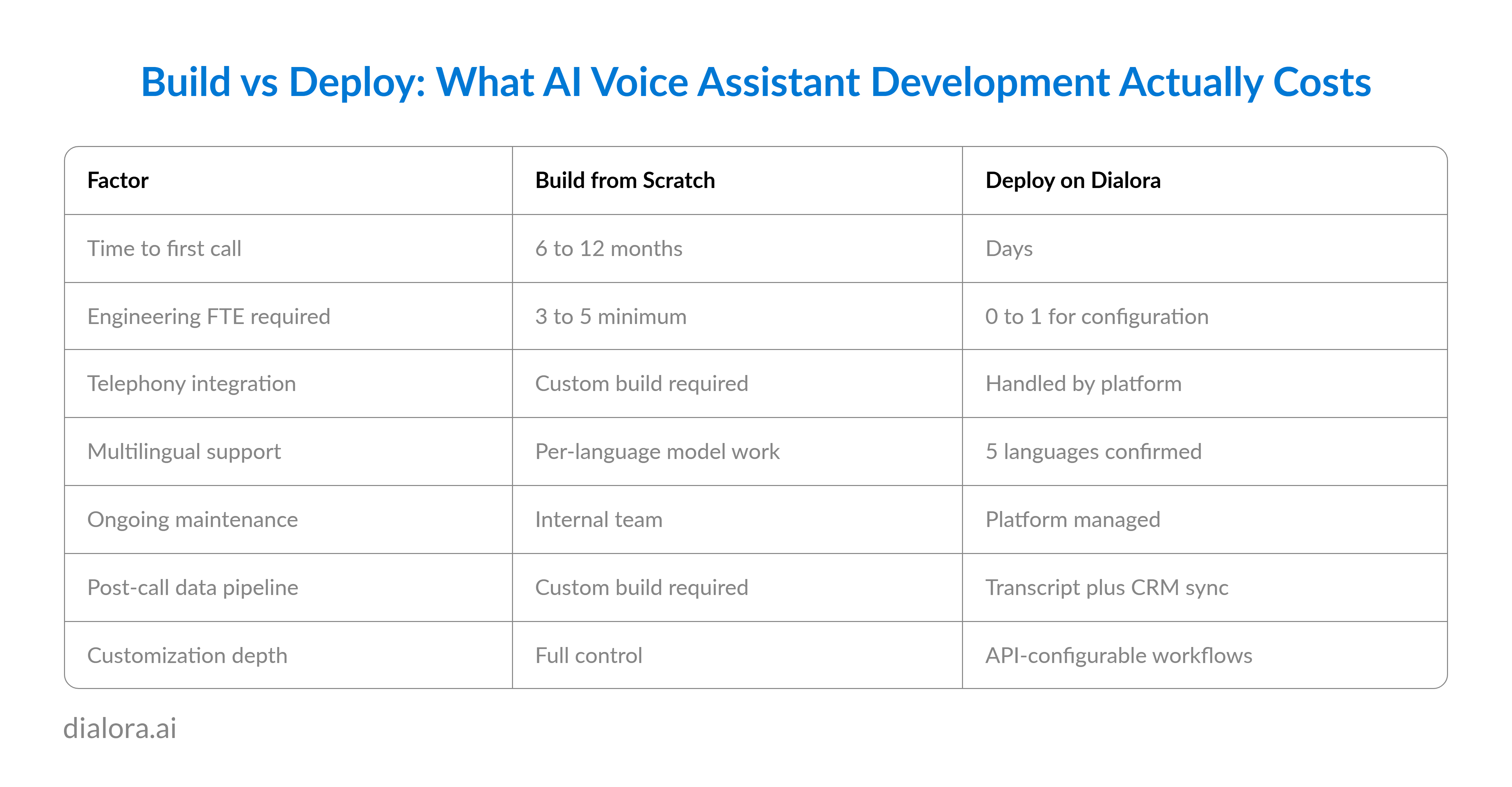
The teams that benefit most from building from scratch are the ones with proprietary voice AI requirements that no platform can meet. Unique wake word detection, hardware integration, or domain-specific models with no commercial equivalent.
Pro-tip: If you can describe your voice AI requirements in a workflow doc, you probably do not need to build from scratch.
Ready to See What Deploying Instead of Building Looks Like?
What to Know Before Starting AI Voice Assistant Development
AI voice assistant development is the right choice when the business requirement genuinely cannot be met by a configurable platform. Those requirements are rarer than most project scopes suggest.
The Python voice assistant tutorials, Alexa skills development guides, and voice assistant development framework comparisons on developer forums cover the sandbox version of the problem. Production telephony, concurrent session management, multilingual ASR, and post-call data pipelines are not in those tutorials.
How does voice AI work at scale is a different question than how it works in a demo. That distinction is where most build decisions should be made.
Conclusion
AI voice agents like Dialora are how to make an AI voice assistant production-ready without the build phase. The platform handles inbound and outbound voice workflows. Booking, intake, qualification, reminders, and post-call CRM sync. The platform runs in English, Spanish, French, Portuguese, and Turkish across 30+ countries. Workflow customization runs through API. Engineering teams configure the call flow logic, routing conditions, and CRM mapping without building the ASR, NLU, or telephony layers themselves.
Most voice AI projects start as voice assistant development initiatives and get scoped down to voice bots because the build timeline expands.
The teams that ship on time are the ones that use a platform instead.
Ready to See a Deployed AI Voice Assistant Handle a Real Call Without a Build Phase?
How to create an AI voice agent does not have to be a 12-month engineering project. Watch a 2-Min Demo
Frequently Asked Questions
How do you build an AI voice assistant from scratch?
AI voice assistant development from scratch involves integrating a speech recognition layer, an NLU engine for intent classification, a dialogue management system for conversation state, and a TTS output layer. The system also needs telephony integration and a post-call data pipeline. Most teams use a combination of open source components and managed APIs, with production deployment taking 6 to 12 months for a reliable system.
What programming language is used for AI voice assistants?
Python is the dominant language for AI voice assistant development because of its ecosystem of NLP libraries, ASR model wrappers, and API integration tooling. Python voice assistant frameworks include LangChain for dialogue orchestration and integrations with Whisper, Deepgram, and Google Cloud STT for speech recognition. JavaScript is used for browser-based implementations with the Web Speech API.
How much does AI voice assistant development cost?
A custom AI voice assistant built from scratch typically requires 3 to 5 engineering FTE over 6 to 12 months, putting the development cost between $300,000 and $800,000 depending on team location and scope. Ongoing maintenance adds a further 1 to 2 FTE per year. Platform-based deployment like Dialora replaces the build cost with a subscription and reduces engineering overhead to configuration and API integration.
What tools are needed for AI voice assistant development?
Core tools for voice AI assistant development include a speech recognition API such as Whisper or Deepgram, an NLU framework for intent classification, a dialogue management library for conversation state, a TTS API for output generation, and a telephony integration layer for live call handling. A voice assistant development framework like LangChain or Rasa can reduce scaffolding time on the NLU and dialogue layers.
What is the difference between a voice bot and a voice assistant?
A voice bot handles a fixed set of scripted interactions within a defined decision tree. A voice assistant handles multi-turn conversations, manages context across a dialogue session, adapts to caller phrasing variations, and routes to escalation when needed. AI voice assistant development produces the latter. Most template-based platforms produce the former, which breaks when callers go off-script.