TL; DR
- Voice calls that do not sync to your CRM create a data gap that breaks follow-up sequences, pipeline attribution, and rep coaching. The call happened. The data never landed anywhere useful.
- The best voice AI APIs for CRM integration do not just log calls. They push transcripts, sentiment scores, and structured contact data to the correct CRM object automatically, without rep action.
- Dialora connects to CRM systems via general API, pushes post-call data without manual entry, and handles inbound and outbound calls across the full sales and support cycle.
The RevOps lead spent two weeks building a post-call logging workflow in HubSpot. Every call got a follow-up task. Every contact got a note. Manual entry. By week four, the sales team had stopped updating it entirely. The calls were happening. The data was not landing anywhere the pipeline could use.
That is the gap most voice AI deployments never solve. Voice AI without CRM integration means your calls run in a silo. The best voice AI APIs for CRM integration close that gap at the moment of the call, not hours later.
One manual step is all it takes for a workflow to collapse.
Best voice AI APIs for CRM integration automatically push call transcripts, sentiment analysis, and structured contact data to the correct CRM object in real time or immediately post-call. These systems eliminate manual logging, feed pipeline data directly to sales and support tools, and trigger follow-up workflows without rep intervention or manual data entry.
Why Does Voice AI Without CRM Integration Create a Data Problem?
Most voice AI deployments produce call recordings and transcripts. Those outputs sit in the voice platform. They do not reach your CRM. They do not update deal stages. They do not trigger follow-up tasks. They do not tell your ops team which calls produced outcomes.
The result is a productivity tool that does not connect to your revenue metrics. You know the calls are happening. You cannot prove what they are producing.
CRM voice integration is not a feature upgrade. It is the condition that makes voice AI results measurable.
The VP of Sales Operations at a B2B SaaS company with 40 inbound reps discovered this six weeks into their first voice AI deployment. The platform handled qualification calls at three times the previous volume. Pipeline velocity did not change. Follow-up rates did not change. The calls were logged in the voice platform. The CRM showed nothing. Three months of call data sat in a system no one in RevOps had access to. She had built the firm's revenue infrastructure from scratch and had never seen a volume improvement produce zero attribution signal.
Pro-tip:
A voice AI platform that does not sync to CRM is a black box. Calls go in and no trail comes out that your revenue team can act on.
Missing it entirely.
What Does Real AI Call Logging CRM Integration Deliver?
AI call logging CRM means two things in practice. The call data lands in the right place automatically. And the data is structured enough to be actionable.
A call transcript dumped into a contact note is better than nothing. It is not an integration. Real voice data CRM sync delivers:
- Contact record updated with call outcome, next step, and topic classification.
- Deal stage advanced or task created based on call result without rep input.
- Sentiment score and AI call tracking CRM data attached to the contact for prioritization.
- Automated CRM call notes pushed to the timeline without rep action.
- AI call summary CRM output triggers follow-up sequences automatically.
The difference between logging and integration is the difference between a record and a workflow trigger.
CRM telephony integration at this level requires a voice AI API that produces structured data, not a raw transcript string. The platform needs to classify the call type, capture the outcome, and map the data to the correct CRM object.
What Are the Best Voice AI APIs for CRM Integration?
The voice AI CRM integration market split clearly in 2025. Platforms with API-native connectivity handle custom schemas, multi-CRM environments, and enterprise-specific field mapping. Platforms with native CRM connectors handle the most common schemas out of the box but break on edge cases.
Test any platform against the dimensions below before committing to a deployment. This applies whether you are evaluating Salesforce voice AI integration, HubSpot voice AI connectivity, or voice AI Zoho CRM sync. These are the variables that determine whether the integration holds up at production volume.
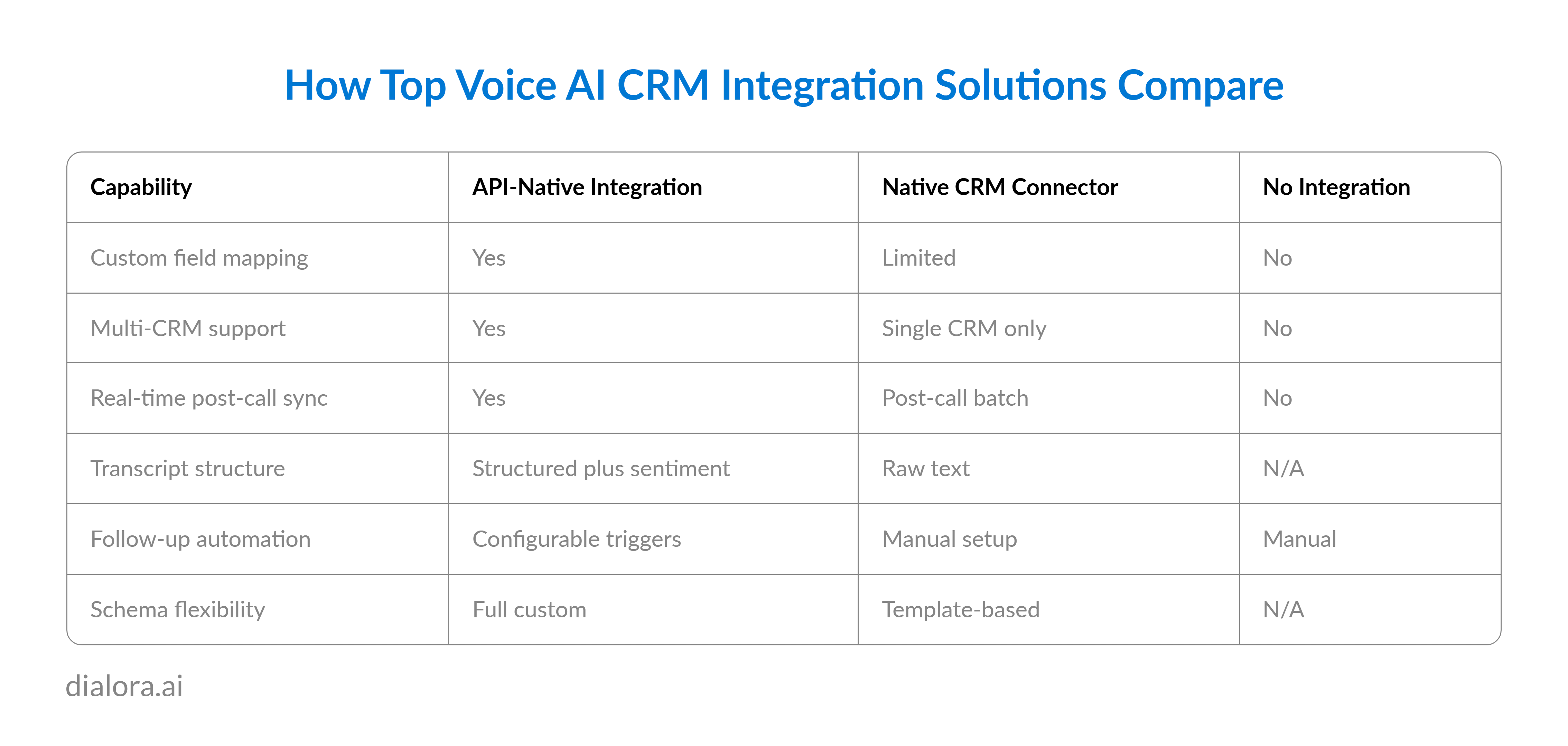
Dialora is one of the best voice AI CRM integration solutions for teams running high-volume inbound and outbound workflows. AI voice agents connect to CRM systems via general API. Post-call data includes transcripts, sentiment analysis, and structured call outcomes. The push goes to the correct contact or deal object without manual intervention. Setup maps to your CRM schema, not a vendor default.
For RevOps and Sales Ops teams running multi-CRM or custom field environments, API-native connectivity is the only approach that holds up over time.
Pro-tip:
The voice AI platforms winning RevOps evaluations in 2026 are the ones where post-call data appears in the CRM before the rep picks up their next call.
Ready to See Live CRM Sync on a Real Qualification Call?
The Voice AI CRM Integration Evaluation in 2026
The AI voice assistant CRM integration evaluation has one practical test. Trigger a call. Follow the data from the voice platform to the CRM contact record. Does it land automatically? Is it structured or a raw text dump? Does it trigger a follow-up task without rep action?
Platforms that pass that test are in a short list. The ones that do not are in the next evaluation cycle.
The product manager at a high-volume inbound team ran this test across six platforms in a single afternoon. She picked the one where the structured data appeared in the contact record before she had finished reviewing the call recording. That was the whole evaluation. It took 90 minutes.
Conclusion
Dialora handles the full call cycle for inbound and outbound workflows. Inbound qualification, lead routing, appointment booking, and post-call CRM push. Outbound follow-up sequences, reminder campaigns, and re-engagement flows. The platform runs in English, Spanish, French, Portuguese, and Turkish across 30+ countries. Calendar integrations confirmed for Google Calendar, Cal.com, and TidyCal. CRM sync runs through a general API without custom development.
Your reps will not manually log 200 calls a week. The data is either automatic or it does not exist.
The CRM knows nothing the voice AI does not tell it. The best AI voice agent for CRM-connected workflows is the one where post-call data lands automatically, not after a rep logs it.
Frequently Asked Questions
How does voice AI integrate with my CRM?
Voice AI integrates with CRM through bidirectional APIs or native connectors that push post-call data to the correct contact, deal, or case object automatically. The best integrations include structured call outcomes, transcripts, sentiment scores, and automated follow-up triggers. Dialora integrates with CRM systems via general API, syncing post-call data without manual entry or rep involvement after each call.
What are the best voice AI APIs for CRM integration?
Best voice AI APIs for CRM integration produce structured post-call data, support custom CRM field mapping, and operate without rep-side manual entry. API-native integrations outperform native connectors for multi-CRM or enterprise environments. Dialora's CRM integration runs via general API with full schema flexibility and post-call data push including transcripts, sentiment analysis, and outcome classification.
Which voice AI solution works best with HubSpot?
Voice AI solutions that work best with HubSpot use the HubSpot API to update contact records, create follow-up tasks, and advance deal stages based on call outcomes. The key capability is structured post-call data rather than raw transcript strings. Dialora connects to HubSpot via general API integration with post-call data mapped to the correct contact or deal object.
How does voice AI integrate with CRM during a live call?
During a live call, voice AI captures intent signals and pre-populates the post-call data payload in real time. When the call ends, the structured data pushes immediately to the CRM. Dialora produces transcripts, sentiment scores, and outcome classification at call end, pushing to CRM before the rep's next interaction, with no manual logging required.
How do I connect an AI voice agent to Salesforce?
Connecting an AI voice agent or voice bot CRM connector to Salesforce requires a platform with API-native CRM integration that supports Salesforce object mapping. The integration should update Contact and Opportunity records, create Tasks, and log call activity automatically. Dialora connects via general API with schema configuration for Salesforce field mapping, syncing call outcomes without manual rep entry on every call.