One location, one missed call
A single small-business-style location — a clinic, a dealership service bay, a branch office — loses very little when one call goes unanswered. The caller tries again, or calls the next result. Nobody at head office sees it happen.
That is true at one location. It stops being true at scale.
What the same failure rate costs across a network
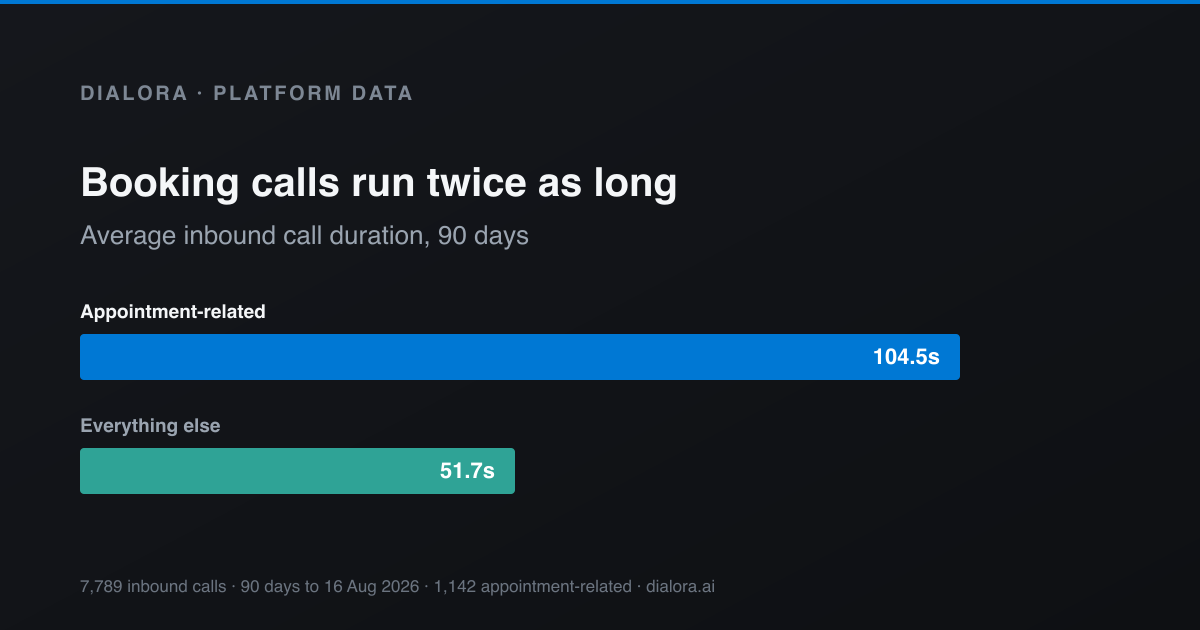
Across Dialora's platform, the average answered inbound call lasts 59.4 seconds, and 68.6% finish inside a minute. Those are short, mechanical calls: hours, availability, a reschedule, a quote. The kind of call a front desk answers dozens of times a day without thinking about it — until the desk is unattended, at lunch, after close, or mid-shift with a customer standing in front of it.
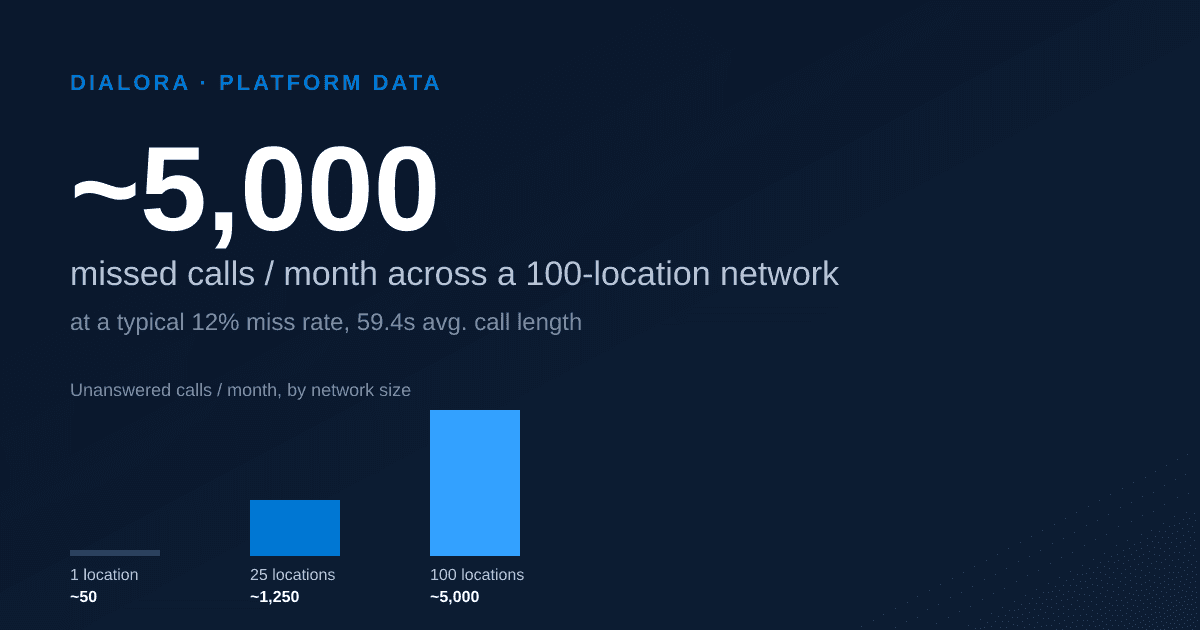
Locations in the network | Calls unanswered per month, at a 12% miss rate | Approximate revenue-adjacent inquiries lost |
1 | roughly 50 | a rounding error |
25 | roughly 1,250 | a staffing conversation |
100 | roughly 5,000 | a board-level line item |
A twelve percent miss rate is not a failing operation. It is close to typical for a network without centralized call handling, because it is the sum of ordinary things: lunch coverage gaps, after-hours volume, one location short-staffed this month. None of it looks like a problem from inside any single location. Aggregated across a hundred of them, it is thousands of calls a month going to voicemail, a competitor, or nowhere.
Why this is a procurement decision, not a per-location one
Left to individual locations, call handling becomes inconsistent by design. One location buys a consumer answering app. Another does nothing. A third's front desk has an informal rule that changes when the person who set it up leaves. None of it is measured centrally, so none of it can be managed centrally.
A managed AI call center consolidates this under one contract, with terms that apply uniformly across every location in the network:
- One answer-rate target, not a different informal standard per location.
- One escalation policy for what gets handed to a person, and who that person is.
- One flat fee per location, so the bill scales linearly with the network rather than with call volume.
- One point of accountability when a location's calls are mishandled.
The cost comparison against per-minute vendors follows the same logic that applies at a single location, at network scale: per-minute pricing rewards low volume and penalizes growth. A location having a good month generates more calls and a larger bill under a per-minute structure. Under a flat per-location fee, the bill is the same number in a slow month and a strong one.
The KPI terms a contract should specify
Enterprise procurement should treat this the way it treats any other outsourced operational function — with figures in the agreement, not assurances in a sales call.
Metric | Set as | Reviewed |
Answer rate | Target percentage, per location and network-wide | Monthly |
Escalation rate to a human | Maximum percentage before review triggers | Monthly |
Change turnaround | Maximum 48 hours from request to live | Per request |
First-call resolution | Target percentage for routine inquiry types | Quarterly |
Escalation rate matters as much as answer rate. A vendor that answers every call but escalates half of them to an overwhelmed on-call line has moved the bottleneck, not removed it. The target should specify what counts as routine — hours, availability, rescheduling, basic pricing — and what should always reach a person, so the figure is comparable month over month rather than shifting with how liberally "routine" gets defined.
What changes in 48 hours, and what does not
Locations change things constantly: hours around a holiday, a promotion, a corrected price, a new service line. Under a managed contract, that change should be a submitted request with a fixed turnaround, not a support ticket of unknown priority.
What does not change in 48 hours is the escalation policy itself, or the answer-rate target. Those are the terms of the agreement and belong in a quarterly review, not a weekly one. Conflating the two — treating every policy change like a content update, or every content update like a contract renegotiation — is where these programs tend to stall.
Where enterprise buyers get this wrong
The most common mistake is measuring the pilot location and extrapolating the network figure from it. A pilot location is usually the best-run one in the network, chosen because it has an engaged manager willing to try something new. Its answer rate before the pilot was already better than average, so the improvement looks smaller than what a struggling or unstaffed location will show. Pilot on a representative location, not the strongest one, or budget for a wider variance across the rollout than the pilot suggested.
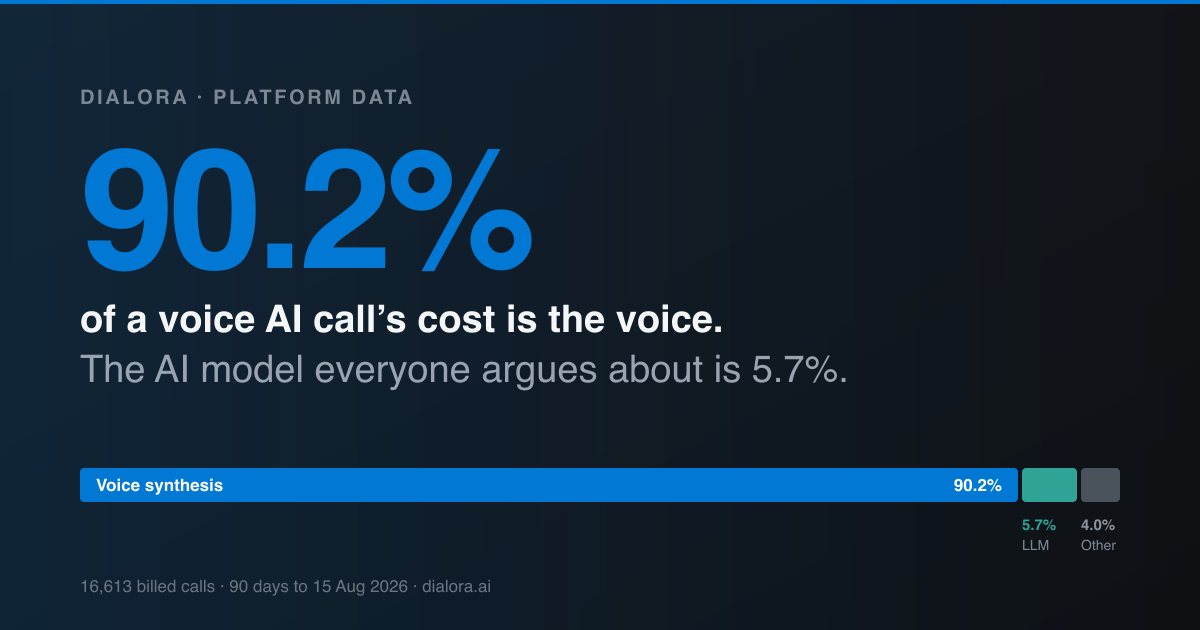
The second mistake is buying the technology decision and skipping the escalation policy decision. The model handling the call is a small part of what determines whether a caller has a good experience. The rules for what it does when a call falls outside routine — an angry caller, a request outside policy, a question it cannot answer — determine most of it, and those rules do not come from a vendor's default configuration. They come from the operator, specified per network, and reviewed against transcripts in the first quarter.
Frequently asked questions
What is the difference between an AI answering service and a managed AI call center? An AI answering service is a self-serve product a single location configures and monitors itself. A managed AI call center is a contracted service across every location in a network, with a specified answer rate, defined escalation rules, and a fixed monthly fee per location rather than per minute.
How is call performance measured across a location network under a managed contract? By four figures reported per location and in aggregate: answer rate, average handling time, escalation rate to a human, and first-call resolution. These are set as targets in the service agreement, not left as informal expectations.
How quickly can call handling instructions change for one location? Within 48 hours under a managed contract. A location changing its hours, adding a promotion, or correcting a script error submits the change and it is live within two business days, with confirmation logged.
Does pricing change as the network adds or removes locations? It is set per location at a flat monthly fee, so adding a location adds one line to the bill rather than renegotiating a blended per-minute rate. Removing a location removes the corresponding line.
Who is accountable when a location's calls are handled incorrectly? The vendor, under the terms specified in the agreement, not the location's staff. That accountability is the reason to centralize call handling under one contract rather than leaving each location to buy or ignore its own answering service.
Summary
A missed call is invisible at the location level and material at the network level. The fix is not a better per-location tool. It is a single managed contract with an answer-rate target, an escalation policy, a flat per-location fee, and a 48-hour change turnaround specified in writing.
Talk to us about a managed rollout
Call duration and answer-rate figures are drawn from Dialora's production platform data across inbound calls in the 90 days to 15 August 2026. Network-scale figures in the table above are illustrative arithmetic applied to that baseline miss rate, not a specific customer's reported results.

Avi Vatsa
Founder & CEO