TL; DR
- Most enterprise voice AI deployments stall by month three because the platform was built for demo conditions, not for the routing logic your operations team has spent two years refining.
- The fastest growing voice AI companies compete on workflow integration depth. Generic pre-built call flows lose to purpose-configured systems at production scale every time.
- Dialora handles inbound booking, outbound follow-up, and post-call CRM sync with full workflow customization via API. No rebuild of your existing process required.
The Chief Innovation Officer who approved the voice AI contract in Q1 is now fielding calls from the ops team about calls the AI cannot handle. Not because the platform does not work. Because it works exactly as configured for the average workflow, and theirs is not average.
Generic voice AI platforms are fast to deploy. They are also fast to expose their limits. The top voice AI companies offering custom deployments solve a different problem. They build a voice layer that fits your process, not theirs.
That gap costs more than the platform fee.
Top voice AI companies offering custom deployments configure AI voice agents to match existing routing logic, CRM connectivity, and booking workflows rather than imposing fixed call flow templates. These platforms handle inbound qualification, outbound reminders, real-time scheduling, and post-call data sync, all adapted to the specific operational rules of the business deploying them.
Why Generic Voice AI Platforms Break at the Workflow Layer
Pre-built voice AI flows are optimized for the median caller doing the median task. That median is a fiction. Your actual call mix includes routing exceptions, transfer conditions, language preferences, and booking rules that no default template accounts for.
The failure mode is predictable. The platform handles 75% of calls cleanly. The remaining 25% fall through. Those calls get transferred, escalated, or abandoned. Your ops team spends the next month managing exceptions the AI created rather than the problems it was supposed to eliminate.
The service director at a mid-market B2B SaaS company learned this in week four of a voice AI rollout. The platform handled standard inquiries without issue. When a tier-one account called outside business hours and needed priority routing, the AI defaulted to its standard hold sequence. The account escalated the next morning. The director had managed inbound operations for seven years and never had a priority client complain about phone handling.
Pro-tip:
A voice AI system that handles 75% of calls cleanly but fails the other 25 percent is not a productivity win. It is a new source of escalations.
This is the problem custom voice AI deployment solves. Not more features. A tighter fit between the AI's behavior and your operational reality.
Right there.
What Custom Voice AI Deployment Actually Looks Like
Custom deployment starts before a single line of configuration is written. The best AI voice platform companies begin with a workflow audit.
That audit maps the existing call flow, call types, routing rules, escalation triggers, booking logic, and CRM schema. Deployment then becomes configuration against a documented spec, not best-guess setup against a vendor template.
Three capabilities define whether a platform can support genuine custom deployment:
- Workflow-native routing: The AI follows call flow logic defined by the operator, not a vendor-imposed decision tree. Routing, transfers, holds, and escalations trigger based on live caller input and configurable business rules.
- Bidirectional CRM sync: Every call produces a transcript, a sentiment score, and a structured data push to the CRM. Post-call logging never requires a human step.
- Multilingual real-time handling: English-only platforms are already limiting deployment scope. The top companies in voice AI for operational efficiency support four or more languages at production scale.
The platforms that survive enterprise contracts are the ones that clear all three. The ones that do not are back in the pilot review queue within six months.
How Do the Top Voice AI Companies Compare on Deployment Depth?
The voice AI vendor shortlist has thinned since 2024. Early platforms competed on demo quality. Second-generation platforms competed on ASR accuracy. The tier-one voice AI API providers winning in 2026 compete on integration depth and workflow fidelity.
Use this comparison to evaluate any platform before a pilot commitment.
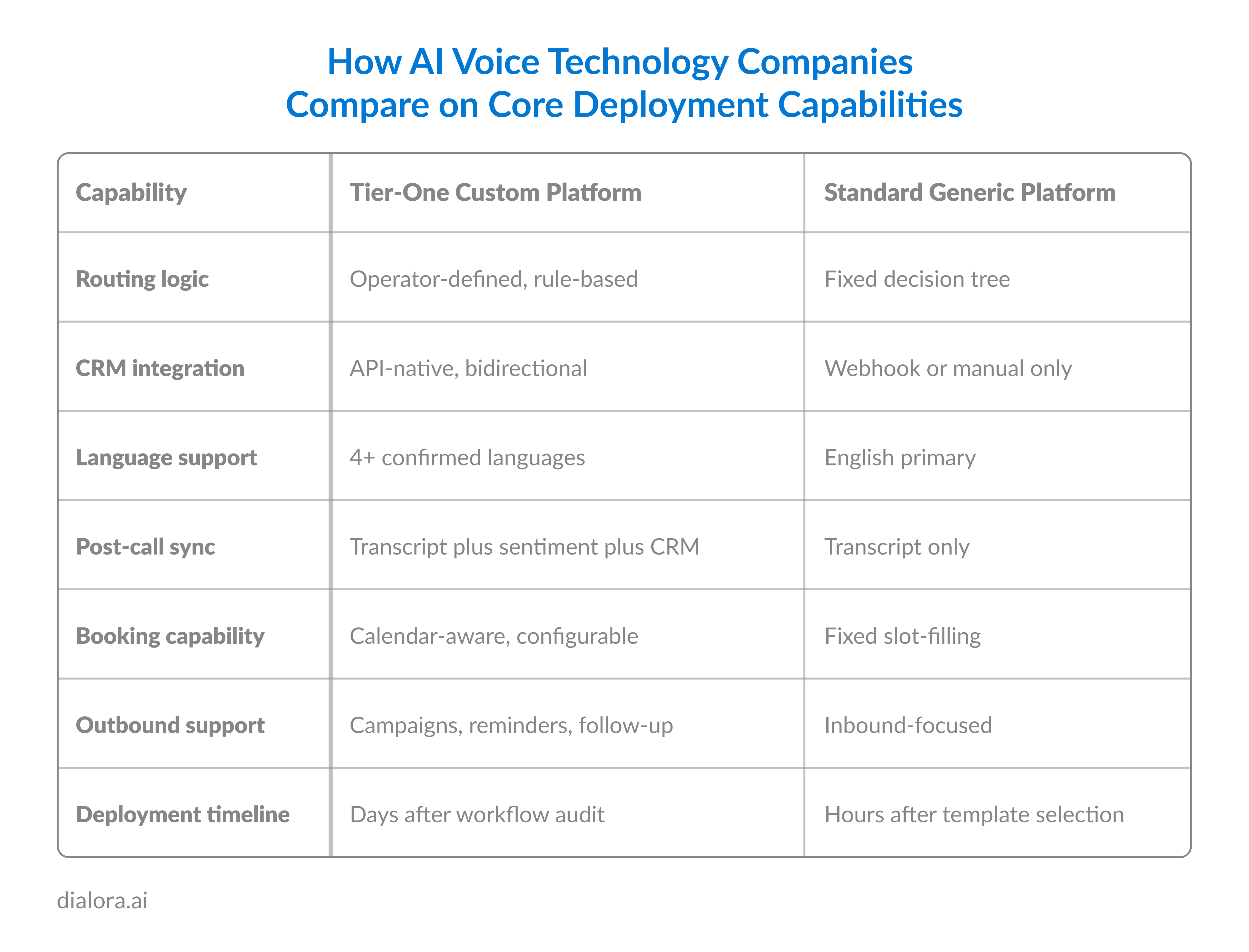
Dialora sits in the tier-one column across every dimension above. The platform handles inbound calls, outbound campaigns, and post-call data sync across 30+ countries. English, Spanish, French, Portuguese, and Turkish at production scale. Full workflow customization via API. Confirmed integrations for Google Calendar, Cal.com, and TidyCal.
Pro-tip: The platform's winning enterprise voice AI deployments in 2026 started with integration architecture. Interface polish came second.
For emerging voice AI companies still competing on demo speed, the gap is widening. Enterprise voice AI solutions require workflow fidelity that templated flows cannot provide.
Which Voice AI Startups Are Growing Fastest in 2026?
The fastest growing voice AI startups between 2024 and 2026 share one characteristic. They stopped trying to be the best voice AI for everyone and became the best voice AI for specific workflows.
Booking-heavy verticals. Intake-heavy verticals. Outbound-heavy verticals. Each has distinct call flow requirements. The platforms that mapped tightly to those requirements won the renewals. The generalists lost them.
The engineering lead at a fast-growing SaaS company evaluated eleven voice AI vendors over six weeks. He built a scoring matrix. Every platform passed the demo stage. Six passed the integration checklist. Two passed the custom routing test against his actual call flow. He picked one of those two. The evaluation took longer than he planned because most vendors had not been asked that question before.
Dialora's growth reflects the same pattern. The platform's outbound reminder capability compounds with inbound booking coverage. The more call types configured, the more complete the voice layer becomes.
Like clockwork.
What the Voice AI Platform Comparison Comes Down to in 2026
The voice AI platform comparison in 2026 is not a feature matrix conversation. It is a workflow compatibility test. Four questions that matter on any shortlist:
Does the platform follow your routing logic or its own? Does it produce post-call data your CRM can actually use? Does it handle your call types at production volume without human backup? Does it operate in the languages your callers use?
Platforms that answer yes to all four are rare. That is the category where the real growth in enterprise voice AI solutions is concentrated.
Dialora's compliance posture clears the enterprise bar. SOC 2 ready. GDPR compliant. BAA available for healthcare customers. PCI compliant for payment-related call flows.
The innovation leads rebuilding their vendor shortlists in 2026 are asking one question first. Does this platform handle the calls my team handles manually, and does it get better over time?
Custom deployment is the answer. Not a longer feature list.
Ready to See Dialora Map to Your Existing Workflow Without a Rebuild?
Frequently Asked Questions
What are the top voice AI companies for custom deployments?
Top voice AI companies offering custom deployments configure AI systems around existing routing logic, CRM architecture, and booking workflows rather than templating over them. They begin with a workflow audit before deployment and produce post-call data that syncs directly to CRM. Dialora operates at this level, covering 30+ countries with API-native CRM connectivity and multilingual support across five languages.
Which voice AI companies offer the best enterprise solutions?
Enterprise voice AI solutions require SOC 2 compliance, multilingual capacity, scalable telephony architecture, and bidirectional CRM integration. The strongest platforms handle inbound and outbound call flows at volume while producing structured post-call data. Dialora meets these requirements with SOC 2 readiness, GDPR compliance, BAA availability for healthcare customers, and confirmed support for five languages.
What are the fastest growing voice AI startups in 2026?
The fastest growing voice AI startups in 2025 and 2026 built on integration depth rather than interface speed. They win enterprise contracts by fitting into existing workflows instead of forcing teams to adapt to a vendor template. Platforms with configurable routing logic, real-time CRM sync, and multilingual capability are leading this growth category.
Which companies specialize in custom voice AI deployment?
Companies specializing in voice AI custom deployment begin with a workflow audit before any configuration starts. They map call types, routing conditions, booking rules, and CRM schemas, then configure the AI to match the operator's spec. This pre-deployment process separates platforms that hold up at production scale from those that stall in the pilot phase.
What are the leading voice AI platforms in 2026?
Leading voice AI platforms in 2026 compete on workflow fidelity, CRM integration depth, and multilingual coverage. The top platforms handle both inbound and outbound call flows, connect to CRM systems via bidirectional API, and produce actionable post-call analytics. Dialora operates at this tier with Google Calendar, Cal.com, and TidyCal integrations and general API connectivity for CRM sync.