TL;DR
- Aircall is a clean, fast-deploying business phone system for startups with strong CRM integration, but its per-user pricing creates friction as teams scale beyond 30 seats.
- The best Aircall alternatives for growing companies range from JustCall and Dialpad for comparable or lower per-seat cost, to RingCentral for broader platform coverage, with autonomous AI call handling as a separate layer.
- Dialora handles the after-hours inbound, outbound follow-up, and autonomous lead qualification that Aircall and every traditional VoIP alternative routes to human agents or voicemail.
Startup founders and sales ops leaders find Aircall early. It is clean, deploys fast, and gets a sales team calling within a week. The friction starts around 20 to 30 seats, where Aircall pricing per user begins to compete with platforms that offer significantly more AI call transcription and automation at comparable cost. The search for Aircall alternatives is rarely about hating the product. It is about the team outgrowing what Aircall was originally built for.
Aircall is a cloud VoIP platform for growing sales and customer success teams that integrates with major CRMs and deploys quickly. Teams searching for Aircall alternatives are usually looking for lower per-seat cost at scale, stronger AI call automation, or better call center uptime reliability at higher volume. The top alternatives include JustCall, CloudTalk, Dialpad, RingCentral, and Dialora for autonomous AI call handling.
Why Fast-Growing Teams Search for Aircall Alternatives
Aircall's design reflects its target: early-stage and growth-stage teams that need a business phone system for startups to get up and running fast. Intelligent call routing, AI call transcription software built into the dashboard, VoIP integration with CRM tools like Salesforce and HubSpot, and an interface that takes days to learn.
At 30 to 50 seats, the Aircall pricing per-user model starts reading differently in the budget cycle. Teams built on speed now have procurement scrutiny. They are asking whether the platform's feature set justifies its per-seat cost compared to Aircall competitors with more AI automation built in.
Three triggers drive Aircall alternative searches most consistently.
- Per-seat pricing at scale: Aircall pricing grows linearly with headcount. Teams approaching 50 seats find competitors offer more automation for comparable or lower cost.
- AI call automation limitations: Aircall provides transcription and analytics, but does not autonomously handle calls. Teams that need after-hours inbound or sales call automation sequences hit this ceiling fast.
- Call center uptime reliability at higher volume: growing teams running more calls per day need SLAs that match the demand.
Pro-tip:
The most common Aircall alternative trigger is the moment a growing sales team realizes that every missed after-hours call is going to a competitor who picked up.
Which Aircall Alternative Best Fits Your Sales Team Size?
The Aircall competitors that come up most often span three tiers: feature-comparable replacements at lower cost, broader business communication platforms, and AI-native call handling layers. Not every growing team has the same gap. The tier you need depends on what broke first.
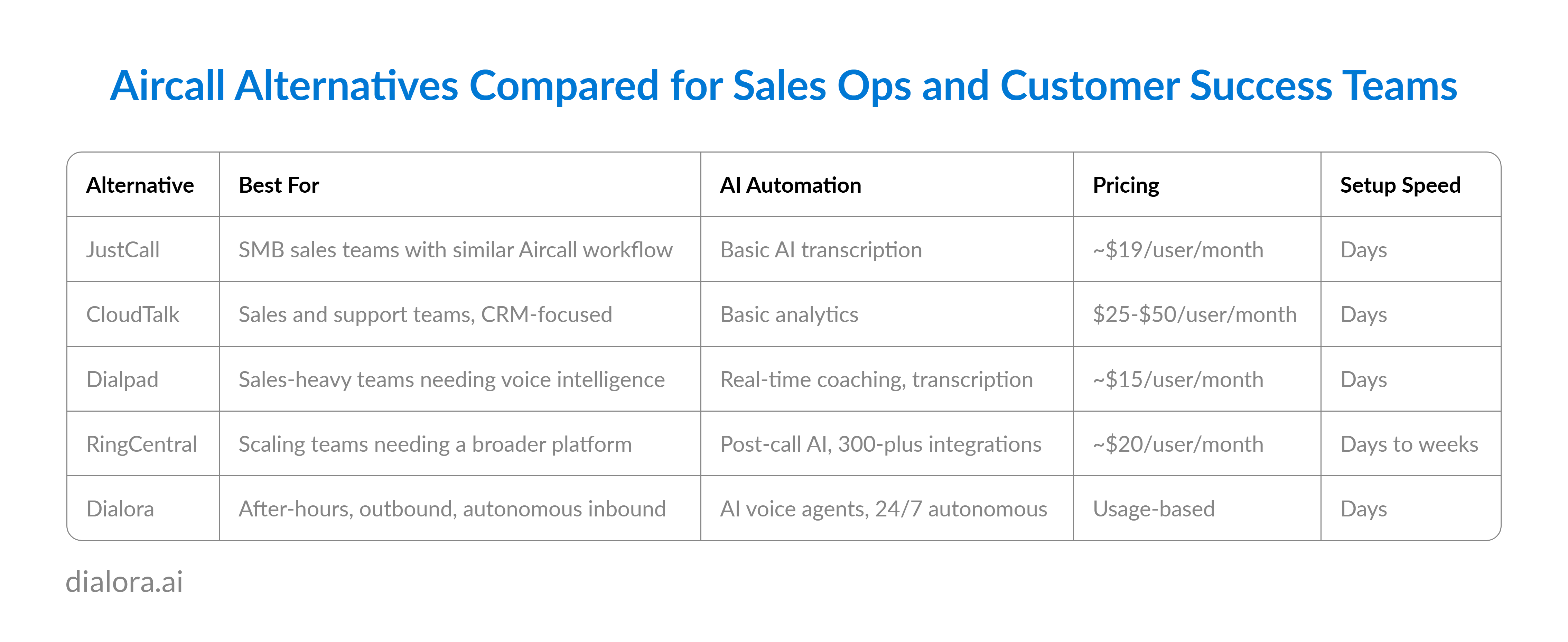
Aircall vs other phone systems comparisons on pricing consistently favour JustCall and Dialpad at the entry level. On AI automation depth, Dialpad leads the group.
What Does Autonomous AI Handle That Every Aircall Alternative Misses?
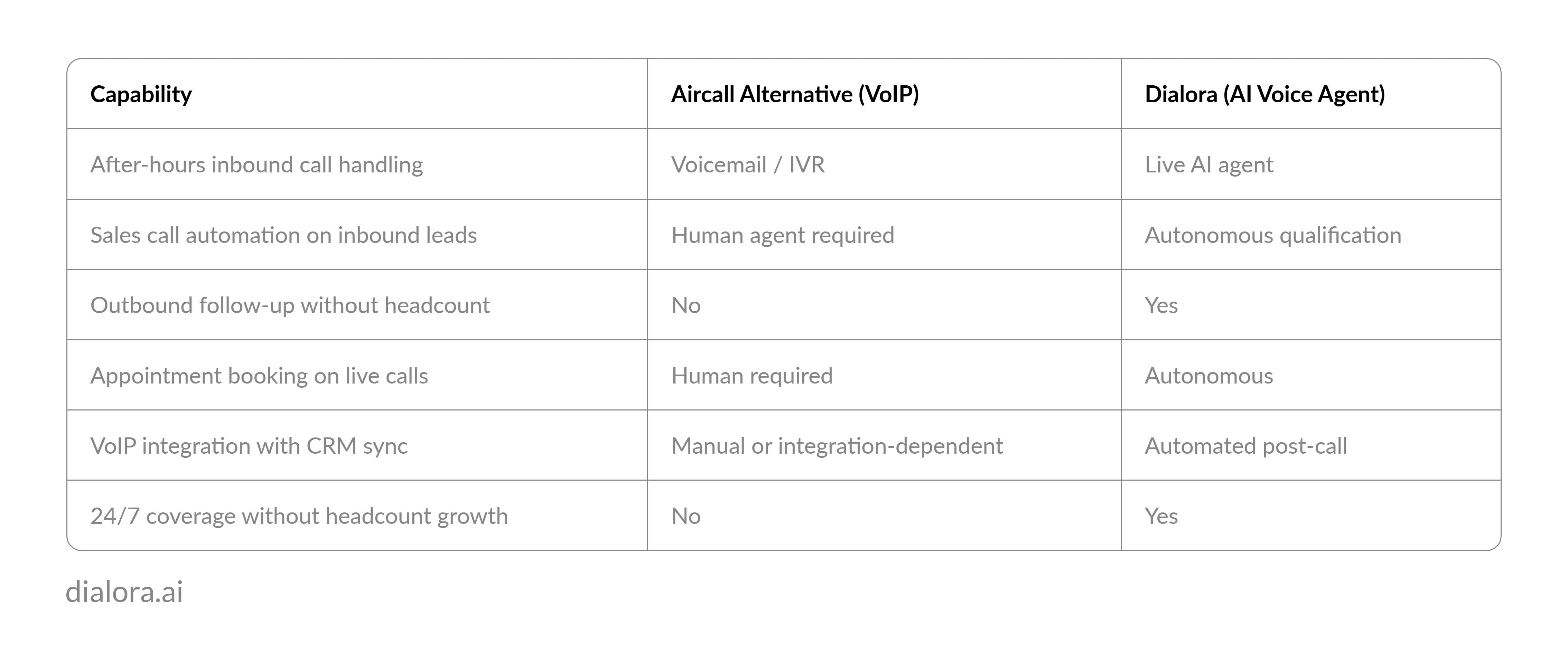
JustCall, CloudTalk, Dialpad, and RingCentral all solve the same problem Aircall solves. They route calls to the humans on your team better or more cheaply. After-hours call handling across all four still ends at voicemail.
Not one of them picks up at 11 pm when a qualified lead calls the sales line. Not one of them runs the outbound follow-up sequence without a sales rep dialling manually. Not one of them qualifies inbound leads without agent time on the call. Not even close.
That gap is what every Aircall alternative shares.
How Traditional VoIP Alternatives Compare to AI Voice Agents for Growing Team Call Coverage
The comparison changes when autonomous handling is the requirement.
How to Pick the Right Aircall Alternative for Your Growth Stage
The best Aircall alternative for growing companies depends on which gap is most expensive right now. If per-seat pricing is the primary driver, JustCall and CloudTalk offer comparable feature sets at a lower cost. If voice intelligence and real-time call coaching are the gap, Dialpad wins. If broader platform coverage and more integrations are needed, RingCentral is the natural step up. If the gap is autonomous call coverage, after-hours inbound, outbound follow-up at scale, and inbound lead qualification without agent time, Dialora covers that layer independently and deploys in days. The fastest-growing sales teams typically pair a scalable Aircall alternative for agent calls with Dialora for the volume no human team can staff consistently.
How Dialora Can Be a Solid Alternative
Dialora is not a VoIP platform. It is an AI voice agent layer that growing teams add alongside their business phone system to handle the autonomous call coverage gap that every Aircall alternative leaves to human staff or voicemail. Startup founders using Dialora recover after-hours inbound that goes unanswered. Sales ops leads use it to run outbound follow-up sequences without burning rep time on manual calls. Customer success teams use it for appointment reminders and inbound qualification at scale. Every call ends with a transcript, a CRM sync, and a logged outcome.
Frequently Asked Questions
What are the best Aircall alternatives for growing companies in 2026?
The best Aircall alternatives for growing companies depend on the team's primary constraint. JustCall and CloudTalk are the closest feature-comparable replacements at a lower per-seat cost. Dialpad is the stronger choice if real-time voice intelligence and AI call transcription software are the gap. RingCentral covers more scale and integrations. Dialora covers the autonomous inbound and outbound call handling that every Aircall alternative still routes to human agents or voicemail.
How does Aircall pricing compare to alternatives for scaling teams?
Aircall pricing starts around $30 per user per month and scales linearly with headcount. JustCall starts around $19 per user per month. Dialpad starts at around $15. CloudTalk runs $25 to $50 per user, depending on the feature tier. All VoIP-based Aircall vs other phone systems comparisons use per-seat models. Dialora uses usage-based pricing. For teams approaching 50-plus seats, the annual budget difference becomes significant.
Why do startups and sales teams switch from Aircall?
Aircall alternative searches at the growth stage are most often triggered by per-seat pricing pressure at 30 to 50 seats, limited AI call automation compared to newer platforms, and after-hours call handling gaps that grow more costly as the team expands. Aircall's clean interface and fast deployment remain genuine strengths. The friction appears when the business needs more automation than the platform was built to provide.
Can any Aircall alternative handle calls autonomously without a human agent?
Traditional Aircall competitors like JustCall, CloudTalk, Dialpad, and RingCentral do not handle calls autonomously. All route calls to human agents or voicemail. Dialora is an AI voice agent platform that handles inbound and outbound calls autonomously 24/7. It qualifies leads, books appointments, runs sales call automation sequences, and syncs all outcomes to CRM platforms without requiring a live agent on the call.
Is Dialora secure and compliant for startup sales and customer success operations?
Dialora operates on SOC 2-ready infrastructure and is GDPR-compliant across 30-plus countries. Dialora uses end-to-end encrypted call management and produces full post-call transcripts stored securely. It integrates natively with Google Calendar, Cal.com, and TidyCal for appointment booking. API documentation and compliance details are available at dialora.ai/docs.