TL;DR
- Qualities are not personality traits. Every company claims empathy, patience and communication. A quality only counts if it survives load, so the real question is whether it holds on the fourteenth call of a bad hour from an agent who started nine weeks ago.
- The people carrying it do not stay. Contact centre attrition runs 30% to 45% a year with 13 to 15 month tenure, so service quality built inside your best agents' heads gets rebuilt from scratch roughly every fourteen months.
- The customers who leave stay silent. Over half switch after one bad experience, 56% never complain at all, and you get about 2.2 chances. Complaint volume is a poor measure of service quality.
- Ownership is the highest-leverage quality. SQM Group found first contact resolution predicts CSAT better than hold time, wait time or friendliness, with a 47-point CSAT gap between one-contact and four-plus-contact resolution.
- Automation helps, with one caveat. AI voice agents remove the queue rather than shorten it, but an agent that cannot hand off is worse than a hold queue. Measure handoff quality, not only containment.
One line: your service quality is whatever survives your busiest hour, because that is the hour people write reviews about.
A customer calls you five times over two years. Four of those calls go fine. The fifth lands on a Tuesday in December when two agents are out sick, the queue is fourteen deep, and the person who finally picks up has already apologised forty times that morning.
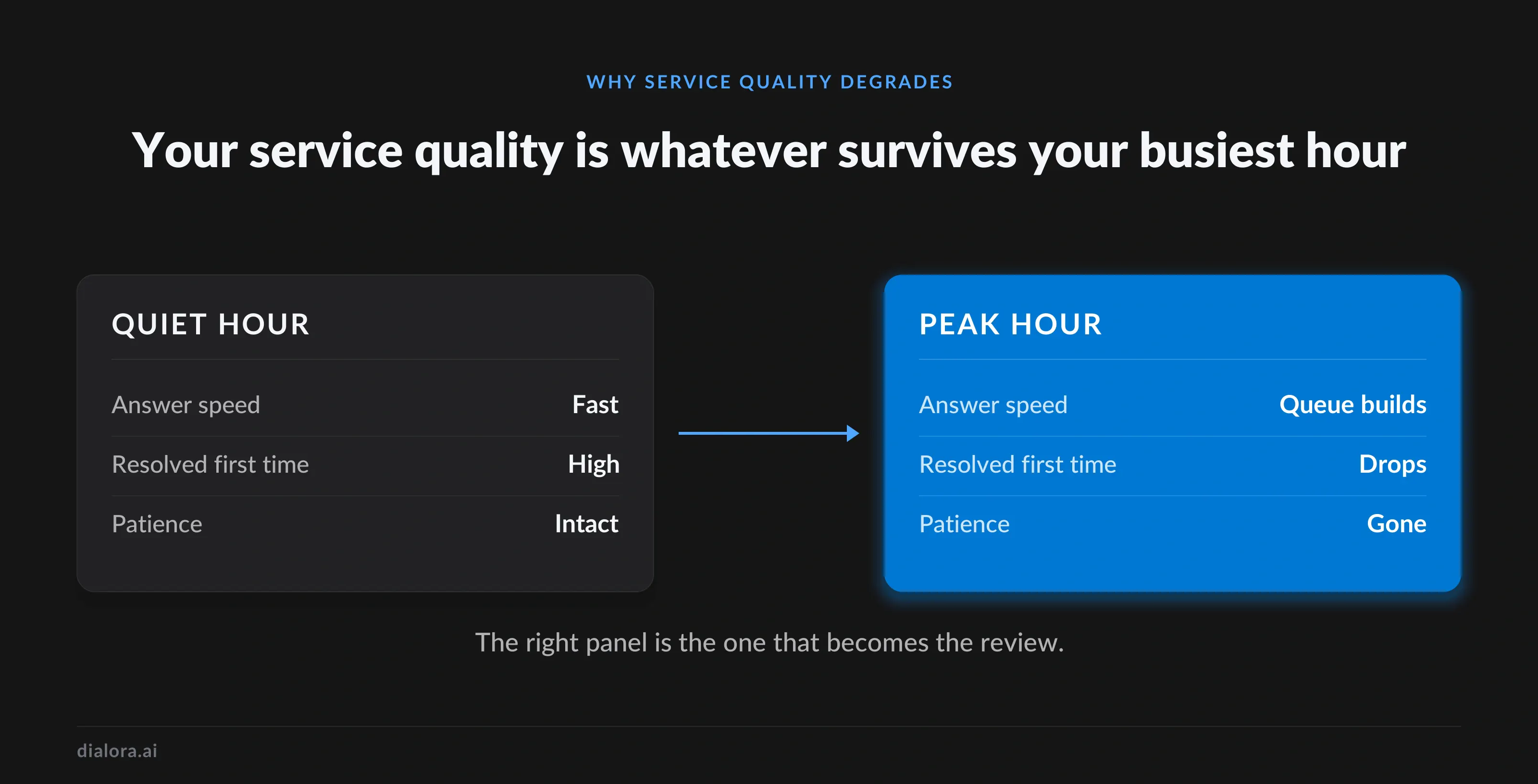
The fifth call is the one that becomes the review.
This is the part most articles about customer service qualities skip. They list empathy, patience and communication, all of which are real, and none of which tell you anything useful, because every company already believes it has them. Nobody writes impatient and unsympathetic on a careers page.
A quality only counts if it survives load. You do not rate a bridge by how well it holds an empty road. The question is not whether your team can be empathetic. It is whether empathy is still there on the fourteenth call of a bad hour, from an agent who started nine weeks ago, at 7 p.m. on a Sunday. That is the rating that decides your reputation, because that is the call people write about.
Why do most lists of customer service qualities change nothing?
Because they describe personality traits, and personality is not the variable that moves. The traits are genuine, but they are properties of individual people on individual days, and a reputation is built from thousands of interactions across shifts, channels and staffing gaps. A quality that only appears when conditions are easy is not a quality. It is a coincidence.
The people who carry the quality do not stay long
This is the uncomfortable arithmetic behind every customer service quality list:
- Attrition runs 30% to 45% a year. QATC and ContactBabel survey data, with offshore voice floors running higher still.
- Average tenure is 13 to 15 months. Most agents leave before their second full peak season, taking the judgement they built with them.
- 87% report high stress, 74% report burnout. Quality starts degrading well before the resignation letter arrives.
- Replacement costs $10,000 to $20,000 per agent. For a 100-seat centre at 40% attrition, that $400,000 to $800,000 a year in rehiring alone.
So if your service quality lives inside the heads of your best agents, you are rebuilding it from scratch every fourteen months. SQM Group's data makes the consequence explicit: contact centres holding attrition under 15% report CSAT scores roughly 26% higher than high-turnover centres, because experienced agents resolve more issues on the first contact. They know the product, the systems, and how to de-escalate before a call turns.
The conclusion is not that people do not matter. It is that a quality has to be built into how the operation runs, not hired for and hoped about.
The customers who leave will not tell you why
The second reason generic quality lists fail is that they assume you will hear about the failure. Mostly you will not.
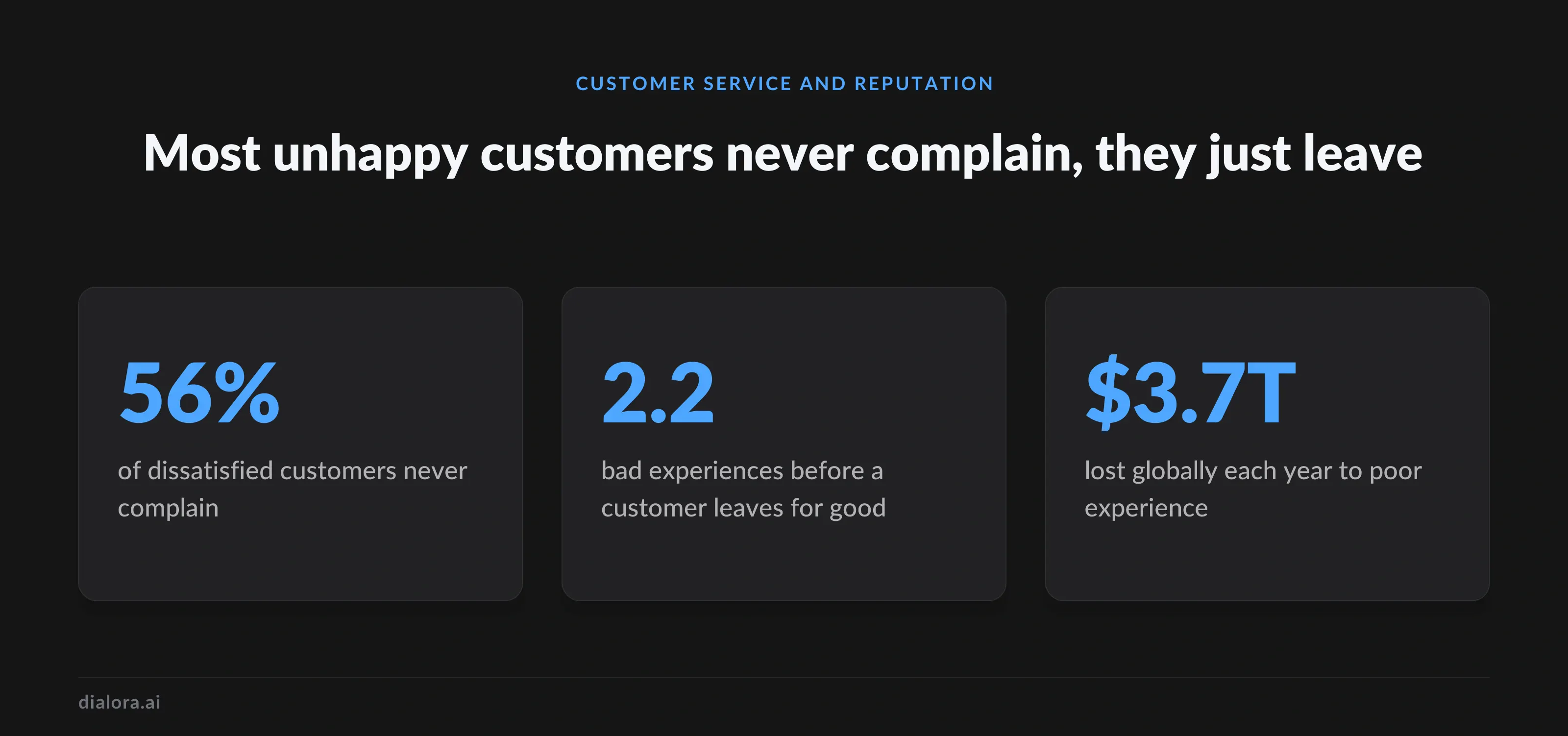
- Over half leave after one bad experience. Zendesk Benchmark data, rising to 73% after multiple failures.
- 56% never complain at all. Zendesk CX Trends research. They simply stop calling, so the loss never reaches your inbox.
- You get about 2.2 chances. The average number of poor experiences a customer tolerates before leaving for good.
- $3.7 trillion a year, globally. Qualtrics XM Institute's estimate, driven by the 51% who cut or stop spending after a bad interaction.
Almost none of that shows up in a complaints log. It shows up as revenue that quietly does not return, which means complaint volume is a poor measure of service quality and always has been.
Ownership, until the issue is actually closed
If you only fix one thing, fix this one. SQM Group's longitudinal data identifies first contact resolution as the strongest single predictor of customer satisfaction, ahead of hold time, wait time and agent friendliness. What their data shows:
- A 47-point CSAT gap. Customers whose issue took four or more contacts scored 47 percentage points lower than those resolved on the first call.
- 1% better FCR, 1% lower cost. Each percentage point of improvement lifts CSAT by roughly the same amount and cuts operating cost by roughly 1%, which makes it one of very few metrics that improves service and margin together.
- Hold time alone costs 19%. Simply placing a customer on hold drops first contact resolution by around a fifth.
- World-class starts at 80%. The cross-industry average sits near 70% to 74%, and only about 5% of contact centres ever reach the world-class band.
The test is first contact resolution paired with repeat contact rate. An agent who is warm, apologetic and transfers you twice has not demonstrated ownership. They have demonstrated politeness.
Consistency, across shift, channel and season
Customers do not average their experiences. They remember the worst one. A service line that is excellent on Tuesday and absent on Sunday teaches people to distrust it on Tuesday as well, because they have learned that the outcome depends on when they happened to call.
Dimensional Research found 72% of consumers consider it poor service if they have to explain their problem to more than one person. That is a consistency failure wearing a communication costume: the information moved between people and lost fidelity on the way.
The test is variance, not the mean. Compare your best-staffed hour against your worst on the same metric. If the two are far apart, you do not have a quality, you have a schedule.
Honesty about what you cannot do
The most underrated quality on any list, and the cheapest to implement. Customers forgive a no far more readily than they forgive a maybe that takes three weeks to become a no. A truthful, immediate refusal with a clear reason costs one call. A hopeful non-answer costs four, plus the review.
This applies with particular force to automated service. Research consistently finds that around 95% of consumers expect a clear explanation of decisions made by AI. The objection is rarely to automation itself. It is automation that will not admit its own limits and will not let you out.
The test is time to a truthful no. Measure how long it takes a customer with an unsolvable request to find out it is unsolvable.
How do you measure customer service quality instead of assuming it?
By sampling the tail rather than the average, and by tracking the handful of metrics that actually predict whether a customer comes back. Most quality assurance programmes do the opposite: they sample randomly, report means, and produce a scorecard that looks healthy right up until churn arrives.
What a quality assurance sample should actually pull
Most customer service quality assurance still scores a random handful of calls per agent per month. Random sampling from a population where most interactions go fine mostly confirms that most interactions go fine.
Weight the sample instead. Pull:
- Calls from your worst-staffed hours. Not your busiest. Understaffed hours are where the standard slips first.
- Anything transferred more than once. Each transfer is a candidate ownership failure, and the customer felt every one of them.
- Second and third contacts on the same issue. These customers have already given you a chance you did not convert.
- Abandoned calls and dead callbacks. The interactions with no survey response attached, which is exactly why they get missed.
That set is small, uncomfortable to review, and contains almost all of your reputation risk.
Read more:
- How To Scale Customer Support
- AI Voice Agents for SaaS Customer Support
- AI Customer Support Agents
- Best Enterprise Customer Service Software
- AI Voice Assistants for Customer Support
- AI Voice Agents Improve Customer Interactions
Where do these qualities break, and what actually holds them?
They break at volume. Every quality above is easy at ten calls a day and hard at four hundred, which is why service reputation tends to decline exactly as a business grows. The queue is the mechanism: once people are waiting, speed, ownership and consistency all degrade together.
looking elsewhere.
Now the honest part, and it cuts against our own product category. An AI agent that cannot hand off is worse than a hold queue. A queue is slow and frustrating, but it ends in a person. A badly built automated line that loops, misunderstands, and offers no route to a human converts a slow bad experience into a fast one, and customers punish that harder because it feels deliberate. The 95% of consumers who expect clear explanations of AI decisions are not objecting to automation. They are objecting to being trapped by it.
The practical version:
- Automate only what is genuinely repetitive. Balance checks, appointment changes, order status. Leave anything requiring judgement on the human path.
- Publish a one-sentence escape hatch. A caller should be able to reach a person by saying so once, without navigating a menu to earn it.
- Measure handoff quality, not only containment. A containment rate rising while repeat contacts also rise is not a success. It is deflection the customer is routing around.
And the blunt caution. If you take forty calls a day with two people who know every customer by name, none of this applies to you. Your consistency problem does not exist yet. Reach for structure when volume exceeds what a person can hold in their head, not before.
Conclusion
The Tuesday call in December was not a training failure. Nobody on that queue had forgotten how to be patient. The operation simply had no capacity left, and every quality the company believed it had went with it.
That is the useful way to read any list of customer service qualities, including this one. The adjectives are easy and everyone claims them. The tests are what separate a company with good service from a company with good intentions and favourable staffing. Pick your worst hour, measure it honestly, and see which of the seven still holds.
The bridge analogy is worth finishing. A rating is not a description of how the structure looks on a quiet afternoon. It is the load at which it is still safe. Your service quality is whatever survives your busiest hour, and your reputation is written by the people who called during it. Dialora builds AI voice agents that answer every call the moment it arrives, hold the same standard at 3 a.m. as at 3 p.m., and hand off to a human the moment a caller asks.
Frequently asked questions
What are the top qualities of a customer service representative?
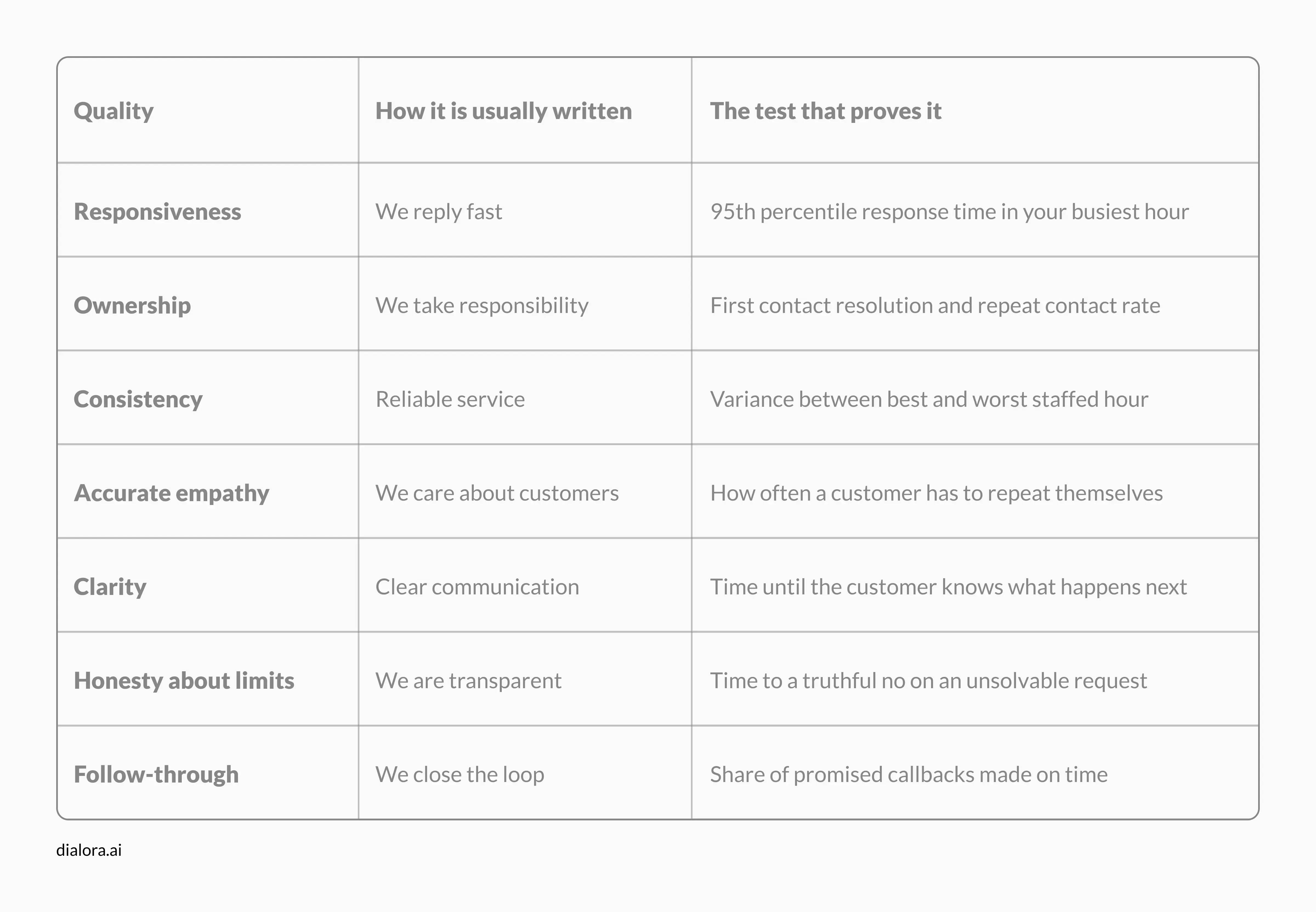
Responsiveness, ownership of the issue until it closes, consistency regardless of shift or channel, accurate listening so the customer does not repeat themselves, clarity about what happens next, honesty about limits, and reliable follow-through. The useful version of this list attaches a measurable test to each quality, because every company believes it already has all seven.
What are the 7 qualities of good customer service?
Responsiveness, ownership, consistency, accurate empathy, clarity, honesty about limits and follow-through. Each becomes real only when it has a pass or fail test: 95th percentile response time, first contact resolution, variance between your best and worst staffed hour, how often customers repeat themselves, time until the customer knows the next step, time to a truthful no, and the share of promised callbacks actually made on time.
What makes a great customer service representative rather than a good one?
Resolution on the first contact. SQM Group's research identifies first contact resolution as the strongest single predictor of customer satisfaction, ahead of hold time, wait time and agent friendliness. Customers whose issues took four or more contacts scored CSAT 47 percentage points lower than those resolved immediately. A friendly agent who transfers you twice has been polite, not effective.
How do you measure customer service quality?
Sample the tail rather than the average. Track 95th percentile response time in your busiest hour, first contact resolution, repeat contact rate, abandonment, and variance between your best and worst staffed hour. Pair every speed metric with a resolution metric, otherwise teams optimise toward shorter calls that solve less.
What should customer service quality assurance actually sample?
Not random calls. Weight the sample toward calls from your worst-staffed hours, calls transferred more than once, customers on their second or third contact about the same issue, and abandoned callbacks. Random sampling from a population where most interactions go fine mainly confirms that most interactions go fine, while your reputation risk sits in the small uncomfortable set.
Does poor customer service really damage business reputation?
Yes, and mostly invisibly. Zendesk Benchmark data shows more than half of consumers switch after a single bad experience and 73% after multiple, while Zendesk CX Trends research found 56% of dissatisfied customers never complain at all. Qualtrics XM Institute puts the global cost of poor experience near $3.7 trillion a year. Complaint volume is a poor proxy for service quality because most unhappy customers leave silently.
Can AI voice agents deliver these customer service qualities?
For responsiveness and consistency, yes, because they answer every call as it arrives and behave the same at 3 a.m. as at 3 p.m. For ownership and honesty about limits, only if the escalation path works. An automated line that loops with no route to a human is worse than a hold queue, since around 95% of consumers expect clear explanations of AI decisions. Measure handoff quality as closely as containment rate.