TL;DR
Scaling support by hiring breaks quality because headcount is the one lever where cost rises in a straight line and quality doesn't follow. Every new agent starts below your average, and with a 13 to 15 month median tenure, you're permanently re-averaging in people who joined nine weeks ago.
The fix is fewer tickets, not more capacity. Four levers, in order:
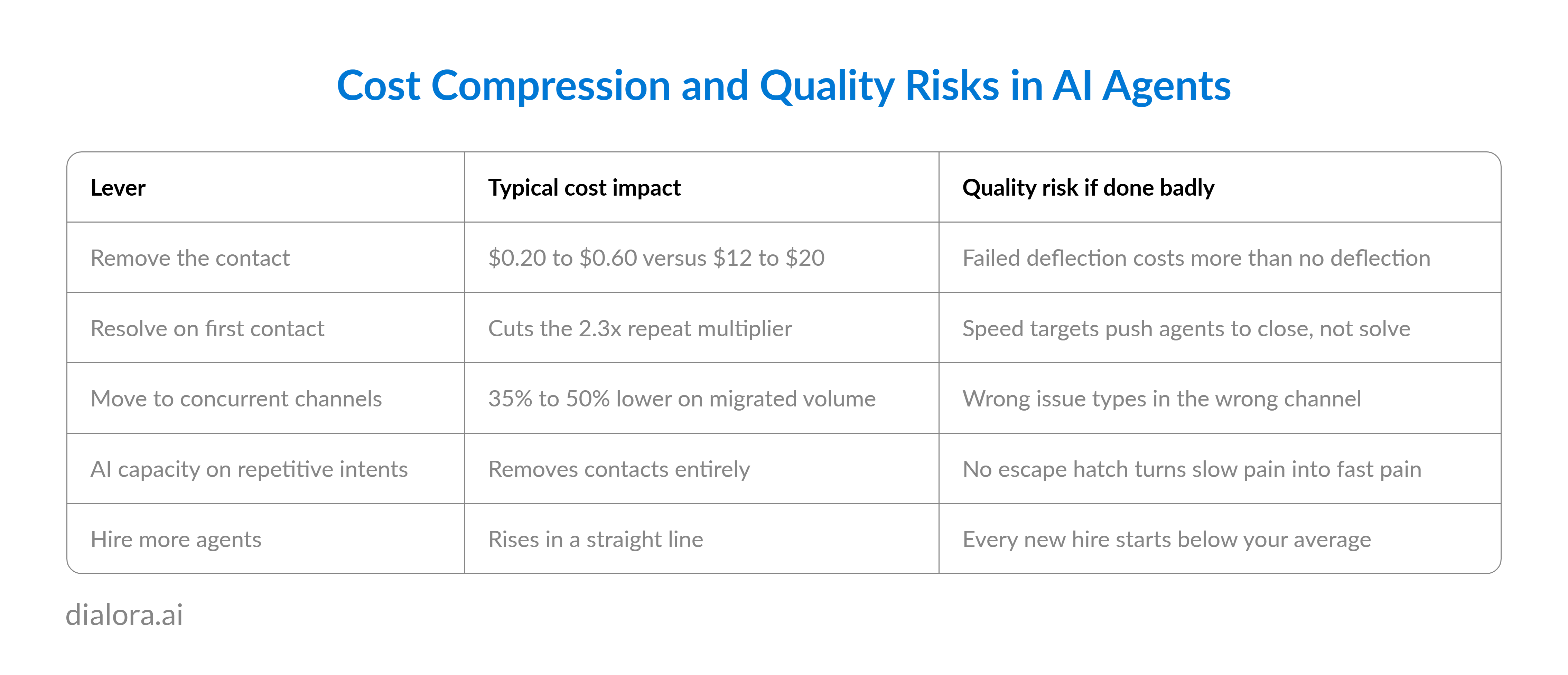
- Remove the contact. Self-service runs $0.20 to $0.60 vs $12 to $20 for voice. Every 10% of genuine deflection cuts total spend 8 to 12%. Fix the docs and product gaps behind your top twenty ticket reasons.
- Resolve on first contact. FCR is the strongest predictor of CSAT ( 47-point gap between one-touch and four-plus). Better routing and AI triage cut escalations 20 to 35%.
- Move volume to concurrent channels. Chat agents handle three to five at once. Migrating 20% of phone volume cuts cost per contact 35 to 50% on that traffic. Only where writing genuinely works.
- Add AI capacity on repetitive intents only. Order status, password resets, appointment changes. Keep complaints, disputes and cancellations on the human path, with a one-sentence escape hatch and full context passed on escalation.
The honesty check: realistic deflection is 8 to 45%, median 22%, and year one usually lands at 10 to 15%, not the 30 to 50% vendors imply. Knowledge base freshness predicts it better than the model does. Failed deflection is worse than none; contacts after a failed self-service attempt escalate 12 points higher. If containment is rising and repeat contacts are rising with it, you move the queue somewhere your reporting can't see.
Under forty tickets a day, none of this applies yet. A shared inbox and a written SLA will beat any platform.
Every good quarter makes support worse.
Sell more, support more. A queue that already took 82 hours to clear at the median across 1,000 SaaS companies now takes longer, so you hire. And hiring is where quality quietly goes.
Not because new agents are bad. Because quality is average, and you have just averaged in people who started nine weeks ago. Contact centre attrition runs 30% to 45% a year with average tenure of 13 to 15 months, so a team that doubles is a team where a large share of agents are newer than the people they joined. The org chart grew. The judgment did not.
Which means most advice on how to scale customer support is answering the wrong question. It asks how to handle more tickets. The question that preserves quality is how to have fewer tickets that need handling at all.
Why does hiring more agents not scale support?
Because headcount is the one lever where cost rises in a straight line and quality does not follow it up. Everything else in a support operation compounds. Hiring does not.
The arithmetic nobody puts in the plan
- Cost per contact stays flat as you grow
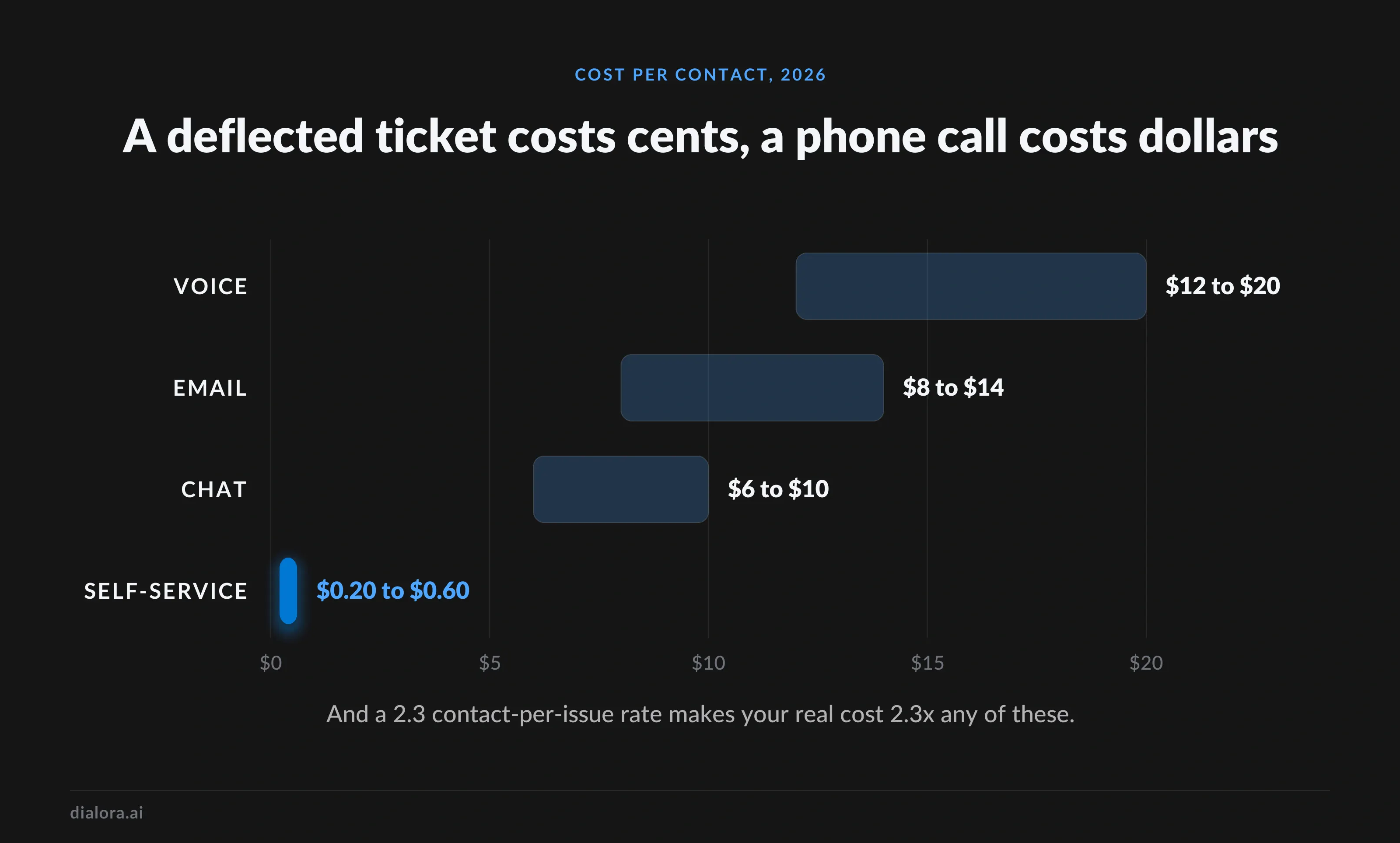
2026 benchmarks put voice at $12 to $20 per contact, email at $8 to $14, chat at $6 to $10. Doubling volume with the same model doubles the bill. There is no volume discount on a human hour.
- Every new agent starts below your average
Ramp takes months, and with 13 to 15-month median tenure, you are replacing experienced agents with new ones on a permanent cycle rather than as a one-off event.
- Repeat contacts multiply everything
At a 2.3 contact-per-issue rate, your real cost per issue is 2.3 times your cost per contact. Scaling a team without fixing resolution scales the repeats too.
- Support spend is already visible
Mid-market SaaS typically runs at 4% to 8% of ARR. That is a line a CFO watches, and headcount growth is the fastest way to move it in the wrong direction.
That is the trap in most customer support scaling plans. Cost rises predictably, quality drifts down unpredictably, and the dashboard only shows the first one. A customer support strategy built on headcount is a plan to spend more for a worse average.
Read more:
- AI Voice Agents for SaaS Customer Support
- AI Customer Support Agents
- Best Enterprise Customer Service Software
- AI Voice Assistants for Customer Support
- AI Voice Agents Improve Customer Interactions
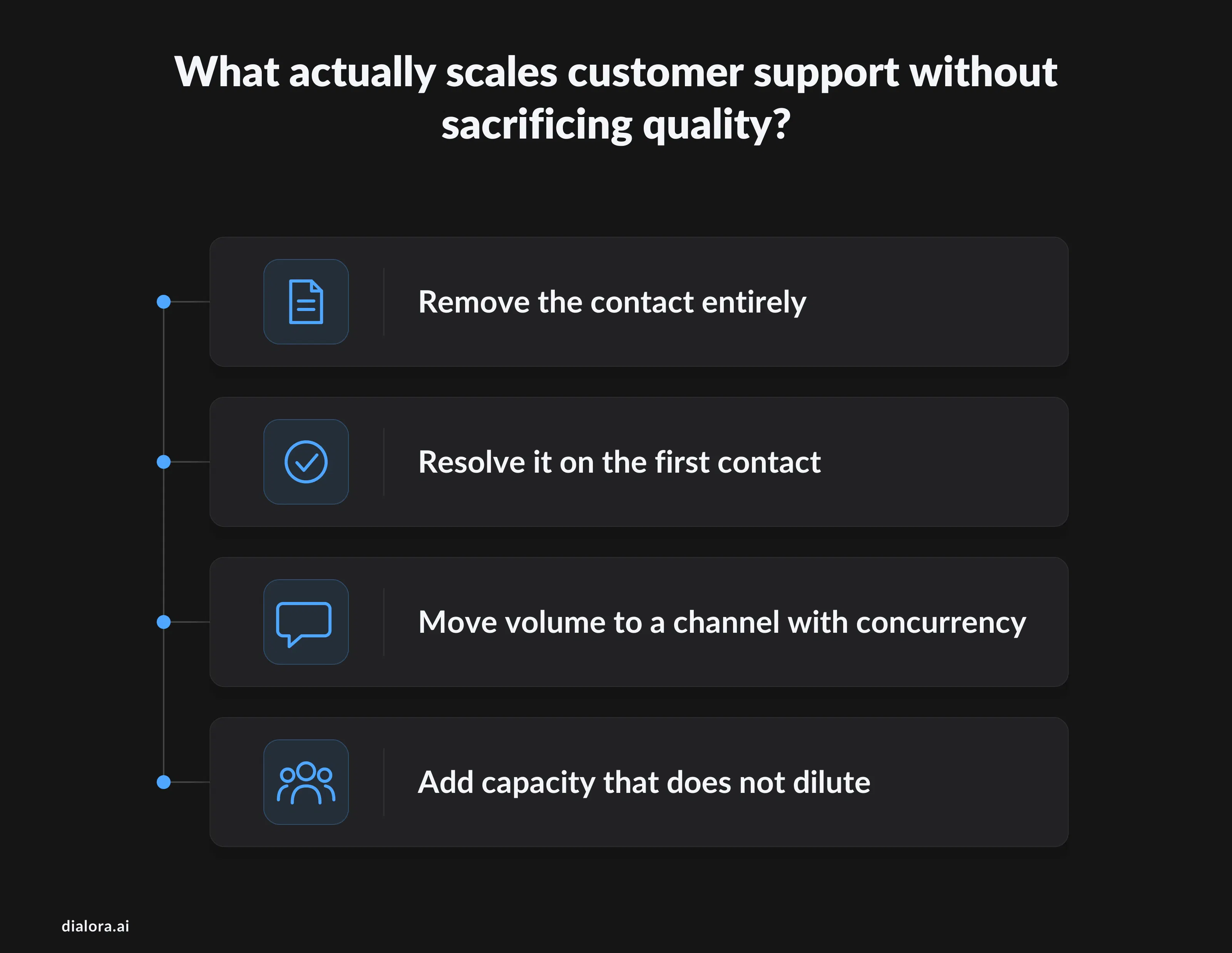
What actually scales customer support without sacrificing quality?
Four levers, ordered by how much each one actually moves. Work them in this order, because each one reduces the load the next one has to carry.
Lever one: remove the contact entirely
The cheapest ticket is the one that never arrives. Gartner puts a fully deflected self-service interaction at roughly $0.10 to $0.25 against $8 to $12 for a live agent handling the same request, and Fullview's analysis across 100-plus benchmarks found self-service at $1.84 per contact against $13.50 for assisted channels.
The work here is knowledge base management and help desk automation, not chatbot software. Every 10% increase in genuine deflection reduces total support spend by roughly 8% to 12%. Start by pulling your top twenty ticket reasons and asking which exist because something in the product or the documentation is unclear.
Lever two: resolve it on the first contact
First contact resolution is the most useful quality metric you have, because it improves the experience and the cost line at the same time. SQM Group's data identifies it as the strongest single predictor of CSAT, ahead of hold time, wait time and agent friendliness, with a 47 point CSAT gap between issues resolved on the first contact and issues that took four or more.
Support ticket routing is where this is won or lost. A password reset sitting behind complex cases in a two-hour SLA queue is paying for a queue position it does not need. AI-assisted triage cuts escalation rates by 20% to 35% in documented deployments, and Freshworks agent-assist data puts handle time reduction from routing, auto-tagging and suggested responses at 15% to 25%.
Lever three: move volume to a channel with concurrency
A phone agent handles one conversation. A skilled live chat agent handles three to five at once, which is why a phone costs three to five times more than chat or email for the same issue type. Migrating 20% of phone volume to chat typically cuts cost per contact by 35% to 50% for those interactions.
The caveat: channel migration only works where writing is genuinely as good as talking. Push an anxious customer with a billing dispute into chat to save $8 and you will get the call anyway, plus a worse review.
Lever four: add capacity that does not dilute
This is where AI customer support earns its place, for a narrow reason. A human agent handles one contact at a time and stops at six. An AI voice agent answers every call as it arrives, at any hour, and behaves identically on the four hundredth call as on the first. It does not ramp, it does not leave after fourteen months, and it does not have a bad Tuesday.
- Put it on the repetitive intents only: Order status, appointment changes, balance checks, password resets. High volume, low judgement, clear success criteria, and the customer support automation with the cleanest measurement.
- Keep judgement on the human path: Complaints, disputes, cancellations, hardship and anything with a relationship behind it should reach a person immediately, whatever your containment target says.
- Publish a one-sentence escape hatch: A caller should reach a human by asking once. If they have to work through a menu to earn it, you have rebuilt the thing you were replacing.
- Measure handoff quality, not only containment: The agent receiving the escalation should get the intent, the path taken and the data collected. Making the customer repeat themselves undoes the whole exercise.
Levers one to three are project work. Lever four is a phone number that starts answering.
Where scaling breaks quality, and how to see it coming
One number gets gamed more than any other in this category, so treat it carefully.
Realistic AI deflection for B2B SaaS sits between 8% and 45%, median around 22%. Best-in-class reaches 35% to 45%. The average team in year one lands at 10% to 15% true deflection, well below the 30% to 50% vendor marketing implies, and the biggest determinant is knowledge base freshness rather than the model. Vendor demos run on freshly tuned documentation against a curated query set. Your year one runs on the documentation that fell behind the product.
Worse than a low deflection rate is a fake one. A customer who attempts self-service, fails, and then calls costs more than one who called immediately, and contacts that follow a failed self-service attempt escalate at a rate 12 points higher. Deflection that does not resolve is not a saving. It is a delay with a worse mood attached.
- Read containment and repeat contacts together: Containment rising while repeat contacts rise is deflection the customer is routing around, not a win.
- Watch escalation rate as your honesty check: If escalations climb after an automation launch, something is deflecting without resolving.
- Track first response time and CSAT by issue type: One blended number hides the segment where the new system is failing.
And the blunt caution. If you handle forty tickets a day with two people who know every customer by name, none of this is your problem yet. A shared inbox and a written SLA will beat any platform on this page. Reach for scalable customer support infrastructure when volume exceeds what your team can hold in their heads, not because the category is fashionable.
Conclusion
Scaling support so often costs quality because most plans scale the wrong thing. Adding agents adds capacity and dilutes judgement at the same time, and only one of those shows up on the dashboard in the first quarter.
The moves that actually work all reduce load rather than absorb it. Remove the contact, resolve it first time, move it somewhere with concurrency, and automate the intents where a human adds nothing. Hire last, deliberately, into the work that g enuinely needs a person.
Then keep one number honest. If containment is rising and repeat contacts are rising with it, you have not scaled anything. You have moved the queue somewhere your reporting cannot see.
Dialora builds AI voice agents that answer every call the moment it arrives, resolve the repetitive intents end to end, and hand a caller to a person the moment they ask, with the full context attached.
Frequently asked questions
How do you scale customer support without sacrificing quality?
Work four levers in order. Remove contacts through knowledge base management and product fixes, resolve what remains on the first contact through better ticket routing, move suitable volume to channels with concurrency, and add AI capacity on repetitive intents only. Hire last, because cost rises in a straight line while quality does not follow it up.
What does it cost to handle a support ticket?
2026 benchmarks put voice at $12 to $20 per contact, email at $8 to $14, chat at $6 to $10, and self-service at $0.20 to $0.60. The number that matters more is cost per issue, since a 2.3 contact-per-issue rate makes your real cost 2.3 times the per-contact figure.
What is a realistic ticket deflection rate?
Between 8% and 45% for B2B SaaS, with a median around 22%. Best-in-class deployments reach 35% to 45%, while the average team in year one gets 10% to 15% true deflection, well below what vendor marketing implies. Knowledge base freshness predicts the outcome more reliably than the underlying model does.
Does AI customer support reduce quality?
Only if the escalation path is broken. AI on repetitive intents raises consistency, because it behaves the same at 3 a.m. as at 3 p.m. and does not degrade on the fourteenth call of a bad hour. Quality drops when automation traps people: a customer who tries self-service, fails and then calls escalates at a rate 12 points higher than one who reaches a person directly.
Which metrics show whether support is scaling well?
Read them in pairs. First contact resolution alongside repeat contact rate, containment alongside escalation rate, and first response time alongside CSAT by issue type rather than blended. Any single metric can be improved by making the experience worse, so every speed number needs a resolution number beside it.