TL; DR
- Most businesses searching for a free AI receptionist are trying to solve a missed call problem, not find free software.
- Free AI receptionist tools exist but come with hard limits on call volume, integrations, and response quality.
- Understanding what free plans actually cover helps you decide whether to start there or move straight to a trial.
A plumber running a two-person operation does not need an enterprise phone system. He needs someone or something to answer the phone when he is under the sink. The calls that go unanswered during a job are not called back. They find a different plumber. Free AI receptionist tools appeal because the pain is real and the budget is tight. But the question worth asking before you sign up for anything is not "Is it free?" It is "Does it actually solve the problem?"
Is There a Truly Free AI Receptionist
Yes and no. Several platforms offer free tiers that include basic call answering and message-taking. What they do not offer for free is the full capability that makes an AI receptionist useful for a growing small business.
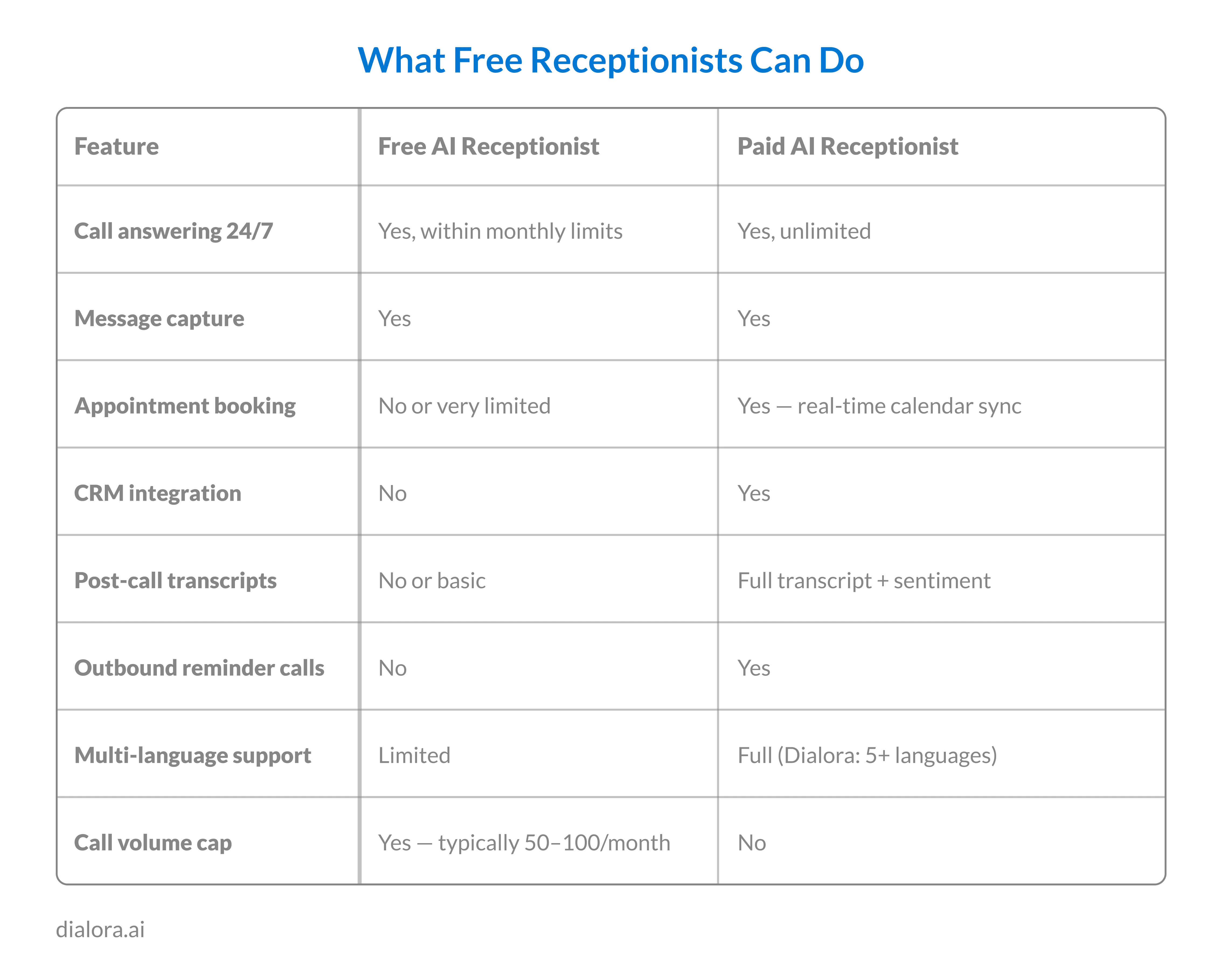
Free tiers typically include:
- A set number of calls or minutes per month (usually 50 to 100 calls)
- Basic call answering and message capture
- Limited or no calendar integration
- No CRM sync or post-call analytics
- Reduced voice quality or slower response times
For a solopreneur testing whether AI call answering fits their workflow, a free tier is a reasonable starting point. For a business taking 30 or more calls per week, the free tier caps out quickly, and you spend more time managing the limits than solving the original problem.
What the Best Free AI Receptionist for Small Business Can Actually Do
The best free-tier AI receptionists do one thing reliably: answer the phone and take a message when you cannot. That solves the most basic version of the missed call problem.
What they do not do: book appointments in real time, sync with your calendar, handle multi-step intake questions, or produce the kind of post-call data that helps you understand your call patterns over time.
Pro Tip: After-hours message capture is the one thing free tiers do reliably. If that is your only gap, start there. If you need bookings confirmed while the caller is still on the line, skip straight to a paid trial.
If your primary need is after-hours message capture, a free AI receptionist may cover it. If you need bookings confirmed while the caller is still on the line, you are looking at a paid tier.
Are Free AI Receptionists Worth Using
For testing: yes. For running a business on it depends entirely on call volume and what the call needs to accomplish.
A free AI receptionist is worth using if you are validating whether AI call handling fits your workflow before committing budget. It is not worth relying on if missed calls are already costing you jobs, because the free tier will introduce its own gaps.
The comparison that matters is not "free vs paid." It is "current missed call rate vs projected missed call rate with the tool." If a paid AI receptionist recovers three bookings per week that you are currently losing, the cost pays for itself before the end of the first month.
Read more:
- Virtual Receptionists vs. Automated Phone Service
- Automate Front Desk Calls in Healthcare
- 5 Reasons Your Front Desk Is Overwhelmed
- AI Medical Receptionist
- AI Receptionist for Small Business
How Do I Create a Free AI Receptionist
Most platforms let you set up a free AI receptionist by connecting a phone number, configuring a greeting, and setting the call handling rules for booking, message-taking, or transfer. Setup time on leading platforms is under 30 minutes.
The variables that require more thought:
- What should the AI say when it answers? (You're greeting and qualification questions)
- What happens after a voicemail - does the caller get a text confirmation?
- Which calls should always go to you directly, regardless of the time?
Getting this right on day one prevents the frustration of a technically working AI that handles calls in a way that confuses your customers.
Pro Tip: Decide in advance which calls always transfer to you, regardless of hour. Defining that list at setup prevents the AI from handling something it should not
What Is the Difference Between Free and Paid AI Receptionists
Three things change most sharply when you move from free to paid:
- Call volume and availability: Free tiers cap out. Paid tiers answer every call, every time, with no monthly ceiling.
- Integration depth: Paid tiers write bookings directly into your calendar, sync call outcomes to your CRM, and produce post-call transcripts that build a picture of your call patterns over time. Free tiers capture the message. Paid tiers capture the outcome.
- Reliability under load: Free infrastructure is often shared and slower to respond during peak hours. A paid AI receptionist that hesitates before answering, or drops a call during a busy morning, creates the impression of a business that does not have its act together.
Dialora's free trial gives small businesses the full paid experience 24/7 call answering, real-time calendar booking, post-call transcripts, and outbound reminders before committing to a monthly plan. A credit card is required to start. The trial is built for businesses that want to measure real outcomes, not explore a reduced-feature demo. If three recovered bookings in the first week do not cover the cost, the conversation is worth having. Start Your Free Trial
Frequently Asked Questions About Free AI Receptionists
Is there a truly free AI receptionist?
Yes, several platforms offer free tiers with basic call answering and message capture. Free plans typically cap at 50 to 100 calls per month and exclude real-time calendar booking, CRM sync, and post-call analytics. They are useful for testing the concept. They are not built for businesses with consistent call volume.
What is the best free AI receptionist for a small business?
The best free option for a small business is one that reliably answers calls, captures messages clearly, and does not introduce call quality problems that reflect poorly on your business. Look for platforms that offer a clear upgrade path so you are not switching systems when you outgrow the free tier.
Are free AI receptionists worth using?
For initial testing, yes. For solving a missed call problem at scale, a free tier will introduce its own limitations before long. The right question is whether the cost of a paid AI receptionist is lower than the cost of the bookings you are currently losing to unanswered calls.
How do I create a free AI receptionist?
Connect a phone number, configure a greeting and call handling rules, and run a test call before going live. Most platforms complete setup in under 30 minutes. The variables that require real thought are the greeting script, the qualification questions, and which call types should always transfer to a human, regardless of the time.
What is the difference between free and paid AI receptionists?
Call volume cap, integration depth, and reliability under load. Free tiers cap monthly calls and exclude calendar and CRM integration. Paid tiers answer unlimited calls, book appointments in real time, sync outcomes to your CRM, and produce full post-call transcripts. The gap between the two widens as call volume grows.